Keh
The Red Storm · Month 12 of 19
Etymology & Name Origin
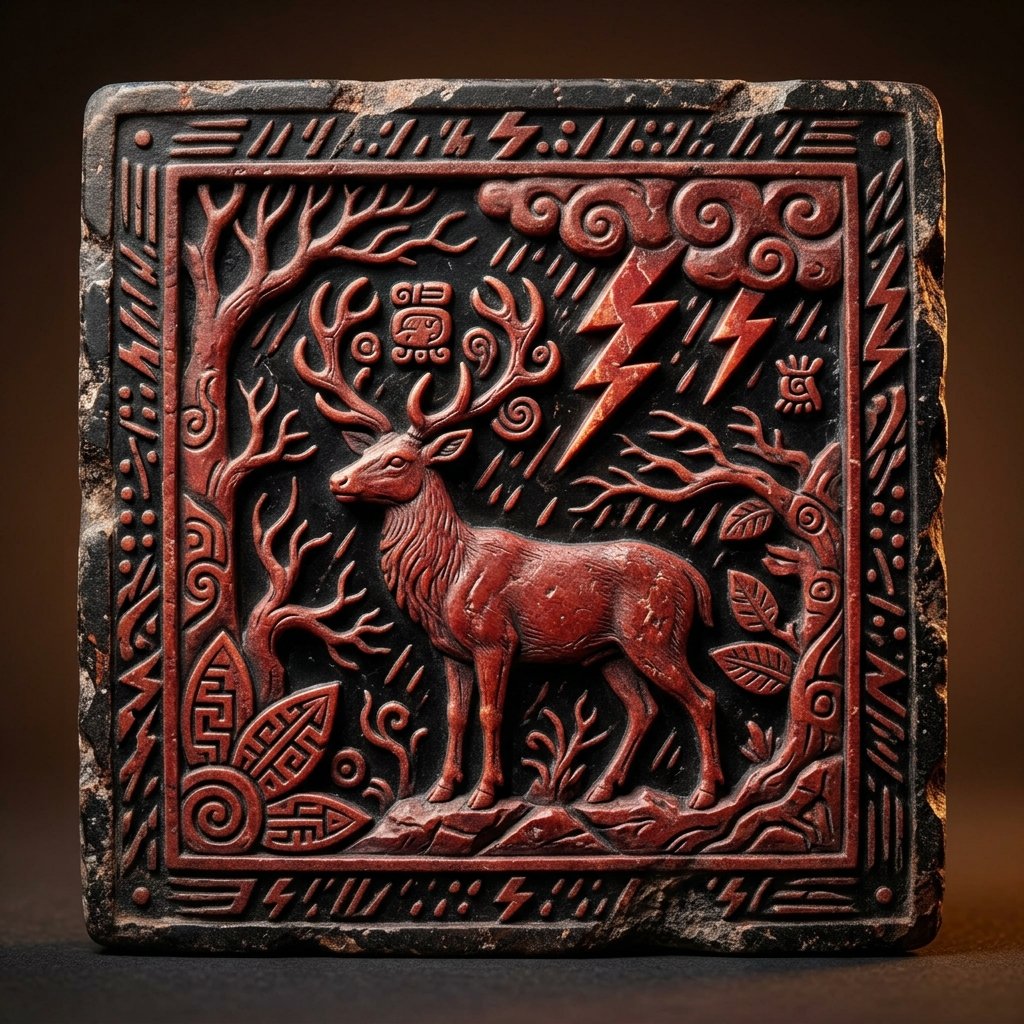
"Keh" (also "Ceh") means "deer" in Yucatec Maya. The "Red Storm" translation reflects the month's association with the red cardinal direction (East), with blood, and with the powerful energy of the forest during the storm season. The deer reappears as a central symbol — not as prey this time (as in Sip) but as the sacred inhabitant of the wild forest, the animal whose grace and alertness embodied the spirit of the untamed natural world.
Cultural Significance
Keh honored the deer as a spiritual being — the forest inhabitant par excellence. While Sip (month 3) focused on the hunting relationship, Keh celebrated the deer's inherent sacredness. The deer was considered a manifestation of the forest lord, and its appearance in the wild was read as an omen. The red storm energy of Keh represented the fierce vitality of the forest during the rainy season — lush, wild, and dangerous.
Rituals & Ceremonies
Ceremonies during Keh involved the forest itself as sacred space. Hunters and farmers made offerings at forest shrines — stone cairns or natural features recognized as dwelling-places of forest spirits. The deer dance (a ritual performed throughout Mesoamerica into the modern era) may have been performed during Keh, with dancers wearing deerskin and antlers to embody the spirit of the animal and honor its sacrificial role in sustaining the community.
Agricultural Cycle
Keh corresponded with the advanced rainy season when crops were growing vigorously. The forest surrounding the milpa fields came alive with activity — birds, insects, mammals, and the deer themselves were all visible and vocal. The farmer's relationship with the forest was complex: the milpa was carved from the forest, which constantly sought to reclaim it. Keh honored this dynamic tension between cultivated and wild space.
Cosmological Role
In Maya cosmology, the deer was associated with the four "pillars" of the sky — the four directional deers that held up the cosmic canopy. This architectural role connected the deer to stability, structure, and the fundamental framework of reality. The red storm energy represented the passionate, dynamic force that animated this structure — the power that flowed through the cosmic framework and gave it life.
Patron Deity
The forest lord Yum Kaax and the deer deity Sip jointly governed the spiritual energy of Keh. These deities represented the wildness and generosity of the forest — the understanding that nature provided abundantly but demanded respect and reciprocity.
Key Takeaway
The Haab' month Keh ("Red Storm") is month 12 of the 19-part Maya solar calendar. Spanning 20 days, it represents month of the deer and forest. Together with the other 17 regular months and the 5-day Wayeb' period, Keh forms the 365-day Haab' cycle that tracked the solar year with remarkable precision.
Frequently Asked Questions
What does the Maya month name Keh mean?
The name "Keh" translates to "Red Storm" in the Haab' solar calendar. "Keh" (also "Ceh") means "deer" in Yucatec Maya.
What ceremonies were performed during Keh?
Ceremonies during Keh involved the forest itself as sacred space. Hunters and farmers made offerings at forest shrines — stone cairns or natural features recognized as dwelling-places of forest spirits.
Which deity is the patron of Keh?
The forest lord Yum Kaax and the deer deity Sip jointly governed the spiritual energy of Keh. These deities represented the wildness and generosity of the forest — the understanding that nature provided abundantly but demanded respect and reciprocity.
How does Keh fit into the Maya calendar system?
Keh is month 12 of 19 in the Haab' solar calendar. It spans 20 days (numbered 0-19 in the Maya system). The Haab' consists of 18 months of 20 days each (360 days) plus a 5-day Wayeb' period, totaling 365 days — almost exactly one solar year.
Scholarly References
- Landa, D. de. Relación de las Cosas de Yucatán. Translated by A. Tozzer. Peabody Museum, 1941, pp. 170-171.
- Tedlock, B. Time and the Highland Maya. University of New Mexico Press, 1992, pp. 107-112.
- Pohl, M. "Maya Ritual Faunas." In Civilization in the Ancient Americas, Peabody Museum Press, 1983, pp. 55-103.
- Miller, M.E. The Murals of Bonampak. Princeton University Press, 2013, pp. 68-92.
 Sak
Sak