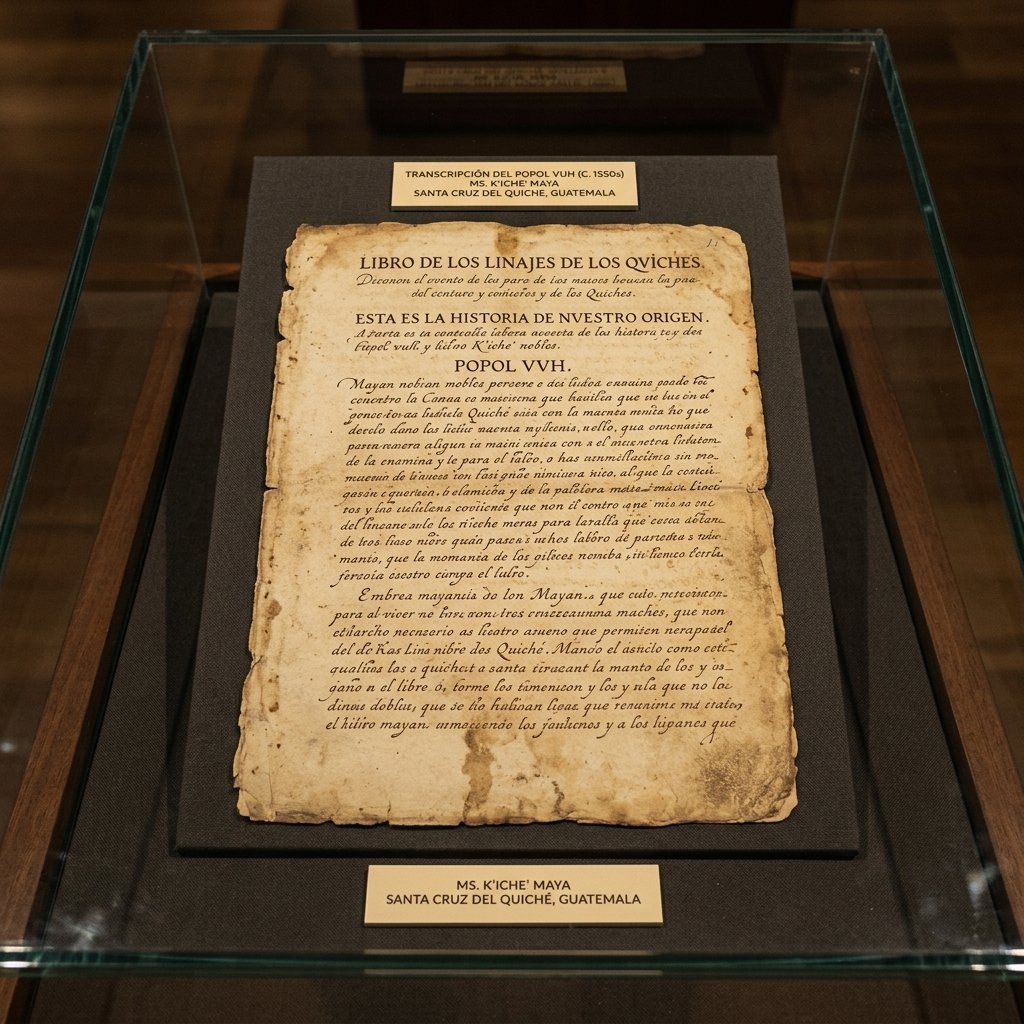
The Popol Vuh at a Glance
"Before there was a world, there was silence. Before there was light, there was the sea. And on the sea, covered in blue-green feathers, the Feathered Serpent waited — thinking, planning, preparing to speak the cosmos into being. This is how the Popol Vuh begins. No fanfare. No thunder. Just intention, floating on water."
The Most Important Book You've Never Read
The Popol Vuh is the creation epic of the K'iche' Maya of highland Guatemala — and, by scholarly consensus, the most important surviving text of pre-Columbian American literature. It is the closest analogue the Americas have to the Book of Genesis, the Mahabharata, or the Epic of Gilgamesh: a foundational narrative that explains how the world was made, how humans came to exist, how the sun and moon were created, and how a specific people traces its origin to the dawn of time.
The text's survival is itself remarkable — arguably miraculous. Of the thousands of Maya books that existed before the Spanish conquest, only four codices survived the systematic burnings ordered by colonial authorities. The Popol Vuh survived because it was not a codex: it was transcribed from oral tradition into a manuscript using the Latin alphabet by K'iche' nobles sometime between 1554 and 1558 — just decades after the conquest. This act of preservation was an act of cultural defiance: in the shadow of colonial destruction, K'iche' intellectuals committed their most sacred narrative to a foreign writing system in order to ensure it would endure.
Dennis Tedlock, whose 1996 translation remains the standard English edition, describes the Popol Vuh as "a book that has no parallel in the Americas... a text that deals with cosmogony, theology, mythology, migration, and history in a single, continuous narrative of extraordinary literary power" (Tedlock, D., Popol Vuh: The Definitive Edition of the Mayan Book of the Dawn of Life, Simon & Schuster, 1996, p. 21).
The Text's Journey: From Oral Tradition to Chicago
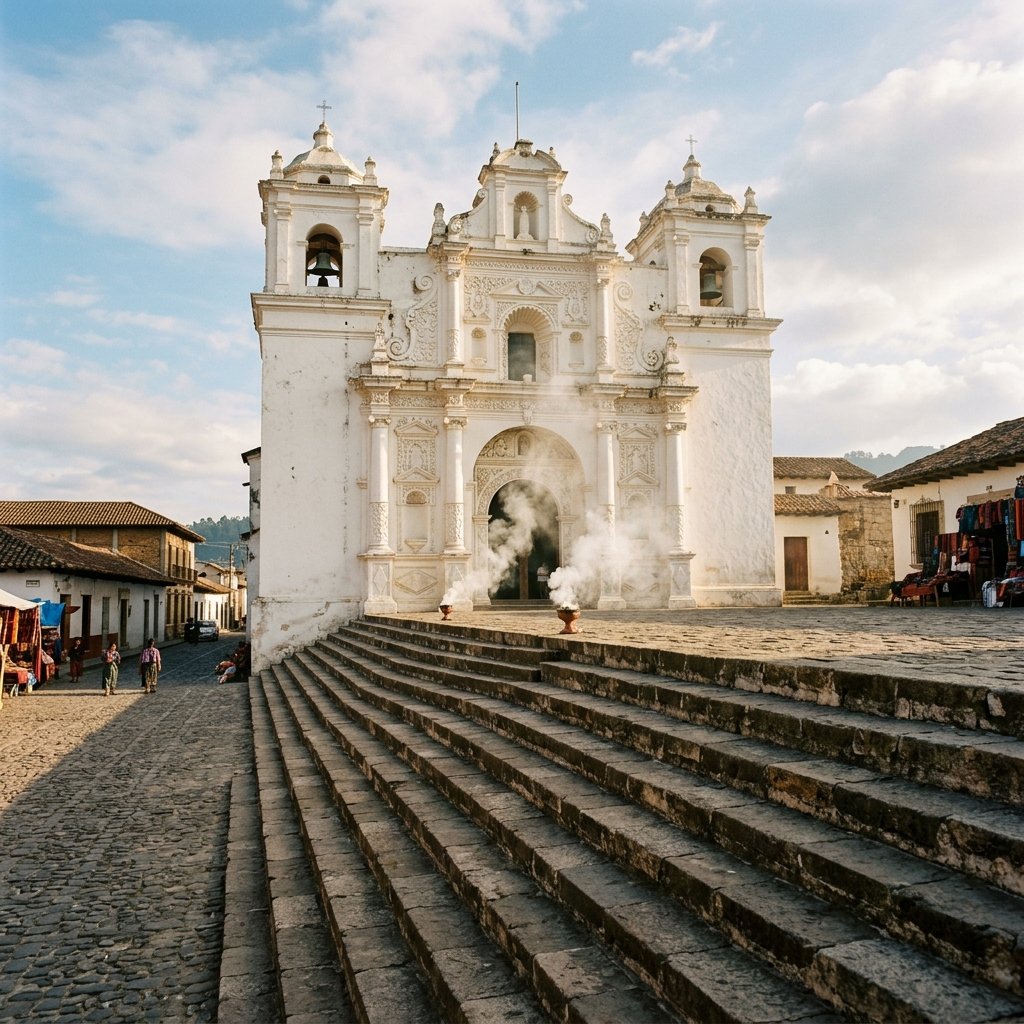
The church of Santo Tomás in Chichicastenango, Guatemala. Around 1701, the Dominican friar Francisco Ximénez discovered a K'iche' Maya manuscript hidden here — the Popol Vuh. He recognized its extraordinary significance and created a bilingual transcription (K'iche' with Spanish translation) that has become one of the most studied documents in the Americas. Chichicastenango remains a center of syncretic Maya-Catholic spiritual practice.
The history of the Popol Vuh text is a story of survival against overwhelming odds:
The narrative exists in oral tradition, transmitted by K'iche' priest-historians (aj k'ixab') over centuries — possibly millennia. The opening of the Popol Vuh itself acknowledges an original hieroglyphic book (Ilb'al, "the instrument of sight") that was consulted by the lords of Q'umarkaj.
The Spanish conquistador Pedro de Alvarado conquers the K'iche' kingdom, burns the capital Q'umarkaj, and executes the K'iche' rulers. Maya books are systematically destroyed by colonial authorities.
K'iche' Maya nobles — literate in both their own language and the Latin alphabet taught by missionaries — transcribe the creation epic from oral tradition (and possibly from a surviving hieroglyphic source) into a manuscript using the Latin script. This act of cultural preservation saves the text from oblivion.
The Dominican friar Francisco Ximénez, parish priest of Chichicastenango, discovers the K'iche' manuscript hidden in his church. He recognizes its significance and creates a bilingual transcription — K'iche' with his own Spanish translation — a document that would become the primary source for all later study.
The original K'iche' manuscript has been lost. Ximénez's bilingual copy resides in the Newberry Library in Chicago. It is one of the most studied and translated documents in the Americas — available in English, Spanish, French, German, Japanese, K'iche', and dozens of other languages.
The Story: Creation in Four Acts
Act I — The Primordial Sea and the Speaking of the World
In the beginning, there is only stillness, silence, darkness, and the sea. The text establishes this cosmic emptiness with careful, almost hypnotic repetition:
"There is not yet one person, one animal, bird, fish, crab, tree, rock, hollow, canyon, meadow, forest. Only the sky alone is there; the face of the earth is not clear. Only the sea alone is pooled under all the sky; there is nothing whatever gathered together."
— Popol Vuh, Opening (Tedlock translation, 1996)
On this dark sea float the creator deities: Tepeu (the Sovereign) and Q'uq'umatz (the Feathered Serpent), "covered in green and blue feathers." Together with Huracán (Heart of Sky) — a triune storm deity whose name survives in English as "hurricane" — they contemplate creation. Then they speak: "Let it be done. Let the earth appear." And from this divine speech, the world is made.
The parallel with the opening of Genesis ("And God said, 'Let there be light'") has been noted by scholars since the earliest studies of the Popol Vuh. The difference, Allen Christenson observes, is that the Popol Vuh's creation is dialogic — it is the product of conversation, committee, and consensus among multiple deities, not the decree of a single omnipotent God. "Creation in the Popol Vuh is fundamentally collaborative," writes Christenson — "an act of collective imagination rather than individual fiat" (Christenson, A.J., Popol Vuh: The Sacred Book of the Maya, University of Oklahoma Press, 2007, p. 60).
Act II — The Three Failures
The gods create animals, but animals cannot speak; they cannot praise their creators. So the gods attempt to create beings capable of language, thought, and gratitude. They fail three times — and each failure carries theological meaning:
Mud People — Failure
The gods shape humans from mud, but they dissolve in water. They cannot hold form, cannot think, cannot speak. Meaning: substance without structure produces nothing. Form requires an appropriate material.
Wood People — Failure
Wooden figures that can walk, talk, and reproduce — but they have no soul, no memory, no gratitude. They forget their creators and overrun the earth. The gods destroy them with a great flood, and their own tools and animals turn against them. Their descendants, the text says, are the howler monkeys. Meaning: function without consciousness is not humanity. To be human requires soul, memory, and the capacity for reverence.
Corn People — Success
The gods discover maize — white and yellow corn — and grind it with water to form human flesh. These corn people can think, speak, remember, and give thanks. They are the first true humans. But they see too clearly — "their vision reached to the four corners of the sky" — so the gods deliberately cloud their vision, limiting them to human sight. Meaning: humanity is made from the sacred plant, but humans are not gods. Knowledge must be bounded by humility.
Act III — The Hero Twins
The longest and most dramatic section of the Popol Vuh tells the epic story of the Hero Twins — Hunahpú and Xbalanqué — who descend into Xibalba (the underworld), defeat its lords through intelligence and voluntary self-sacrifice, resurrect their father (the Maize God), and ascend to become the Sun and Moon.
Read the Complete Hero Twins Story →
Act IV — The Founders
The final section of the Popol Vuh shifts from cosmic mythology to political history — tracing the founding lineages of the K'iche' people from their mythic origins through their migration across the highlands, the establishment of their kingdoms, and the dynasty of rulers who governed from Q'umarkaj (Utatlán). This section transforms the Popol Vuh from a creation epic into a charter document — a text that legitimizes K'iche' political authority by connecting living rulers to the cosmic events of creation.
Q'umarkaj: The Place Where the Popol Vuh Was Born
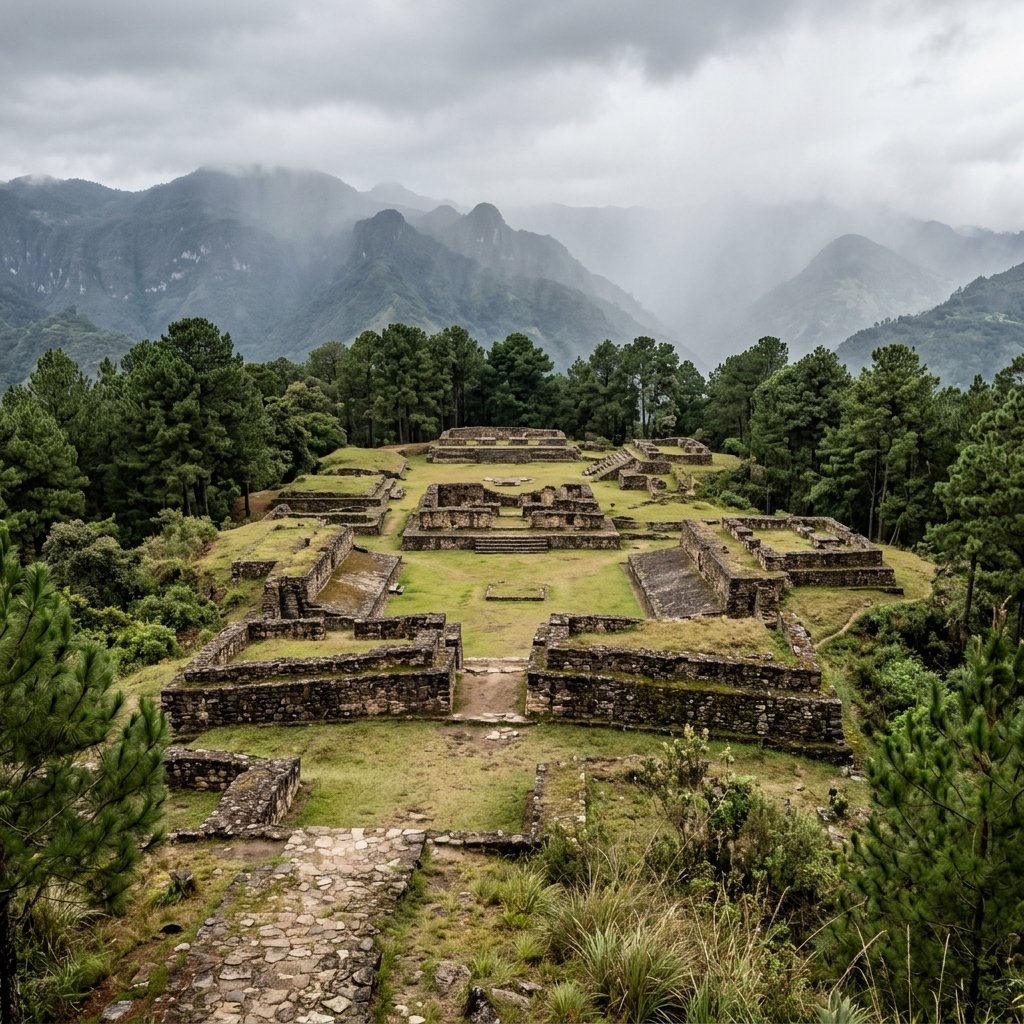
The ruins of Q'umarkaj (Utatlán), near Santa Cruz del Quiché, Guatemala — the ancient K'iche' Maya capital. It was here that the Popol Vuh's narrative was preserved by the priest-historians of the K'iche' court. Pedro de Alvarado burned the city in 1524, but the oral tradition survived. The site, on a defensible plateau surrounded by ravines, remains a place of ritual significance for contemporary K'iche' Maya spiritual practitioners.
Q'umarkaj (meaning "Place of the Decayed Reeds," known to the Spanish as Utatlán) was the capital of the K'iche' Maya kingdom — the political and religious center where the Popol Vuh's narrative was generated, preserved, and transmitted. Located on a defensive plateau near modern Santa Cruz del Quiché, the city housed the temples, palaces, and ball courts of the K'iche' ruling elite.
When the Spanish conquistador Pedro de Alvarado arrived in 1524, he lured the K'iche' lords to his camp outside the city, captured them, and burned Q'umarkaj to the ground. But the narrative survived in the memories of the K'iche' priest-historians — men who had been trained to memorize the sacred texts word for word. Within three decades, they committed it to the Latin alphabet, ensuring its preservation.
Themes: What the Popol Vuh Teaches
Creation Through Language
The gods speak the world into existence. Language is not merely a tool for describing reality — it is the force that creates reality. This idea places the Popol Vuh alongside Genesis and the Vedic hymns as one of the great texts in which creation is fundamentally a linguistic act.
Maize as Human Substance
The assertion that human flesh is literally made from corn is not metaphor but theological axiom. Since maize constituted 70–80% of the Maya caloric intake, isotopic analysis of Maya remains confirms that their bodies were, at the molecular level, overwhelmingly maize-derived. The Popol Vuh's claim is biochemically accurate.
Death as Transformation
The Hero Twins defeat death not by avoiding it but by dying willingly and returning. This teaches that death is a transition, not a terminus — and that the willingness to sacrifice oneself is the highest form of power.
The Limits of Knowledge
When the corn people see too clearly — "like gods" — the creators deliberately cloud their vision. This is a profound meditation on epistemological humility: humans are capable of great understanding, but they are not meant to understand everything. Wisdom includes the knowledge of one's own limitations.
Reading the Popol Vuh Today
Two English translations dominate contemporary scholarship:
- Dennis Tedlock (Popol Vuh: The Definitive Edition of the Mayan Book of the Dawn of Life and the Glories of Gods and Kings, 1985; revised 1996) — a literary translation that reads like poetry, informed by Tedlock's work with K'iche' Maya daykeeper Don Andrés Xiloj. The standard for general readers.
- Allen J. Christenson (Popol Vuh: The Sacred Book of the Maya, 2007) — a more literal scholarly translation with extensive commentary, preferred by academics for its precision and its attention to the K'iche' original.
For K'iche' Maya communities in highland Guatemala today, the Popol Vuh is not merely a historical artifact — it is a living text. K'iche' spiritual practitioners (aj q'ij, "daykeepers") continue to consult its wisdom, read it in ceremonies, teach it to their children, and understand it as a truthful account of cosmic and human origins. In 2012, UNESCO recognized the Popol Vuh as part of the Intangible Cultural Heritage of Guatemala — affirming its continuing significance to the living descendants of its creators.
References
- Christenson, A.J. Popol Vuh: The Sacred Book of the Maya. University of Oklahoma Press, 2007.
- Coe, M.D. The Maya Scribe and His World. Grolier Club, 1973.
- Recinos, A. Popol Vuh: The Sacred Book of the Ancient Quiché Maya. Translated by Delia Goetz and Sylvanus G. Morley. University of Oklahoma Press, 1950.
- Tedlock, D. Popol Vuh: The Definitive Edition of the Mayan Book of the Dawn of Life. Simon & Schuster, 1996.
Frequently Asked Questions
Is the Popol Vuh like the Bible?
In the sense that it is a sacred creation narrative and foundational text for a civilization — yes. Both texts begin with creation from a formless void, describe the shaping of the world through divine speech, and include flood narratives. But the Popol Vuh emerged from a fundamentally different cosmological framework: creation is collaborative (multiple gods), cyclical (multiple attempts), and materially specific (humans made from corn, not clay). Unlike the Bible, the Popol Vuh also integrates political founding narratives and dynastic histories into the same text.
Why are humans made from corn?
Maize was the literal foundation of Maya civilization — the crop that sustained millions for millennia and constituted 70–80% of the caloric intake. The Popol Vuh's assertion that humans are made from corn reflects both a spiritual truth (corn is the sacred substance of life) and a biological reality (the Maya were, at the molecular level, overwhelmingly composed of maize-derived carbon). It is simultaneously a theological axiom and — in a way the K'iche' authors could not have known — a biochemical fact.
Where was the Popol Vuh manuscript found?
The K'iche' Maya manuscript was discovered by the Dominican friar Francisco Ximénez around 1701 in the parish church of Chichicastenango, Guatemala — a highland town that remains one of Guatemala's most important cultural centers. Ximénez created a bilingual copy (K'iche' with Spanish translation). The original K'iche' manuscript has been lost; Ximénez's copy now resides in the Newberry Library in Chicago.
Can I visit places mentioned in the Popol Vuh?
Yes. Chichicastenango — where the manuscript was found — has a vibrant Maya market and the church of Santo Tomás, where syncretic Maya-Catholic ceremonies continue on the church steps. The K'iche' capital Q'umarkaj (Utatlán), near Santa Cruz del Quiché, is an archaeological site open to visitors. The Maya highlands of Guatemala — particularly the areas around Lake Atitlán, Quetzaltenango, and the Cuchumatanes mountains — remain the heartland of living K'iche' culture where the Popol Vuh's legacy is most directly felt.
Is the Popol Vuh still read today?
Yes — and not only by scholars. For K'iche' Maya communities in Guatemala, the Popol Vuh remains a living sacred text. K'iche' daykeepers (aj q'ij) consult its wisdom in ceremonies, teach its narratives to their children, and understand it as a truthful account of origin. In 2012, UNESCO recognized the Popol Vuh as part of the Intangible Cultural Heritage of Guatemala. The text's influence extends far beyond academia — it is a foundation of contemporary Maya cultural identity and self-determination.