Wo
The Black Conjunction · Month 2 of 19
Etymology & Name Origin
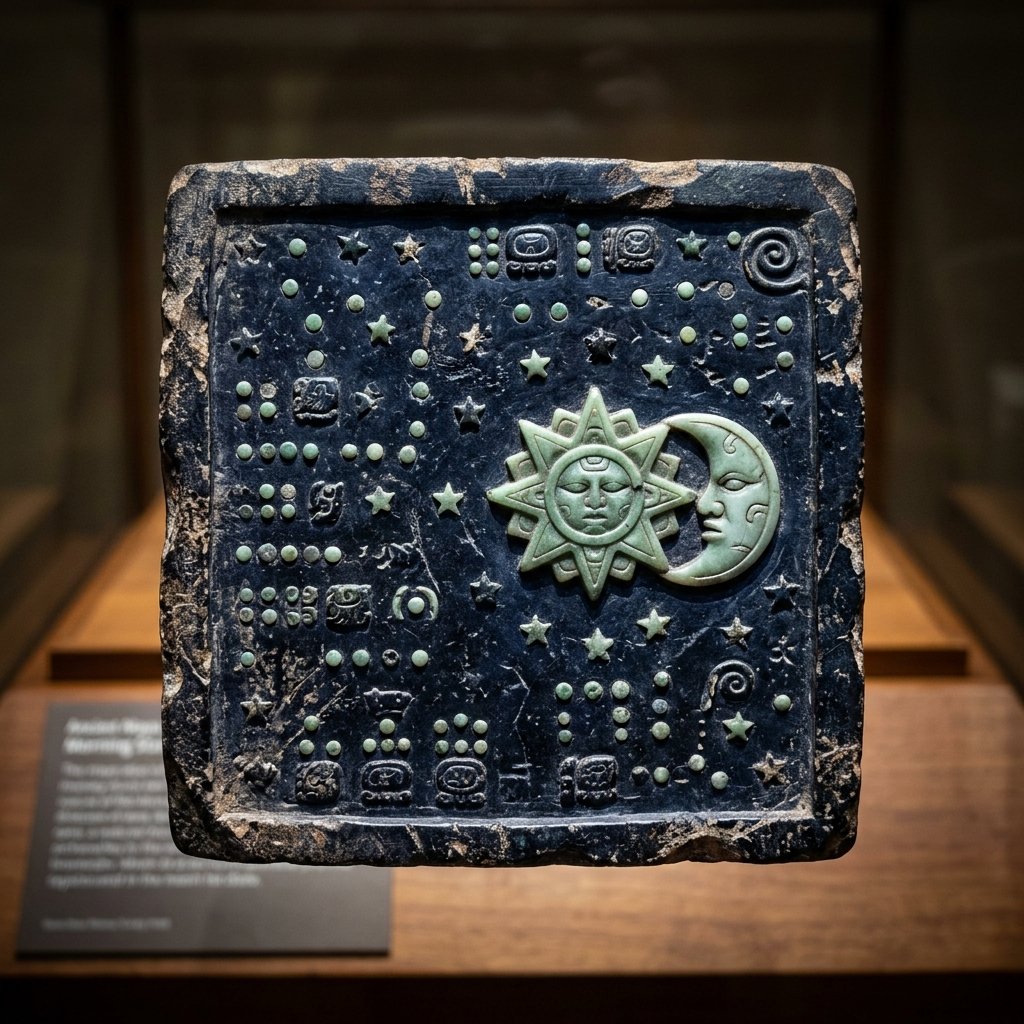
The name "Wo" (also written "Uo") likely derives from a term associated with darkness, blackness, or the frog — an amphibian closely linked to rain and nocturnal activity in Maya thought. The "Black Conjunction" translation refers to the alignment of celestial bodies in the dark sky, emphasizing this month's deep connection to nighttime astronomical observation.
Cultural Significance
Wo was considered a month of heightened spiritual perception, when the boundaries between the visible and invisible worlds thinned. The darkness it invokes is not negative but revelatory — the darkness of the night sky that reveals the stars, planets, and the Milky Way (the Sak Be, or "White Road," understood as the path to Xibalba). This was a time when priests and astronomers conducted their most precise celestial observations.
Rituals & Ceremonies
During Wo, Maya priests performed ceremonies honoring the patron deities of writing, learning, and priestly knowledge. Landa recorded that ceremonies in this month involved special prayers by the ah kin (sun priests), who would "prognosticate" the coming agricultural season based on celestial signs observed during the dark nights of Wo. It was also the period when young scribes were initiated into the priesthood.
Agricultural Cycle
Wo fell during a transitional period in the agricultural cycle. Farmers observed celestial markers during the clear dry-season nights to determine optimal timing for field preparation. The position of certain star groups — particularly the Pleiades — provided critical calendar benchmarks for when to begin burning cleared fields.
Cosmological Role
The "conjunction" in Wo's name reflects the Maya obsession with celestial mechanics. Conjunctions — moments when celestial bodies appear to meet in the sky — were considered powerful supernatural events. Venus conjunctions were particularly significant, associated with warfare and the descent of deities to earth. The blackness of Wo represents the primordial darkness before creation described in the Popol Vuh.
Patron Deity
Itzamná, the supreme creator deity and lord of knowledge, was honored during Wo. As the patron of scribes and learning, Itzamná embodied the intellectual inquiry that characterized this month of celestial observation.
Key Takeaway
The Haab' month Wo ("Black Conjunction") is month 2 of the 19-part Maya solar calendar. Spanning 20 days, it represents month of the night sky and celestial observation. Together with the other 17 regular months and the 5-day Wayeb' period, Wo forms the 365-day Haab' cycle that tracked the solar year with remarkable precision.
Frequently Asked Questions
What does the Maya month name Wo mean?
The name "Wo" translates to "Black Conjunction" in the Haab' solar calendar. The name "Wo" (also written "Uo") likely derives from a term associated with darkness, blackness, or the frog — an amphibian closely linked to rain and nocturnal activity in Maya thought.
What ceremonies were performed during Wo?
During Wo, Maya priests performed ceremonies honoring the patron deities of writing, learning, and priestly knowledge. Landa recorded that ceremonies in this month involved special prayers by the ah kin (sun priests), who would "prognosticate" the coming agricultural season based on celestial signs observed during the dark nights of Wo.
Which deity is the patron of Wo?
Itzamná, the supreme creator deity and lord of knowledge, was honored during Wo. As the patron of scribes and learning, Itzamná embodied the intellectual inquiry that characterized this month of celestial observation.
How does Wo fit into the Maya calendar system?
Wo is month 2 of 19 in the Haab' solar calendar. It spans 20 days (numbered 0-19 in the Maya system). The Haab' consists of 18 months of 20 days each (360 days) plus a 5-day Wayeb' period, totaling 365 days — almost exactly one solar year.
Scholarly References
- Aveni, A. Skywatchers of Ancient Mexico. University of Texas Press, 2001, pp. 40-55.
- Landa, D. de. Relación de las Cosas de Yucatán. Translated by A. Tozzer. Peabody Museum, 1941, pp. 156-158.
- Milbrath, S. Star Gods of the Maya: Astronomy in Art, Folklore, and Calendars. University of Texas Press, 1999, pp. 250-265.
- Tedlock, D. Popol Vuh: The Definitive Edition. Simon & Schuster, 1996, pp. 63-72.
 Pop
Pop