Key Takeaway
Jade (ya'ax in Yucatec Maya) was the most valued substance in the Maya world — associated with life, breath, royalty, maize, water, and the eternal soul. While Europeans coveted gold, the Maya reserved jade for their highest kings, their most sacred rituals, and their most important burials. The craftsmanship required to shape jadeite — one of the hardest natural materials — without metal tools represents a remarkable technological achievement.
Why Jade, Not Gold?
For modern observers accustomed to equating wealth with gold, the Maya preference for jade can seem puzzling. But the logic was deeply consistent with Maya cosmology. Jade's green color connected it to the most vital elements of Maya life:
- Water — the cenotes and rivers that sustained civilization
- Maize — the sacred crop from which humanity was made (according to the Popol Vuh)
- Breath and wind — ik', the life force itself
- The center of the world — green was the color of the cosmic center in Maya directional symbolism (red=east, white=north, black=west, yellow=south, green=center)
As archaeologist Karl Taube has argued, jade was not merely "expensive" to the Maya — it was ontologically precious, meaning it was believed to contain actual life-force and spiritual power (Taube, Olmec Art at Dumbarton Oaks, 2004).
Geology and Sourcing
Maya jade is jadeite — a sodium aluminum silicate (NaAlSi₂O₆) formed under extreme pressure in tectonic subduction zones. It is distinct from the more common nephrite jade used in Chinese art. On the Mohs hardness scale, jadeite rates 6.5–7 — harder than steel, and significantly harder to work than gold, copper, or marble.
The primary geological source of Maya jadeite was the Motagua River valley in highland Guatemala, where tectonic collision between the Caribbean and North American plates created the conditions for jadeite formation. This source was identified through trace-element analysis by geologist George Harlow and colleagues at the American Museum of Natural History (Harlow, Geology, 1993).
A second major source was identified in 2001 — the Sierra de las Minas deposits in Guatemala, containing blue-green and lavender jadeite varieties previously thought to exist only in Myanmar (Seitz et al., Journal of Archaeological Science, 2001).
Craftsmanship Without Metal
The Maya shaped jadeite without metal tools — an extraordinary feat given the stone's extreme hardness. Their techniques, reconstructed through experimental archaeology, included:
Shaping Methods
- String sawing — cord pulled back and forth with quartz sand abrasive
- Tubular drilling — hollow bird-bone or reed tubes with jade-dust abrasive
- Percussion flaking — controlled hammer strikes to rough-shape blanks
- Grinding and polishing — progressive abrasion using increasingly fine sand
Labor Investment
- A single jade earflare: ~300 hours of labor
- A royal mosaic mask: estimated 2,000–5,000+ hours
- String-sawing through a 10cm jade block: ~100 hours
- Drilling a single bead: ~20 hours
Estimates from experimental replication by Hruby, Latin American Antiquity, 2007
The Great Jade Masks
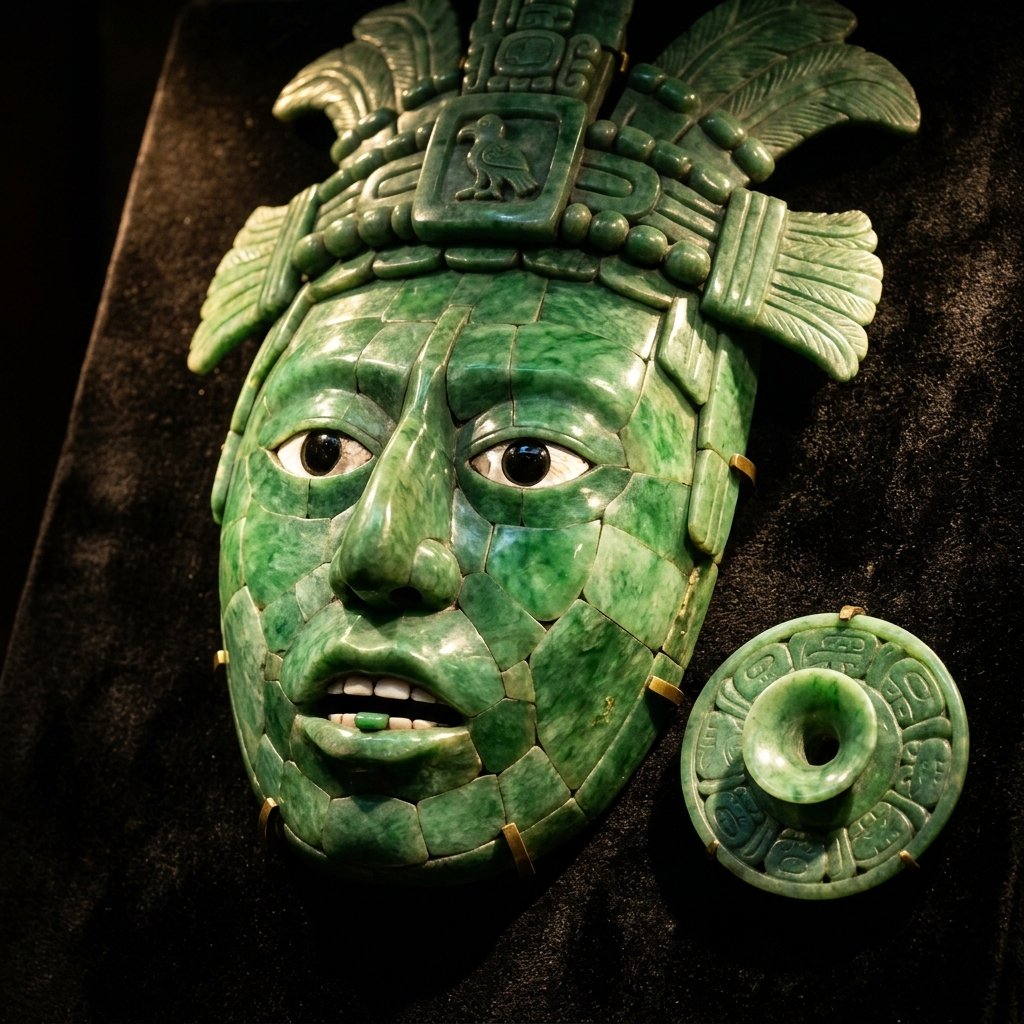
The most spectacular surviving Maya jade artifacts are the mosaic funerary masks placed on royal burials. The most famous is the jade mask of K'inich Janaab' Pakal, discovered in 1952 by Alberto Ruz Lhuillier inside the Temple of the Inscriptions at Palenque. Composed of hundreds of individually carved and fitted jadeite pieces, the mask transformed the dead king into the Maize God — prepared for rebirth through the earth.
Other significant jade burial assemblages include the tomb at Calakmul (Structure II) containing a jade mask with the highest-quality blue-green jadeite found at any Maya site (Carrasco Vargas et al., Latin American Antiquity, 1999), and the royal tomb at Río Azul, where a jade-encrusted skeleton was found with a jade bead placed inside the mouth — to capture the departing soul.
Jade in Ritual and Trade
Jade was not just for burial. It served as the primary medium of elite display, diplomatic exchange, and sacred offering throughout Maya history:
- Royal regalia: Kings wore jade earflares, necklaces, wristlets, anklets, and belt ornaments weighing several kilograms collectively
- Diplomatic gifts: Jade objects were exchanged between city-states as markers of alliance, tribute, or submission
- Cenote offerings: Jade artifacts have been recovered from the Sacred Cenote at Chichén Itzá — cast into the water as offerings to Chaac
- Mouth beads: A jade bead placed in the mouth of the dead to capture the ik' (breath/soul) — the most ubiquitous jade practice across Maya social classes
The "Lost" Jade Source
After the Spanish conquest, the location of Maya jadeite sources was forgotten. For centuries, scholars assumed that all jade in the Americas was nephrite (as in China) or that jadeite must have been imported from Asia. It was not until 1954 that geologists rediscovered jadeite deposits in the Motagua Valley of Guatemala, confirming a local Mesoamerican source. Subsequent studies using neutron activation analysis and LA-ICP-MS (laser ablation mass spectrometry) have matched specific archaeological artifacts to specific geological outcrops — revealing ancient trade routes (Kovacevich et al., Journal of Archaeological Science, 2005).
Frequently Asked Questions
Is Maya jade the same as Chinese jade?
No. Maya jade is jadeite (NaAlSi₂O₆), while most Chinese jade is nephrite (Ca₂(Mg,Fe)₅Si₈O₂₂(OH)₂). They are chemically different minerals that happen to share a common English name. Jadeite is harder, denser, and can achieve more vivid colors than nephrite. The Motagua Valley in Guatemala and the Kachin State in Myanmar are the world's two primary jadeite sources.
How did the Maya cut jade without metal tools?
Through abrasion — using harder materials (quartz sand, jade dust) as cutting agents applied via string saws, tubular drills (bone or reed), and grinding stones. The process was extraordinarily labor-intensive: cutting through a 10cm jade block using string-sawing could take over 100 hours (Hruby, Latin American Antiquity, 2007).
References & Further Reading
- Taube, K. A. (2004). "Flower Mountain: Concepts of Life, Beauty, and Paradise Among the Classic Maya." RES: Anthropology and Aesthetics, 45, 69–98.
- Harlow, G. E. (1993). "Middle American jade: geologic and petrologic perspectives." Geology, 21(5), 440–443.
- Seitz, R., et al. (2001). "Jadeite Jade from Guatemala." Journal of Archaeological Science, 28(7), 781–790.
- Hruby, Z. X. (2007). "Reconstructing Maya jade working." Latin American Antiquity, 18(1), 79–96.
- Kovacevich, B., et al. (2005). "Provenance analysis of jade artifacts in the Maya area." Journal of Archaeological Science, 32(5), 643–653.
- Carrasco Vargas, R., et al. (1999). "A dynastic tomb from Campeche, Mexico." Latin American Antiquity, 10(1), 45–65.