Diego de Landa at a Glance
The Paradox
No figure in Maya studies provokes more contradictory emotions than Diego de Landa. In a single lifetime, this Franciscan friar committed what may be the greatest act of cultural destruction in the history of the Americas — and then, almost as if in unconscious atonement, produced the single most important document for Maya scholarship. He burned the library and then wrote the encyclopedia.
Understanding Landa requires holding two truths simultaneously: he was a zealot who destroyed irreplaceable knowledge, and he was a careful observer who preserved knowledge that would otherwise have been lost entirely. Modern Maya studies exist because of what Landa saved. Modern Maya studies mourn because of what Landa destroyed.
The Burning at Maní
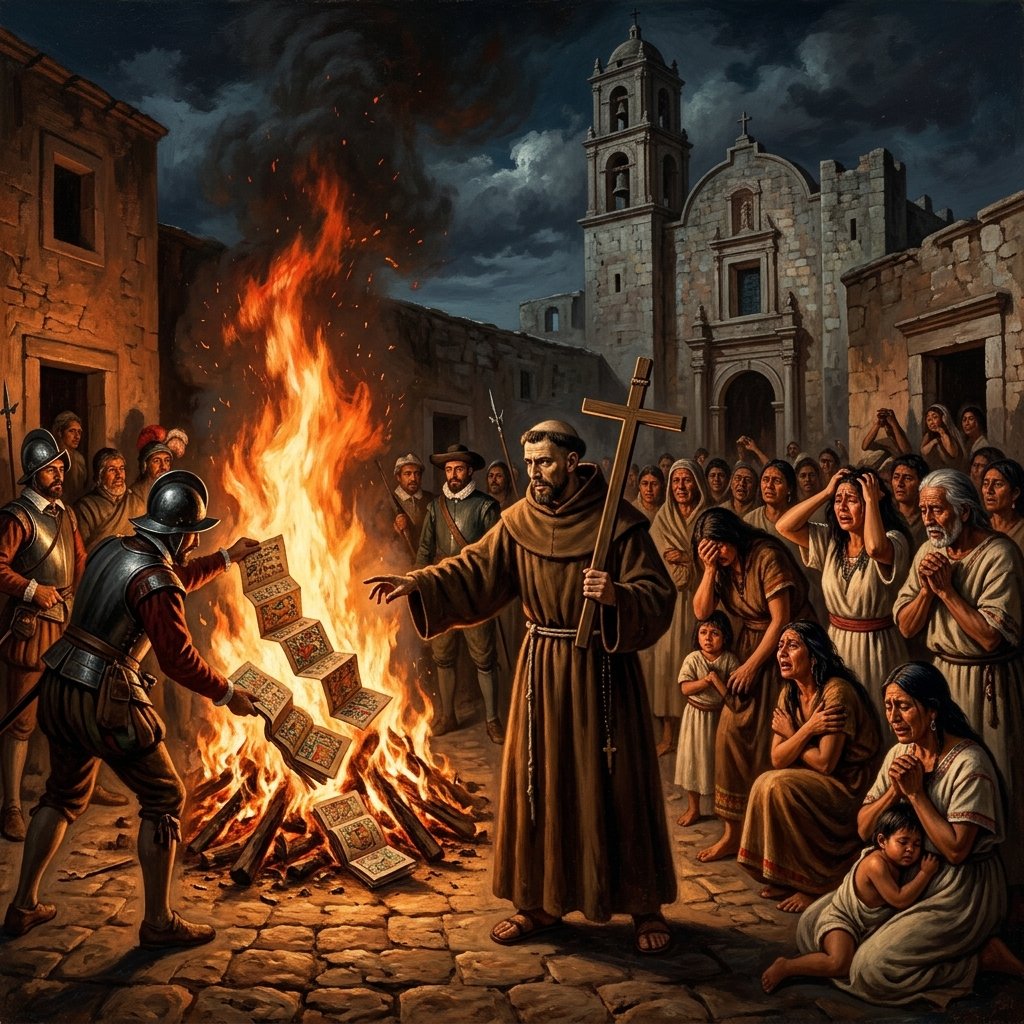
On July 12, 1562, Diego de Landa — then the Franciscan provincial of the Yucatán — conducted an auto-da-fé (public act of faith) at the town of Maní. Alarmed by evidence that recently converted Maya people were continuing to practice their traditional religion in secret, Landa ordered a mass confiscation and destruction of religious objects.
In his own words:
"We found a large number of books in these characters and, as they contained nothing in which there were not to be seen superstition and lies of the devil, we burned them all, which they regretted to an amazing degree and which caused them much affliction." — Diego de Landa, Relación de las Cosas de Yucatán, c. 1566
Landa reported destroying 27 hieroglyphic rolls and approximately 5,000 "idols" (carved figures). He also subjected suspected relapsed converts to torture — hanging them by their wrists, pouring water on their backs, and suspending stones from their feet. Some died. The brutality was so extreme that even other Spanish colonists complained, leading to Landa being recalled to Spain to face investigation.
The Relación: Destruction's Strange Twin
While in Spain defending himself against the charges, Landa composed his Relación de las Cosas de Yucatán ("Account of the Affairs of Yucatán"), completed around 1566. Possibly written to demonstrate his knowledge of Maya culture and justify his actions, the Relación is a comprehensive ethnographic survey of Yucatec Maya life covering:
- The calendar: Detailed descriptions of the Tzolk'in and Haab' calendars, including month names, deity associations, and festival cycles.
- The "alphabet": Landa's attempt to record Maya hieroglyphic sounds — a crucial but flawed document that would prove essential for decipherment centuries later.
- Religion: Descriptions of Maya deities, ceremonies, sacrifices, and the role of priests and diviners.
- Daily life: Agriculture, food, housing, clothing, marriage customs, burial practices, and warfare.
- History: Accounts of the founding of cities, the movements of lineages, and the political structure of the Yucatán at the time of the conquest.
The Key to Decipherment
Landa's most consequential contribution was his recording of what he called the Maya "alphabet" — a list of hieroglyphic signs paired with Spanish letter sounds. Landa misunderstood the system: Maya writing is syllabic (each sign represents a consonant-vowel combination), not alphabetic. When Landa asked his Maya informant to write the letter "B," the informant wrote the syllable be — the Maya syllable that sounds like the Spanish letter name.
For nearly four centuries, scholars dismissed Landa's "alphabet" as nonsense. Then, in 1952, Russian linguist Yuri Knorosov realized that Landa's data was correct — it just needed to be understood as syllabic rather than alphabetic. This breakthrough cracked the Maya code and set in motion the complete decipherment of Maya hieroglyphs over the following decades (Coe, M.D., Breaking the Maya Code, 1992, pp. 143–159).
The irony is inescapable: the man who burned Maya writing also preserved the clue that allowed modern scholars to read it.
Judgment
Landa was acquitted by the Spanish Council of the Indies and returned to the Yucatán in 1572 as Bishop — the highest ecclesiastical authority in the region. He served until his death in 1579. His Relación survived in a single abridged copy, discovered in the 19th century by the French scholar Brasseur de Bourbourg.
Modern scholars remain divided. The Mayanist Michael Coe called Landa's burning "the equivalent of the destruction of the Library of Alexandria." Others note that without the Relación, the decipherment of Maya writing might have been impossible — or delayed by generations. Landa is thus both the villain and the inadvertent hero of Maya studies — a colonial figure whose legacy defies simple moral categories.
Frequently Asked Questions
Who was Diego de Landa?
A Franciscan friar and Bishop of Yucatán (1524–1579) who both destroyed and preserved Maya knowledge. He burned thousands of Maya books in 1562 but also wrote the Relación de las Cosas de Yucatán, which became the indispensable source for understanding Maya calendar systems, religion, and — most crucially — writing.
How many Maya books did Landa burn?
Landa himself reported burning 27 hieroglyphic rolls and ~5,000 carved figures. The true scale of destruction across the Yucatán was likely much larger. Only four Maya codices survive today — the Dresden, Madrid, Paris, and Grolier — suggesting that hundreds or thousands of manuscripts were lost.
Why is Landa important for Maya decipherment?
Landa recorded a Maya "alphabet" — his flawed but phonetically accurate attempt to map hieroglyphic sounds. In 1952, Yuri Knorosov realized Landa's data was syllabic, not alphabetic, cracking the Maya code. The Relación thus became the Rosetta Stone of Maya decipherment — making the book-burner also the key to reading the books.
Scholarly References
- Landa, D. de. Relación de las Cosas de Yucatán (c. 1566). Trans. A.M. Tozzer. Peabody Museum, Harvard University, 1941.
- Coe, M.D. Breaking the Maya Code. Thames & Hudson, 3rd edition, 2012.
- Clendinnen, I. Ambivalent Conquests: Maya and Spaniard in Yucatan, 1517–1570. Cambridge University Press, 1987.
- Restall, M. & Chuchiak, J.F. "A Reevaluation of the Authenticity of Fray Diego de Landa's Relación." Ethnohistory, vol. 49, 2002, pp. 651–669.