Key Takeaway
Maya Blue is not an ordinary paint. It is a nanostructured hybrid material — organic indigo molecules locked inside the channels of a clay mineral called palygorskite — that was invented by the ancient Maya around 800 AD. Its chemical stability is so extraordinary that it has survived over a millennium of tropical weathering, and it resists concentrated nitric acid, sodium hydroxide, and organic solvents. No other pre-industrial civilization produced anything comparable.
What Makes Maya Blue Remarkable
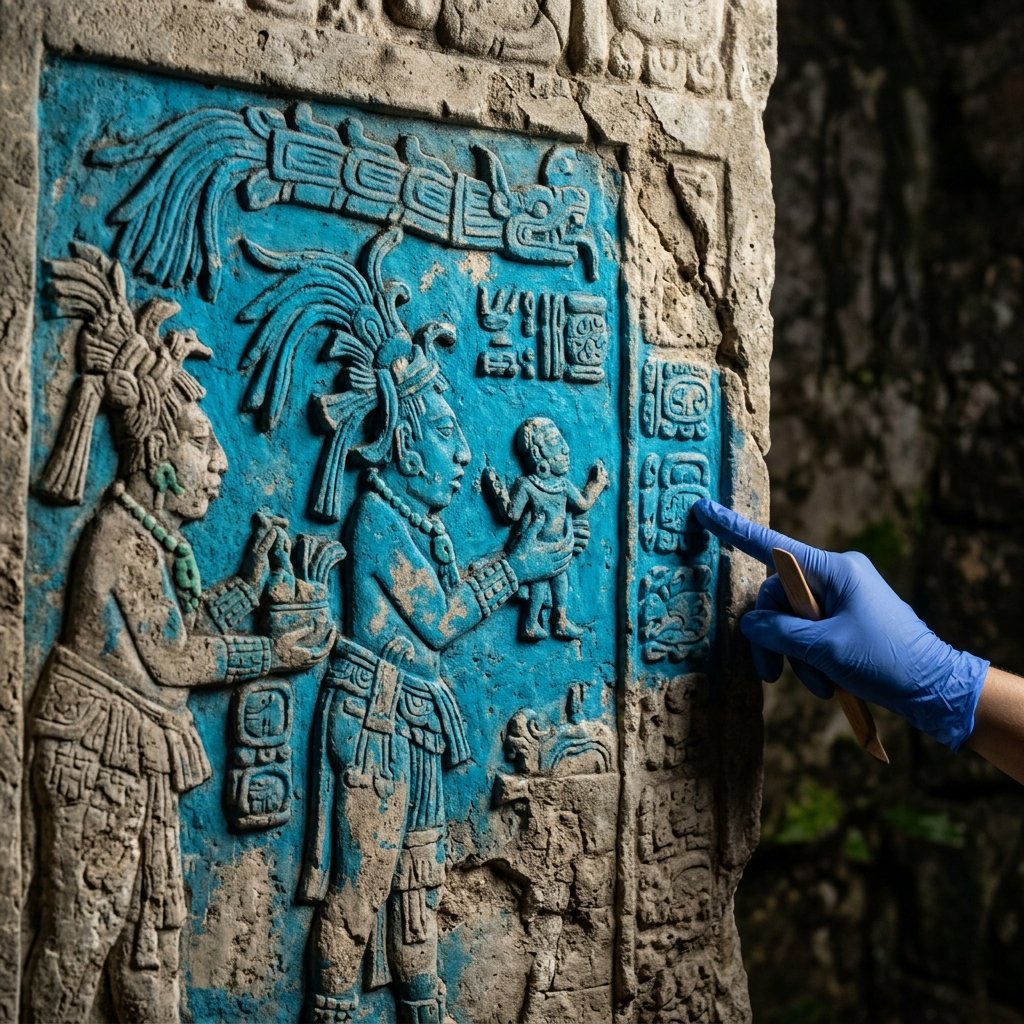
When Spanish friars arrived in the Yucatán in the 16th century, they noted the brilliant turquoise-blue paint adorning Maya temples. Centuries of tropical rain, humidity, UV radiation, and biological growth had failed to fade it. This observation went largely unexamined until the 20th century, when chemists began to investigate how an ancient civilization could have produced a pigment with properties that challenge modern materials science.
What researchers discovered was startling: Maya Blue is not a simple mineral paint or plant dye. It is a nano-composite material created by a process that bonds organic indigo molecules into the crystal lattice of a specific clay mineral, producing a hybrid with properties that neither component possesses alone.
Chemistry of the Pigment
The two ingredients of Maya Blue are deceptively simple:
- Indigo — the blue dye extracted from the Indigofera suffruticosa plant (añil), which the Maya cultivated extensively. Alone, indigo is fugitive — it fades rapidly in sunlight and washes away in water.
- Palygorskite — a needle-shaped clay mineral (also called attapulgite) with an unusual internal channel structure at the nanometer scale. The Maya sourced it from specific deposits in the Yucatán, particularly near the site of Sacalum.
When these two materials are heated together — research suggests temperatures between 150°C and 200°C — the indigo molecules are driven into the nano-channels of the palygorskite clay and become chemically bonded within the mineral framework. This encapsulation protects the otherwise fragile indigo from degradation.
"The indigo molecules are encapsulated within the channels of the palygorskite framework, protecting them from chemical and photochemical degradation."
— Chiari et al., Archaeometry 45(4), 2003
Scientific Investigations
The modern scientific study of Maya Blue has produced a rich body of peer-reviewed research:
Durability Testing
Laboratory tests confirm what centuries of tropical weathering already demonstrated — Maya Blue possesses remarkable chemical resistance:
| Test Agent | Result | Note |
|---|---|---|
| Concentrated HNO₃ | Resistant | Most organic dyes destroyed instantly |
| 2M NaOH (alkali) | Resistant | Color unchanged after prolonged exposure |
| Organic solvents | Resistant | Acetone, toluene, DMF — no extraction |
| UV radiation | Highly resistant | Minimal fading after accelerated aging |
| Biological attack | Resistant | Unaffected by fungi and bacteria |
Ritual Significance
Maya Blue was not merely decorative — it carried deep ritual significance. The color blue was associated with sacrifice, rain, and the divine. At Chichén Itzá, objects recovered from the Sacred Cenote — including human remains — were coated in Maya Blue before being cast into the water as offerings to Chaac, the rain god.
Archaeological chemist Dean Arnold and colleagues proposed that the pigment was itself created as part of the sacrificial ritual — the burning of copal incense mixed with palygorskite and indigo-bearing plant material would have simultaneously produced the pigment, the sacred smoke, and the heat necessary for the chemical bonding reaction (Arnold et al., Antiquity 82, 2008).
Modern Applications
The extraordinary properties of Maya Blue have attracted interest from modern materials scientists seeking environmentally friendly, non-toxic pigments with extreme durability. Research groups have synthesized Maya Blue analogues using different organic dyes and clay minerals, exploring applications in:
- Conservation: Developing long-lasting, non-toxic pigments for art restoration
- Industrial coatings: UV-resistant and chemically stable paints
- Environmental science: Clay–organic hybrids for pollutant removal from water
- Nanotechnology: Understanding natural nanocomposite structures as models for bio-inspired materials design
Where to See Maya Blue
Surviving examples of Maya Blue can be seen at:
- The murals of Bonampak, Chiapas (the most extensive surviving Maya mural program)
- The Temple of the Warriors at Chichén Itzá
- Ceramic vessels in the National Museum of Anthropology, Mexico City
- The Cenote Sagrado offerings at the Peabody Museum, Harvard University
Frequently Asked Questions
Can Maya Blue be made today?
Researchers have successfully synthesized Maya Blue in laboratory settings by heating mixtures of indigo and palygorskite. However, reproducing the exact color and durability of ancient samples remains challenging, partly because the specific palygorskite deposits, heating conditions, and processing techniques used by the Maya are not fully understood (Reyes-Valerio, De Bonampak al Templo Mayor, 1993).
Is Maya Blue toxic?
No. Unlike many historical blue pigments — such as Egyptian Blue (copper-based), Prussian Blue (iron cyanide), or cobalt blue — Maya Blue is composed entirely of non-toxic, naturally occurring materials: plant-derived indigo and clay. This makes it of particular interest for modern applications requiring non-toxic colorants.
Why didn't other civilizations discover this?
The creation of Maya Blue requires both indigo (widely available) and palygorskite clay with the correct nanopore dimensions — a relatively rare mineral with significant deposits in the Yucatán Peninsula. The Maya's geographic access to both materials, combined with their sophisticated understanding of heat-treating natural materials, gave them uniquely favorable conditions for this invention.
References & Further Reading
- Van Olphen, H. (1966). "Maya Blue: A Clay-Organic Pigment?" Science, 154(3749), 645–646. doi:10.1126/science.154.3749.645
- José-Yacamán, M., et al. (1996). "Maya Blue Paint: An Ancient Nanostructured Material." Science, 273(5272), 223–225. doi:10.1126/science.273.5272.223
- Chiari, G., et al. (2003). "Pre-Columbian nanotechnology: reconciling the mysteries of the Maya Blue pigment." Archaeometry, 45(4), 671–689.
- Polette-Niewold, L. A., et al. (2007). "Organic/Inorganic Complex Pigments: Ancient Colors Maya Blue." Journal of Inorganic Biochemistry, 101(11-12), 1958–1973.
- Arnold, D. E., et al. (2008). "The first direct evidence of the production of Maya Blue." Antiquity, 82(315), 151–164.
- Giustetto, R., et al. (2013). "Maya Blue: A Computational and Spectroscopic Study." Journal of Physical Chemistry C, 117(34), 17519–17528.
- Sánchez del Río, M., et al. (2006). "The Maya Blue Pigment." In: Developments in Clay Science, Volume 1. Elsevier.