Chak Chel at a Glance
The Other Moon Goddess
Most popular sources present the Maya as having a single Moon Goddess — Ix Chel, the beautiful maiden of fertility, medicine, and weaving. But Maya theology was more nuanced than that. The Moon Goddess had (at least) two distinct aspects:
- Goddess I / Ix Chel — the young, beautiful, creative aspect. Associated with fertility, medicine, sexuality, and the waxing moon.
- Goddess O / Chak Chel — the old, destructive, wrathful aspect. Associated with floods, storms, death, the waning moon, and the end of world ages.
This dual structure — maiden and crone, creator and destroyer — is one of the most sophisticated theological concepts in Maya religion. It mirrors the lunar cycle itself: the moon grows from nothing to fullness (the maiden), then diminishes from fullness to darkness (the crone). Both phases are necessary. Without destruction, there is no space for renewal.
The Flood Scene: Dresden Codex Page 74
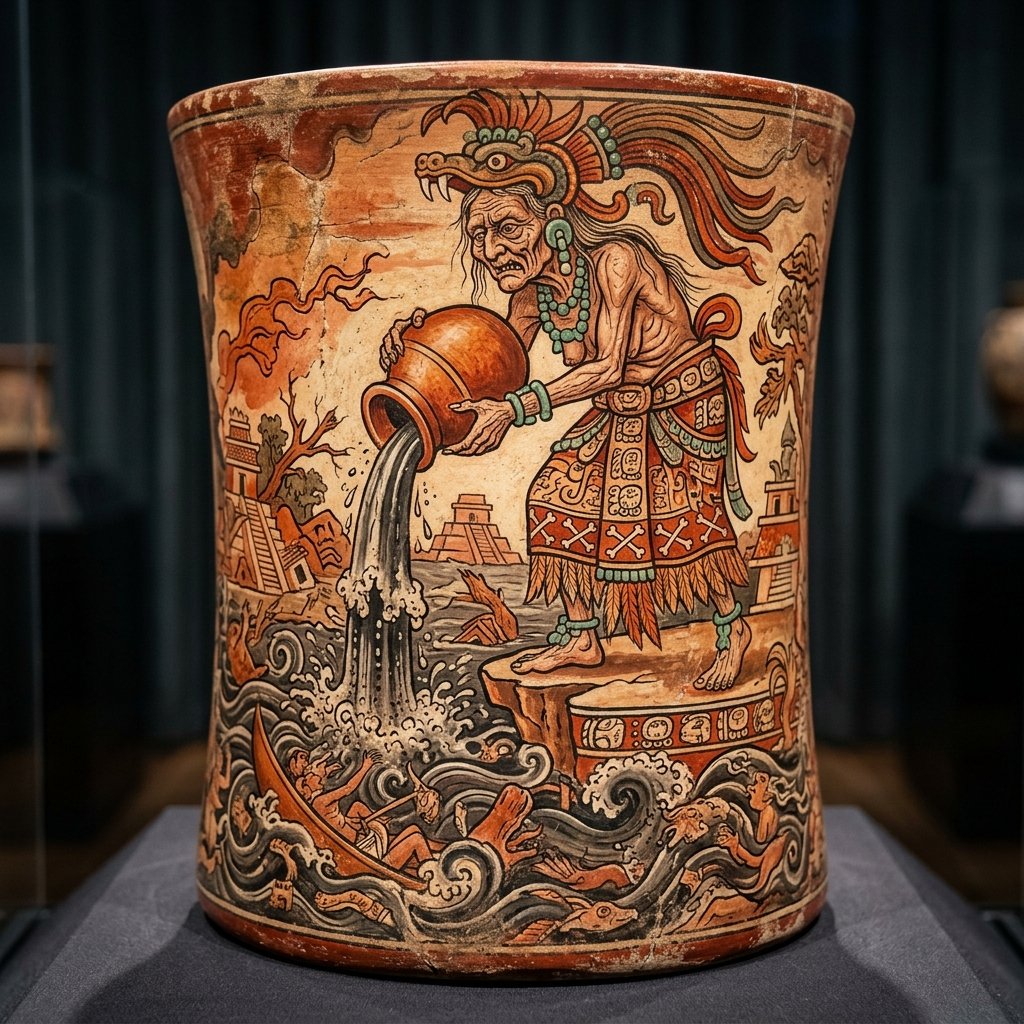
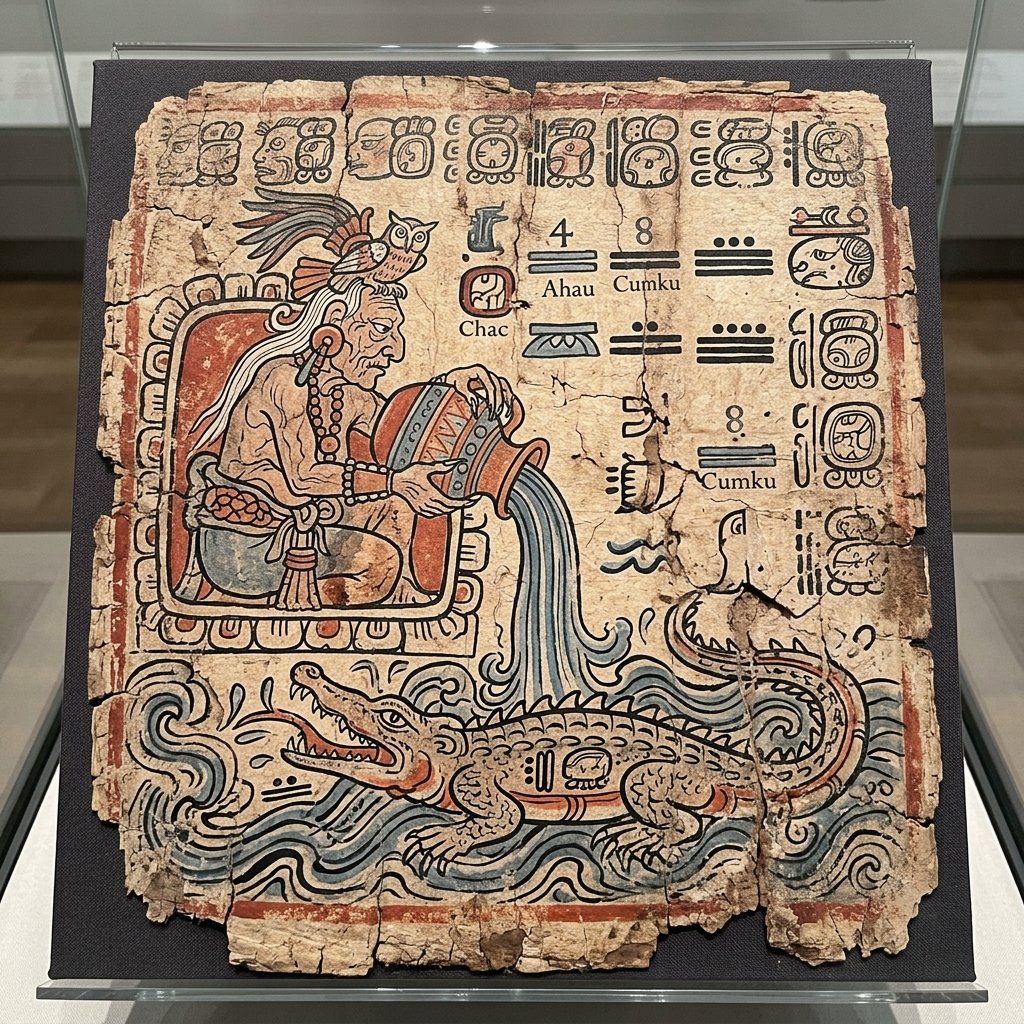
The most famous image of Chak Chel appears on Page 74 of the Dresden Codex — one of the most dramatic scenes in all of Maya art. The page shows:
- Chak Chel stands above the world, pouring water from an overturned ceramic jar. The water streams downward in torrents.
- Her body is decorated with crossed bones — the symbol of death.
- She wears a serpent headdress — a coiled snake atop her head, sometimes interpreted as watersnakes representing the destructive power of flooding rivers.
- Below her, a great cosmic crocodile or sky-serpent also pours water from its mouth.
- At the bottom of the scene, the world is engulfed in the deluge.
The Diagnostic Features
Chak Chel can be identified in Maya art by several consistent visual elements:
- Old age: She is always depicted as elderly — sagging skin, wrinkled face, sometimes toothless
- Clawed hands: Her fingers end in sharp claws — jaguar or eagle talons — emphasizing her predatory, dangerous nature
- Crossed-bone motif: Her skirt or body is decorated with crossed bones — the death symbol
- Serpent headdress: A snake coiled on her head, sometimes identified as a water serpent
- Spindle and weaving tools: Like Ix Chel, she is associated with textile arts — but where Ix Chel creates, Chak Chel unravels
- Inverted water vessel: The overturned jar from which she pours the flood
Why Destruction Is Necessary
Chak Chel is not evil. She is necessary. In Maya cosmology, creation is cyclical — each world age must end in destruction before a new, improved version can be created. The flood that destroyed the wooden people was not divine cruelty but divine quality control: the wooden people were defective (they could not worship), so the gods destroyed them to try again.
Chak Chel is the agent of that necessary destruction. Without her, the cosmos would be stuck with flawed creations forever. She clears the ground. She washes away the failed. She makes space for the maize people — the final, successful creation.
Chak Chel vs. Ix Chel: The Confusion
For decades, popular sources (and even some academic ones) conflated Chak Chel and Ix Chel into a single "Moon Goddess." This confusion arose because:
- Both are associated with the moon
- Both are associated with water (Ix Chel with healing waters; Chak Chel with destructive waters)
- Both are female deities with serpent associations
- Colonial sources sometimes used the name "Ix Chel" loosely for any female deity
Modern scholarship (especially the work of Karl Taube) has established that they are distinct goddesses — or at minimum, two fundamentally different aspects of a lunar concept that should not be collapsed into a single figure. The young moon maiden and the old flood crone have different iconography, different codex designations (Goddess I vs. Goddess O), and different theological functions (Taube, K., The Major Gods of Ancient Yucatan, 1992, pp. 64–69, 99–105).
References
- Taube, K. The Major Gods of Ancient Yucatan. Dumbarton Oaks, 1992.
- Schele, L. & Miller, M.E. The Blood of Kings: Dynasty and Ritual in Maya Art. Kimbell Art Museum, 1986.
- Thompson, J.E.S. "The Moon Goddess in Middle America." Carnegie Institution of Washington Contributions to American Anthropology and History, No. 29, 1939.
- Vail, G. & Hernández, C. Re-Creating Primordial Time: Foundation Rituals and Mythology in the Postclassic Maya Codices. University Press of Colorado, 2013.
- Coe, M.D. The Maya. Thames & Hudson, 9th edition, 2015.
Frequently Asked Questions
Is Chak Chel the same as Ix Chel?
No — modern scholarship treats them as distinct goddesses (or at minimum, fundamentally different aspects of a lunar concept). Ix Chel (Goddess I) is the young, beautiful, creative moon maiden associated with fertility and medicine. Chak Chel (Goddess O) is the aged, destructive crone associated with floods and the end of world ages. They have different iconography, different codex designations, and different theological functions.
What does the Dresden Codex flood scene show?
Page 74 of the Dresden Codex shows Chak Chel pouring torrential water from an overturned jar onto the world below, while a cosmic crocodile-serpent adds to the deluge. It depicts the destruction of a previous world age through flood — a necessary act of cosmic renewal that clears the way for a new creation. It is one of the most dramatic and widely reproduced images in all of Maya art.
Why is Chak Chel depicted as old and frightening?
Chak Chel's aged, clawed, bone-decorated appearance reflects her function as the agent of cosmic destruction. In Maya theology, destruction is not evil — it is necessary for renewal. Each world age must end before a better one can begin. Chak Chel's frightening appearance communicates the terrifying power required to unmake a world, and her old age represents the accumulated wisdom to know when destruction is necessary.