Xaman Ek at a Glance
The Fixed Point in a Turning Sky
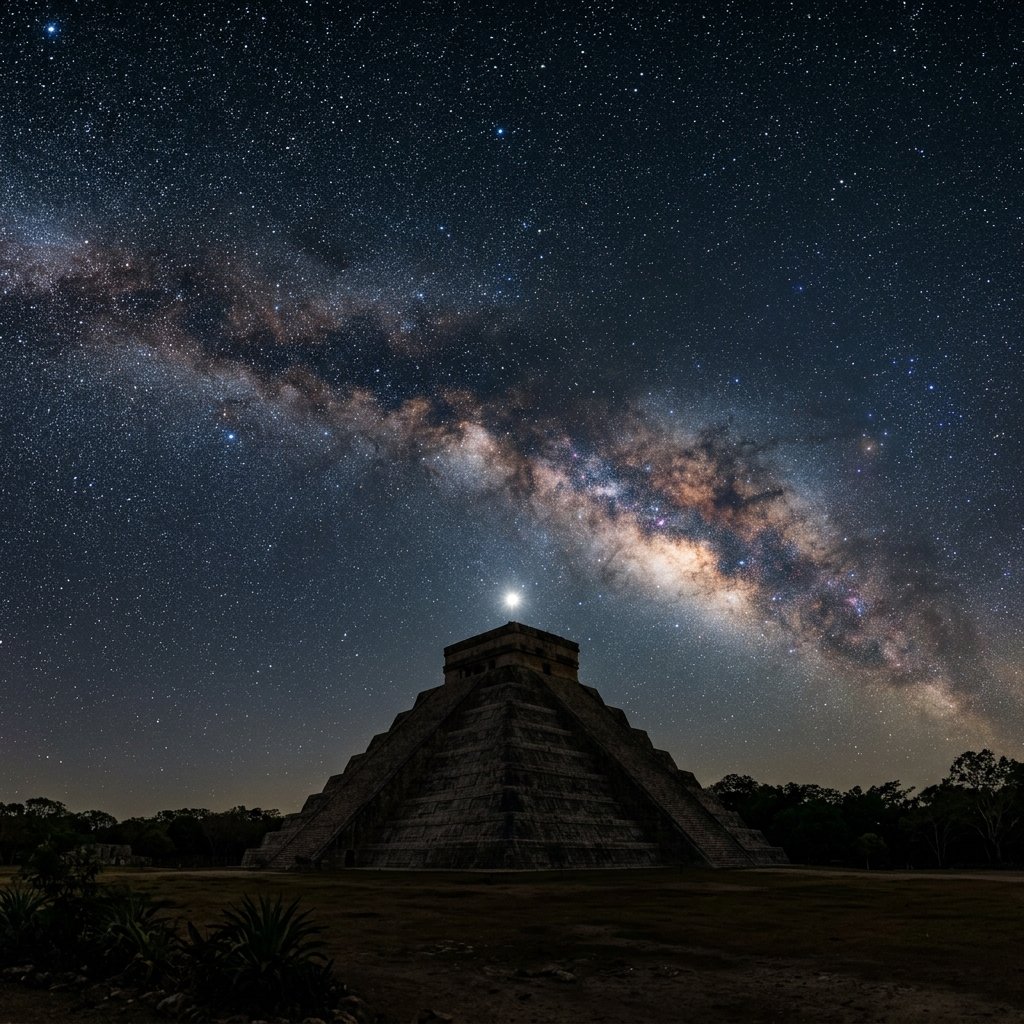
The Maya were among the most accomplished astronomers of the ancient world. Their observations of Venus, the Moon, eclipses, and the solar year were precise enough to rival — and sometimes exceed — contemporary Old World calculations. But of all the celestial objects they tracked, one stood apart: the North Star.
Unlike every other visible star, the North Star (Polaris) does not move. While all other stars appear to rotate around the sky over the course of a night, Polaris remains fixed in the north — a constant, reliable reference point. For a civilization whose trade networks spanned thousands of kilometers through dense jungle, roadless terrain, and dangerous coastlines, this fixed navigational reference was quite literally a matter of life and death.
Xaman Ek is the divine personification of that certainty.
Patron of Merchants
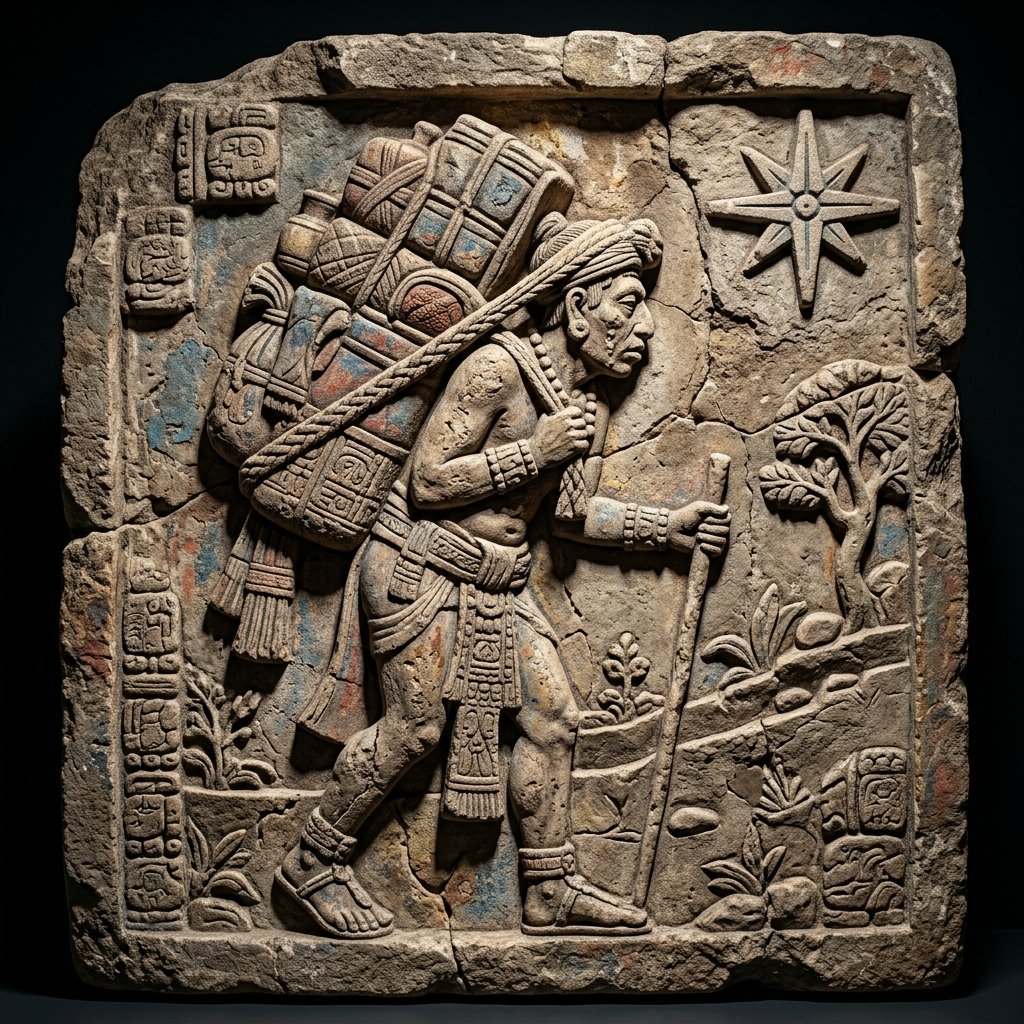
Xaman Ek's role as patron of merchants connects him directly to one of the most vital — and dangerous — professions in Maya civilization. Long-distance merchants (ppolom in Yucatec Maya) carried goods over vast distances:
- Cacao from the Tabasco and Soconusco lowlands
- Jade from the Motagua River Valley in Guatemala
- Obsidian from the volcanic highlands
- Salt from the coastal salt pans of the Yucatán
- Quetzal feathers from the cloud forests of highland Guatemala
- Marine shells from the Caribbean coast
These trade routes passed through rival kingdoms, remote jungle, and territories controlled by potentially hostile groups. Merchants traveled armed and in groups, and they required divine protection. Xaman Ek and Ek Chuaj (the black-painted merchant god) together formed the divine patron pair of the merchant class (Thompson, J.E.S., Maya History and Religion, 1970, pp. 306–308).
Xaman Ek in the Codices
In the surviving Maya codices, Xaman Ek appears as a figure with a distinctive snub-nosed face and a head element that may represent a compass-star or directional marker. He is sometimes depicted:
- Seated on a sky-band (indicating his celestial nature)
- Associated with the direction north (the direction of the ancestors and the white ceiba tree)
- In conjunction with Ek Chuaj, suggesting connected rituals for safe trading journeys
Navigation in the Maya World
Understanding Xaman Ek's importance requires understanding the navigational challenges the Maya faced. The Maya lowlands are dense tropical forest with essentially flat terrain — there are no mountain ranges or major landmarks visible from a distance. The jungle canopy blocks most horizon views. Roads (sacbeob, "white roads") connected some city-states, but many trade routes followed jungle trails without infrastructure.
In this environment, celestial navigation was essential. Merchants traveling at night — which was preferred for avoiding the extreme heat — relied on the stars, and especially the North Star, to maintain their bearing. The architectural orientation of many Maya buildings toward the cardinal directions may also reflect this practical navigational concern, not just ceremonial symbolism (Aveni, A., Skywatchers of Ancient Mexico, 2001, pp. 280–285).
The North Star and Maya Cosmology
The north held special significance in Maya cosmology. It was associated with:
- The white direction — one of the four directional colors assigned to the Bacabs
- The realm of the ancestors — the direction from which the dead could return during rituals
- The cosmic pole — the axis around which the visible universe appeared to rotate
By fixing the North Star in a divine figure — Xaman Ek — the Maya were transforming an astronomical observation into a theological statement: the cosmos has a fixed center of orientation, and that center is divine.
References
- Thompson, J.E.S. Maya History and Religion. University of Oklahoma Press, 1970.
- Aveni, A. Skywatchers of Ancient Mexico. University of Texas Press, revised edition, 2001.
- Taube, K. The Major Gods of Ancient Yucatan. Dumbarton Oaks, 1992.
- Tozzer, A.M. Landa's Relación de las cosas de Yucatán. Harvard University, Peabody Museum Papers, Vol. 18, 1941.
- Coe, M.D. The Maya. Thames & Hudson, 9th edition, 2015.
Frequently Asked Questions
Who is Xaman Ek?
Xaman Ek is the Maya god of the North Star and the patron deity of merchants and travelers. His name in Yucatec Maya literally means "North Star" (xaman = north, ek' = star). He provided divine navigational guidance to the long-distance traders who carried jade, cacao, obsidian, and other goods across thousands of kilometers of jungle terrain.
How did the Maya navigate through the jungle?
The Maya used celestial navigation, relying primarily on the North Star (Polaris) — the only star that appears fixed in the sky. In the dense jungle lowlands with flat terrain and limited horizon visibility, the stars were the most reliable navigational tool. Some cities were connected by raised stone roads called sacbeob, but many trade routes followed jungle trails without infrastructure, making stellar navigation essential.
What is the connection between Xaman Ek and Ek Chuaj?
Xaman Ek (North Star god) and Ek Chuaj (god of commerce/cacao) together formed the divine patron pair of Maya merchants. Xaman Ek provided navigational guidance — the ability to find one's way — while Ek Chuaj provided commercial protection. Merchants would invoke both deities before embarking on dangerous long-distance trading expeditions through jungle and hostile territory.