A Note on Method
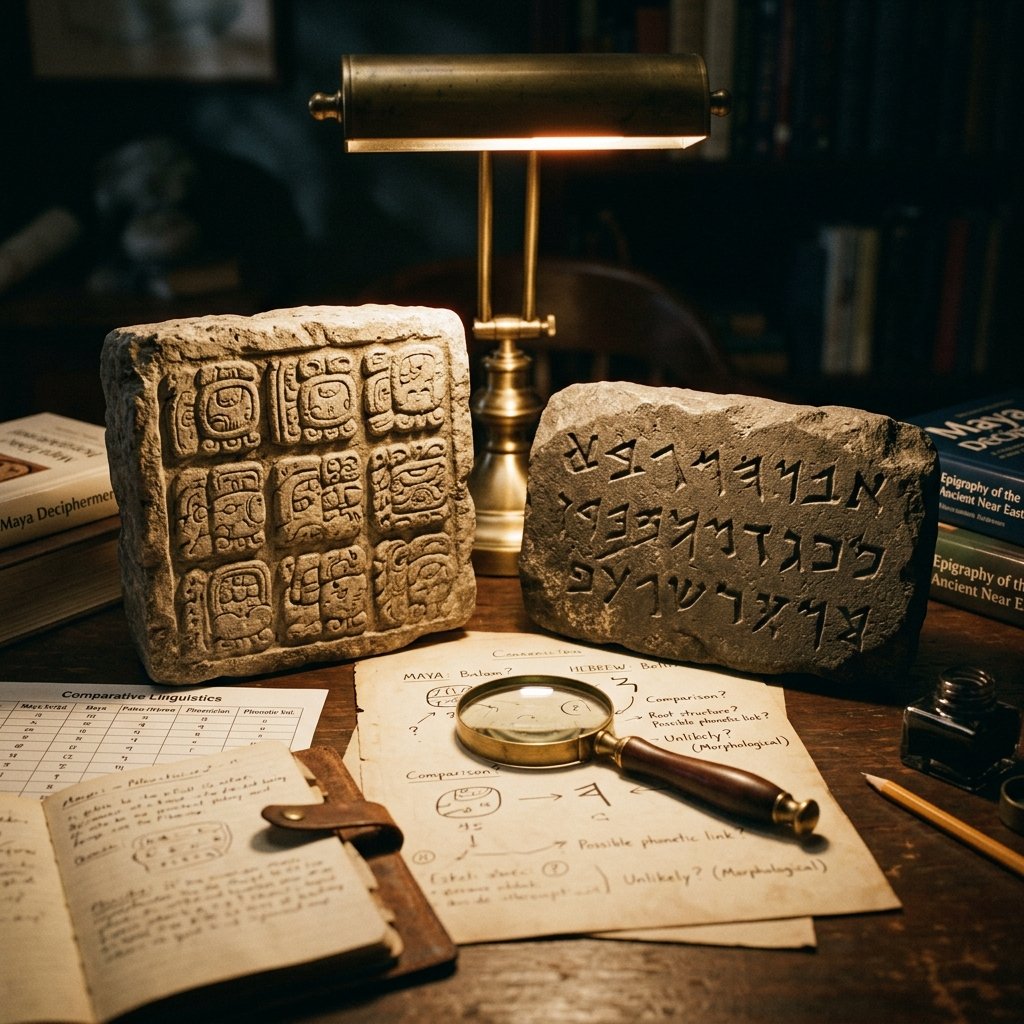
Comparing writing systems across cultures requires extreme methodological rigor. Visual similarity between individual signs is almost always meaningless — with enough symbols to choose from, coincidental resemblances are inevitable. What matters are structural and systematic parallels: shared organizational principles, comparable encoding strategies, and consistent correspondences across multiple features. This article applies that standard.
What Maya Writing Actually Is
Before we can evaluate any proposed external influences, we need to understand what Maya writing is and how it works. (For the full story, see our comprehensive Maya Writing article.)
The Maya hieroglyphic script is a logo-syllabic system — it uses both logograms (one sign = one word) and syllabograms (one sign = one consonant-vowel syllable). It contains approximately 800 distinct signs and can express any word in any Maya language. It was in use from at least 300 BC to the Spanish conquest.
The Mainstream Position
The consensus among professional epigraphers — represented by scholars like Michael Coe, David Stuart, Stephen Houston, and Linda Schele — is unequivocal: Maya writing is an independent invention with no structural relationship to any Old World script.
The arguments are straightforward:
- Maya script encodes Mayan languages (Ch'olan and Yucatecan) — not Semitic languages
- The syllabic values of Maya signs were determined internally through substitution patterns — they have no correspondence to Hebrew, Egyptian, or any other known phonetic inventory
- The glyph block organizational system (main sign + affixes) has no parallel in Near Eastern writing
- The evolutionary history of Maya script can be traced from precursor traditions (Epi-Olmec, Zapotec bar-and-dot notation) — it has a local developmental trajectory
These are strong arguments, and any responsible investigation must acknowledge them as the scholarly starting point.
The Observations That Get People Thinking
Having established the consensus, here are the observations that — while insufficient to overturn it — have generated discussion in comparative linguistics and religious scholarship:
1. Structural Type: Logo-Syllabic Systems Are Rare
The logo-syllabic writing type — combining word-signs and syllable-signs in a single system — is extremely rare in the history of writing. Only four traditions independently developed it:
| System | Region | Date | Type |
|---|---|---|---|
| Sumerian Cuneiform | Mesopotamia | ~3400 BC | Logo-syllabic |
| Egyptian Hieroglyphs | Near East / North Africa | ~3200 BC | Logo-consonantal |
| Chinese | East Asia | ~1200 BC | Logographic (with phonetic elements) |
| Maya | Mesoamerica | ~300 BC | Logo-syllabic |
The fact that the Maya independently arrived at the same type of writing system as the Sumerians and Egyptians is either a remarkable convergence or an indication of a deeper principle — that logo-syllabic encoding is the "natural" architecture for complex writing. Linguist Florian Coulmas has argued that this convergence is structurally significant, even if it doesn't imply contact (Coulmas, Writing Systems, 2003).
2. The "Reformed Egyptian" Question
The Book of Mormon states that its records were written in "reformed Egyptian" — described as a modified form of Egyptian script adapted by Hebrew speakers over centuries. This is often dismissed as an impossibility, but it's worth noting that analogous real-world examples exist:
- Demotic — a simplified ("reformed") version of Egyptian hieroglyphs used from ~700 BC to ~400 AD, contemporary with the Book of Mormon's claimed period
- Meroitic — an Egyptian-derived script used in ancient Nubia (Sudan) to write a non-Egyptian language
- Proto-Sinaitic / Proto-Canaanite — Semitic workers in Egyptian turquoise mines adapted Egyptian hieroglyphic signs to write their own Semitic language (~1800 BC) — the ancestor of the Phoenician, Hebrew, and Arabic alphabets
The concept of Semitic-speaking peoples adapting Egyptian writing systems is not only possible — it's exactly how the alphabet was invented. Whether this bears on the Book of Mormon question is a matter of interpretation, not plausibility (Goldwasser, Journal of Near Eastern Studies, 2006).
3. Scribal Culture Parallels
Both Maya and ancient Hebrew cultures shared a strikingly similar conception of the scribe's role in society:
- Scribes as an elite class with sacred status
- Writing as a divine gift (Maya: Itzamná / Monkey Gods; Hebrew: God dictating to Moses)
- Records kept in institutional libraries or archives
- The act of writing itself as ritually significant — not just functional
- Deliberate destruction of enemy records as cultural warfare
These parallels may reflect universal features of literate civilizations rather than specific contact. But comparative literacy scholars like Jack Goody have noted that the social embedding of literacy — who writes, for whom, and why — often reveals more about a culture's values than the script itself (Goody, The Logic of Writing and the Organization of Society, 1986).
Where the Evidence Stands
Here is the honest assessment:
- Visual sign comparison: Not convincing. With 800+ Maya signs and 22+ Hebrew letters, random resemblances are inevitable and prove nothing.
- Structural type: Genuinely interesting but explicable through convergent development.
- "Reformed Egyptian" concept: Historically plausible (the alphabet itself is a "reformed Egyptian" system), but no Maya inscription has been identified as encoding any Semitic language.
- Scribal culture: Real parallels, but possibly universal features of literate societies rather than evidence of contact.
The honest conclusion: there is no direct evidence of Hebrew influence on Maya writing. But some of the structural and cultural parallels are non-trivial and deserve more rigorous comparative study than they have received — particularly from scholars without ideological commitments on either side.
Frequently Asked Questions
Has anyone found Hebrew text in the Americas?
Several inscribed objects have been claimed as Hebrew — most notably the Bat Creek Stone (Tennessee, 1889) and the Newark Holy Stones (Ohio, 1860). Most archaeologists consider these forgeries or misidentifications, though minority researchers continue to argue for their authenticity. No inscription from a controlled archaeological context has been confirmed as Hebrew by mainstream epigraphy.
Could a Near Eastern script have existed in the Americas and been lost?
In principle, yes — writing on perishable materials (bark paper, wood, textiles) can vanish entirely. The Maya themselves produced thousands of codices, of which only four survive. If a hypothetical Near Eastern script in the Americas was used on similar perishable materials, it could have disappeared without trace — especially given the Spanish destruction of indigenous records. This is not evidence for its existence, but it does mean that absence of evidence is not necessarily evidence of absence.
References & Further Reading
- Coulmas, F. (2003). Writing Systems: An Introduction to their Linguistic Analysis. Cambridge University Press.
- Goldwasser, O. (2006). "Canaanites Reading Hieroglyphs: The Invention of the Alphabet." Ägypten und Levante / Egypt and the Levant, 16, 121–160.
- Goody, J. (1986). The Logic of Writing and the Organization of Society. Cambridge UP.
- Houston, S. D. (2004). "The Archaeology of Communication Technologies." Annual Review of Anthropology, 33, 223–250.
- Coe, M. D. (2012). Breaking the Maya Code. 3rd ed. Thames & Hudson.
- Daniels, P. T. & Bright, W. (1996). The World's Writing Systems. Oxford UP.