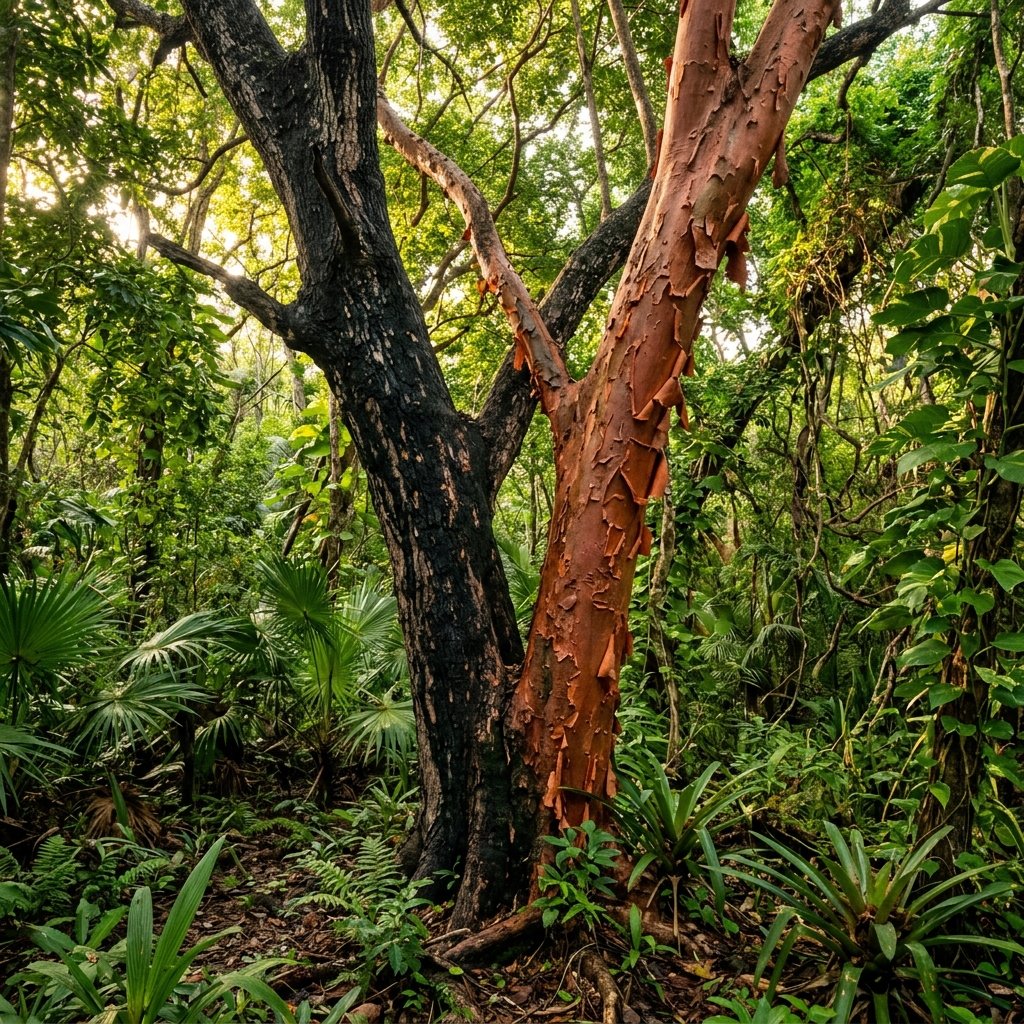
The Legend at a Glance
The Legend
In the ancient Maya world, two warrior princes served the same lord. Kinich was noble, gentle, and beloved by his people. Tizic was powerful, arrogant, and feared. Both fell in love with the same woman — Nicté-Ha, a princess whose beauty was said to rival the moon's.
Nicté-Ha chose Kinich, the kind one. Tizic, consumed by jealousy, challenged his rival to a fight to the death. The two brothers met on a field of battle and killed each other — their blood soaking into the earth.
The gods, moved by the tragedy, transformed the two warriors into trees so they would stand together for eternity:
- Tizic became the Chechén tree — dark, menacing, and poisonous. Its sap causes painful blistering rashes on contact with skin. Even standing beneath it during rain can cause burns, as the toxin washes down with the water. The tree reflects Tizic's bitter, destructive nature.
- Kinich became the Chacá tree — with smooth, reddish-copper bark that peels away in papery sheets. Its sap is medicinal — it soothes and heals the very rash caused by the Chechén. The tree embodies Kinich's nurturing spirit, forever offering the cure to his brother's poison.
And Nicté-Ha? She became the white water lily (Nymphaea ampla) — floating serenely on the surface of cenotes and lagoons, forever out of reach of both brothers, beautiful and untouchable.
The Real Trees
What makes this legend extraordinary is that the botanical facts are entirely real.
The Chechén (Black Poisonwood)
Metopium brownei, commonly called the Chechén or Black Poisonwood, is a member of the Anacardiaceae family — the same family as poison ivy and poison sumac. It is native to the Yucatán Peninsula, Belize, Guatemala, and parts of the Caribbean.
- Its sap contains urushiol-related compounds that cause severe contact dermatitis — painful blisters, swelling, and itching that can last for weeks.
- The tree is identifiable by its dark, often black-spotted bark and shiny, compound leaves.
- Local guides in the Yucatán consistently warn visitors to avoid touching the tree or standing beneath it during rain.
The Chacá (Gumbo-Limbo)
Bursera simaruba, known as the Chacá or Gumbo-Limbo, is one of the most recognizable trees in the Neotropical lowlands. It is easily identified by its distinctive reddish, peeling bark — locals sometimes call it the "tourist tree" because it looks sunburned.
- Its inner bark and sap contain anti-inflammatory terpenes that genuinely soothe skin irritation — including the rash caused by the Chechén (Cáceres, A. et al., "Antigonorrhoeal Activity of Plants Used in Guatemala," Journal of Ethnopharmacology, 1995).
- Traditional Maya healers (j-men) have used Chacá bark poultices to treat Chechén burns for centuries — a practice documented by colonial-era sources and modern ethnobotanists.
- The two trees frequently grow in close proximity in the wild, which likely inspired and reinforced the legend.
Why Do They Grow Together?
The ecological co-occurrence of Chechén and Chacá is not magical — it reflects shared habitat preferences. Both species thrive in the semi-deciduous tropical forests of the Yucatán's karst limestone landscape. They favor similar soil conditions, drainage patterns, and light exposure.
However, not every Chechén has a Chacá nearby, and vice versa. The legend selectively emphasizes the cases where they do co-occur — a common pattern in folklore, where humans notice and mythologize the striking coincidences while ignoring the exceptions.
The Legend in Context
The Chechén and Chacá legend belongs to a global category of etiological myths — stories that explain the origin of natural phenomena. Similar legends exist in traditions worldwide:
- The Greek myth of Daphne, who became a laurel tree to escape Apollo.
- The Japanese legend of the pine and cherry trees that represent an eternal couple.
- The Arawak legend of the manchineel tree, whose poison was attributed to a vengeful spirit.
What distinguishes the Maya version is its practical utility. The legend is not merely poetic — it serves as a survival instruction: if you touch the Chechén, look for the Chacá nearby and apply its bark. The story encodes real botanical knowledge in a form that is memorable, transmissible, and emotionally engaging — precisely the qualities that ensure a practical lesson survives across generations.
Visiting the Trees
Both trees are commonly encountered on nature walks and archaeological site visits across the Yucatán Peninsula. Many tour guides at sites like Chichen Itza, Uxmal, Calakmul, and Tulum will point out Chechén and Chacá trees and tell the legend as part of their tour. At some eco-parks and nature reserves, the trees are labeled for educational purposes.
References
- Cáceres, A. et al. "Antigonorrhoeal Activity of Plants Used in Guatemala for the Treatment of STD." Journal of Ethnopharmacology, Vol. 48, No. 2, 1995, pp. 85–88.
- Roys, R.L. The Ethno-Botany of the Maya. Tulane University, Middle American Research Series, Publication 2, 1931.
- Barrera Marín, A. et al. Nomenclatura Etnobotánica Maya. INAH, México, 1976.
- Burns, A.F. An Epoch of Miracles: Oral Literature of the Yucatec Maya. University of Texas Press, 1983.
Frequently Asked Questions
Does the Chacá tree really cure the Chechén rash?
Yes — to a degree. The inner bark and sap of the Chacá (Bursera simaruba) contain anti-inflammatory terpenes that soothe the contact dermatitis caused by the Chechén. It is not a complete medical cure (severe cases may still require medical treatment), but as a field remedy it provides genuine relief. This traditional use has been documented by ethnobotanists since the colonial period.
How can I identify the Chechén tree?
The Chechén (Metopium brownei) has dark bark that often shows black spots or streaks where the sap has dripped. Its leaves are compound with 3–7 shiny oval leaflets. If you see a tree with dark, spotty bark in the Yucatán jungle, keep your distance. Local guides can help with identification — do not touch unfamiliar trees in the forest.
Do the two trees always grow together?
No — not always. They share similar habitat preferences, so they frequently co-occur in the same forests, but it is not a botanical rule. The legend emphasizes the cases where they grow near each other, which is a common pattern in folklore — humans notice and mythologize striking coincidences.