Xibalba at a Glance
What Is Xibalba?
Xibalba (sometimes written Xibalbá or Xibalbay) is the Maya underworld — a vast subterranean kingdom ruled by death gods and populated by demons, monsters, and the souls of the dead. The name comes from the K'iche' Maya root xib, meaning "fright" or "trembling" — making Xibalba literally the "Place of Fear."
It is essential to understand that Xibalba is not equivalent to the Christian concept of Hell. In Maya cosmology, Xibalba was not a place of punishment for the wicked — it was where nearly all souls went after death, regardless of moral conduct during life. The exceptions were those who died in childbirth, in battle, by sacrifice, or by suicide — these souls went directly to a celestial paradise (Coe, M.D., The Maya, 2015, p. 209).
The Geography of Xibalba
According to the Popol Vuh, Xibalba is accessed by descending a steep road that leads underground. The journey includes:
- A steep descent into the earth through a ravine.
- A river of blood (pus in some translations) — one of several rivers that must be crossed.
- A river of water — seemingly benign but difficult to navigate.
- A crossroads where four roads meet — black, white, red, and yellow — and the traveler must choose correctly. The black road leads to Xibalba; the others lead to traps.
The Popol Vuh describes Xibalba as having a council house where the Lords of Death held court, and several houses of trial — each designed to test and destroy visitors.
The Lords of Xibalba
The Popol Vuh names twelve Lords of Xibalba, organized in pairs. Each pair governs a specific aspect of death and suffering:
The Houses of Terror
Visitors to Xibalba — whether summoned or arriving as souls of the dead — were subjected to a series of trial houses, each a lethal test:
- Dark House (Quequma-ha) — Total darkness. Visitors were given a torch and cigars that had to remain lit until morning. Anyone whose torch burned out was killed.
- Razor House (Chayin-ha) — Filled with slashing obsidian blades that moved of their own accord.
- Cold House (Xuxulim-ha) — Extreme cold with driving hail and wind.
- Jaguar House (Balami-ha) — Filled with hungry jaguars.
- Fire House (Chi-ha) — Filled with raging flames.
- Bat House (Zotzil-ha) — Filled with shrieking death bats, including Camazotz (the "Snatch Bat"), who decapitated Hunahpu during the Hero Twins' journey.
Caves, Cenotes, and the Physical Underworld
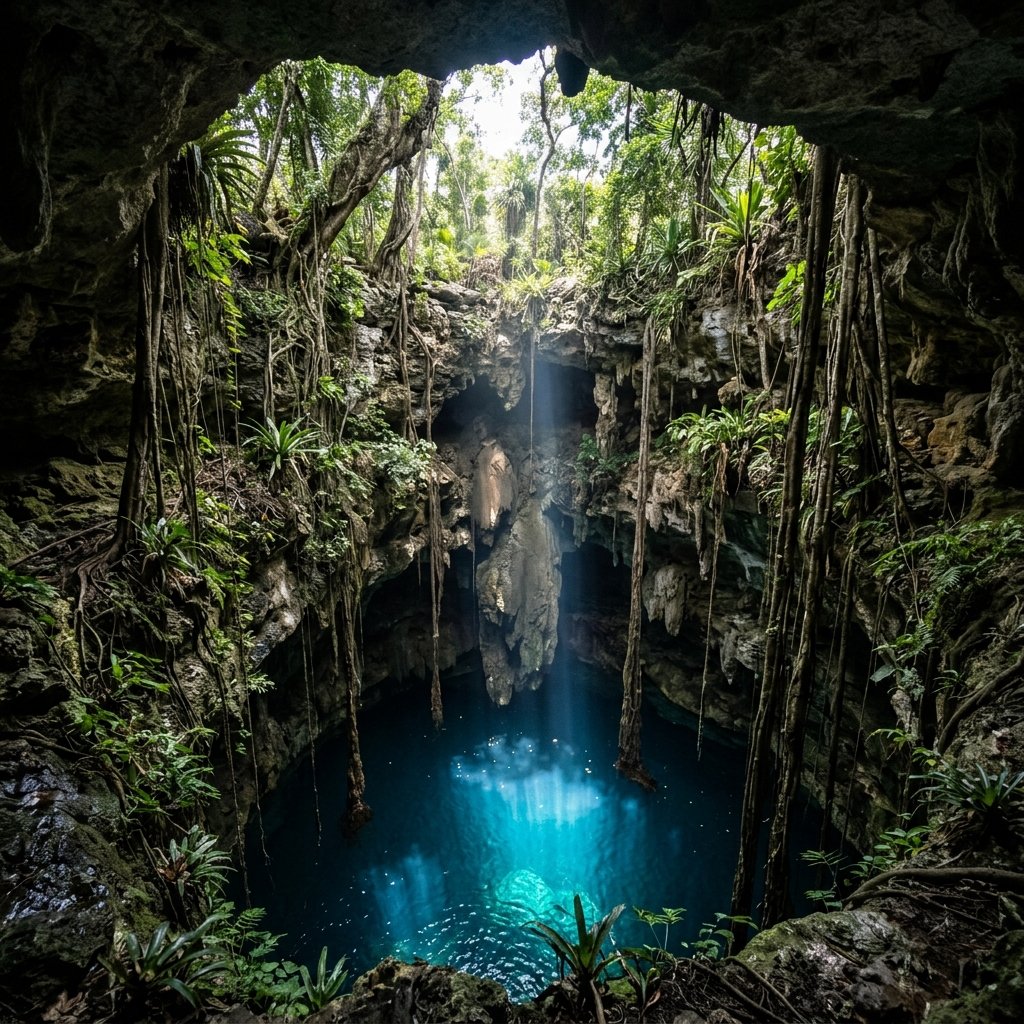
The Maya did not consider Xibalba to be purely mythological. The underworld had physical entry points in the landscape — specifically, caves and cenotes. The Maya lowlands are characterized by karst limestone geology, which produces extensive cave systems and sinkholes (cenotes) that were understood as ch'en — actual portals to Xibalba.
Archaeological evidence from these sites supports this interpretation:
- Actun Tunichil Muknal, Belize: This cave contains human skeletal remains, ceramics, and stoneware deep inside the chambers. The most famous is the "Crystal Maiden" — a complete female skeleton whose bones have calcified and sparkle in torchlight. The deposits suggest ritual use over centuries (Awe, J.J. et al., "The Western Belize Regional Cave Project," in Research Reports in Belizean Archaeology, 2005).
- The Sacred Cenote at Chichen Itza: Dredging operations in the early 20th century recovered jade objects, gold, pottery, copal incense, and human remains from this 60-meter-wide natural sinkhole — confirming it as a major pilgrimage site for offerings to the underworld gods (Coggins, C. & Shane, O.C., Cenote of Sacrifice, University of Texas Press, 1984).
- Naj Tunich, Guatemala: This cave contains painted hieroglyphic inscriptions and drawings dating to the Late Classic period, including depictions of underworld deities and ritual scenes — essentially a "gallery" of Xibalba-related art created deep underground (Stone, A., Images from the Underworld: Naj Tunich and the Tradition of Maya Cave Painting, 1995).
Xibalba in Maya Cosmology
The Maya conceived of the cosmos as having three tiers:
- The Upper World (ka'an) — the thirteen layers of heaven, home of celestial deities.
- The Middle World (kab) — the surface of the earth, where humans live.
- The Underworld (Xibalba) — the nine layers below the earth, home of the dead and the death gods.
These tiers were connected by the World Tree (Wakah-Chan) — the ceiba tree whose roots reached into Xibalba, whose trunk stood in the Middle World, and whose branches extended into the Upper World. The king, when he ascended the throne, symbolically became this World Tree — the axis connecting all three realms (Schele, L. & Freidel, D., A Forest of Kings, 1990, pp. 66–92).
References
- Tedlock, D. Popol Vuh: The Definitive Edition of the Mayan Book of the Dawn of Life. Simon & Schuster, 1996.
- Coe, M.D. The Maya. Thames & Hudson, 9th edition, 2015.
- Stone, A. Images from the Underworld: Naj Tunich and the Tradition of Maya Cave Painting. University of Texas Press, 1995.
- Coggins, C. & Shane, O.C. (eds.) Cenote of Sacrifice: Maya Treasures from the Sacred Well at Chichen Itza. University of Texas Press, 1984.
- Schele, L. & Freidel, D. A Forest of Kings: The Untold Story of the Ancient Maya. William Morrow, 1990.
- Brady, J.E. & Prufer, K.M. (eds.) In the Maw of the Earth Monster: Mesoamerican Ritual Cave Use. University of Texas Press, 2005.
Frequently Asked Questions
Is Xibalba the same as Hell?
No. Xibalba is not a place of punishment for the wicked. In Maya cosmology, nearly all souls went to Xibalba after death, regardless of moral conduct. It is closer to the Greek concept of Hades — a general realm of the dead — than to the Christian Hell. Souls who died in battle, childbirth, sacrifice, or suicide bypassed Xibalba entirely, going instead to a celestial paradise.
Can you visit a real entrance to Xibalba?
The Maya believed that caves and cenotes were physical entrances to Xibalba. You can visit many of these sites today — including the Sacred Cenote at Chichen Itza, Actun Tunichil Muknal in Belize (which contains ancient human remains), and numerous cenotes across the Yucatán Peninsula. These places were sacred ritual sites for millennia.
How many levels does Xibalba have?
Maya cosmology describes the underworld as having nine levels, mirroring the thirteen levels of the Upper World. The Popol Vuh does not describe all nine levels in detail but focuses on specific landmarks — the river crossings, the crossroads, the council house, and the Houses of Terror. Nine-level pyramids (like the Temple of Inscriptions at Palenque) are believed to symbolize this underworld structure.