The Myth at a Glance
Context: The Era of the False Gods
The story of Zipacna occurs early in the Popol Vuh narrative, in the period before the current creation of humanity. After the destruction of the wooden people and before the creation of the maize-humans, the earth was dominated by a family of arrogant, self-aggrandizing beings:
- Vucub Caquix (Seven Macaw) — a monstrous bird who declared himself the sun and moon. His jeweled teeth and glowing eyes mimicked celestial light, but he was a pretender — a false sun ruling in the darkness before the true dawn.
- Zipacna — Seven Macaw's eldest son. He boasted of creating the mountains and possessed immense physical strength.
- Cabrakan (Earthquake) — Seven Macaw's second son. He could shake and topple mountains.
The Hero Twins — Hunahpu and Xbalanque — were tasked with defeating all three of these false powers before the current world order could be established.
Zipacna and the 400 Boys
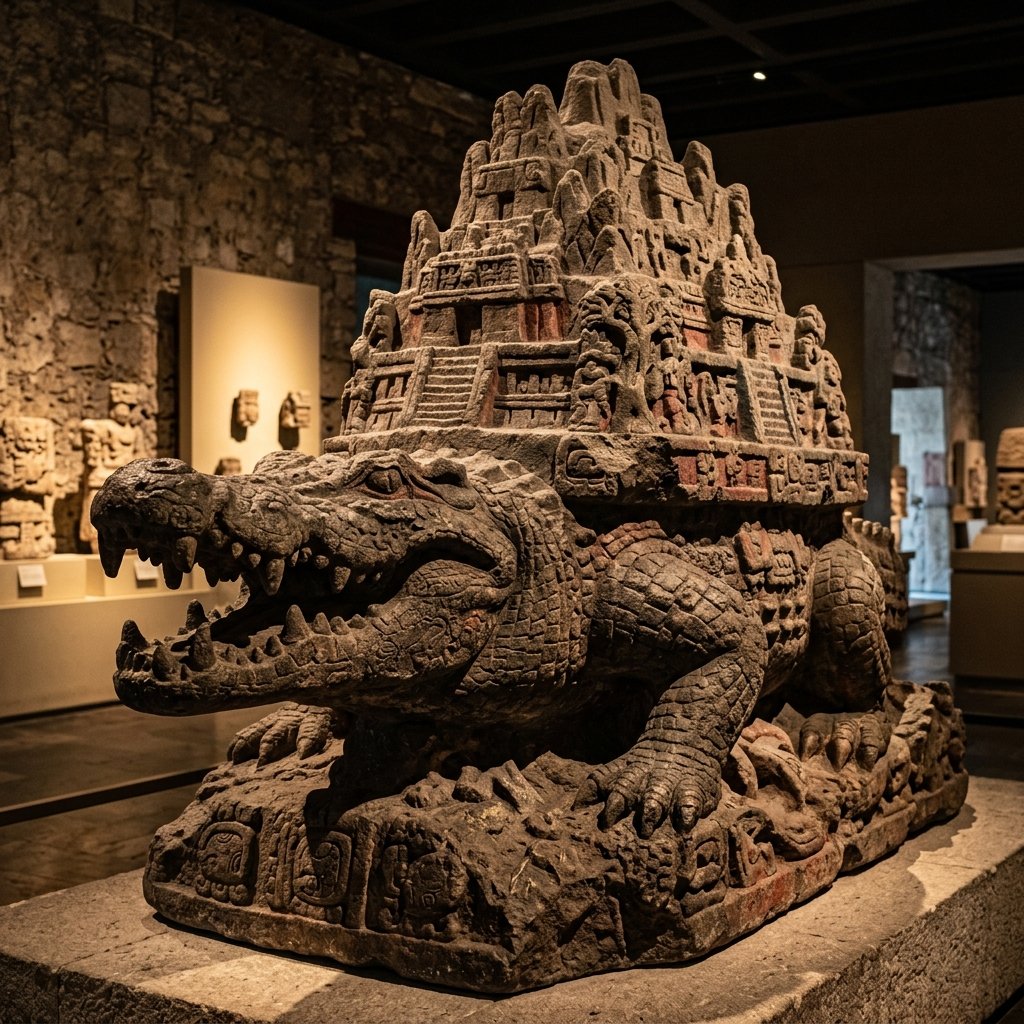
Zipacna was awesomely powerful. Every night he bathed in rivers and every day he carried mountains on his back — placing them wherever he wished, reshaping the landscape of the earth. He boasted endlessly about his strength.
One day, Zipacna encountered a group of 400 boys (the K'iche' text uses hun kam, "four hundred," which in Maya usage means "a great number" or "innumerable"). The boys were trying to drag an enormous log to use as a ridgepole for their house, but they could not move it.
Zipacna effortlessly picked up the log and carried it to the site. The boys were amazed — but also frightened. They saw Zipacna's monstrous strength and decided he was too dangerous to live. They hatched a plan to kill him: they would dig a deep pit, invite Zipacna to help them, and when he descended into the hole, they would drop the huge log on him and crush him.
But Zipacna was not foolish. He suspected the trap. When he climbed into the pit, the boys dropped the log — but Zipacna had dug a side tunnel and hid in it. He waited silently while the boys celebrated his "death," drinking and feasting above the pit.
When the boys were drunk and sleeping, Zipacna exploded from the earth and brought the house down on all 400 of them, killing them all.
The 400 boys ascended to the sky and became the Pleiades star cluster — known to the K'iche' Maya as Motz (meaning "handful" or "fist"). The Popol Vuh states: "They became the stars known as Motz, and so they remain to this day" (Tedlock, 1996, p. 80).
The Hero Twins Destroy Zipacna
The Hero Twins later avenged the 400 boys. Knowing that Zipacna's one weakness was his appetite — he ate crabs from the river — they crafted a false crab from a bromeliad flower, placing it deep inside a cave at the base of a mountain called Meavan.
When Zipacna crawled into the narrow cave to seize the crab, the Twins caused the mountain to collapse on him, pinning him forever. Zipacna was turned to stone — trapped beneath the mountain he once boasted of carrying.
What the Story Means
The Zipacna narrative operates on several levels:
- Cosmic ordering: Zipacna, like his father Seven Macaw, represents disordered, chaotic power — strength without wisdom, boasting without legitimacy. The Hero Twins' task is to clear the world of these false powers before the true creation (the maize-humans) can begin. This is a creation myth in which destruction precedes creation.
- Astronomical explanation: The 400 boys becoming the Pleiades is a classic etiological myth — explaining why a cluster of stars appears as a tight group in the night sky. The Pleiades were important in Maya agricultural calendars, as their heliacal rising (first appearance before dawn) was associated with the planting season.
- Mountain origins: Zipacna's role as mountain-creator provides an explanation for the dramatic landscape of highland Guatemala, where volcanic peaks and limestone ridges dominate the terrain.
- Hubris: Zipacna's boastfulness is his defining flaw. His strength is real, but his inability to use it wisely — and his need to be recognized for it — is what leads to conflict and ultimately his destruction.
The Pleiades in Maya Astronomy
The identification of the 400 boys with the Pleiades connects this myth to Maya astronomical practice. The Pleiades (Motz) were observed closely by Maya astronomers for practical and ritual purposes:
- Agricultural timing: The heliacal rising of the Pleiades (when they first become visible before dawn) occurred around mid-May in the Maya world, coinciding with the beginning of the rainy season and the optimal planting time for maize.
- New Fire ceremonies: Among the Aztec (and likely the Maya), the passage of the Pleiades through the zenith at midnight was associated with calendrical renewal ceremonies.
- Architectural alignment: Several Maya buildings show alignments to the Pleiades' rising or setting points (Aveni, A.F., Skywatchers of Ancient Mexico, 2001, pp. 41–43).
References
- Tedlock, D. Popol Vuh: The Definitive Edition of the Mayan Book of the Dawn of Life. Simon & Schuster, 1996.
- Christenson, A.J. Popol Vuh: The Sacred Book of the Maya. University of Oklahoma Press, 2007.
- Aveni, A.F. Skywatchers of Ancient Mexico. University of Texas Press, 2001.
- Milbrath, S. Star Gods of the Maya: Astronomy in Art, Folklore, and Calendars. University of Texas Press, 1999.
Frequently Asked Questions
Were there really 400 boys?
The number 400 (hun kam in K'iche') is a conventional expression meaning "innumerable" or "a great multitude" — similar to how English uses "a thousand" to mean "very many." The 400 boys represent a large, undifferentiated group who collectively become the clustered stars of the Pleiades.
What does Zipacna represent?
Zipacna represents raw, chaotic power without wisdom or legitimacy. He is physically mighty (he carries mountains) but morally disordered — boastful, deceptive, and destructive. In the Popol Vuh's cosmological sequence, he and his father Seven Macaw represent the false powers that must be eliminated before the true world order can be established. His destruction by the Hero Twins clears the stage for legitimate creation.
Can I see the Pleiades from Maya ruins?
Yes — the Pleiades are visible from the entire Maya world (tropical latitudes between 14°N and 21°N). They are best seen during the dry season (November through April) when they are high in the night sky. Several Maya buildings show possible alignments to the Pleiades. Stargazing at archaeological sites like Uxmal, Calakmul, or Tikal — far from light pollution — offers a striking view of the stars the Maya called Motz.