Why This Museum Matters
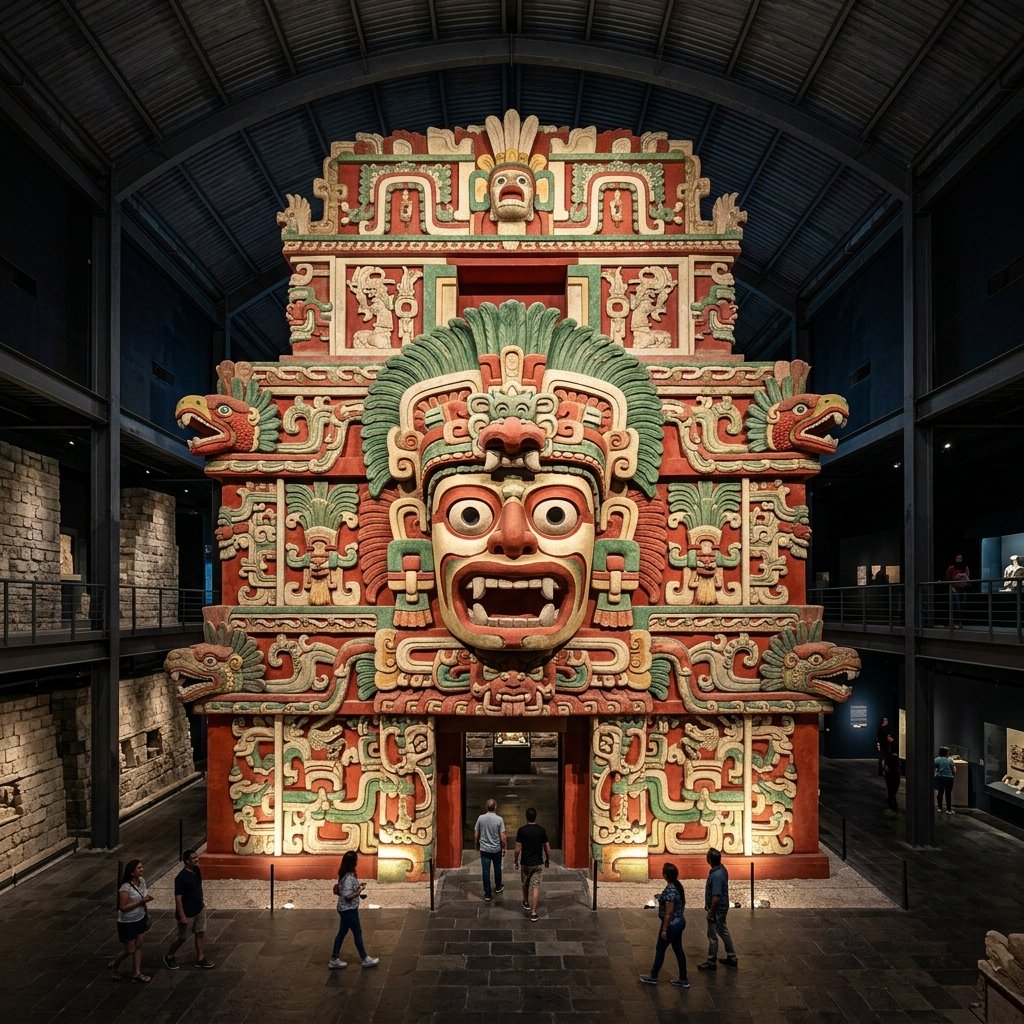
There is no museum experience quite like the Copán Sculpture Museum. You enter through a tunnel carved to mimic the archaeological tunnels beneath the Acropolis, emerging into a cavernous atrium dominated by a full-scale, brilliantly painted reconstruction of the Rosalila Temple — the single best-preserved Maya temple ever discovered. The original temple, built around AD 571 and sealed intact inside a later pyramid, retains its original painted stucco facade almost undamaged. The museum reconstruction reproduces every detail in living color: enormous sun god masks with gaping mouths, macaw heads, serpent bodies, and layers of red, green, yellow, and cream paint. It is the only place on Earth where you can see what a Maya temple looked like when it was new.
Signature Artifacts
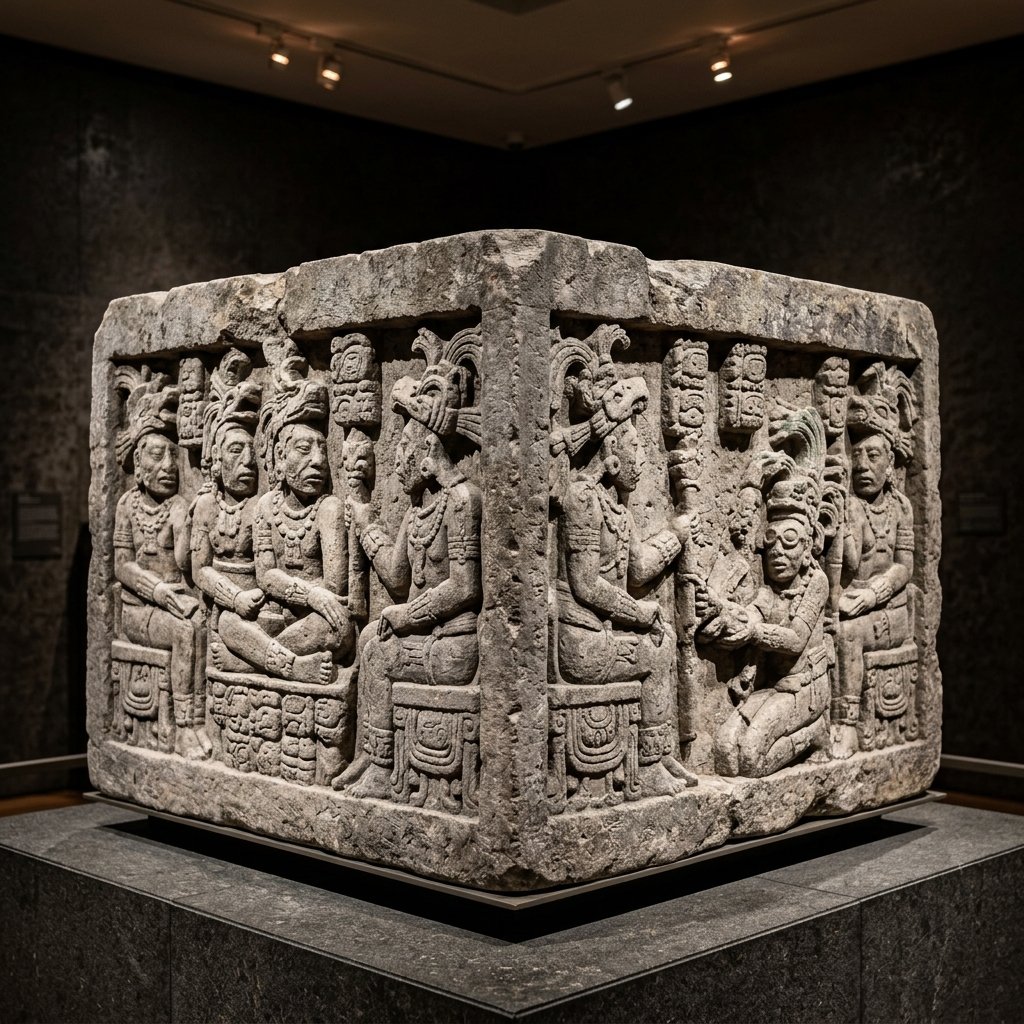
Altar Q
Perhaps the single most historically informative Maya monument ever carved. This square stone altar — approximately 1 meter per side — depicts all 16 rulers of Copán's dynasty seated around its four faces, from the founder K'inich Yax K'uk' Mo' (accession AD 426) to the final great king Yax Pasaj Chan Yopaat (r. AD 763–810), who commissioned the altar. On the west face, Yax Pasaj receives the royal staff of office directly from the founder — spanning 400 years of dynastic history in a single image. The hieroglyphic text records each ruler's name and accession date.
Date: Dedicated AD 776. The original stands in situ outside Temple 16; a replica is in the museum.
Copán's Sculpted Stelae
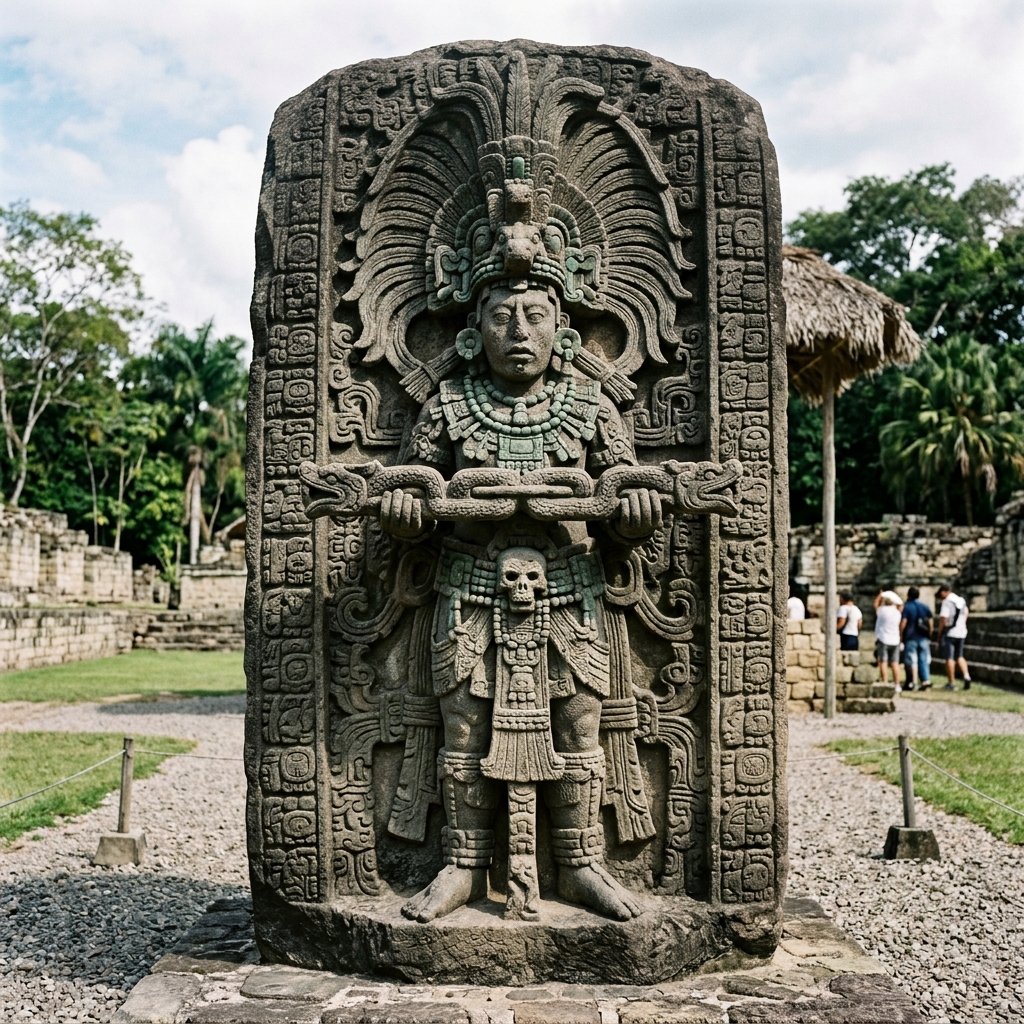
Copán is famous for producing the most three-dimensional Maya sculpture anywhere — figures carved almost in the round, projecting from the stone surface with extraordinary depth. The museum houses original stelae depicting kings like 18 Rabbit (Waxaklajuun Ub'aah K'awiil, r. AD 695–738) in full regalia: towering feathered headdresses, jade pectorals, serpent bars, and jaguar-skin loincloths. 18 Rabbit is considered the greatest patron of sculpture in Maya history — he erected more stelae than any other ruler.
Tragedy: 18 Rabbit was captured and beheaded by the ruler of the minor site of Quiriguá in AD 738 — one of the most shocking events in Maya political history and the beginning of Copán's decline.
Additional Highlights
- Building facades: Reconstructed sections of carved building facades from the Acropolis, showing serpent masks, sky bands, mat motifs, and ancestor portraits.
- Full-head stelae: Copán's unique "full-figure" stelae, where entire monuments are carved as three-dimensional portraits.
- Hieroglyphic Stairway context: Interpretive materials for the longest Maya text ever carved (2,200+ glyph blocks).
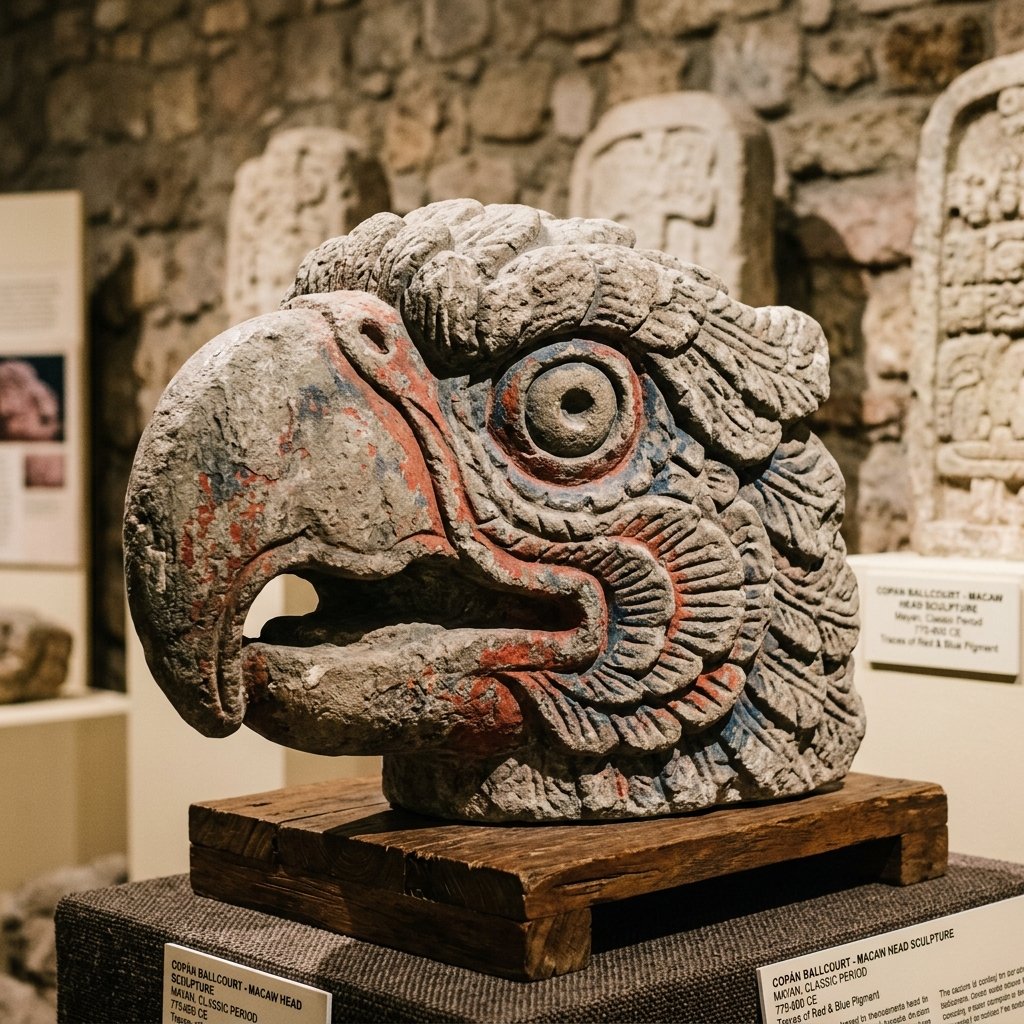
- Macaw heads: Enormous sculptural macaw heads from the ballcourt — vibrantly colored when originally plastered and painted.
Scholarly References
- Fash, W. L. (2001). Scribes, Warriors, and Kings: The City of Copán and the Ancient Maya. Thames & Hudson.
- Agurcia Fasquelle, R. (2004). "Rosalila, Temple of the Sun-King." In Understanding Early Classic Copán, eds. E. Bell et al., pp. 101–112.
- Martin, S. & Grube, N. (2000). Chronicle of the Maya Kings and Queens. Thames & Hudson. pp. 190–213 (Copán).
- Stuart, D. (2004). "The Beginnings of the Copán Dynasty." In Understanding Early Classic Copán, eds. E. Bell et al., pp. 215–247.
- Baudez, C. F. (1994). Maya Sculpture of Copán: The Iconography. University of Oklahoma Press.
The Archaeological Tunnels
For an additional fee (~$15 USD), visitors can enter the archaeological tunnels beneath the Acropolis — a network of excavated passages that reveal the original buried temples sealed inside later constructions. The tunnels lead to viewing areas where you can see the original Rosalila temple facade in situ — faded but remarkably preserved, with traces of the original red and green paint still visible on the stucco. This is one of the most extraordinary experiences available at any Maya site.
Practical Information
Contact & Location
- 📍 Copán Archaeological Park, ~1 km east of Copán Ruinas town center, Honduras
- 🌐 asociacioncopan.org
- 🏛️ Managed by the Instituto Hondureño de Antropología e Historia (IHAH)
Visitor Information
- 🕐 Daily: 8:00 AM – 5:00 PM
- 💰 Museum admission: ~$7–10 USD (included with park entry)
- 🔦 Archaeological tunnels: ~$15 USD additional
- 💵 Bring cash (Lempiras or USD) — limited card acceptance
- 🚌 Buses from San Pedro Sula (~3 hrs) or Guatemala City (~5 hrs)
Tips for Your Visit
- Visit the museum first. The Rosalila reconstruction and the interpretive displays will dramatically enrich your understanding of the ruins outside. Most visitors who skip the museum and head straight to the ruins miss crucial context.
- Pay for the tunnels. The extra $15 is worth every penny. Seeing the original Rosalila temple facade in its buried, preserved state — and understanding how the reconstruction was created — is an unforgettable experience.
- Hire a guide. Local guides are available at the ticket office and dramatically enhance the experience. Many are Maya community members with deep personal connections to the site.
- Allow a full day. The museum, the main archaeological site, the tunnels, and the Las Sepulturas residential area can comfortably fill 5–6 hours.
- Stay in Copán Ruinas town. The charming town is walkable and has excellent restaurants and hotels at all price points. It's worth spending at least one night.
Frequently Asked Questions
Is the Rosalila reconstruction accurate?
Extremely. The reconstruction was created under the direct supervision of Ricardo Agurcia Fasquelle, the archaeologist who discovered the original temple in 1989. Every detail of the stucco modeling and paint colors was meticulously reproduced based on the original, which remains sealed inside Temple 16 in near-perfect condition. The colors may seem startlingly vivid — but this is what Maya temples actually looked like.
Can I see the original Rosalila temple?
Yes, through the archaeological tunnel system (additional ~$15 USD). The tunnel leads to a viewing area where you can see the original buried facade with traces of original paint. Access may be restricted during the rainy season (June–October) if water levels are high.