Why This Museum Matters
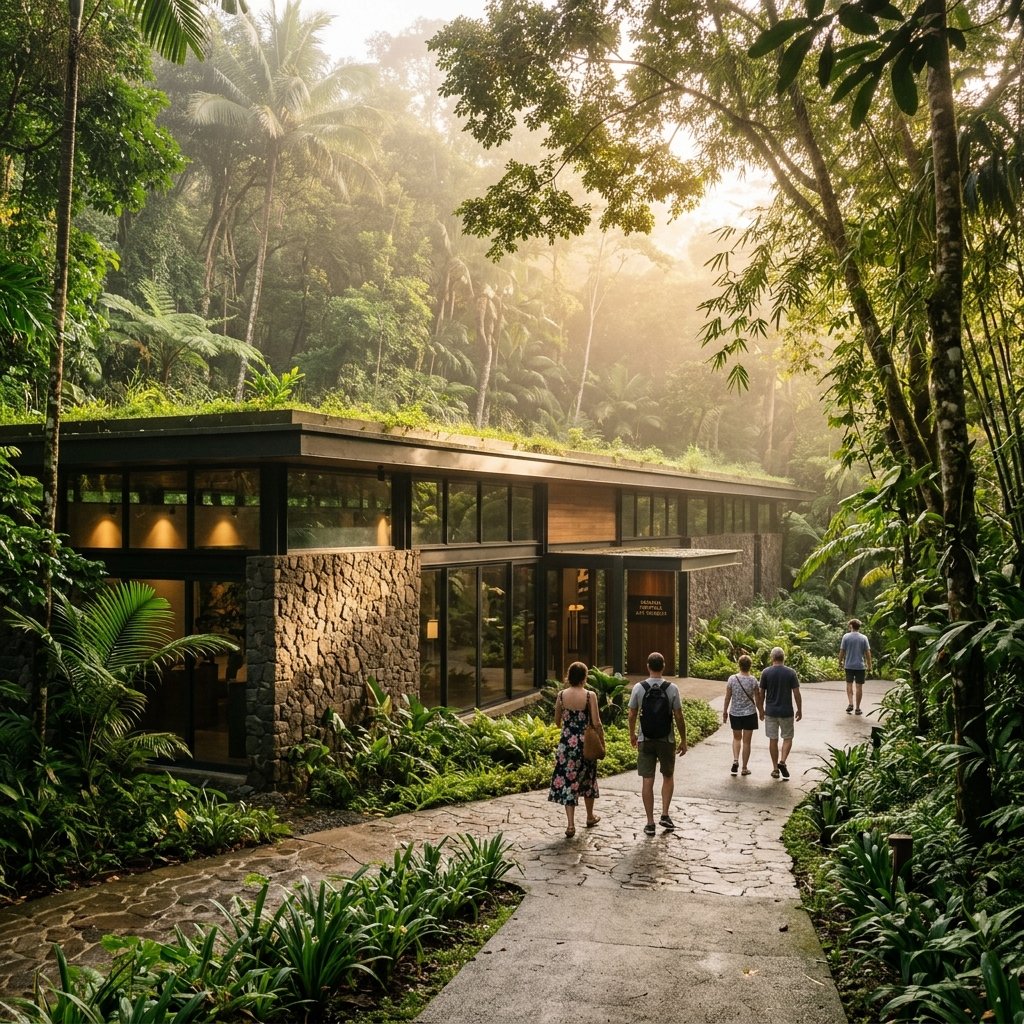
The Museo de Sitio de Palenque, named after Alberto Ruz Lhuillier — the archaeologist who spent four years clearing the interior staircase of the Temple of the Inscriptions to discover Pakal's tomb in 1952 — sits within the Palenque archaeological zone, surrounded by the same tropical rainforest that concealed the city for a thousand years. The collection is intimate rather than encyclopedic: fewer than 300 objects, but each one is extraordinary. The museum's stucco portrait heads are among the finest naturalistic sculptures in the ancient Americas, and its incense burners — towering clay constructions adorned with deity masks, feathers, and floral motifs — have no parallel anywhere in the Maya world.
Signature Artifacts
Stucco Portrait Heads
Palenque's sculptors achieved something no other Maya city matched: true portraiture. The museum displays life-size stucco heads of royal individuals — not idealized types, but specific people with distinct features: a receding chin, an aquiline nose, full lips, heavy-lidded eyes. The most famous is a head believed to represent K'inich Janaab Pakal himself, found beneath his sarcophagus. These portraits — modeled in lime plaster over stone armatures — demonstrate a commitment to individual likeness that Western art did not achieve until the Roman period.
Significance: The stucco portrait tradition at Palenque is considered to represent the pinnacle of Maya naturalistic sculpture.
Palenque Incense Burners
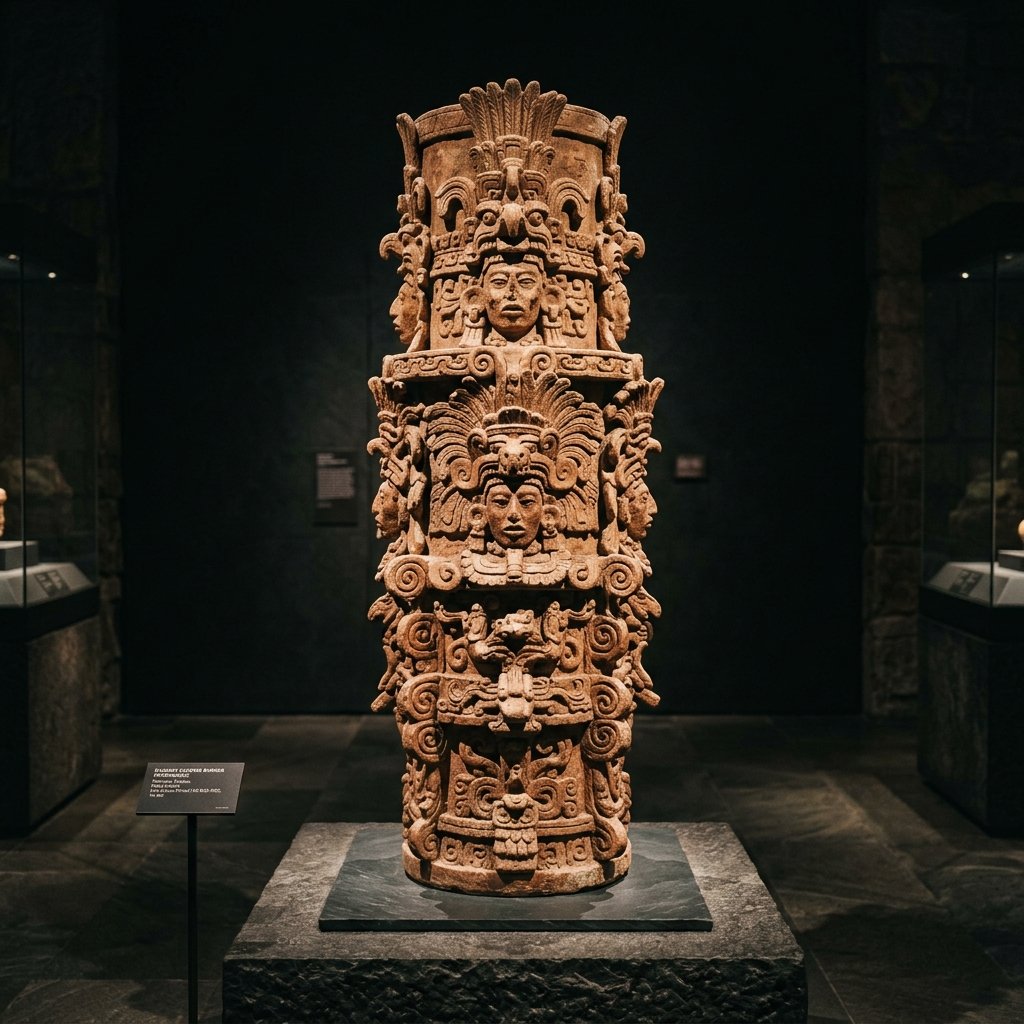
The most spectacular ceramic objects in the Maya world. These towering incensarios — some over 1 meter tall — are clay cylinders topped with elaborate assemblages of deity masks, feathered serpents, jade ear spools, floral elements, and headdress components, all modeled in high relief. The complexity is staggering: each burner contains dozens of individually modeled elements. They were used in royal ancestor rituals, with copal incense burned inside the cylinder, the smoke emerging through the deity's open mouth — literally "breathing" life into the god image.
Found: In cross-shaped vaulted chambers within the temple platforms — ritual caches placed during building dedication ceremonies.
Additional Highlights
- Carved stone tablets: Limestone panels from the Palace and temples, inscribed with hieroglyphic texts recording the Palenque dynasty — births, accessions, wars, and deaths of kings including K'inich Kan Bahlam II and K'inich Ahkal Mo' Nahb III.
- Jade ornaments from royal tombs: Pectorals, ear spools, rings, and beads recovered from tombs in the Temple of the Inscriptions and the Temple of the Cross complex.
- The Red Queen's remains: Materials from the tomb of the "Red Queen" (discovered in Temple XIII in 1994), whose skeleton was covered in bright red cinnabar powder and accompanied by a jade mask and elaborate offerings. She is believed to be Tz'akbu Ajaw, wife of Pakal.
- Architectural stucco fragments: Fragments of the painted stucco reliefs that once covered Palenque's buildings.
Scholarly References
- Robertson, M. G. (1983). The Sculpture of Palenque, Vol. I–IV. Princeton University Press.
- Stuart, D. & Stuart, G. (2008). Palenque: Eternal City of the Maya. Thames & Hudson.
- Ruz Lhuillier, A. (1973). El Templo de las Inscripciones, Palenque. INAH.
- Martin, S. & Grube, N. (2000). Chronicle of the Maya Kings and Queens. Thames & Hudson. pp. 154–175 (Palenque).
- Cuevas García, M. (2007). Los incensarios del Grupo de las Cruces, Palenque. INAH.
- González Cruz, A. (2011). "The Red Queen." In Palenque: Recent Investigations, ed. D. Stuart. Pre-Columbian Mesoweb Press.
The Setting
No museum on this list has a more magical physical setting. The building sits within the archaeological zone, surrounded by the dense Chiapas rainforest. Howler monkeys call from the canopy above. Toucans and parrots fly overhead. The air is thick with humidity and the scent of vegetation. Walking from the museum to the ruins is a 10-minute stroll through the same jungle that concealed Palenque from the outside world for nearly a millennium. The combination of world-class art and wild tropical nature is unforgettable.
Practical Information
Contact & Location
- 📍 Carretera Palenque-Ruinas Km 6.5, C.P. 29960, Palenque, Chiapas, Mexico
- 📞 +52 (916) 345-2684
- ✉️ museodesitiopalenque@inah.gob.mx
- 🌐 lugares.inah.gob.mx
Visitor Information
- 🕐 Tuesday – Sunday: 8:30 AM – 5:00 PM
- 🚫 Closed Mondays
- 💰 Included with Palenque archaeological zone admission
- 🆓 Free Sundays for Mexican nationals
- 🚗 6.5 km from Palenque town center
Tips for Your Visit
- Visit the museum first. The stucco portraits and incense burners provide essential context for understanding the ruins — especially the Temple of the Inscriptions and the Palace.
- Go early. The site opens at 8:30 AM. Morning light through the jungle canopy is spectacular, and humidity is lowest before 10 AM.
- Bring insect repellent. The rainforest location means mosquitoes, particularly during the wet season (June–October).
- Allow a full day. Between the museum, the main ruins (Temple of the Inscriptions, Palace, Group of the Cross), and the outlying structures visible from the jungle trails, Palenque deserves 5–6 hours minimum.
Frequently Asked Questions
Is the tomb of Pakal accessible inside the Temple of the Inscriptions?
No — the tomb has been permanently closed to visitors to prevent further deterioration from humidity and foot traffic. The best way to experience the tomb is through the full-scale replica at the Museo Nacional de Antropología in Mexico City. Pakal's original jade death mask is also in Mexico City, not at Palenque.
Who was the Red Queen?
The "Red Queen" (Reina Roja) was discovered in Temple XIII in 1994 — a female skeleton entirely covered in bright red cinnabar powder, accompanied by a jade mask, malachite ornaments, and bone needles. DNA and isotope analysis strongly suggests she was Tz'akbu Ajaw, principal wife of Pakal and mother of kings K'inich Kan Bahlam II and K'inich K'an Joy Chitam II. Her tomb rivals Pakal's in its ritual complexity.