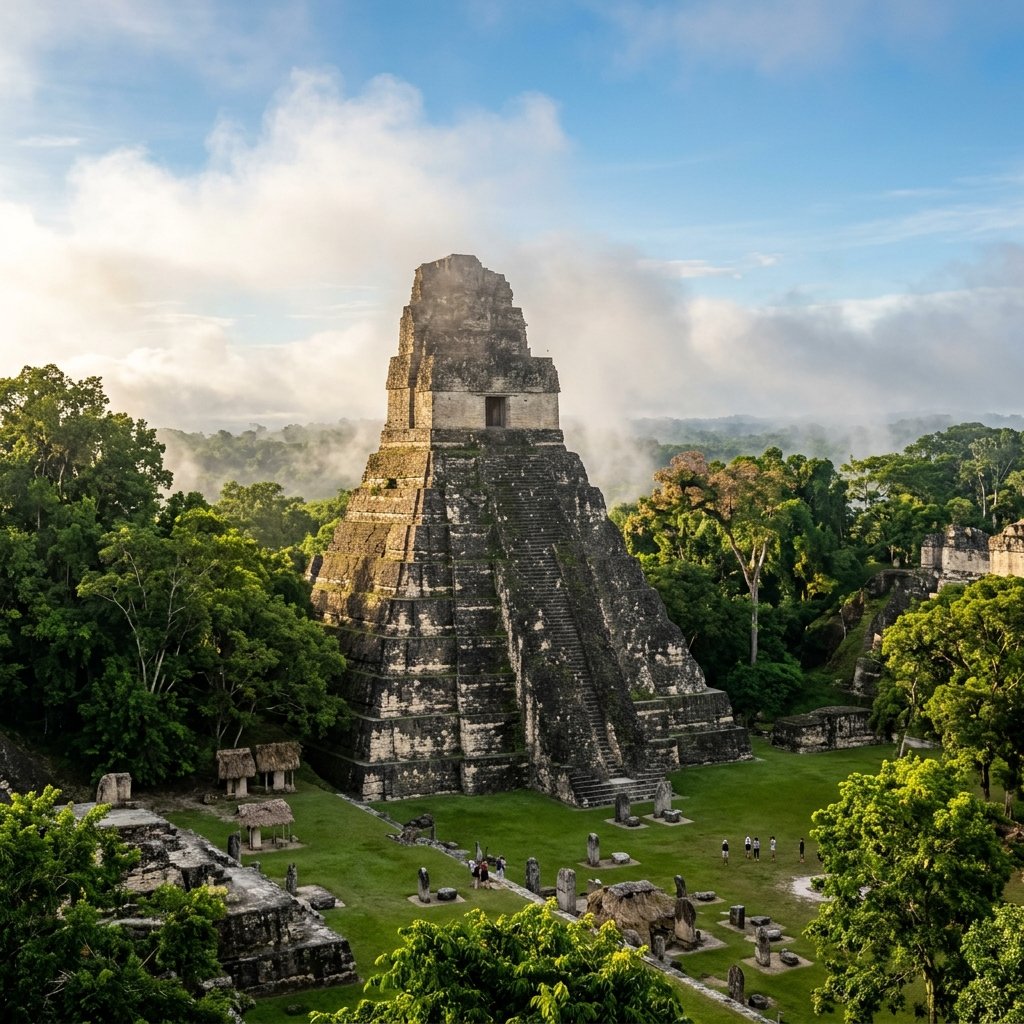
Tikal at a Glance
Why Tikal Is the Greatest Maya City
If Chichén Itzá is the most famous Maya site, Tikal is the most powerful. For over a thousand years, the city the ancient Maya called Yax Mutal dominated the political landscape of the Maya lowlands — a military superpower, economic hub, and religious center whose influence was felt from the highlands of Mexico to the coasts of Belize.
At its zenith in the mid-8th century AD, Tikal's urban core supported an estimated 60,000 to 100,000 people, with a broader settlement zone extending over 120 km² — making it one of the largest cities in the world at the time (Culbert et al., Tikal Report No. 25, University of Pennsylvania Museum, 1990). A 2018 LiDAR survey by the PACUNAM Foundation stunned the archaeological world by revealing that the greater Tikal region contained over 60,000 previously unknown structures — houses, fortifications, agricultural terraces, and raised roads — suggesting a population potentially exceeding 10 million people across the interconnected Maya lowland civilization (Canuto et al., Science, 361, 2018).
But what makes Tikal truly unforgettable is its setting. The pyramids don't sit in cleared plazas — they erupt from the jungle canopy. Before you see the temples, you hear the prehistoric roar of howler monkeys echoing across the forest, toucans darting between ceiba trees, and spider monkeys swinging overhead. Walking the forest trails between temple groups, you understand viscerally why the Maya believed the jungle was alive with spiritual power.
The Architecture: Monuments to Power and the Dead
Temple I — Temple of the Great Jaguar (47m)
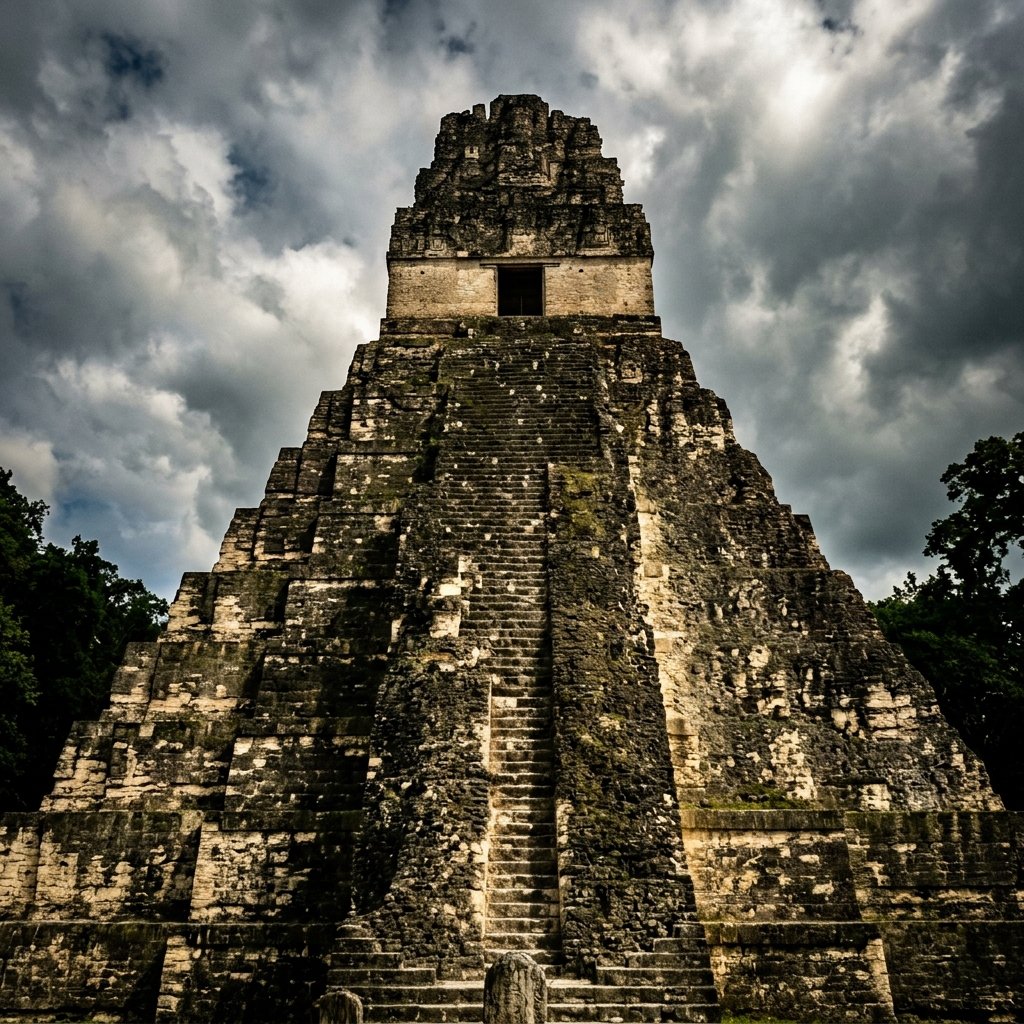
Temple I (Temple of the Great Jaguar) — nine steep tiers crowned by a towering roof comb. Built as the funerary monument of King Jasaw Chan K'awiil I, the warrior-king who defeated Calakmul in 695 AD and launched Tikal's golden age.
The most iconic structure in the Maya world. Temple I rises 47 meters from the Great Plaza in nine vertiginously steep tiers, crowned by a massive roof comb — once brightly painted with the image of the king seated on a jaguar throne. The pyramid was commissioned by, and built as the funerary monument of, Jasaw Chan K'awiil I (Ruler A), who ascended the throne in 682 AD and defeated Tikal's arch-rival Calakmul in the pivotal battle of 695 AD.
When archaeologists Aubrey Trik and Edwin Shook excavated the burial chamber deep within the pyramid's core in 1962, they discovered one of the richest royal tombs in Maya history. Jasaw Chan K'awiil was interred with 16 pounds of jade ornaments, including a spectacular jade mosaic vessel, intricately carved bone tubes depicting canoe scenes from the Maya underworld, spondylus shell ornaments, obsidian blades, and pottery bearing his royal titles. The carved bone tubes — depicting the Maize God's canoe journey through Xibalba — are among the finest examples of Maya miniature art ever found (Martin & Grube, Chronicle of the Maya Kings and Queens, Thames & Hudson, 2000).
Temple IV — Temple of the Two-Headed Serpent (65m)
The tallest pre-Columbian structure ever built in the Americas. Temple IV rises an astonishing 65 meters (213 feet) above the jungle floor — taller than a 20-story building. It was built by Yik'in Chan K'awiil, the son and successor of Jasaw Chan K'awiil, around 741 AD to commemorate his own military victories over the cities of Naranjo and El Perú-Waka'.
The magnificently carved wooden lintels from atop Temple IV — depicting the king seated on a grand throne beneath a supernatural two-headed serpent — were removed in the 19th century and now reside in the Völkerkundemuseum in Basel, Switzerland. They are among the largest surviving examples of ancient Maya wood carving (Jones & Satterthwaite, Tikal Report 33A, University of Pennsylvania, 1982).
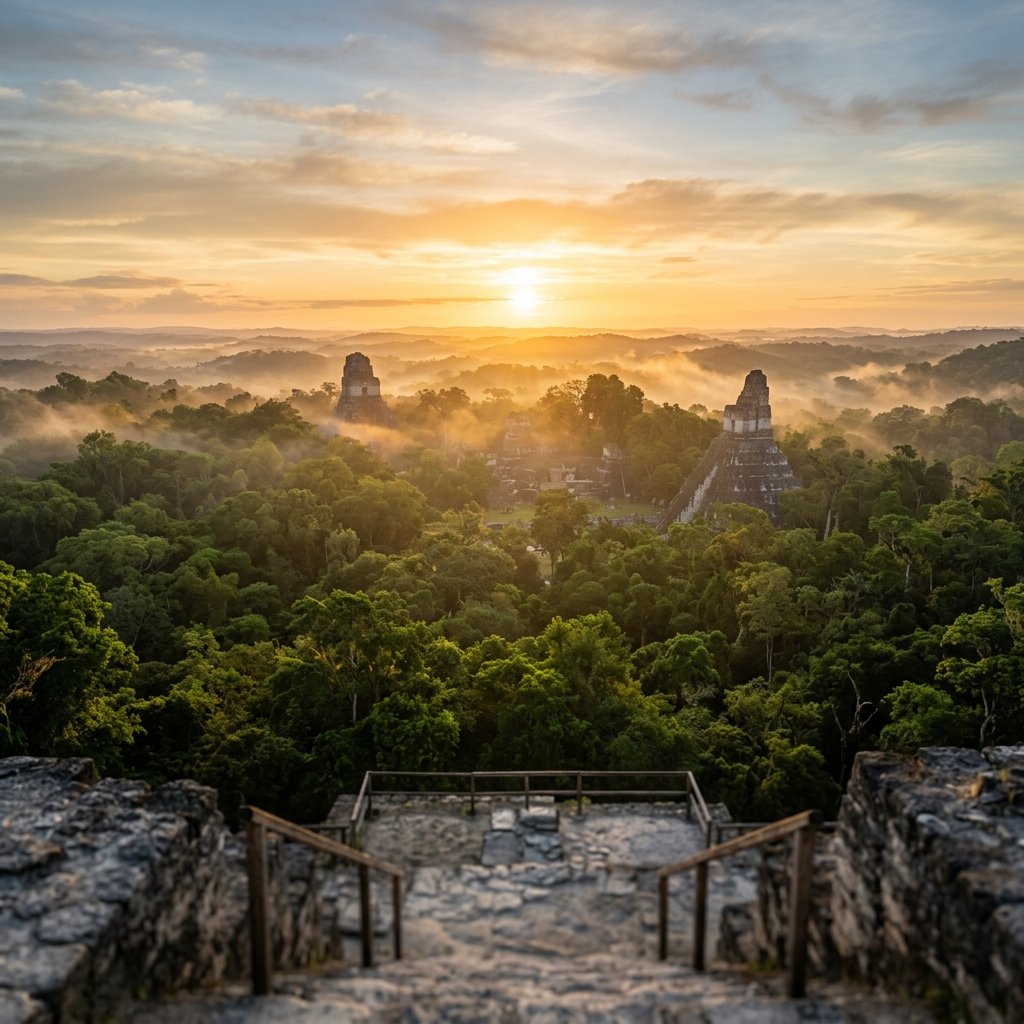
The view from atop Temple IV at sunrise — the most breathtaking panorama in Maya archaeology. The roof combs of Temples I, II, and III pierce through an unbroken ocean of jungle canopy. This exact vista served as the rebel base in Star Wars: A New Hope (1977).
Today, visitors can climb Temple IV via a wooden stairway — and the sunrise from the summit is widely regarded as the single most awe-inspiring experience available at any Maya archaeological site. As the sun breaks the horizon, mist rises from the warming canopy, howler monkeys begin their dawn chorus, and the roof combs of Temples I, II, and III pierce the green sea of trees like stone islands. The same view was filmed by George Lucas for the rebel base scenes in Star Wars: A New Hope (1977).
The Great Plaza
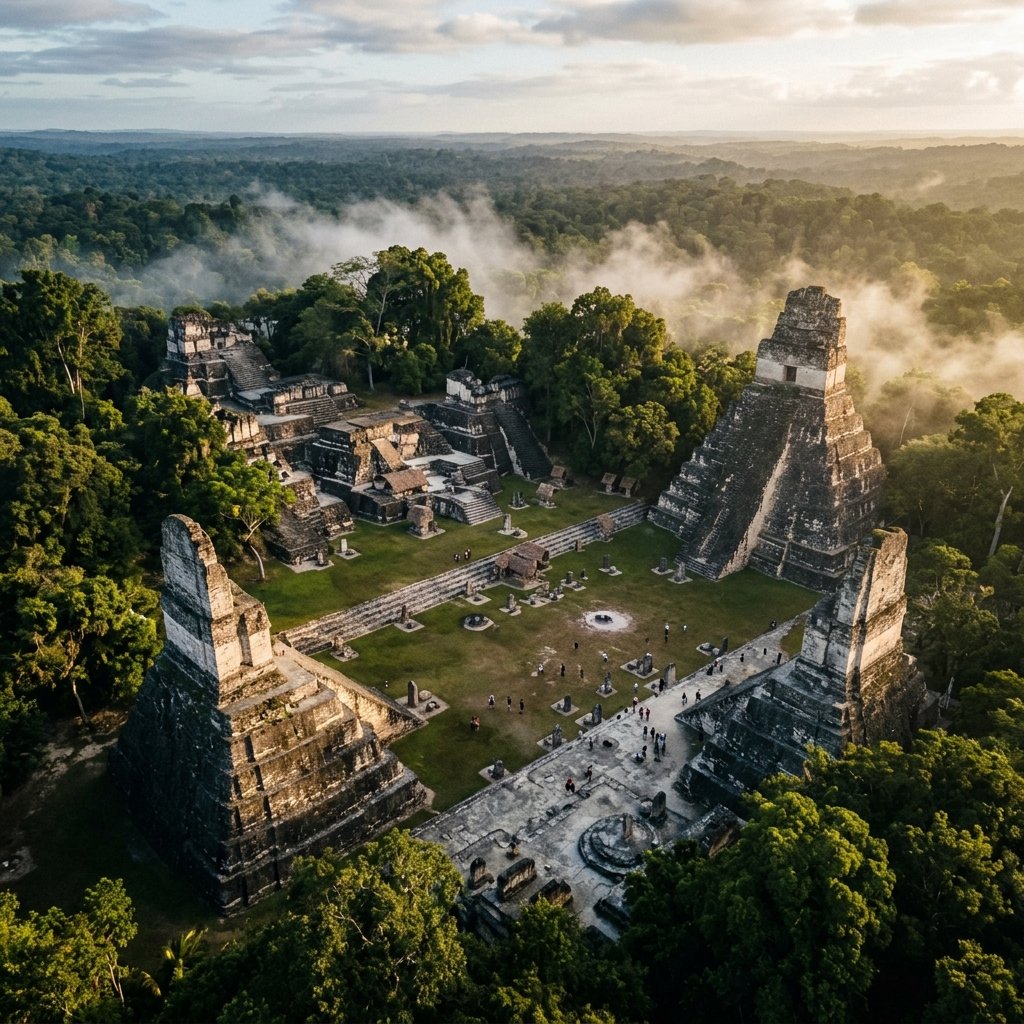
The Great Plaza — the ceremonial heart of Tikal for over a thousand years. Temple I (left) and Temple II (right) face each other across the paved court, with the North Acropolis — a royal burial complex spanning 1,500 years — along the far edge. Stelae and altars documenting dynastic history line the plaza.
The ceremonial heart of Tikal. Temples I and II face each other across the vast paved court — a masterpiece of urban theater designed to awe visiting dignitaries, rival emissaries, and the city's own population. The North Acropolis along the plaza's northern edge is a dense layered complex of burial platforms spanning over 1,500 years of continuous royal interments, from the earliest Preclassic period through the Late Classic — essentially a royal cemetery built on top of itself for sixty generations (Coe, Tikal: A Handbook of the Ancient Maya Ruins, University of Pennsylvania Museum, 1967).
Dozens of stelae and altars line the plaza, documenting the dynastic history of Tikal's rulers. Stela 31, recovered from inside a destroyed temple, is among the most important sculptures in all of Maya art: it depicts the 5th-century king Siyaj Chan K'awiil II ("Stormy Sky") flanked by two warriors in full Teotihuacan military regalia — the earliest direct evidence of the profound influence of the great Mexican metropolis of Teotihuacan on Maya political life (Stuart, "The Arrival of Strangers" in Mesoamerica's Classic Heritage, 2000).
The Lost World Complex (Mundo Perdido)
This Preclassic ceremonial complex, predating the Great Plaza by centuries, features the Great Pyramid — a massive radial platform with stairways on all four sides aligned with the solstices and equinoxes. Archaeological evidence suggests continuous use from as early as 700 BC, making it one of the oldest monumental structures at Tikal and a key site for understanding the origins of Maya astronomical architecture (Laporte & Fialko, Ancient Mesoamerica, 1990).
The Tikal–Calakmul Superpower War
The greatest conflict in Maya history was not a single battle but a centuries-long geopolitical struggle between Tikal (Yax Mutal) and its northern rival Calakmul (Kaan, "The Snake Kingdom"). From the 6th through 8th centuries AD, these two superpowers waged a Cold War–scale conflict for dominance of the entire Maya lowlands — building alliances, fighting proxy wars, and launching devastating military campaigns against each other (Martin & Grube, Chronicle of the Maya Kings and Queens, 2000).
The key events of this epic struggle include:
- 378 AD — "The Entrada": A general named Siyaj K'ahk' ("Fire is Born"), likely sent from Teotihuacan, arrived at Tikal and overthrew its existing dynasty — installing a new ruling line with connections to central Mexico. This event transformed Tikal into a regional superpower.
- 562 AD — The "Star War": Calakmul orchestrated an alliance that defeated Tikal in a devastating conflict recorded as an "axe event" or "star war." Tikal entered a 130-year period of silence — no new monuments, no recorded rulers — known as the Tikal Hiatus.
- 695 AD — The Victory: King Jasaw Chan K'awiil I shattered Calakmul's power in a decisive military victory, capturing the Calakmul king Yich'aak K'ahk' ("Claw of Fire"). This triumph launched Tikal's greatest building boom — including Temples I, II, IV, and much of what visitors see today.
The parallel to modern superpower rivalry is striking. Tikal and Calakmul didn't just fight each other — they organized the entire Maya world into competing alliance networks, much like NATO and the Warsaw Pact. Cities across the lowlands were forced to choose sides, and the consequences of choosing wrong were catastrophic (Martin & Grube, 2000).
Wildlife: A Living National Park
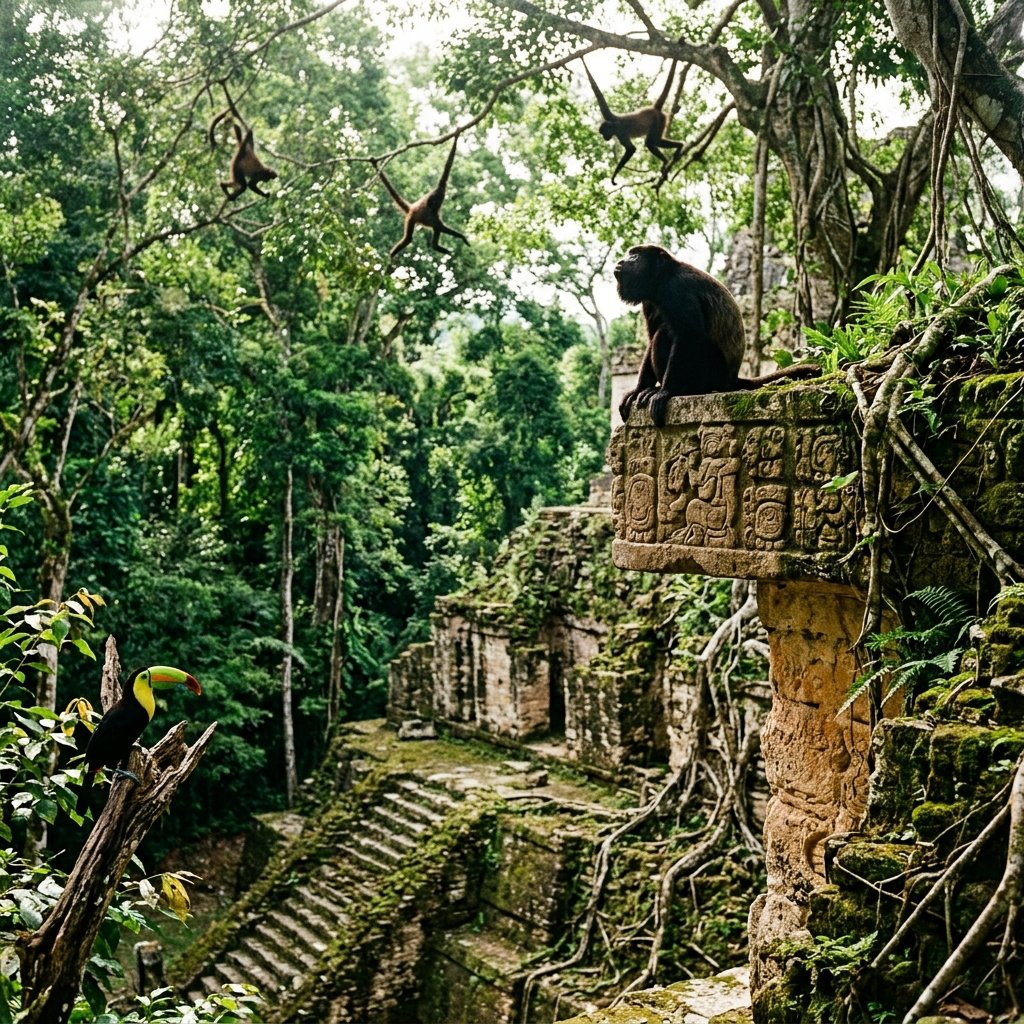
Tikal is simultaneously a world-class archaeological site and a thriving tropical wildlife sanctuary. Howler monkeys, spider monkeys, toucans, coatimundis, and occasionally jaguars share the ruins with visitors — the ancient city belongs to the jungle now.
Tikal National Park encompasses 576 km² of protected tropical forest — making it one of the most important wildlife reserves in Central America. The park is home to over 350 species of birds, including the endangered ocellated turkey, keel-billed toucans, and king vultures. Mammals include howler monkeys (whose prehistoric-sounding calls echo across the site at dawn and dusk), spider monkeys, white-nosed coatimundis, and an estimated population of jaguars — the animal most sacred to the ancient Maya and namesake of Temple I (Primack, Timber, Tourists, and Temples, Island Press, 1998).
The wildlife experience is not incidental — it is inseparable from the archaeological experience. Walking the jungle trails between temple groups, you are immersed in the same forest that surrounded the city when it was alive. Howler monkeys announce your approach exactly as they announced visiting armies 1,300 years ago. The ceiba trees the Maya revered as the World Tree still tower over the plazas. At Tikal, the past is not behind glass — you walk through it.
Practical Travel Guide
Sunrise Tour
Book the sunrise tour (park entry at 4:30 AM). Watching dawn from Temple IV as the jungle awakens — howler monkeys roaring, mist rising, roof combs emerging from the canopy — is the single most unforgettable experience in Central American travel. Book through your hotel in Flores or at the park entrance.
Getting There
Fly to Flores (FRS) from Guatemala City (~1 hour), then 1 hour by shuttle to Tikal. Alternatively, overnight buses run from Guatemala City, Belize City, and Semuc Champey. Stay in Flores (budget-friendly island town) or at the lodges inside the park itself for early morning access.
How Long to Visit
Minimum full day (6–8 hours walking). Two days is ideal. The park covers 576 km² and distances between temple groups are significant — it's 20+ minutes of jungle trail between the Great Plaza and Temple IV. Bring serious walking shoes, water, and insect repellent.
Wildlife Tips
Bring binoculars — essential for birdwatching and appreciating roof comb details. Dawn and dusk offer the best wildlife activity. Spider monkeys are commonly spotted near the Lost World Complex. Listen for howler monkeys starting at 4:30 AM — their roar carries 5 km through the forest.
Visitor Comparison
| Feature | Tikal | Chichén Itzá | Calakmul |
|---|---|---|---|
| Tallest Pyramid | 65m (Temple IV) | 24m (El Castillo) | 45m (Structure II) |
| Can climb? | ✅ Temple IV | ❌ No | ✅ Structure II |
| Jungle Setting | Dense tropical | Scrubland | Dense tropical |
| Wildlife | Exceptional | Limited | Outstanding |
| Time Needed | 1–2 days | 3–5 hours | Full day |
Key Academic References
- Canuto, Marcello A. et al. "Ancient lowland Maya complexity as revealed by airborne laser scanning of northern Guatemala." Science, 361(6409), 2018.
- Coe, William R. Tikal: A Handbook of the Ancient Maya Ruins. University of Pennsylvania Museum, 1967.
- Culbert, T. Patrick et al. "The Population of Tikal, Guatemala." Precolumbian Population History in the Maya Lowlands, 1990.
- Jones, Christopher & Satterthwaite, Linton. The Monuments and Inscriptions of Tikal: The Carved Monuments. University of Pennsylvania Museum, 1982.
- Laporte, Juan Pedro & Fialko, Vilma. "New Perspectives on Old Problems: Dynastic References for the Early Classic at Tikal." Ancient Mesoamerica, 1990.
- Martin, Simon & Grube, Nikolai. Chronicle of the Maya Kings and Queens. Thames & Hudson, 2000.
- Primack, Richard B. et al. Timber, Tourists, and Temples: Conservation and Development in the Maya Forest. Island Press, 1998.
- Stuart, David. "The Arrival of Strangers: Teotihuacan and Tollan in Classic Maya History." Mesoamerica's Classic Heritage, University Press of Colorado, 2000.
Frequently Asked Questions
Can you still climb the pyramids at Tikal?
Yes — Temple IV (the tallest) has a wooden stairway and is climbable. Temple II is also accessible. Temple I (Temple of the Great Jaguar) has been closed to climbing since 1992 for preservation. The sunrise from Temple IV is one of the most extraordinary experiences in all of archaeology.
Is the Star Wars connection real?
Yes. The rebel base scenes in Star Wars: A New Hope (1977) used aerial footage shot from the top of Temple IV at Tikal. The distinctive view of pyramid roof combs rising above the jungle canopy is unmistakable. George Lucas's crew filmed the sequence during production in Guatemala.
How does Tikal compare to Chichén Itzá?
They are very different experiences. Chichén Itzá is more accessible, better-preserved, and architecturally refined. Tikal is wilder, more immersive, and dramatically set in deep jungle. Tikal's pyramids are also significantly taller (65m vs 24m). If you can only visit one Maya site, scholars and experienced travelers overwhelmingly recommend Tikal for the complete experience.
What was the Tikal Hiatus?
After Calakmul defeated Tikal in a "star war" in 562 AD, the city entered a 130-year period of silence — no new monuments were erected and no rulers were recorded. This "hiatus" ended spectacularly when Jasaw Chan K'awiil I defeated Calakmul in 695 AD, launching the greatest building boom in Tikal's history.
Is Tikal safe to visit?
Yes. Tikal National Park is one of Guatemala's most heavily visited and well-managed tourist sites. The park is guarded, maintained, and visited by hundreds of thousands of international tourists annually. Standard precautions apply — the main risks are heat, dehydration, and the occasional aggressive spider monkey.