Body Modification at a Glance
The Body as a Canvas
In Western culture, the human body is generally viewed as something that should be left in its natural state, with modifications like tattoos or piercings often pushed to the margins of society. To the ancient Maya, the exact opposite was true.
An unmodified body was considered raw, unrefined, and distinctly un-aristocratic. To be socially elite and spiritually pure meant enduring extreme physical pain to permanently alter one's flesh, bone, and teeth. The Maya utilized their bodies as a canvas to encode their social status, their military prowess, and their devotion to the gods (Tiesler, V., Transforming the Body, 2012).
Cranial Modification: The Profile of a God
The most dramatic and permanent modification began just days after birth.
Because infant skulls are highly malleable, Maya mothers—particularly in the noble classes—would bind their baby’s head between two wooden boards. Over several months, this constant pressure forced the skull to grow backward and upward, resulting in a dramatically elongated, sloping forehead.
Why do this? Look at any Classic Maya carving of the Maize God. The deity is always depicted with a sloping forehead that mimics the shape of a corn cob. By reshaping their children's heads, the Maya were literally molding their children into the physical image of their most sacred agricultural deity. A sloped forehead became the absolute gold standard of physical beauty and nobility.
Dental Inlays: Scintillating Smiles
If a sloping forehead wasn't enough to mark someone as elite, their smile certainly would.
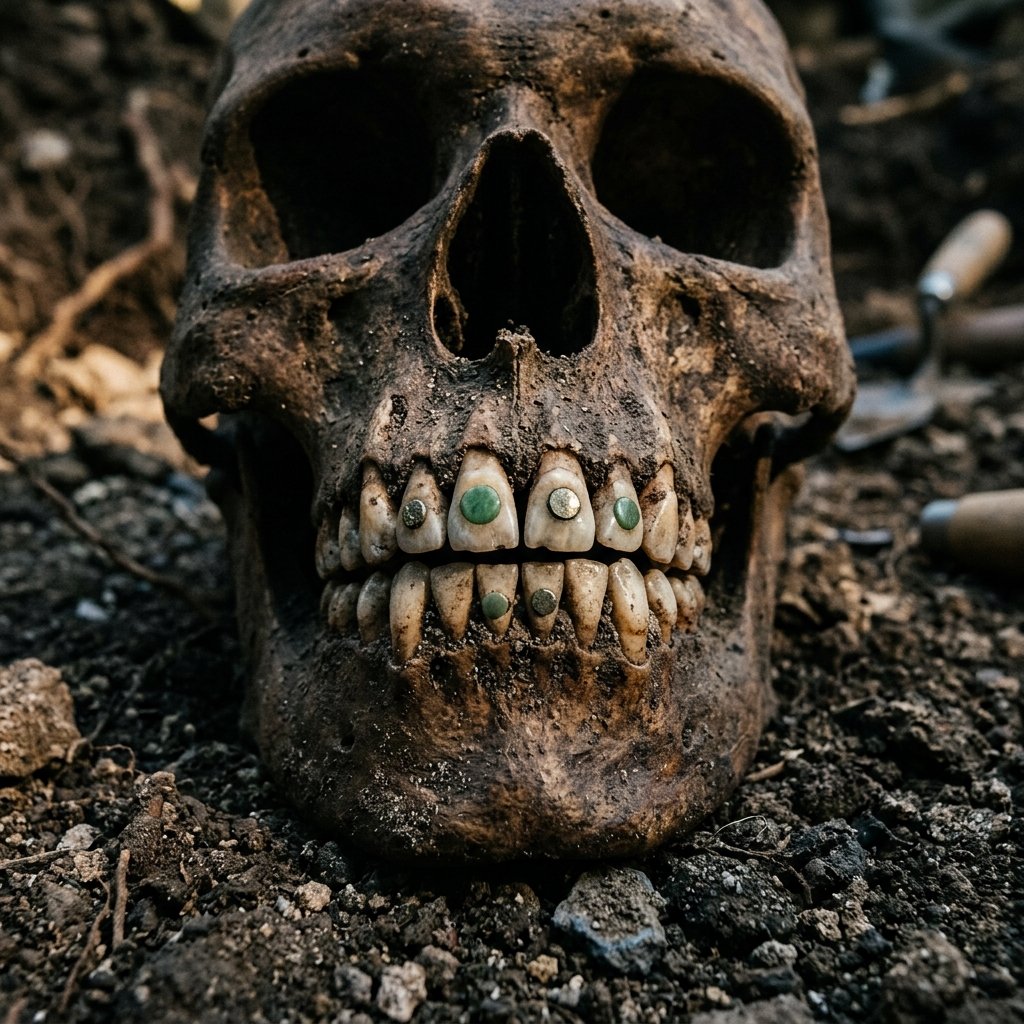
Maya dentists performed incredibly precise operations using only hollow bone drills and abrasive sand. They bored perfectly circular holes into the enamel of the front incisors and canines—careful not to pierce the sensitive nerve pulp—and glued in highly polished discs of jadeite, iron pyrite, or turquoise using a cement made from plant resins and crushed bone.
When a Maya lord smiled or spoke, their mouth would literally flash with green (the color of life and water) and the mirror-like reflection of pyrite. These inlays were worn by both men and women, primarily as markers of extreme wealth and social status (Romero, J., Mutilaciones Dentarias, 1958).
Tattoos and Scarification
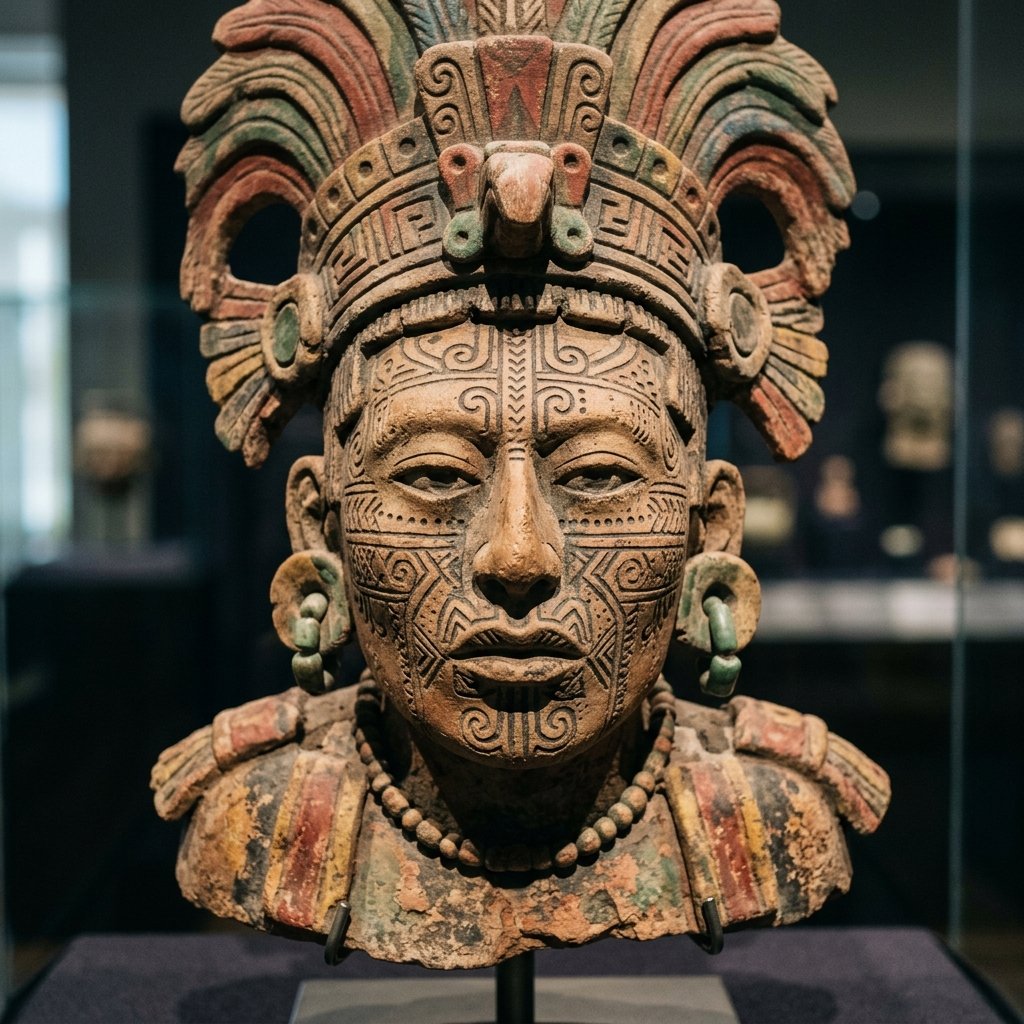
By the time the Spanish arrived in the 16th century, they noted that the Maya of the Yucatan were heavily tattooed. Bishop Diego de Landa observed that young men would delay tattooing themselves until marriage, but afterward, their upper bodies, arms, and legs were covered in intricate designs.
The process was agonizing. The design was painted on the skin, and an artist would trace it by cutting into the flesh with obsidian blades or piercing it with needles, rubbing charcoal or colored pigments into the wounds.
Even more extreme was scarification. To create raised, 3D patterns on the skin (keloids), the Maya would make deep cuts and rub irritating substances (like ash or dirt) into the wound to force it to heal with thick, raised scar tissue. Facial scarification around the mouth and chin is frequently depicted on high-quality ceramic figurines of warriors and nobles from the Classic period.
References
- Demarest, A.A. Ancient Maya: The Rise and Fall of a Rainforest Civilization. Cambridge University Press, 2004.
- Romero, J. Mutilaciones Dentarias Prehispánicas de México y América en General. INAH, 1958.
- Tiesler, V. Transforming the Body: Osteological and Contextual Analysis of Cranial Shaping and Dental Inlay among the Classic Maya. In The Bioarchaeology of Individuals, University Press of Florida, 2012.
- Tozzer, A.M. Landa's Relación de las Cosas de Yucatán. Peabody Museum, 1941.
Frequently Asked Questions
Did shaping the skull damage the brain?
No. Modern bioarchaeological analysis of artificially shaped Maya skulls shows no evidence of diminished brain volume or neurological damage. Because the binding was done during infancy when the skull sutures were still open and the brain was rapidly growing, the brain simply adapted to the new shape of the cranial vault without compression.
Why did the Maya want to be cross-eyed?
Strabismus (being cross-eyed) was considered an extreme mark of beauty and divine favor, possibly because the supreme sun god, Kinich Ahau, was frequently depicted with crossed eyes. Mothers would dangle beads or pitchballs attached to a child's forelock between their eyes to train the muscles inward.
Did dental inlays cause teeth to fall out?
Amazingly, no. Maya dental modifications were performed with such high skill that archaeologists routinely find skulls where the jade inlays are still perfectly seated in the teeth after 1,500 years. The resin cements they used actually possessed antibacterial properties, preventing cavities and infection while holding the stone in place.