Skull Symbolism at a Glance
A Different Relationship with Death
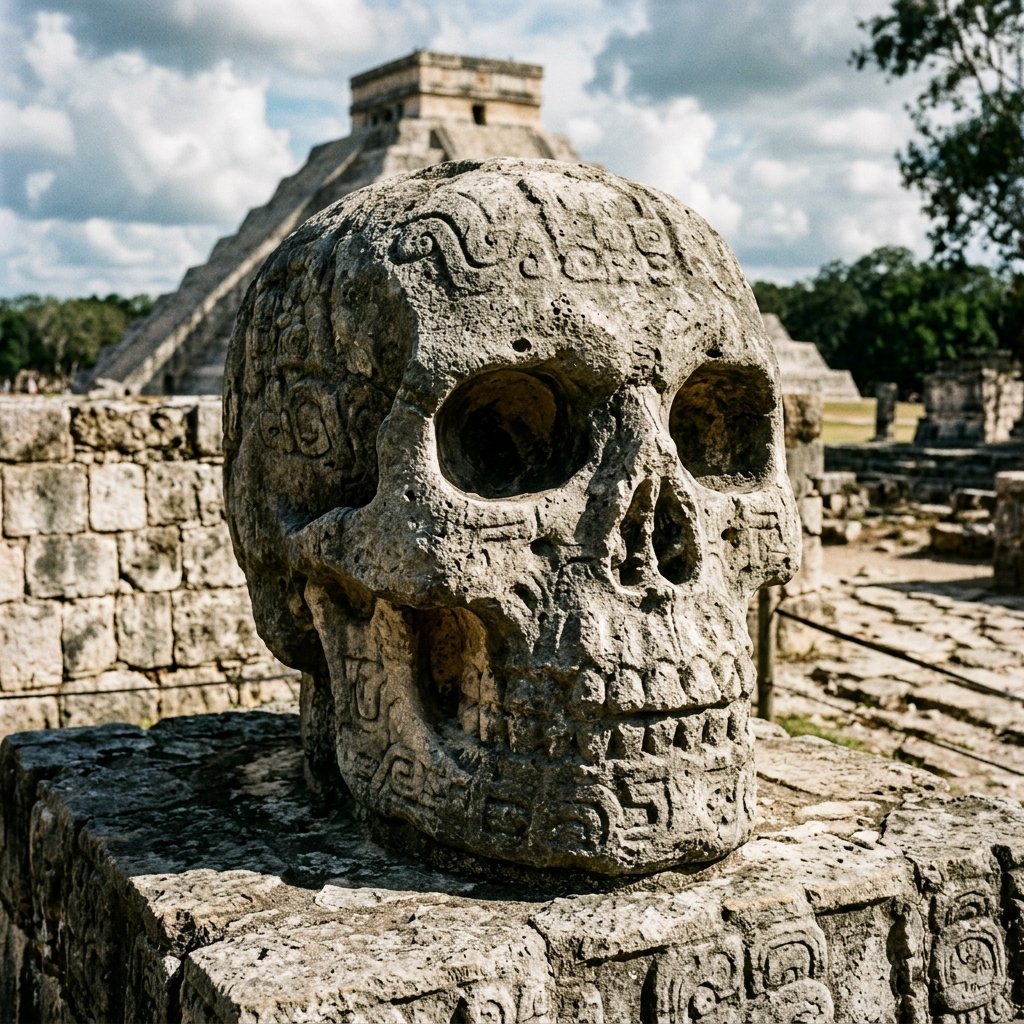
When modern tourists visit Maya ruins and see walls covered in carved human skulls, the immediate reaction is often horror. In the Western tradition, the skull is an emblem of finality, toxicity, or pure evil.
To the ancient Maya, the skull carried a very different weight. While it certainly inspired fear—being the primary domain of the terrifying Lords of Xibalba—death was not a final endpoint. In Maya cosmology, death and life were engaged in an eternal, cyclical dance. Flesh rotted, but the hard, white bone remained. To the Maya, the skull was like a seed: a hard core planted in the earth from which new life would eventually sprout.
The Tzompantli: The Architecture of Terror
While the skull had regenerative meanings, the Maya also weaponized its terrifying visual power for political purposes.
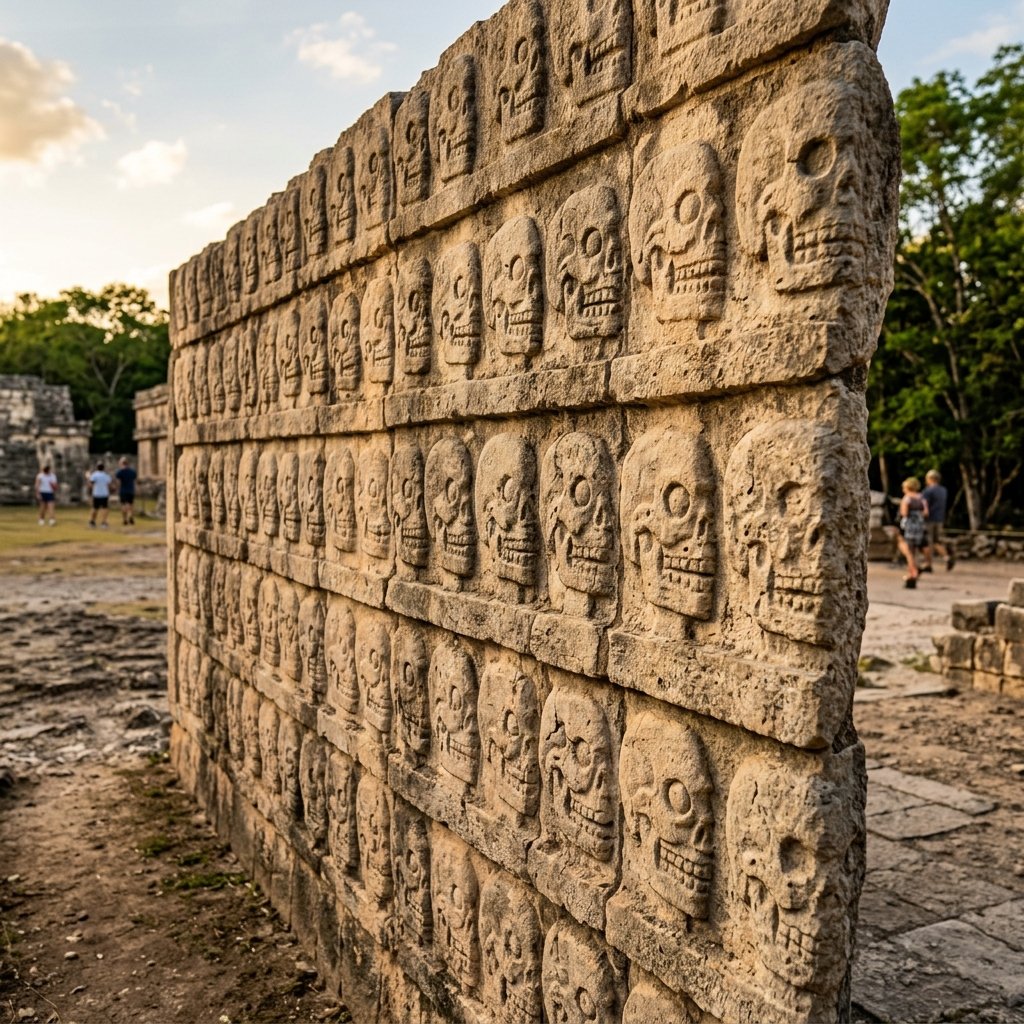
During the Postclassic period (c. 900–1500 AD), influence from Central Mexico brought the architectural feature known as the Tzompantli (Skull Rack) to the Maya region. The most famous example sits adjacent to the Great Ballcourt at Chichén Itzá. It is a massive, T-shaped stone platform whose walls are carved with hundreds of slightly different, stylized human skulls impaled on wooden stakes.
The Tzompantli served a dual purpose. Cosmologically, it represented the power of the Death Gods and the requirement of sacrifice to keep the universe ordered. Politically, it was a weapon of psychological warfare. Displaying the severed heads of conquered enemies and sacrificed ballplayers was highly effective state propaganda, serving as a visceral warning to rival cities and rebellious subjects.
The Skull in Myth and Mathematics
The skull features prominently in the core narrative of the Popol Vuh. When the first human ancestors (Hun Hunahpu and Vucub Hunahpu) are defeated by the Lords of Death, they are sacrificed and buried in Xibalba. But Hun Hunahpu's severed head is placed in a barren calabash tree.
The tree miraculously blooms, and when the underworld princess Blood Moon (Xquic) approaches the skull, it spits into her hand, magically impregnating her with the Hero Twins. Here, the skull is explicitly depicted not as the end of life, but as the generative seed of future victory.
The skull also played a vital role in Maya Mathematics. The Maya used specialized deity portraits (Head Variants) to represent numbers. The fleshless human lower jawbone explicitly represented the number 10. When scribes wanted to write numbers from 14 to 19, they simply added the skeletal jawbone of death over the deity representing the single digit (e.g., 4 + fleshless jaw = 14) (Coe, M.D. & Van Stone, M., Reading the Maya Glyphs, 2005).
Defleshing and Ancestor Veneration
Archaeological evidence reveals that the Maya interacted with the skulls of their ancestors in ways that seem shocking today. Royalty were often buried under the floors of multi-room houses or palaces. Years later, tombs were frequently re-opened.
The living descendants would perform rituals involving the defleshing of the bones. Skulls were sometimes removed, painted bright red with cinnabar, and kept in royal caches or used in ceremonies. By keeping the skull of a powerful ancestor, the living king retained access to their spiritual power and legitimized his own rule (Fitsimmons, J.L., Death and the Classic Maya Kings, 2009).
References
- Christenson, A.J. Popol Vuh: The Sacred Book of the Maya. University of Oklahoma Press, 2007.
- Coe, M.D. & Van Stone, M. Reading the Maya Glyphs. Thames & Hudson, 2nd edition, 2005.
- Fitzsimmons, J.L. Death and the Classic Maya Kings. University of Texas Press, 2009.
- Tiesler, V. & Cucina, A. New Perspectives on Human Sacrifice and Ritual Body Treatments in Ancient Maya Society. Springer, 2007.
Frequently Asked Questions
What is a Tzompantli?
A Tzompantli is a "Skull Rack." It was a wooden platform structure used to publicly display the severed heads of sacrificial victims or captives of war. The most famous Maya example is the stone base of the Tzompantli at Chichén Itzá, which is densely carved with skull iconography.
Did the Maya keep the skulls of their ancestors?
Yes. Royal Maya tombs were frequently re-entered years after death. The descendants would process the bones, sometimes painting the skulls bright red and keeping them for use in rituals. This was seen as a profound act of respect and a way to retain the ancestor's spiritual power.
Why did the Maya associate the skull with the number 10?
In the formal Maya numerical system, every number from 0 to 13 was represented by a specific deity's face. The ruler of the underworld (the Death God) was assigned the number 10. Therefore, the fleshless lower jawbone of a skull became the mathematical symbol for adding ten to a number.