Xul
The Dog · Month 6 of 19
Etymology & Name Origin
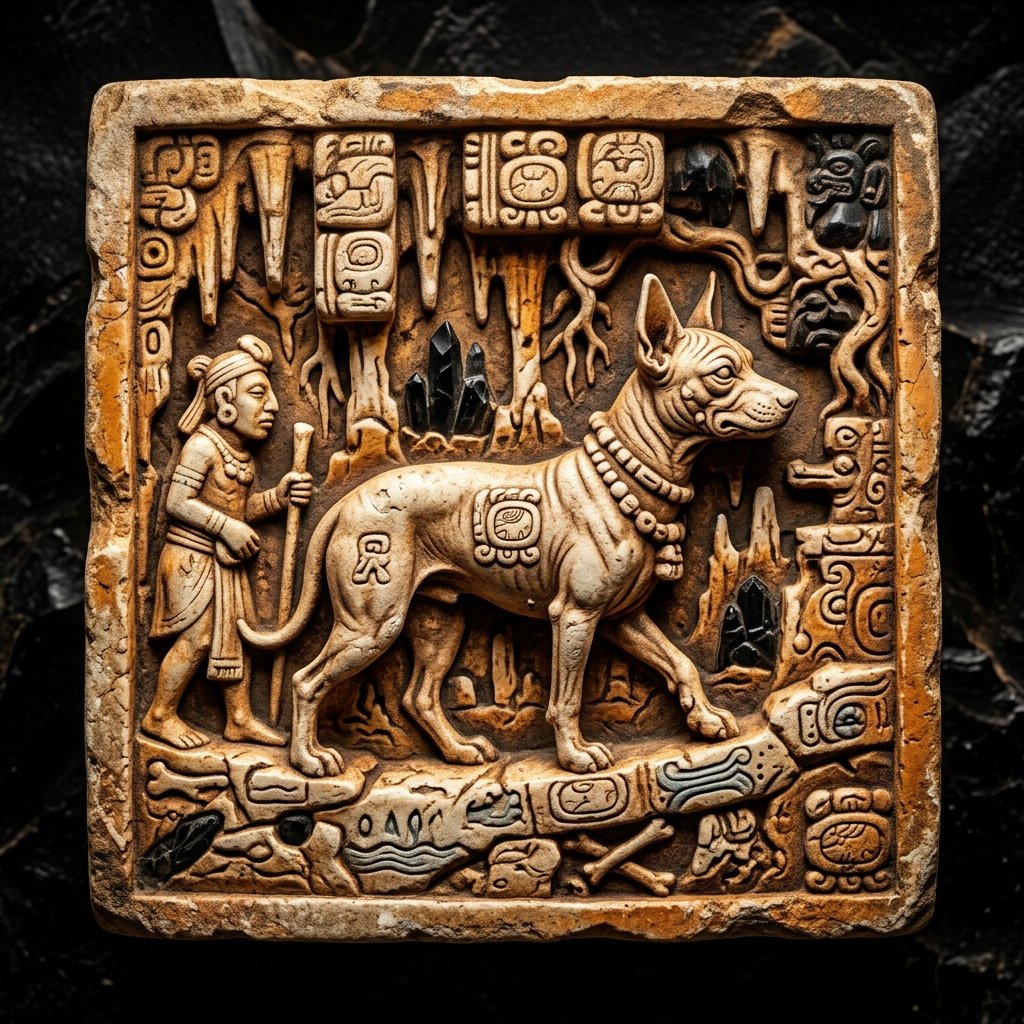
The name "Xul" translates to "end" or "termination" in Yucatec Maya, and is closely associated with the dog — the animal that guides souls to the afterlife. The dual meaning of "ending" and "canine guide" reflects the Maya understanding that every ending is also a passage, and that the faithful dog stands at the threshold to lead the dead safely through the dark waters of the underworld.
Cultural Significance
Xul was a month of profound spiritual significance, marking a period when the veil between the living and the dead was considered thin. The dog's role as psychopomp — guide of souls — made this month particularly important for ancestor veneration and funerary rites. Archaeological evidence of dog burials alongside elite Maya tombs confirms the deep cultural connection between dogs and the journey to the afterlife.
Rituals & Ceremonies
During Xul, Landa recorded that an important ceremony called Chickabanab was performed in honor of Kukulkán (the Feathered Serpent) at the great temples of the Yucatán. Banners of featherwork were erected on poles, and the ceremony involved communal feasting, prayers for good harvests, and the descent of the deity's spirit into the temple. Offerings were also made at family shrines for deceased relatives, with the household dog playing a symbolic role as the guide who would lead ancestors back for the visit.
Agricultural Cycle
Xul occurred during the final stages of the dry season preparation cycle. The "ending" connotation of the month name may reference the conclusion of field-preparation activities before the rains returned. This was a period of anticipation — the work was done, and farmers awaited the sky's response.
Cosmological Role
In Maya cosmology, the dog (tz'i' in K'iche', pek in Yucatec) accompanied the dead across the river that separated the living world from Xibalba. The Popol Vuh describes companions on the underworld journey who serve as guides through its trials. Colonial-era sources record that Maya families sometimes sacrificed dogs to bury with the dead, believing the animal's spirit would navigate the treacherous underworld paths. This cosmological role gave the dog — and the month of Xul — a sacred guardian function.
Patron Deity
Kukulkán (the Feathered Serpent, equivalent to Quetzalcoatl) received special veneration during Xul, particularly at Chichén Itzá. The "descent" of Kukulkán during this month is echoed architecturally in the famous equinox shadow-serpent on the Temple of Kukulkán.
Key Takeaway
The Haab' month Xul ("Dog") is month 6 of the 19-part Maya solar calendar. Spanning 20 days, it represents month of the dog and guidance to the underworld. Together with the other 17 regular months and the 5-day Wayeb' period, Xul forms the 365-day Haab' cycle that tracked the solar year with remarkable precision.
Frequently Asked Questions
What does the Maya month name Xul mean?
The name "Xul" translates to "Dog" in the Haab' solar calendar. The name "Xul" translates to "end" or "termination" in Yucatec Maya, and is closely associated with the dog — the animal that guides souls to the afterlife.
What ceremonies were performed during Xul?
During Xul, Landa recorded that an important ceremony called Chickabanab was performed in honor of Kukulkán (the Feathered Serpent) at the great temples of the Yucatán. Banners of featherwork were erected on poles, and the ceremony involved communal feasting, prayers for good harvests, and the descent of the deity's spirit into the temple.
Which deity is the patron of Xul?
Kukulkán (the Feathered Serpent, equivalent to Quetzalcoatl) received special veneration during Xul, particularly at Chichén Itzá. The "descent" of Kukulkán during this month is echoed architecturally in the famous equinox shadow-serpent on the Temple of Kukulkán.
How does Xul fit into the Maya calendar system?
Xul is month 6 of 19 in the Haab' solar calendar. It spans 20 days (numbered 0-19 in the Maya system). The Haab' consists of 18 months of 20 days each (360 days) plus a 5-day Wayeb' period, totaling 365 days — almost exactly one solar year.
Scholarly References
- Landa, D. de. Relación de las Cosas de Yucatán. Translated by A. Tozzer. Peabody Museum, 1941, pp. 162-164.
- White, C.D. Reconstructing Ancient Maya Diet. University of Utah Press, 1999, pp. 115-130.
- Tedlock, D. Popol Vuh: The Definitive Edition. Simon & Schuster, 1996, pp. 108-112.
- Schele, L. & Freidel, D. A Forest of Kings: The Untold Story of the Ancient Maya. William Morrow, 1990, pp. 350-360.
 Sek
Sek