Yaxkin
The New Sun · Month 7 of 19
Etymology & Name Origin
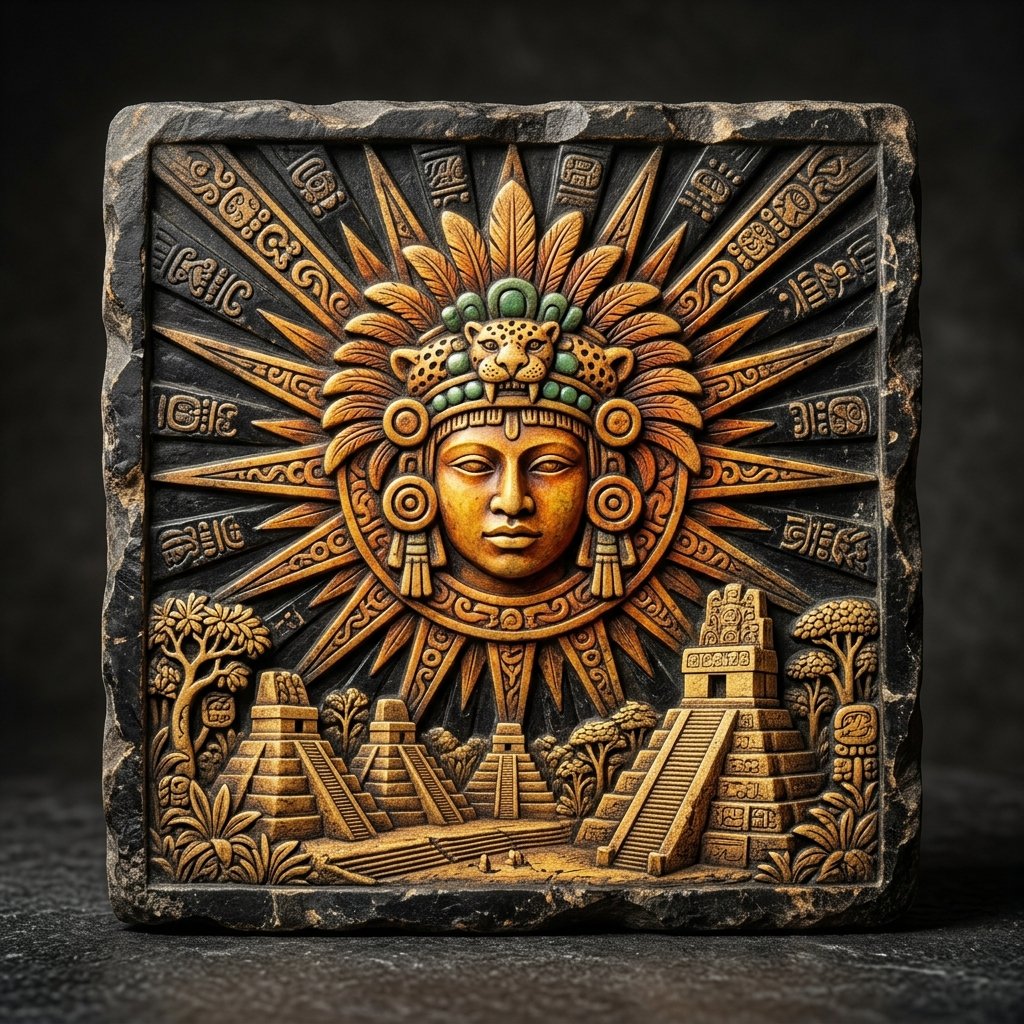
The name "Yaxkin" combines two Maya roots: "yax" meaning "green," "new," or "first," and "kin" meaning "sun" or "day." The resulting compound — "New Sun" or "Green Sun" — evokes the image of a young, fresh solar energy: the sun at its most vital and generative, before it grows old and descends into the underworld. This is the sun of morning, of spring, of new growth.
Cultural Significance
Yaxkin represented the peak of solar energy and vitality in the Maya calendar. This was the month when the sun was understood to be at its most powerful and most generous — flooding the earth with the light and heat that drove all growth. The "newness" of Yaxkin's sun was not about calendar position but about quality: this was purified, regenerated solar force, as though the sun itself had been reborn.
Rituals & Ceremonies
During Yaxkin, ceremonies focused on the renewal of sacred objects, temple furnishings, and ritual implements. Landa described this as a time of "renovating the temple" — literally resurfacing sacred buildings with fresh plaster and paint. The renewal of physical structures mirrored the renewal of solar energy, creating a correspondence between the microcosm (human-built space) and the macrocosm (the celestial cycle). The sun deity Kinich Ahau received special offerings.
Agricultural Cycle
The fresh solar energy of Yaxkin coincided with the greening of the landscape as early rains began to fall. Planted fields — sown in previous months — were beginning to show their first green shoots. The "green sun" illuminated green growth, and farmers watched anxiously for signs that the maize was establishing itself properly. This was a month of watchful hope.
Cosmological Role
The concept of a "new sun" connects Yaxkin to the broader Maya belief in cyclical destruction and recreation. The Popol Vuh and other sources describe multiple creation cycles in which previous suns were destroyed and replaced. Each new sun brought a new world-age with different creatures and different rules. Yaxkin thus carries the energy of cosmic renewal — not just a new day but a new era.
Patron Deity
Kinich Ahau, the Sun God, was the principal deity of Yaxkin. Depicted with large square eyes, a Roman nose, and the "kin" (sun) glyph on his cheek, Kinich Ahau was the most powerful celestial deity — the face of the sun itself during its daytime journey across the sky.
Key Takeaway
The Haab' month Yaxkin ("New Sun") is month 7 of the 19-part Maya solar calendar. Spanning 20 days, it represents month of the fresh sun and green time. Together with the other 17 regular months and the 5-day Wayeb' period, Yaxkin forms the 365-day Haab' cycle that tracked the solar year with remarkable precision.
Frequently Asked Questions
What does the Maya month name Yaxkin mean?
The name "Yaxkin" translates to "New Sun" in the Haab' solar calendar. The name "Yaxkin" combines two Maya roots: "yax" meaning "green," "new," or "first," and "kin" meaning "sun" or "day.
What ceremonies were performed during Yaxkin?
During Yaxkin, ceremonies focused on the renewal of sacred objects, temple furnishings, and ritual implements. Landa described this as a time of "renovating the temple" — literally resurfacing sacred buildings with fresh plaster and paint.
Which deity is the patron of Yaxkin?
Kinich Ahau, the Sun God, was the principal deity of Yaxkin. Depicted with large square eyes, a Roman nose, and the "kin" (sun) glyph on his cheek, Kinich Ahau was the most powerful celestial deity — the face of the sun itself during its daytime journey across the sky.
How does Yaxkin fit into the Maya calendar system?
Yaxkin is month 7 of 19 in the Haab' solar calendar. It spans 20 days (numbered 0-19 in the Maya system). The Haab' consists of 18 months of 20 days each (360 days) plus a 5-day Wayeb' period, totaling 365 days — almost exactly one solar year.
Scholarly References
- Landa, D. de. Relación de las Cosas de Yucatán. Translated by A. Tozzer. Peabody Museum, 1941, pp. 164-165.
- Taube, K. "The Classic Maya Maize God: A Reappraisal." In Fifth Palenque Round Table, 1983, pp. 171-181.
- Stuart, D. The Order of Days. Harmony Books, 2011, pp. 180-195.
- Milbrath, S. Star Gods of the Maya. University of Texas Press, 1999, pp. 100-115.
 Xul
Xul