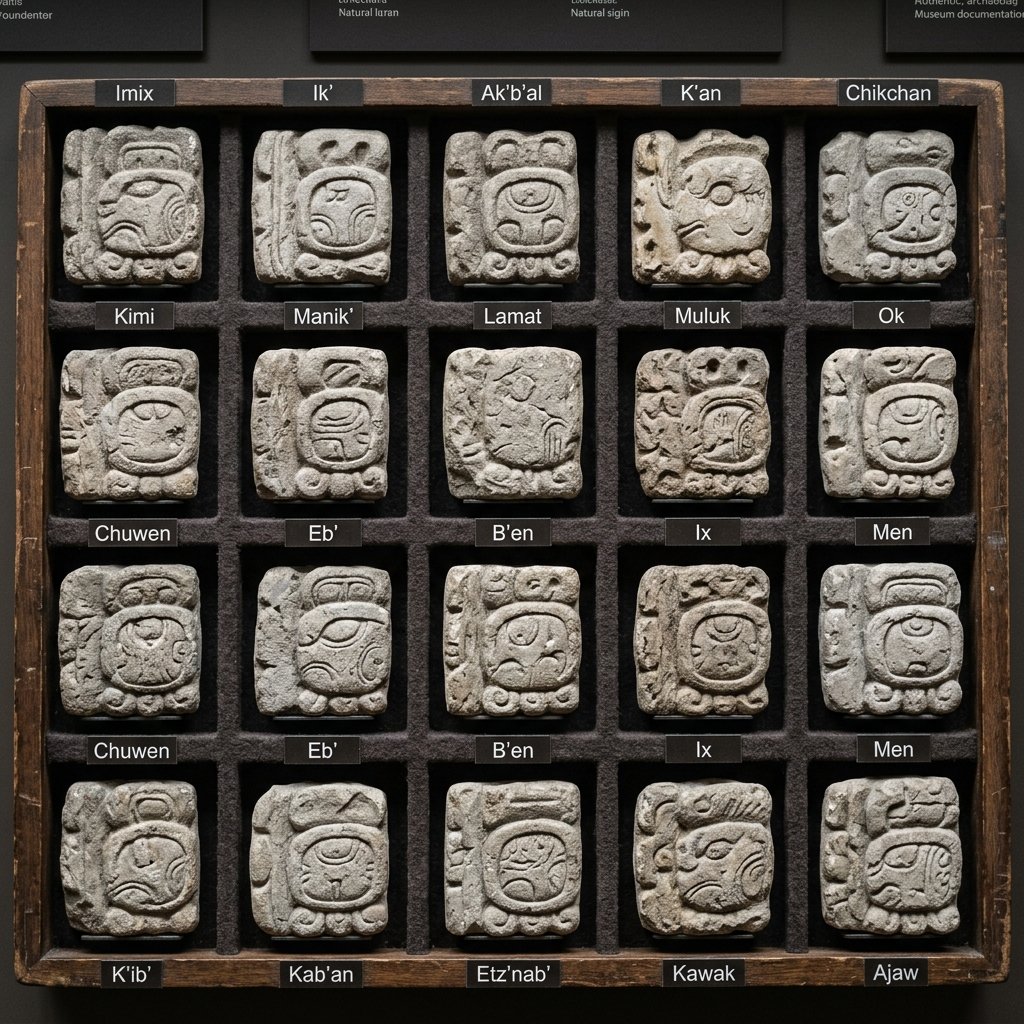
The Tzolk'in at a Glance
"A calendar can measure more than seasons. It can measure destiny."
What Is the Tzolk'in?
The Tzolk'in (also spelled Tzolkin or Tzolk'in) is a 260-day sacred calendar that formed the spiritual heart of Maya timekeeping. Unlike the Haab, which tracked the solar year for civic and agricultural purposes, the Tzolk'in governed ritual life, divination, naming ceremonies, marriage decisions, warfare timing, and personal destiny. The Smithsonian's National Museum of the American Indian describes it as a cycle in which "each day has a unique quality, a specific spiritual character" (NMAI, "Living Maya Time," 2024).
Encyclopædia Britannica identifies the Tzolk'in as "a ritual cycle of 260 named days" created by the permutation of 20 day names with 13 numerical coefficients. Because 20 and 13 share no common factor other than 1, every combination of name and number is unique within the cycle: 20 × 13 = 260 distinct day positions before the pattern repeats (Britannica, "Maya calendar," 2024).
The Mechanics: 20 Names × 13 Numbers
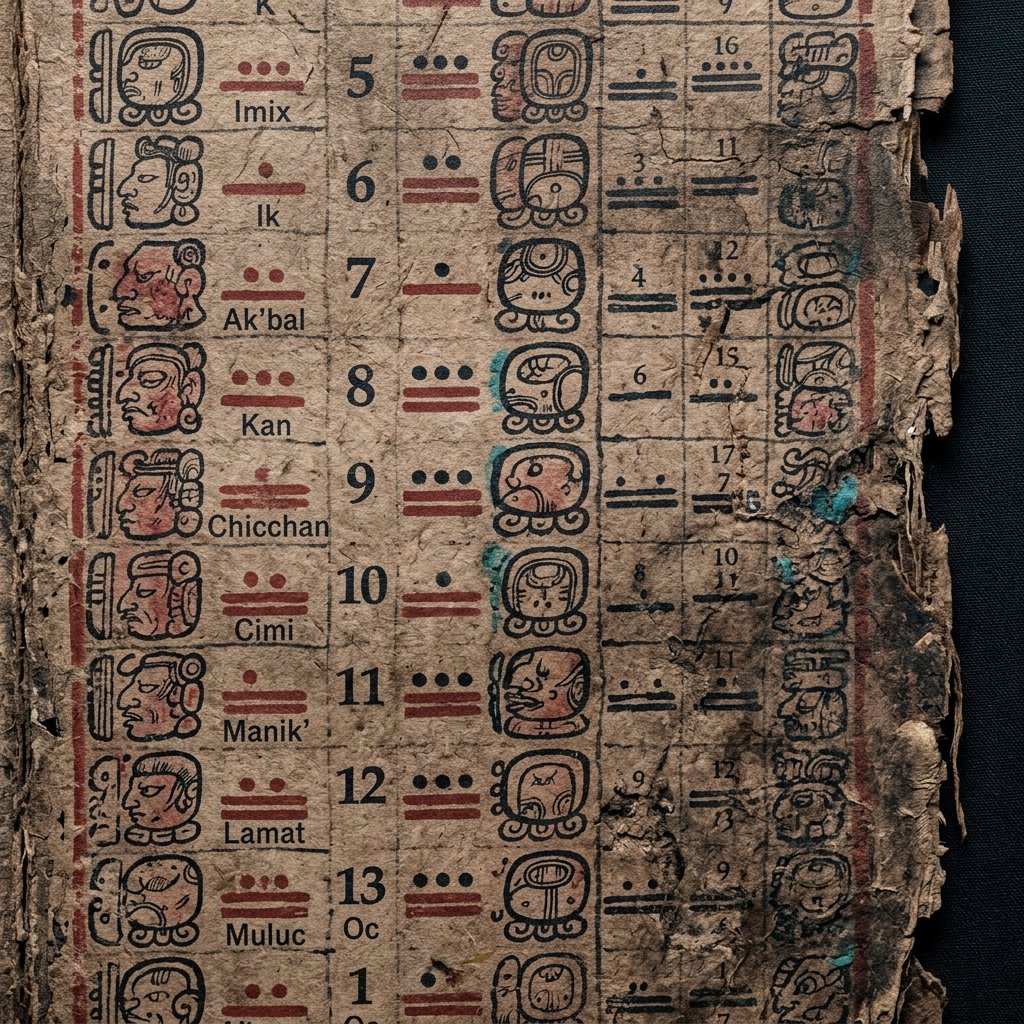
A codex page showing Tzolk'in day signs with their associated numeral coefficients. Maya scribes used red and black pigments on bark paper to record these ritual almanacs, which were consulted by aj k'in (daykeepers) for divination and ceremony scheduling.
The Tzolk'in operates like two interlocking gears. One gear has 20 teeth — the day names (sometimes called nawales or day signs). The other gear has 13 teeth — the tones or numeric coefficients. Each day, both gears advance by one position:
When the 13-number sequence finishes (at 13 Ben), it resets to 1 — but the day names continue from the 14th name onward. So the next day after 13 Ben is 1 Ix, not 1 Imix. The sequences only realign after 260 days, when 1 Imix returns. This elegant mathematical interlocking ensures that every day in the cycle carries a unique energetic signature that will not repeat for exactly 260 days (Thompson, J. E. S., Maya Hieroglyphic Writing: An Introduction, University of Oklahoma Press, 1960, pp. 97–105).
The 20 Day Names and Their Meanings
Source: Day name orthography follows the revised Colonial Yucatec forms standardized in the Dictionary of Maya Hieroglyphs (Montgomery, 2002) and Thompson (1960). The meanings listed are scholarly consensus translations; some remain partially debated. For a complete guide to the spiritual and personality profiles of each day sign, see our 20 Day Signs guide.
Ritual, Divination, and Social Life
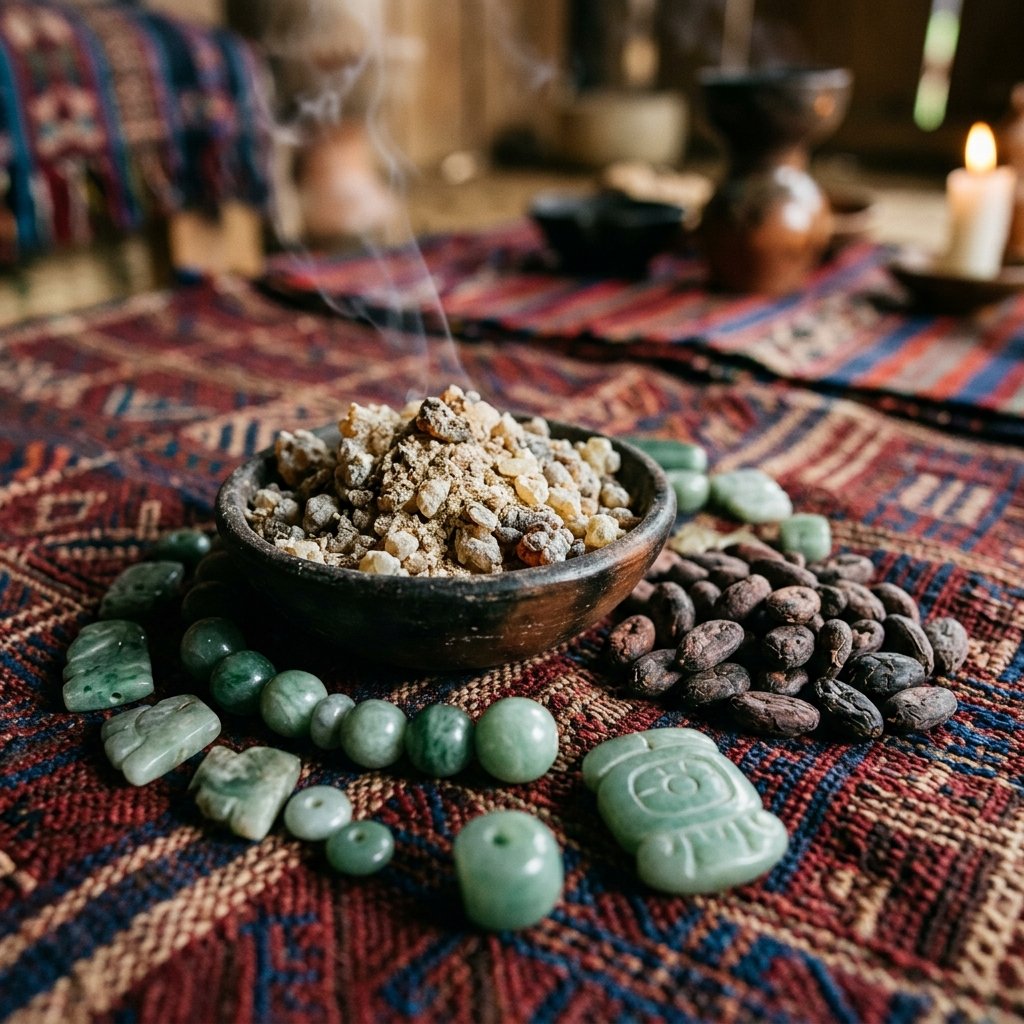
Divination tools of the Maya daykeeper (aj k'in). Copal incense, cacao beans, red seeds (tz'ite), and jade or obsidian were central to the calendrical consultations that governed everything from marriage timing to agricultural decisions. These practices survive today among Highland Maya communities.
The Tzolk'in was not a passive measurement of time. It was an active divinatory instrument. Specialist calendar priests — called aj k'in ("daykeeper" or "he of the sun/day") — were consulted for virtually every major life decision: marriage, naming, planting, warfare, trade journeys, and political ceremonies (Tedlock, B., Time and the Highland Maya, University of New Mexico Press, 1992, pp. 89–115).
The method of divination described by modern ethnographers in the K'iche' highlands involves counting red tz'ite seeds and crystals while progressing through the Tzolk'in day sequence, reading the energy and portent of specific day positions relative to the question asked. Barbara Tedlock's landmark 1992 ethnography documents this practice in extraordinary detail and demonstrates that it is directly descended from Classic-period ritual calendrics (Tedlock, 1992, pp. 118–149).
Maya kings derived their very names from the Tzolk'in. The famous ruler of Palenque, K'inich Janaab Pakal, bore a name incorporating solar and calendrical references. Military campaigns were timed to auspicious Tzolk'in dates. The dedication of stelae, temples, and ballcourts was keyed to specific day positions within the 260-day cycle (Stuart, D., "The Inscriptions from Temple XIX at Palenque," Pre-Columbian Art Research Institute, 2005, pp. 65–78).
Why 260 Days? Competing Origin Theories
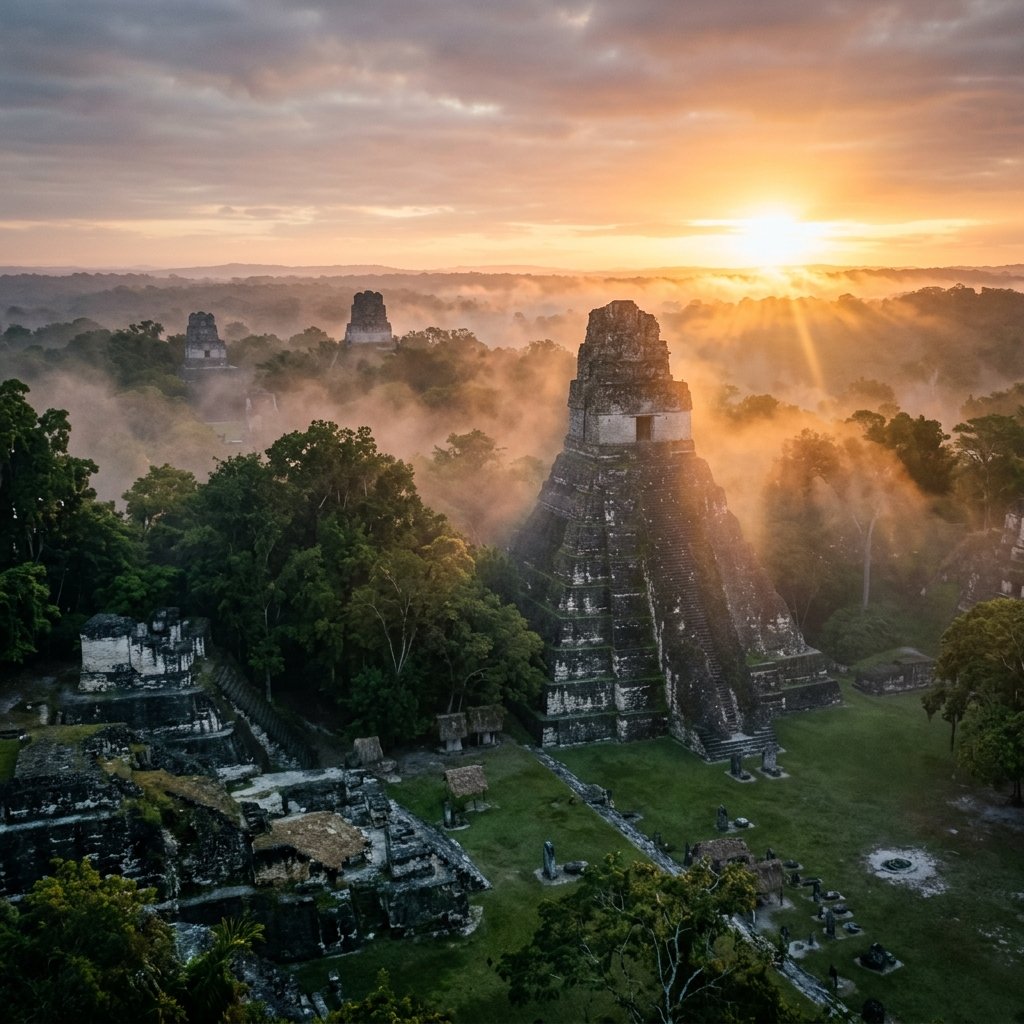
Dawn over the pyramids. The Tzolk'in marked a cycle of sacred time that governed every dimension of Maya life — from the naming of newborns to the timing of battles. One theory links the 260-day count to the interval between solar zenith passages at key latitudes in Mesoamerica.
The origin of the 260-day count is one of the great unsettled questions in Mesoamerican studies. No single explanation commands universal agreement, but several compelling theories have been proposed:
1. The Human Gestation Hypothesis
The average human pregnancy from last menstruation to birth spans approximately 266 days — close enough to 260 to suggest a biological connection. In a culture where birth-day naming was central to identity, a calendar tracking the gestation cycle would have deep practical and symbolic resonance. This theory has been advanced by several scholars, though it remains circumstantial (Rice, P. M., Maya Calendar Origins, University of Texas Press, 2007, pp. 28–33).
2. The Zenith-Passage Interval Hypothesis
Vincent Malmström proposed in 1973 that the 260-day count originated at a latitude (~14.8° N) where the two annual zenith passages of the sun are separated by exactly 260 days. This latitude passes through southern Mesoamerica — notably Izapa and Copán — where the earliest evidence of sophisticated calendrical systems has been found (Malmström, V. H., "Origin of the Mesoamerican 260-Day Calendar," Science, 181(4103), 1973, pp. 939–941). This remains one of the most cited origin theories in the field, though it has also been critiqued for being latitude-specific.
3. The Agricultural Cycle Hypothesis
In the highland Guatemala maize-growing regions, approximately 260 days separate the planting from the harvest of maize. This makes the Tzolk'in a practical agricultural clock in specific ecological zones. However, the Maya occupied diverse environments from coastal lowlands to highland valleys, making a single agricultural explanation insufficient for the entire culture area (Aveni, A. F., Skywatchers of Ancient Mexico, University of Texas Press, 2001, pp. 143–148).
4. Mathematical Harmony
Perhaps most compellingly, 260 is the least common multiple of 13 and 20 — the two numbers most fundamental to Mesoamerican cosmology. Thirteen represented the levels of heaven and the joints of the human body. Twenty represented the digits (fingers and toes) and the base of the counting system. The number 260 may simply be the inevitable product of a culture that organized the cosmos around these two sacred integers (Lounsbury, F. G., "Maya Numeration, Computation, and Calendrical Astronomy," Dictionary of Scientific Biography, 1978).
A Note on Evidence
The honest scholarly answer is that we do not know with certainty why the Mesoamerican sacred calendar is 260 days. The origin may be a combination of these factors, or it may derive from a logic that no longer survives in the archaeological record. What we know is that the 260-day count was widespread across Mesoamerica — shared by the Zapotec, Mixtec, and Aztec as well as the Maya — suggesting an extremely ancient origin, possibly predating the Maya civilization itself. Recent archaeological evidence from San Bartolo, Guatemala has pushed direct evidence for sophisticated calendar use back to the 3rd century BC or earlier (Saturno, W. et al., "Early Maya Writing at San Bartolo, Guatemala," Science, 311(5765), 2006, pp. 1281–1283).
How the Tzolk'in Pairs with the Haab
In daily use, the Maya almost never cited a Tzolk'in date alone. Instead, it was paired with the Haab to create a Calendar Round date. Because 260 and 365 share no common factor other than 5, the combined system does not repeat for 18,980 days — approximately 52 solar years. This meant that any Calendar Round date uniquely identified a specific day within a 52-year window (Thompson, 1960, pp. 123–135).
For events that needed to be dated across longer spans — royal accessions, dynastic histories, mythological creation events — the Maya added the Long Count, which eliminated all ambiguity by counting total elapsed days from a fixed starting point.
The Tzolk'in Lives On
Unlike many aspects of ancient Maya culture, the 260-day calendar was never fully extinguished. Despite five centuries of colonial suppression, aj k'in daykeepers in the K'iche', Kaqchikel, and Ixil communities of highland Guatemala have maintained an unbroken count. Barbara Tedlock's fieldwork documented daykeepers whose count matched the Classic-period Tzolk'in to the day — an unbroken chain of calendrical tradition spanning over two thousand years (Tedlock, 1992, pp. 1–15).
The Tzolk'in is not a museum artifact. It is a functioning spiritual technology still used by living Maya communities to guide planting, ceremonies, healing, conflict resolution, and the interpretation of dreams.
Frequently Asked Questions
Was the Tzolk'in uniquely Maya?
No. The 260-day sacred calendar was shared across Mesoamerica. The Aztec called it Tonalpohualli, the Zapotec called it Piye, and the Mixtec used a version as well. This widespread distribution suggests the system predates any single Mesoamerican civilization and may originate in the deep Preclassic period or earlier.
Why did 260 days matter?
Scholars have proposed multiple explanations: the approximate length of human gestation, the interval between solar zenith passages at key latitudes, the agricultural cycle of highland maize, and the mathematical product of the two most sacred Mesoamerican numbers (13 × 20). No single explanation has achieved consensus.
Is the Tzolk'in still used today?
Yes. Daykeepers in the Guatemalan highlands — particularly among the K'iche' and Kaqchikel peoples — maintain an unbroken Tzolk'in count that matches the ancient Classic-period cycle. It remains central to ceremonial, agricultural, and spiritual life in these communities.
What determined which day sign you were born on?
Your Tzolk'in day sign was simply the day position in the 260-day cycle on which you were born. It was not chosen — it was fixed by your birthdate. The day sign was believed to shape your personality, talents, challenges, and destiny. Try our Sign Calculator to find yours.
Scholarly References
- Aveni, A. F. (2001). Skywatchers of Ancient Mexico. University of Texas Press.
- Britannica. (2024). "Maya calendar." Encyclopædia Britannica.
- Lounsbury, F. G. (1978). "Maya Numeration, Computation, and Calendrical Astronomy." Dictionary of Scientific Biography.
- Malmström, V. H. (1973). "Origin of the Mesoamerican 260-Day Calendar." Science, 181(4103), 939–941.
- Montgomery, J. (2002). Dictionary of Maya Hieroglyphs. Hippocrene Books.
- NMAI / Smithsonian. (2024). "Living Maya Time: Calendar Overview."
- Rice, P. M. (2007). Maya Calendar Origins. University of Texas Press.
- Saturno, W. et al. (2006). "Early Maya Writing at San Bartolo, Guatemala." Science, 311(5765), 1281–1283.
- Stuart, D. (2005). "The Inscriptions from Temple XIX at Palenque." Pre-Columbian Art Research Institute.
- Tedlock, B. (1992). Time and the Highland Maya. University of New Mexico Press.
- Thompson, J. E. S. (1960). Maya Hieroglyphic Writing: An Introduction. University of Oklahoma Press.