The Haab at a Glance
"The Maya built a year out of perfect twenties — until reality forced them to add five uneasy days at the end."
What the Haab Is — and Why It Matters
The Haab (sometimes written Haab') is the Maya solar calendar, a 365-day count that organized civic life, agricultural planning, ceremony scheduling, and market cycles across the Maya world for at least two millennia. Encyclopædia Britannica identifies the Haab as "a civil year of 365 days" composed of 18 named months of 20 days each, followed by a terminal period of 5 unnamed days (Britannica, "Maya calendar," 2024). The National Museum of the American Indian (Smithsonian) provides the same 18 × 20 + 5 structure and notes that the Haab tracked "the approximate solar year" (NMAI, "Living Maya Time: Calendar Overview," 2024).
Unlike the Gregorian calendar — which inserts a leap day every four years to stay synchronized with the tropical year (365.2422 days) — the Haab ran for exactly 365 days, every year, without correction. This is why philologists often call it the "vague year" (año vago in Spanish colonial literature): over decades, the Haab slowly drifted relative to the actual seasons. But this was not an oversight. The Maya were fully aware of the discrepancy, and they chose mathematical elegance over astronomical tracking in this particular count (Aveni, A. F., Skywatchers of Ancient Mexico, University of Texas Press, 2001, pp. 149–157).
Why 18 Months of 20 Days? The Logic of Vigesimal Culture

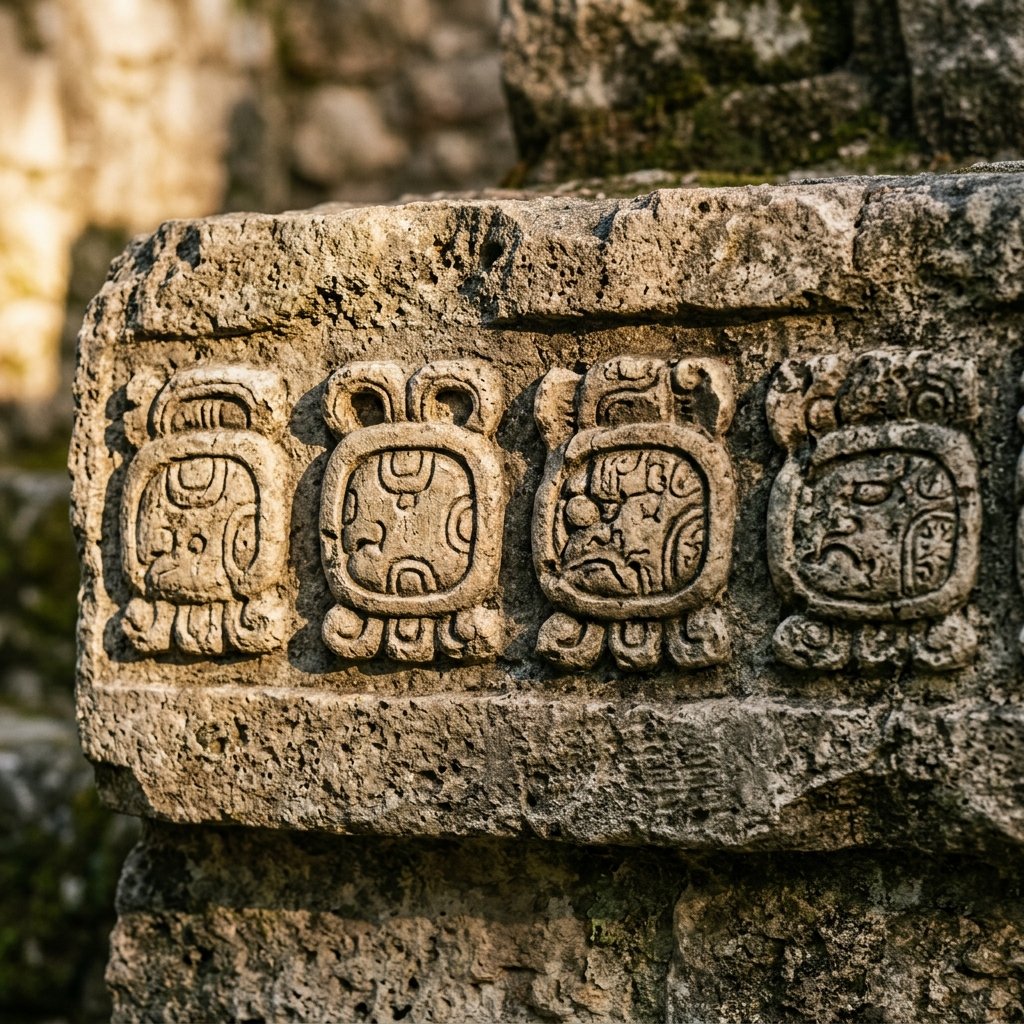
Haab month glyphs rendered in a codex-style format. The Maya painted their calendar notations in red and black pigments on folded bark-paper books called codices. Only four genuine Maya codices survive today — the rest were destroyed during the Spanish conquest, an incalculable loss to our understanding of Maya timekeeping.
To modern eyes, dividing a year into 18 months seems odd. But the Maya were a vigesimal (base-20) culture. They counted in twenties the same way we count in tens. Their number system, their architecture, and their calendrics were all rooted in multiples of 20 (Ifrah, G., The Universal History of Numbers, Wiley, 2000, pp. 311–327).
In a vigesimal framework, the Haab is almost mathematically inevitable:
- 20 days × 18 months = 360 days. This is one tun in the Long Count system — the backbone of Maya chronometry.
- 360 + 5 = 365 days. The five remainder days (Wayeb) round the count up to approximate the solar year.
The number 360 is extraordinarily useful: it divides evenly by 2, 3, 4, 5, 6, 8, 9, 10, 12, 15, 18, 20, 24, 30, 36, 40, 45, 60, 72, 90, 120, and 180. This made administrative calculations, tribute scheduling, and market-day rotation effortless. The Haab was not a rough approximation of the solar year — it was a precision administrative tool optimized for a vigesimal economy (Rice, P. M., Maya Calendar Origins, University of Texas Press, 2007, pp. 44–52).
The 18 Named Months and the Wayeb
Each of the 18 regular months carried a name and was associated with specific agricultural activities, deities, or natural phenomena. Days within each month were numbered 0 through 19 — with day 0 called the "seating" (chum) of the month. This is analogous to saying "the month begins today" before the first full day is counted (Thompson, J. E. S., Maya Hieroglyphic Writing: An Introduction, University of Oklahoma Press, 1960, pp. 116–122).
| # | Month Name | Approximate Meaning | Association |
|---|---|---|---|
| 1 | Pop | "Mat" or "Jaguar" | New Year; renewal ceremonies |
| 2 | Wo | "Black Conjunction" | Night sky observations |
| 3 | Sip | "Red Conjunction" | Hunting deity rites |
| 4 | Sotz' | "Bat" | Cave and underworld rituals |
| 5 | Sek | Uncertain | Agricultural preparation |
| 6 | Xul | "Dog" or "End" | Ceremonies honoring Kukulkán |
| 7 | Yaxk'in | "New Sun" | Solstice-related observances |
| 8 | Mol | "Collection" | Water gathering; rain petitions |
| 9 | Ch'en | "Well" or "Cave" | Cenote and water rituals |
| 10 | Yax | "Green" or "First" | Agricultural renewal |
| 11 | Sak | "White" | Seasonal transition |
| 12 | Keh | "Deer" | Hunting season observances |
| 13 | Mak | "Enclosure" | Fire and mountain deity rites |
| 14 | K'ank'in | "Yellow Sun" | Late-season solar rites |
| 15 | Muwan | "Owl" (Screech Owl) | Underworld/night deity rites |
| 16 | Pax | "Planting Time" | War and martial ceremonies |
| 17 | K'ayab | "Turtle" | Earth and agriculture rites |
| 18 | Kumk'u | "Granary" or "Dark" | Rain deity ceremonies |
| 19 | Wayeb | "Nameless Days" | 5 dangerous, liminal days — no labor, fasting, no bathing |
Source: Month names and associations follow the orthography and interpretations in Thompson, J. E. S. (1960) and Boot, Erik, "The Updated Preliminary Classic Maya–English, English–Classic Maya Vocabulary" (2009). Month meanings remain partially contested among epigraphers; associations are drawn from colonial-era ethnographic sources including Bishop Diego de Landa's Relación de las cosas de Yucatán (c. 1566).
The 19th Segment: Wayeb — Five Days of Cosmic Danger
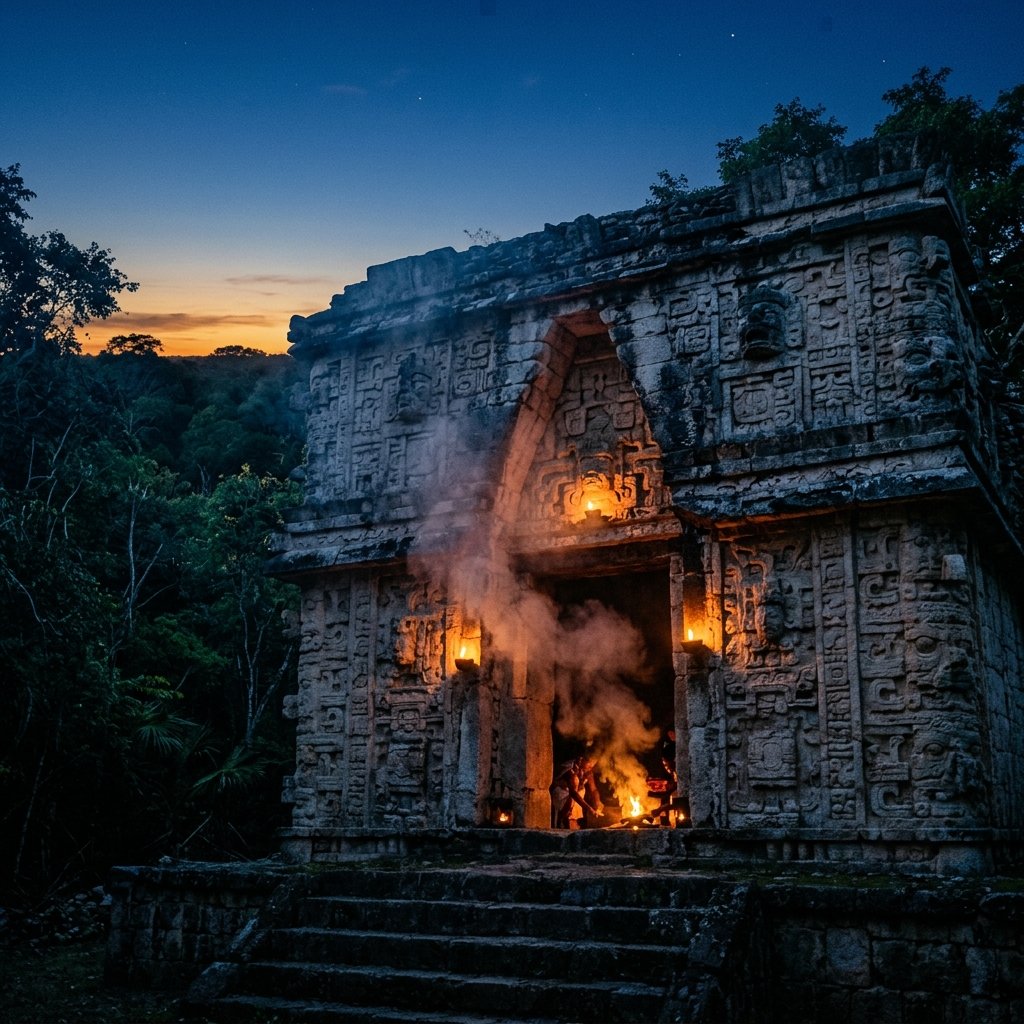
During the five Wayeb days, the Maya believed the barriers between the mortal world and Xibalba (the underworld) were dangerously thin. Temples were shuttered, markets closed, and people stayed indoors to avoid malevolent spiritual forces. The arrival of the new year's first month — Pop, the "Seating of the Mat" — was cause for celebration and relief.
After the 18th month (Kumk'u) concluded, five extra days remained before the cycle began again. These were the Wayeb (sometimes Wayeb' or Uayeb), and the Maya regarded them with deep unease. Bishop Diego de Landa, writing in the 1560s, recorded that during the Wayeb the Maya "did not wash, nor comb, nor do any servile or fatiguing work" — an extraordinary stricture from a culture known for its industriousness (Landa, D., Relación de las cosas de Yucatán, c. 1566, trans. Tozzer, 1941, p. 151).
Structurally, the Wayeb was not a "month" at all. Its days were numbered 0 through 4 (only five positions), and it was sometimes written with a distinct glyph that epigraphers translate as signifying "the resting of the year" or "the bed of the year" (Coe, M. D. and Van Stone, M., Reading the Maya Glyphs, Thames & Hudson, 2005, pp. 43–44).
The cosmological logic was consistent: 360 days represented the ordered creation, governed by the regular months and their patron deities. The five extra days fell outside the cosmic order — a narrow gap through which the lords of Xibalba (the underworld) could reach into the living world. The Wayeb was Maya culture's version of "between the years," a universal calendrical anxiety shared with cultures from ancient Egypt to medieval Europe (Aveni, 2001, pp. 156–158).
How Haab Dates Were Written
A Haab date consists of two elements: a day number (0–19) and a month name. For example, the first day of the first month is written 0 Pop (the "seating" of Pop), followed by 1 Pop, 2 Pop, and so on through 19 Pop. The next day is 0 Wo (the seating of the second month), then 1 Wo, and onward.
In practice, the Maya almost never recorded a Haab date in isolation. Instead, it was always paired with a Tzolk'in date to form what scholars call a Calendar Round position. A full Calendar Round date looks like: 4 Ahau 8 Kumk'u — a Tzolk'in day (4 Ahau) locked to a Haab day (8 Kumk'u). This particular date is significant: it is the Long Count creation date, 13.0.0.0.0, corresponding to August 11, 3114 BC in the Gregorian calendar under the GMT correlation (Lounsbury, F. G., "Maya Numeration, Computation, and Calendrical Astronomy," Dictionary of Scientific Biography, 1978).
What the Haab Could and Could Not Do
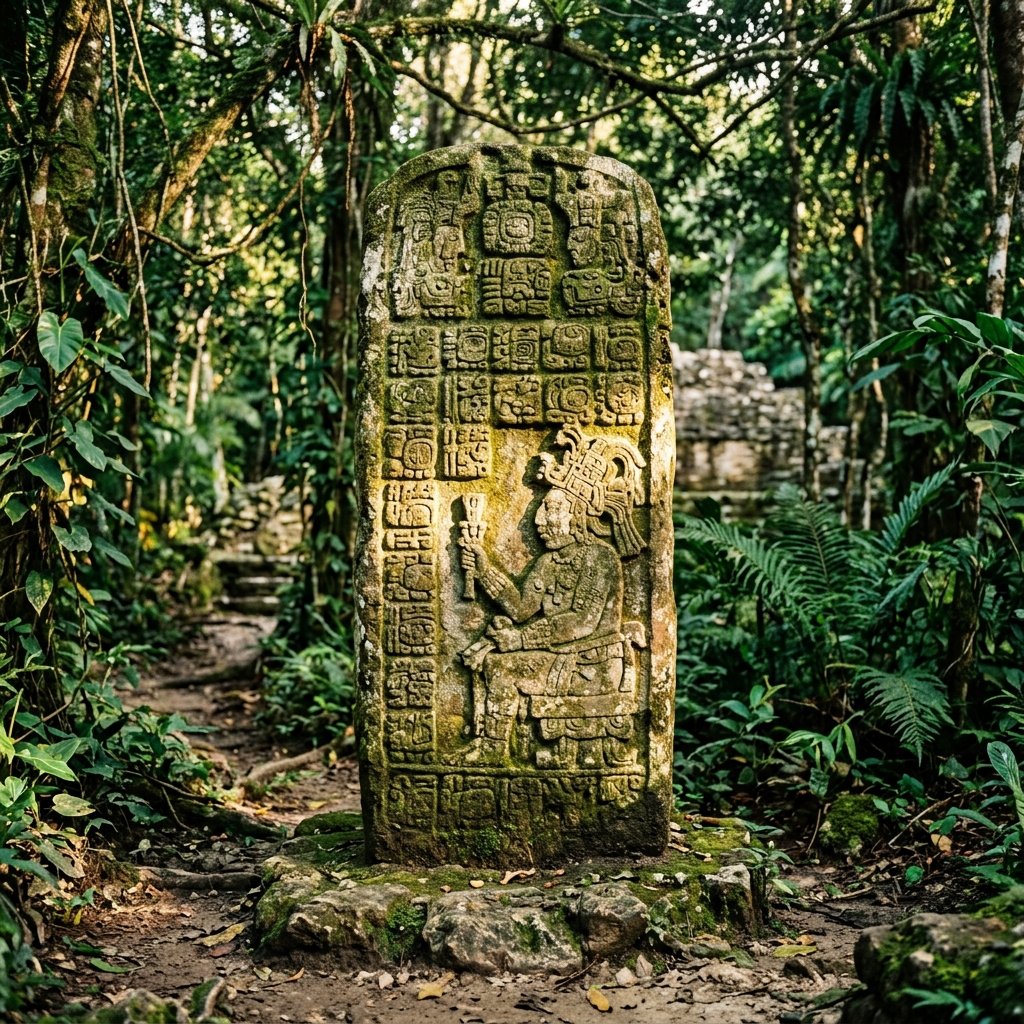
A Classic-period Maya stela bearing calendrical inscriptions. Stelae like this one recorded royal events — accessions, battles, ritual bloodlettings — using the full Calendar Round (Tzolk'in + Haab) and Long Count. The Haab component of these dates anchored events within the civil year.
What it could do:
- Track the civil year. Markets, tribute schedules, royal anniversaries, and agricultural rites were organized by the Haab.
- Provide seasonal reference. Even without leap-day correction, month names carried traditional seasonal associations that communities understood with local adjustment.
- Interlock with the Tzolk'in. When paired with the 260-day sacred calendar, any Calendar Round date uniquely identified a day within a 52-year span (18,980 days).
- Feed the Long Count. The 360-day tun — essentially the Haab minus the Wayeb — served as the fundamental unit in Maya Long Count chronology.
What it could not do:
- Stay synchronized with the seasons forever. Without leap-day insertions, the Haab drifted by approximately one day every four years. Over 1,460 years, the calendar would complete a full seasonal rotation. The Maya knew this; they simply accepted the drift as a property of the count rather than an error to be corrected (Malmström, V. H., "Origin of the Mesoamerican 260-Day Calendar," Science, 181(4103), 1973, pp. 939–941).
- Uniquely identify a date across centuries. Two different years could share the same Calendar Round date. This is why the Maya developed the Long Count — to anchor events in an absolute, non-repeating chronology.
Why is the Haab called a "Vague Year"?
The term "vague year" (from the French année vague) was coined by early European philologists to describe any 365-day calendar that lacks leap-day correction. The ancient Egyptian calendar was also a "vague year" of 365 days. The label refers to the calendar's relationship to the tropical year, not to any imprecision in the mathematical system itself. The Haab is mathematically exact — it counts exactly 365 days, every time. It simply does not attempt to track the fractional excess of 0.2422 days per year that would require intercalation (Parker, R. A., The Calendars of Ancient Egypt, University of Chicago Press, 1950, p. 30).
Why the Haab Mattered for Civic and Agricultural Life
For the farming majority of the ancient Maya, the Haab was the most practically relevant calendar. The month names carried traditional associations with planting cycles, hunting seasons, rainy-season preparations, and honey harvests. Markets operated on Haab-linked schedules. Tribute payments from subordinate polities were due on specific Haab dates. Royal accession anniversaries — critical events for legitimizing dynastic power — were tracked in Haab years (Sharer, R. J. and Traxler, L. P., The Ancient Maya, 6th ed., Stanford University Press, 2006, pp. 108–114).
The New Year ceremony — when 0 Pop returned — was among the most important public festivals in the Maya calendar. De Landa describes elaborate processions, the replacement of household idols, the renewal of hearth fires, and community feasting. The Wayeb fasting and anxiety that preceded it made the arrival of Pop all the more cathartic: the ordered world had survived another passage through chaos (Landa, trans. Tozzer, 1941, pp. 135–154).
The Haab in Living Tradition
The Haab is not merely an archaeological curiosity. Communities in the Guatemalan highlands — particularly among the K'iche', Kaqchikel, and Tz'utujil peoples — continue to use traditional calendar systems that descend directly from the ancient Haab. The Smithsonian's National Museum of the American Indian emphasizes that the Maya calendars "are not relics of the past" but "living, functioning systems that remain central to ceremonial and community life" (NMAI, "Living Maya Time," 2024).
Frequently Asked Questions
Why didn't the Maya add a leap day?
The Maya prioritized mathematical elegance and cyclical regularity over astronomical synchronization in the Haab. Adding a leap day would have disrupted the interlocking relationship with the Tzolk'in and Long Count. They tracked the fractional excess separately through astronomical calculations. Their computed solar year of 365.2420 days is actually more precise than the Gregorian calendar's 365.2425 days (Aveni, 2001).
Why 18 months instead of 12?
The Maya were a vigesimal (base-20) culture. Eighteen months of 20 days produces 360 — a number with extraordinary divisibility that served as the foundation of the Long Count's tun. In a base-20 world, 18 × 20 is more natural than 12 × 30.
Was the Haab astronomically exact?
The Haab itself is exactly 365 days — no more, no less. It does not claim to be an exact measurement of the tropical year (365.2422 days). But the Maya clearly knew the tropical year exceeded 365 days; their astronomical tables in the Dresden Codex demonstrate computations of extraordinary precision, well beyond what the Haab alone provides (Thompson, 1960).
How did people actually use the Haab day-to-day?
The Haab determined market days, tribute schedules, agricultural rituals, naming ceremonies, political anniversaries, and the timing of major public festivals. It was the "civil clock" of Maya life. Sacred and divinatory functions were handled by the Tzolk'in.
Scholarly References
- Aveni, A. F. (2001). Skywatchers of Ancient Mexico. University of Texas Press.
- Britannica. (2024). "Maya calendar." Encyclopædia Britannica.
- Coe, M. D. and Van Stone, M. (2005). Reading the Maya Glyphs. Thames & Hudson.
- Ifrah, G. (2000). The Universal History of Numbers. Wiley.
- Landa, D. (c. 1566 / trans. Tozzer, A. M., 1941). Relación de las cosas de Yucatán. Peabody Museum.
- Lounsbury, F. G. (1978). "Maya Numeration, Computation, and Calendrical Astronomy." Dictionary of Scientific Biography.
- Malmström, V. H. (1973). "Origin of the Mesoamerican 260-Day Calendar." Science, 181(4103), 939–941.
- NMAI / Smithsonian. (2024). "Living Maya Time: Calendar Overview."
- Parker, R. A. (1950). The Calendars of Ancient Egypt. University of Chicago Press.
- Rice, P. M. (2007). Maya Calendar Origins. University of Texas Press.
- Sharer, R. J. and Traxler, L. P. (2006). The Ancient Maya. 6th ed. Stanford University Press.
- Thompson, J. E. S. (1960). Maya Hieroglyphic Writing: An Introduction. University of Oklahoma Press.