The Books of Chilam Balam at a Glance
The Jaguar Prophet
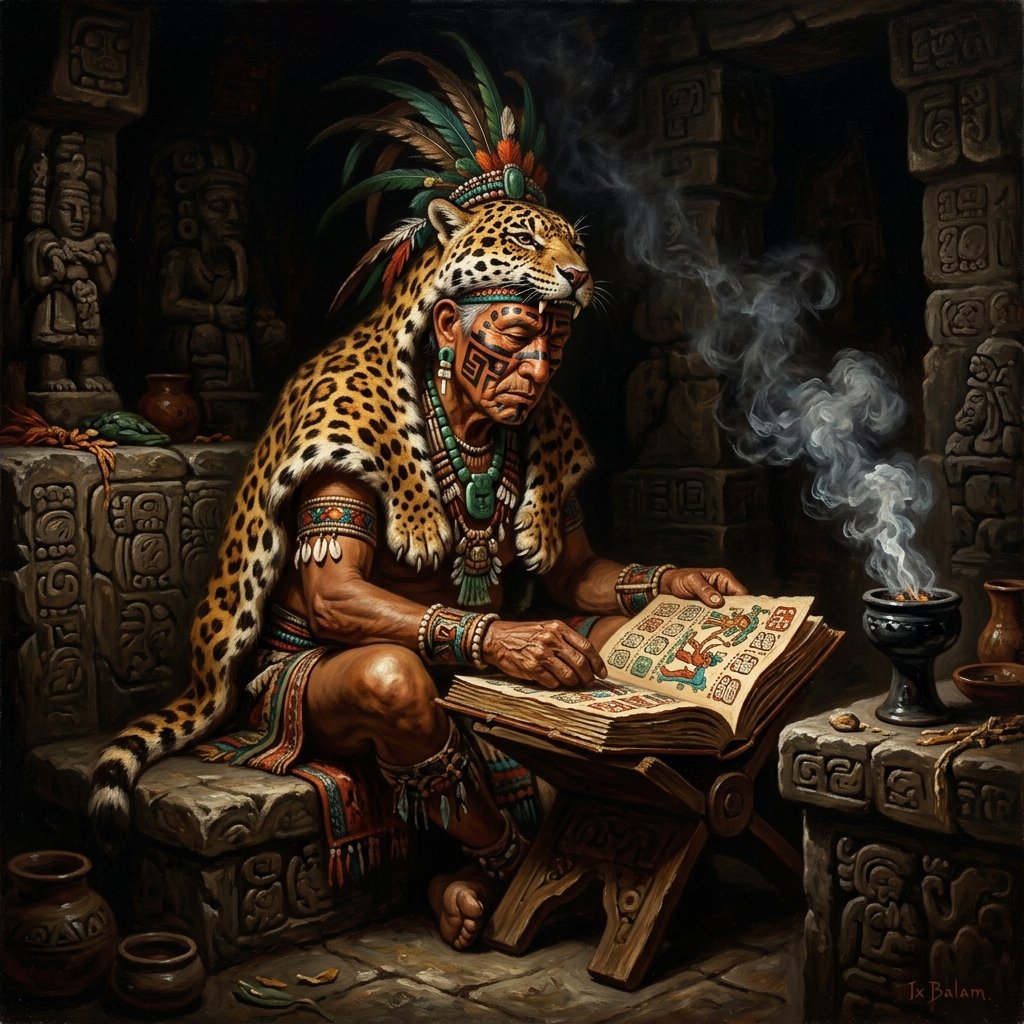
Chilam Balam — "Jaguar Prophet" or "Jaguar Priest" — was a legendary Maya seer who reportedly predicted the arrival of strangers from the east before the Spanish appeared. Whether he was a real historical figure or a composite of several prophetic traditions remains debated, but his name became attached to an extraordinary body of literature that preserved Maya knowledge through the darkest period of colonial oppression.
The Books of Chilam Balam were written in Yucatec Maya using the Latin alphabet — a technology introduced by the Spanish friars. The irony is profound: the same alphabet that the colonizers used to suppress indigenous culture was turned by Maya scribes into a tool for preserving their own traditions. These texts are the written record of a civilization fighting to remember itself (Restall, M., Maya Conquistador, 1998, pp. 128–152).
What the Books Contain
The Books of Chilam Balam are compilations — encyclopedic collections assembled over decades or centuries. They typically include:
- K'atun prophecies: Predictions for each K'atun (approximately 20-year period) in the Maya calendar cycle. The Maya believed history repeated in K'atun patterns — the events of one K'atun 8 Ahau would resemble those of the previous K'atun 8 Ahau, roughly 256 years earlier.
- Historical chronicles: Accounts of the founding of cities, the movements of lineages, wars, plagues, and the Spanish conquest — told from the Maya perspective.
- Ritual and ceremonial texts: Instructions for ceremonies, including the proper words, offerings, and timing for rituals tied to the calendar.
- Medical knowledge: Treatments for illnesses, herbal remedies, and descriptions of diseases — a valuable record of Maya ethnobotany.
- Astronomical tables: Eclipse predictions, planetary observations, and correlations between the Maya and European calendars.
- Creation narratives: Cosmological texts describing the origins of the world, ancestors, and the sacred landscape.
The K'atun Wheel: History as Prophecy
The most distinctive feature of the Chilam Balam texts is their concept of cyclical time. The Maya organized history around the K'atun — a period of 7,200 days (approximately 19.7 years). Thirteen differently named K'atuns rotate in a fixed sequence, completing a full cycle (the "Short Count" or "K'atun Wheel") in approximately 256 years.
Each named K'atun carried specific prophetic associations. K'atun 8 Ahau, for example, was associated with political upheaval and foreign invasion. When the Spanish arrived during a K'atun 8 Ahau cycle, Maya intellectuals interpreted the conquest through this prophetic framework — not as random disaster but as the predicted fulfillment of cyclical time.
This worldview created a peculiar relationship between past and future: by studying what happened in previous K'atun cycles, one could predict what would happen in future ones. History was not a line but a wheel — and the Chilam Balam texts were the user's manual for reading that wheel (Edmonson, M., The Ancient Future of the Itza, 1982).
The Major Surviving Books
The most complete and most studied version. Contains creation narratives, K'atun prophecies, the account of the Spanish conquest, riddles, and astronomical observations. Named after the town of Chumayel in the Yucatán. Now in the Princeton University Library.
The longest of the surviving texts. Emphasizes K'atun prophecies and contains detailed historical chronologies of the Itzá Maya. Named after the town of Tizimin in eastern Yucatán. Now in the Museo Nacional de Antropología, Mexico City.
Contains medical recipes, ritual instructions, and a chronicle of events from the founding of Mayapán to the Spanish conquest. Maní is the town where Diego de Landa burned the Maya codices in 1562 — making it bitterly appropriate that this town also preserved Maya knowledge.
Why the Chilam Balam Matters Today
The Books of Chilam Balam are among the most important primary sources for understanding Maya civilization because they provide the Maya perspective on their own history. While Spanish colonial records describe the Maya from the outside — as subjects to be converted and governed — the Chilam Balam texts describe Maya experience from the inside: how they understood the conquest, how they interpreted their own traditions, and how they fought to maintain cultural identity under colonial rule.
These are not relics of a dead culture. Contemporary Maya communities in the Yucatán continue to reference Chilam Balam prophecies, and the K'atun cycle remains a framework for understanding historical change in some traditional communities.
Frequently Asked Questions
What are the Books of Chilam Balam?
Colonial-era Maya manuscripts written in Yucatec Maya using the Latin alphabet. They contain K'atun prophecies, historical chronicles, medical knowledge, ritual instructions, and astronomical tables. At least 9 versions survive, each named after the Yucatán town where it was preserved.
How are the Books of Chilam Balam different from the Popol Vuh?
Different tradition, different region. The Popol Vuh is K'iche' Maya (Guatemalan highlands), focused on creation mythology. The Chilam Balam is Yucatec Maya (Yucatán Peninsula), focused on prophecy and cyclical history. Together they represent the two great literary traditions of the Maya world.
What is K'atun prophecy?
The Maya believed history repeated in K'atun cycles of approximately 20 years. Each K'atun had a prophetic character. By studying past cycles, Maya priests predicted future events. The Spanish arrival during K'atun 8 Ahau — a period associated with invasion — was interpreted as prophetic fulfillment, not random catastrophe.
Scholarly References
- Edmonson, M.S. The Ancient Future of the Itza: The Book of Chilam Balam of Tizimin. University of Texas Press, 1982.
- Roys, R.L. The Book of Chilam Balam of Chumayel. University of Oklahoma Press, 1967.
- Restall, M. Maya Conquistador. Beacon Press, 1998.
- Clendinnen, I. Ambivalent Conquests: Maya and Spaniard in Yucatan, 1517–1570. Cambridge University Press, 1987.