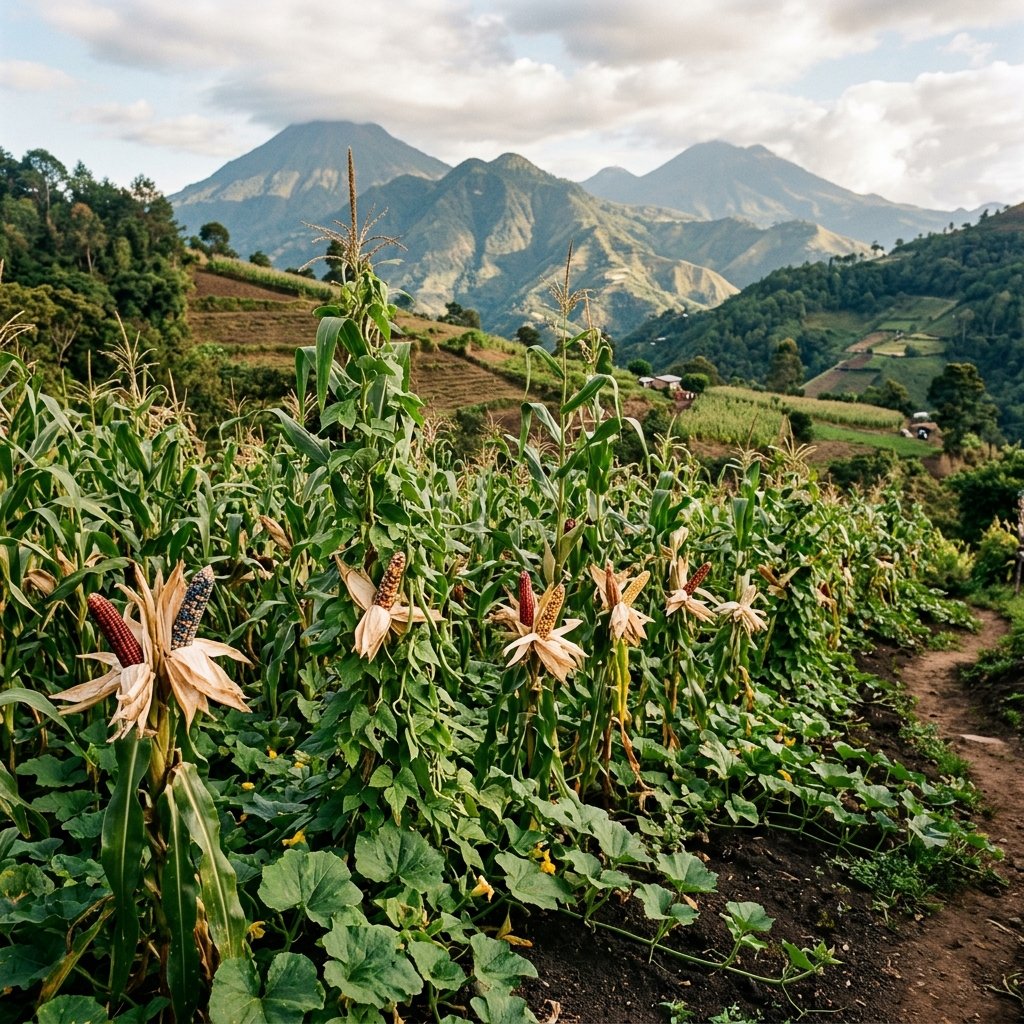
The Maya Diet at a Glance
"The Maya didn't just eat maize — they were maize. The Popol Vuh declares that human flesh was shaped from corn dough, and isotopic analysis of Maya skeletal remains confirms that their bodies were, at the molecular level, overwhelmingly composed of maize-derived carbon. The theological claim is biochemically accurate."
Sacred Maize: The Substance of Humanity
Maize was not just food — it was the substance of humanity itself. The Popol Vuh describes how the gods created human beings from maize dough after failing with mud and wood. To eat maize was, quite literally, to participate in one's own divine nature. The Maize God was among the most revered deities in the Maya pantheon — his death and resurrection by the Hero Twins encoded the annual cycle of planting, harvest, and renewal.
The Maya transformed raw maize through an ingenious process called nixtamalization — soaking dried corn in an alkaline lime (cal) solution. This process softens the kernels, releases bound niacin (preventing pellagra — the disease that ravaged European populations who adopted corn without this technique), and dramatically improves protein quality and bioavailability. The resulting dough (masa) is the foundation of tortillas, tamales, and atole — foods still central to Mexican and Central American cuisine today. Nixtamalization is one of the most significant food-processing innovations in human history (Katz, S.H., Hediger, M.L., & Valleroy, L.A., "Traditional Maize Processing Techniques in the New World," Science, 184(4138), 1974, pp. 765–773).

A Maya metate and mano — the essential grinding tools found in every Maya household. The flat basalt metate surface shows centuries of wear from the daily labor of grinding nixtamalized maize into masa. This was the center of Maya domestic life: the preparation of maize was a daily ritual that connected the household to the cosmic cycle of the Maize God's death and rebirth.
The Maya Pantry
Staples
- Tortillas — eaten at every meal, the daily bread of the Maya
- Tamales — masa wrapped in banana or corn leaves, steamed
- Atole — hot corn-based drink, sweet or savory
- Pozole — corn and meat soup, served at feasts
- Black beans — boiled with chili, epazote, and herbs
Flavors & Seasonings
- Chili peppers — multiple varieties, used in every meal
- Tomatoes (tomatl) — a Maya region crop
- Avocado (ahuacatl) — present in many dishes
- Vanilla (tlilxochitl) — the world's first vanilla users
- Achiote (annatto) — red spice and food colorant
Protein Sources
- Turkey — the only large domesticated animal
- Deer — the primary wild game
- Fish and shellfish — essential for coastal communities
- Iguana — a common, protein-rich food source
- Hairless dogs — specially bred for consumption
Drinks & Sweets
- Cacao/chocolate — sacred elite drink
- Balché — fermented honey-bark ritual drink
- Honey — from native stingless bees (Xunan Kab)
- Fruit — papaya, guava, sapodilla, mamey, nance
- Pulque — fermented agave, in some regions
Agricultural Innovation
The Maya developed sophisticated farming techniques that sustained an estimated 10–15 million people — one of the densest populations in the pre-industrial world — in challenging tropical terrain:
- Milpa (slash-and-burn): The traditional cycle of clearing, burning, planting, and fallowing that allowed tropical soils to regenerate. The milpa system is still practiced by Maya farmers today and has been shown to support remarkable biodiversity.
- Raised field agriculture: In swampy lowlands, the Maya constructed raised planting beds above the water table, with canals between them that served simultaneously as fish farms, irrigation sources, and aquatic gardens.
- Terracing: Hillside terraces prevented erosion and expanded farmable land in the highlands — some still visible today at sites across Guatemala and Belize.
- Forest gardens: Rather than clear-cutting, the Maya managed diverse multi-story forest gardens where useful trees, crops, and medicinal plants grew together — an early form of agroforestry that modern ecologists now recognize as one of the most sustainable agricultural systems ever devised.
Foods the Maya Gave the World
Many foods now central to global cuisine originated in the Maya region — a fact that makes the Maya one of the most culinarily influential civilizations in human history:
References
- Katz, S.H., Hediger, M.L., & Valleroy, L.A. "Traditional Maize Processing Techniques in the New World." Science, 184(4138), 1974, pp. 765–773.
- Coe, S.D. America's First Cuisines. University of Texas Press, 1994.
- Lentz, D.L., Hockaday, B., Dunning, N.P., et al. "Forests, Fields, and the Edge of Sustainability at the Ancient Maya City of Tikal." PNAS, 111(52), 2014, pp. 18513–18518.
Frequently Asked Questions
Did the Maya eat meat?
Yes — primarily turkey (the only large domesticated animal), deer, fish, iguana, and small game. However, meat was less central to the diet than plant foods, and access was stratified by social class: elite Maya had regular access to meat, while commoners relied more heavily on beans and maize for their protein. Archaeological evidence from midden deposits shows that coastal communities consumed significantly more fish and shellfish than inland populations.
What was a typical Maya meal?
A common daily meal consisted of corn tortillas, black beans, chili salsa, and seasonal vegetables or squash. The morning meal was typically atole — a hot, thickened corn drink. Chocolate was reserved for elites and special occasions. Tamales were prepared for feasts and ceremonies. Meals were eaten seated on the ground around a communal hearth, with food served on simple ceramic plates.