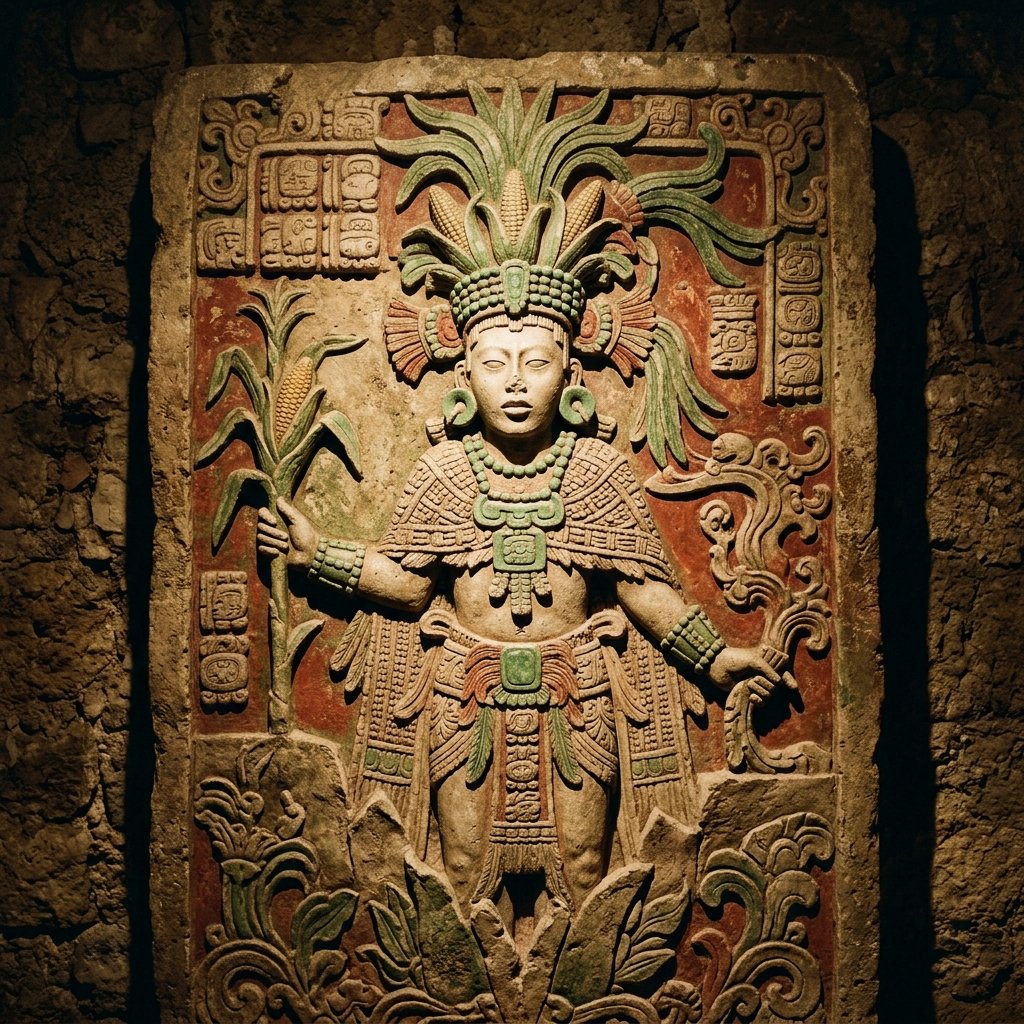
The Maize God at a Glance
"The gods tried mud, and it dissolved. They tried wood, and it had no soul. They tried animals, and they could not speak. Finally, they ground maize into dough and shaped it into flesh, and humanity was born — thinking creatures made from corn. To the Maya, this is not metaphor. It is literal. You are maize. The Maize God is your substance."
The God You Eat
The Maya Maize God — designated God E in the Schellhas classification — occupies a unique position in the pantheon. He is not the most powerful god (Itzamná holds that rank), nor the most famous (Kukulkán draws the largest crowds), nor the most terrifying (Ah Puch claims that honor). He is something more intimate: he is the god you eat.
Maize (Zea mays) was not merely a food crop for the Maya — it was the constitutive substance of human flesh. The Popol Vuh states explicitly that, after three failed attempts to create humanity (from mud, wood, and animals), the gods finally succeeded by grinding white and yellow maize into dough and molding it into human bodies. This is not a metaphor but a theological claim: human flesh is corn flesh. When the Maya ate maize, they were consuming the body of the god who was simultaneously the substance of their own bodies — a sacramental loop of divine reciprocity.
As the scholar Karl Taube has demonstrated, the Maize God was "the single most important deity in Classic Maya religion" in terms of artistic depiction and ritual attention, appearing "more frequently than any other supernatural being in Classic Maya ceramic art" (Taube, K., "The Classic Maya Maize God: A Reappraisal," in Fifth Palenque Round Table, 1983, Pre-Columbian Art Research Institute, 1985, pp. 171–181).
The Most Beautiful God
The Maize God is, consistently and without exception, the most beautiful figure in Maya art. He embodies the Maya ideal of physical perfection: an elongated skull (shaped in infancy by head-binding to mimic the tapered form of a corn cob), smoothly tonsured hair (representing corn silk), crossed eyes (a mark of divine beauty shared with Kinich Ahau), and a graceful, slender body adorned with jade jewelry.
This beauty is not incidental — it carries theological weight. The Maize God's perfection represents the ideal state of creation: the world as it should be, before death and decay intervene. Maya royal courts emulated his appearance deliberately. The practice of cranial modification (head-binding in infancy) was specifically designed to produce the corn-cob head shape; jade ornaments replicated those worn by the god; and the association of beauty with maize was so pervasive that the Maya word for "beauty" and the word for "maize" share a linguistic root.
The Death and Resurrection of the Maize God
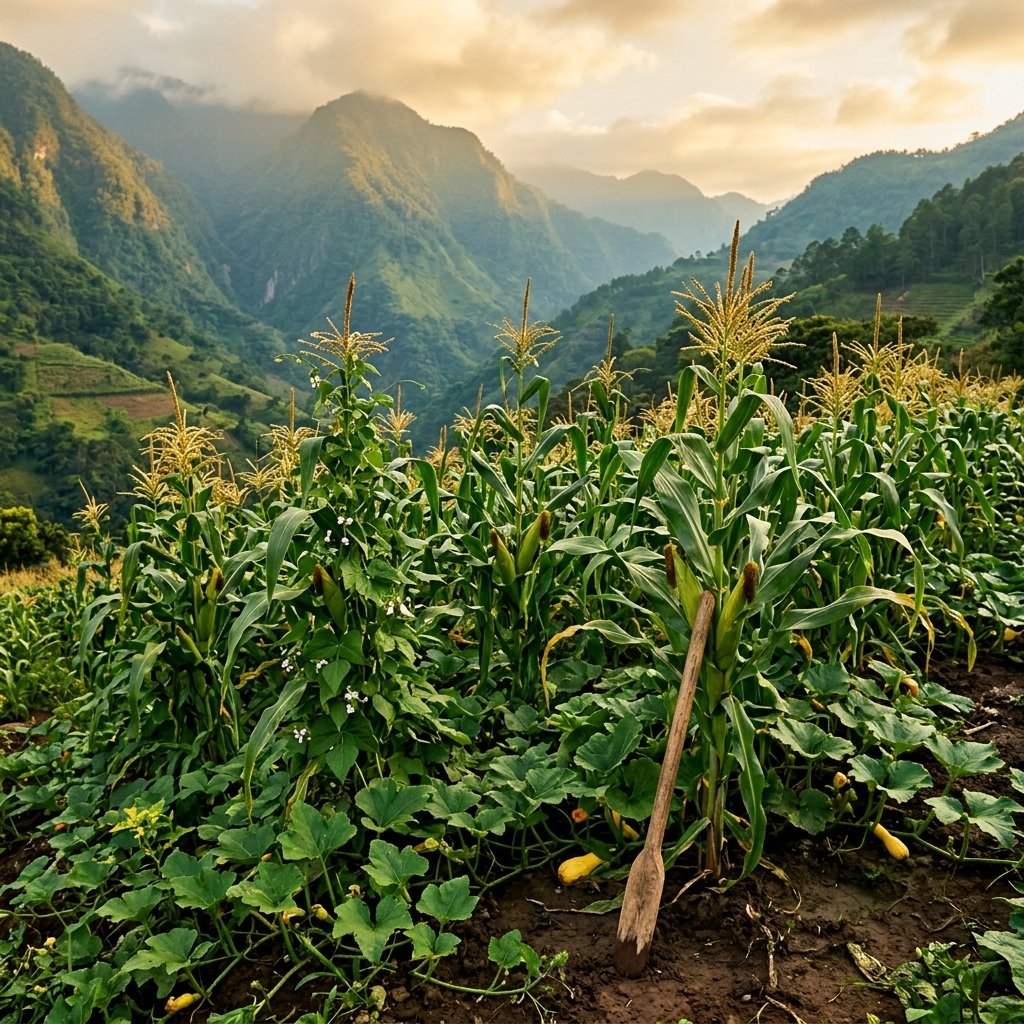
A traditional milpa cornfield — the ancient Maya agricultural system in which maize, beans, and squash are grown together (the "Three Sisters"). This polyculture method, which the Maya have practiced for over 4,000 years, embodies the Maize God's theology: the corn dies at harvest, its seeds are buried in the earth, and new plants emerge — the god's annual death and resurrection made visible in every field.
The Maize God's most important theological function is his death-and-resurrection cycle — a narrative that maps directly onto the agricultural year:
Planting — Death and Burial
When the Maya farmer plants corn seeds in the earth, the Maize God "dies" — returning to the underworld (Xibalba) just as the sun descends at dusk. The seed is entombed in darkness, surrounded by death.
Germination — The Underworld Journey
In the dark earth, the seed transforms — the old husk dissolves, a new shoot pushes upward. This is the Maize God navigating Xibalba, fighting his way through the trials, preparing for rebirth.
Sprouting — Resurrection
The corn sprout breaks through the earth's surface — the Maize God is reborn. Classic Maya art frequently depicts the Hero Twins helping their father (the Maize God) emerge from a crack in the earth, assisted back to life.
Harvest — Death Again
The mature corn is cut down — the Maize God dies again. His body becomes food that sustains his children (humanity). His seeds are saved and replanted. The cycle begins again. It never ends.
Hun Hunahpú: The Maize God in the Popol Vuh
In the Popol Vuh, the Maize God appears under the name Hun Hunahpú ("One Hunahpú"). His story is among the most poignant in Mesoamerican mythology. Hun Hunahpú and his twin brother Vucub Hunahpú are avid ballplayers whose noisy games disturb the lords of Xibalba. Summoned to the underworld, they are subjected to trials they cannot pass and are sacrificed. Hun Hunahpú's head is hung in a calabash tree.
From that tree, a maiden named Xquic ("Blood Woman") approaches the skull, which spits into her hand and impregnates her. She gives birth to the Hero Twins — Hunahpú and Xbalanqué — who grow up to avenge their father by descending into Xibalba themselves, defeating its lords through wit and sacrifice, and resurrecting the Maize God from the earth.
This narrative encodes the agricultural cycle in mythic form: the seed (Hun Hunahpú) is "killed" and buried in the earth (Xibalba). From that death comes new life (the Hero Twins). The children of the seed return to the earth to liberate their father (the sprouting of the new plant from the buried seed). The cycle repeats eternally — just as the cornfield is planted, harvested, and planted again.
Maize and Maya Civilization
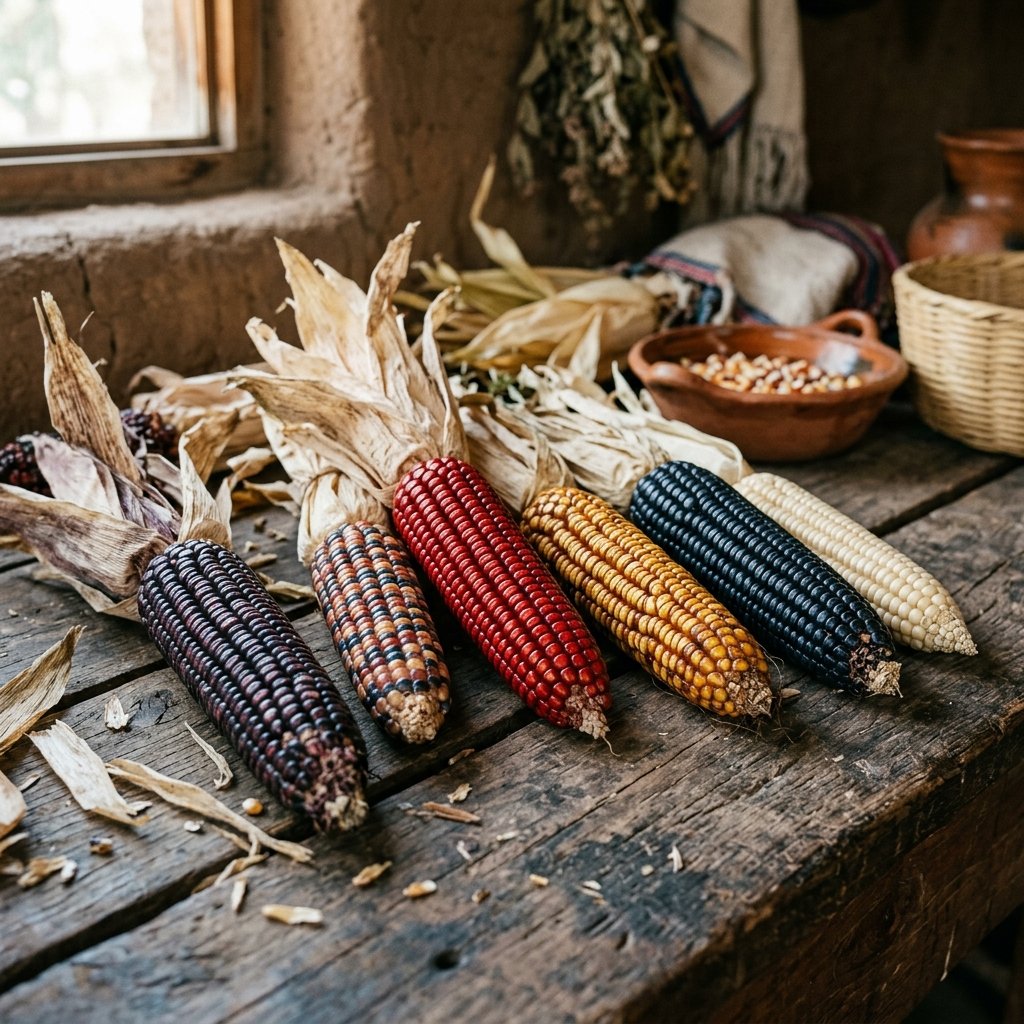
Heirloom Mesoamerican maize varieties. Modern genetic research has confirmed that maize was first domesticated from the wild grass teosinte in the Balsas River valley of southern Mexico approximately 9,000 years ago — making it one of the oldest continuously cultivated crops on Earth. The extraordinary color diversity of heritage varieties reflects millennia of careful selective breeding by indigenous farmers.
It is difficult to overstate the centrality of maize to Maya civilization. Modern nutritional analysis estimates that maize constituted 70–80% of the caloric intake of ancient Maya populations — making it, in the most literal sense, the substance of their bodies. Without maize, Maya cities could not have been built, Maya armies could not have been fed, and Maya populations could not have reached the densities that enabled their cultural achievements.
The Maya preparation method — soaking dried corn in an alkaline solution of water and lime ash (nixtamalization) before grinding it into dough — was as theologically significant as it was nutritionally essential. The process, which releases niacin (vitamin B3) that would otherwise remain nutritionally unavailable, prevented the deficiency disease pellagra that ravaged European populations when they adopted maize without the preparation technique. The Maya's survival depended not just on growing corn but on knowing how to prepare it — knowledge the Maya attributed directly to the gods.
References
- Christenson, A.J. Popol Vuh: The Sacred Book of the Maya. University of Oklahoma Press, 2007.
- Coe, S.D. & Coe, M.D. The True History of Chocolate. Thames & Hudson, 2013.
- Taube, K. "The Classic Maya Maize God: A Reappraisal." In Fifth Palenque Round Table, 1983. Pre-Columbian Art Research Institute, 1985.
- Taube, K. The Major Gods of Ancient Yucatan. Dumbarton Oaks, 1992.
- Tedlock, D. Popol Vuh: The Definitive Edition of the Mayan Book of the Dawn of Life. Simon & Schuster, 1996.
Frequently Asked Questions
Why did the Maya elongate their skulls?
Maya head-binding — the practice of gently shaping an infant's soft skull using boards — was performed to create the elongated, corn-cob-shaped cranium associated with the Maize God. It was a mark of beauty, social status, and divine identity. The practice was painless (infant skull bones are highly malleable) and had no effect on brain function. It was one of the most vivid examples of the Maya belief that the human body should model the divine body — and the divine body was shaped like corn.
Is Yum Kaax the same as Hun Hunahpú?
The Maize God has several names depending on the period and region. "Hun Hunahpú" is his name in the K'iche' Maya Popol Vuh. "God E" is his Schellhas classification. "Yum Kaax" ("Lord of the Forest") is a Yucatec Maya epithet that later colonial sources applied to both the Maize God and a broader forest/nature deity. Modern scholars generally use "the Maize God" or "God E" to avoid confusion, while acknowledging that the deity's identity was both stable (always connected to maize) and regionally variable.
Were humans really made from corn?
In Maya theology — yes. The Popol Vuh describes the creation of humanity from maize dough as historical fact, not allegory. And in a surprisingly literal biological sense, the Maya were not wrong: since maize constituted 70–80% of their caloric intake, the carbon atoms in their bodies were overwhelmingly maize-derived. Isotopic analysis of Maya skeletal remains confirms this — the Maya literally were, at the molecular level, what they ate. They were corn.