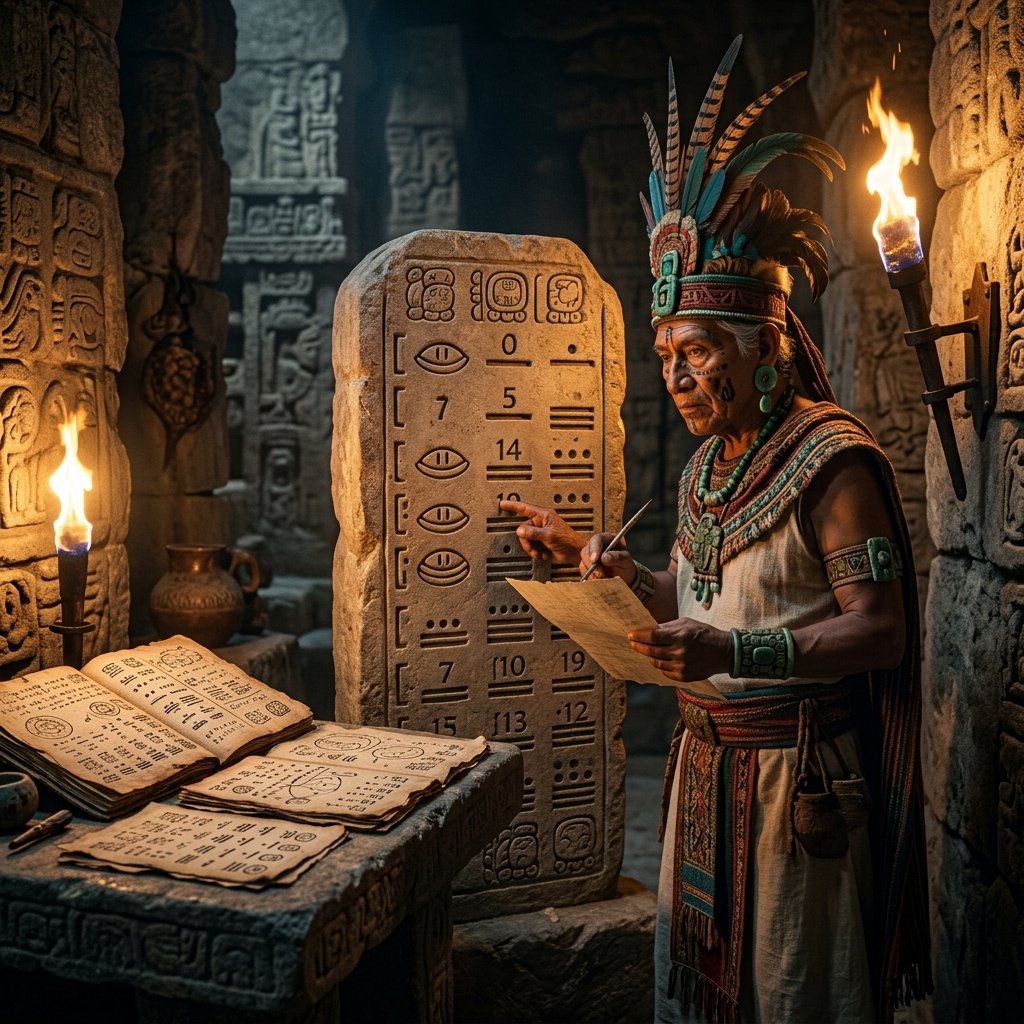
Maya Mathematics at a Glance
"The concept of zero — that emptiness itself could be a number — is one of the most profound intellectual breakthroughs in human history. The Maya arrived at it completely on their own."
Why Zero Matters More Than Any Other Number
Modern civilization runs on zero. It is the backbone of every algorithm, every bank balance, every computer processor. Yet for most of recorded human history, zero did not exist. The ancient Greeks — who produced Euclid, Archimedes, and Pythagoras — never conceived of it. The Romans, whose engineering feats still stand two millennia later, had no symbol for nothing. The Egyptians, who built the pyramids with extraordinary geometric precision, never assigned a numeral to the void.
In the entire history of mathematics, only three civilizations independently invented zero as a functional numeral: the Babylonians (who developed a placeholder but never a true standalone number), the Indians (who formalized it by the 5th century AD), and the Maya of Mesoamerica (Kaplan, R., The Nothing That Is: A Natural History of Zero, Oxford University Press, 2000, pp. 17–25).
What makes the Maya achievement astonishing is its total isolation. They had zero contact with Old World intellectual traditions. No trade routes connected the Yucatán to Mesopotamia. No traveling scholars carried ideas between hemispheres. The Maya reached the same revolutionary conclusion as the greatest mathematical cultures of Asia — but they reached it alone, in the tropical lowland forests of Central America.
The Three Symbols That Built a Civilization
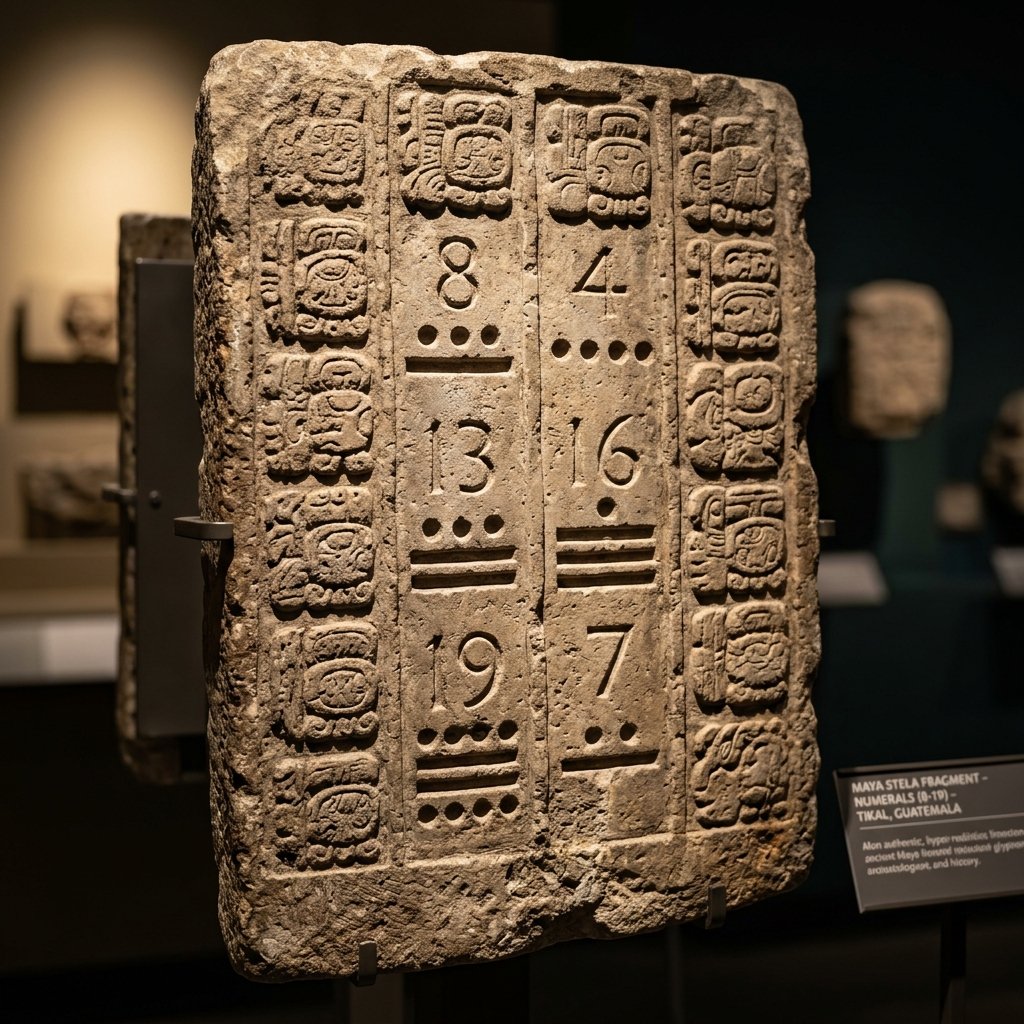
Dot-and-bar numerals carved into limestone. With just three symbols — a dot for one, a horizontal bar for five, and a shell glyph for zero — the Maya could express any conceivable number, from the harvest count of a single field to the age of the cosmos.
The elegance of the Maya numerical system is breathtaking in its minimalism. Where the Romans needed seven distinct letters (I, V, X, L, C, D, M) and still could not perform multiplication without an abacus, the Maya needed exactly three symbols to express any number to infinity:
The Dot
Value: 1
Up to four dots can be stacked horizontally to represent the values 1 through 4. A fifth unit is never written as five dots; instead, it becomes a bar.
The Bar
Value: 5
A single horizontal bar represents five. Up to three bars can stack vertically (15), and dots sit atop the bars to fill the range up to 19. This hybrid subtractive system is remarkably efficient.
The Shell
Value: 0
A stylized shell glyph represents zero — "completion." Without this symbol, positional notation collapses. Its invention is the single most important mathematical achievement in pre-Columbian America.
This system is what mathematicians call a positional notation — the same principle that governs our own decimal system. In our system, the digit "3" means three when it appears in the ones column, thirty in the tens column, and three hundred in the hundreds column. Its value depends on its position. The Maya system works identically, except it counts in groups of twenty instead of ten (Ifrah, G., The Universal History of Numbers, Wiley, 2000, pp. 310–317).
How Base-20 Works: A Step-by-Step Explanation
Our modern system is decimal (base-10), almost certainly because we have ten fingers. The Maya system is vigesimal (base-20), and the prevailing scholarly theory is that the Maya counted on both fingers and toes. The Yucatec Maya word for twenty, k'al, shares a linguistic root with the word for "person" — a human being is, literally, a complete set of twenty (Houston, S., The Life Within: Classic Maya and the Matter of Permanence, Yale University Press, 2014).
Maya numbers are written vertically, reading from bottom to top. Each level represents a progressively higher power of twenty:
Notice the critical irregularity: in a pure base-20 system, the third position should multiply by 400 (20 × 20). Instead, the Maya used 360 (18 × 20). Why? Because 360 closely approximates the length of the solar year. This deliberate mathematical compromise — breaking the pure vigesimal pattern to align the number system with the astronomical calendar — reveals that Maya mathematics was not an abstract theoretical exercise. It was a practical tool designed specifically to model time (Thompson, J. E. S., Maya Hieroglyphic Writing: An Introduction, University of Oklahoma Press, 1960, p. 155).
Worked Example: The Number 4,513
Let's express the decimal number 4,513 in Maya vigesimal notation, step by step:
The Invention of Zero: A Deeper Look
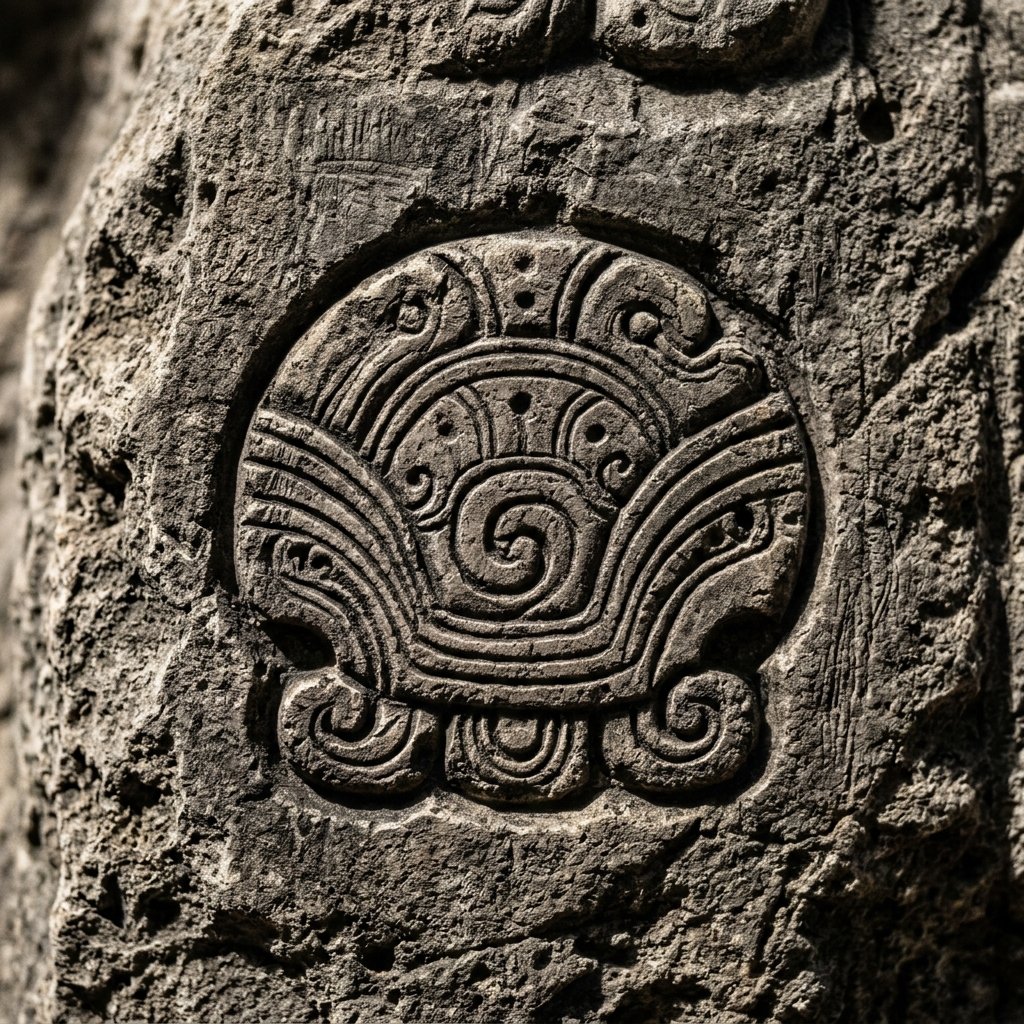
The Maya zero glyph — a stylized shell or flower. This small carved symbol represents one of the most profound intellectual achievements in human history: the recognition that "nothing" is itself a quantity.
The difficulty of inventing zero cannot be overstated. It requires an extraordinary conceptual leap: the recognition that absence is itself a thing. It is the mathematical equivalent of realizing that silence is a form of sound, or that darkness is a kind of light. Most cultures never made this leap because it seems to defy common sense — how can "nothing" be "something"?
The earliest known Maya use of zero appears on Stela 2 at Chiapa de Corzo, dated to approximately 36 BC. On this monument, the Long Count date includes a shell glyph functioning as a true positional placeholder — not merely a decorative filler, but a numeral that changes the meaning of the glyphs around it. Without it, the date inscribed on the monument would be mathematically unreadable (Coe, M. D. and Van Stone, M., Reading the Maya Glyphs, Thames & Hudson, 2005, pp. 42–44).
This date places the Maya invention of zero roughly contemporary with the earliest Babylonian placeholder zeros, and centuries before the Indian subcontinent formalized zero as a standalone number (the Bakhshali manuscript, dated to the 3rd–4th century AD, contains the earliest Indian zero). Crucially, the Maya zero was not merely a placeholder. Classic Period inscriptions show it used in terminal positions — that is, as a meaningful value in its own right, not just as a gap-filler to prevent positional ambiguity (Lounsbury, F. G., "Maya Numeration, Computation, and Calendrical Astronomy," Dictionary of Scientific Biography, Vol. 15, Supplement 1, pp. 759–818).
The Conceptual Machinery: How Zero Powered the Long Count
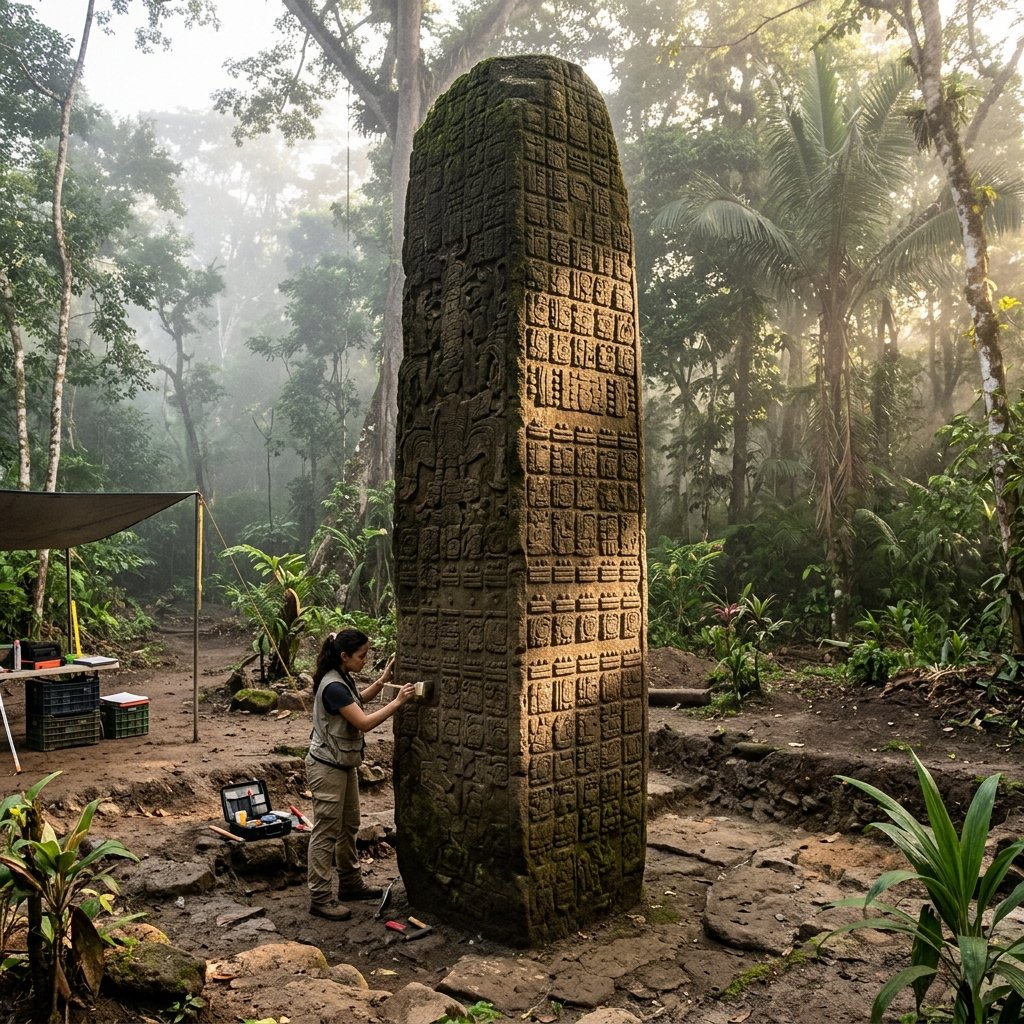
Stela at Quiriguá bearing an enormous Long Count date. Without zero, inscriptions like these — tracking dates across tens of thousands of years — would be structurally impossible. Zero is what makes Maya chronology work.
Consider what happens if you try to write the Long Count date 9.0.0.0.0 without zero. You would need to somehow indicate that the K'atun, Tun, Winal, and K'in positions are all empty while the B'aktun position contains a nine. Without a zero symbol, there is no way to distinguish "9.0.0.0.0" from "9" or "9.0" or "9.0.0." The entire chronological system collapses into unreadable chaos.
The Long Count tracks time from a mythological creation event in 3114 BC, and Maya scribes used it to record dates spanning thousands of years. The Tablet of the Cross at Palenque contains a mythological date calculated to 1,246,826 days before the contemporary king's accession — a number expressible only because zero allows the positional system to compress enormous quantities into a few compact glyphs (Stuart, D., The Inscriptions from Temple XIX at Palenque, PARI, 2005).
The Dresden Codex: Mathematics in Practice
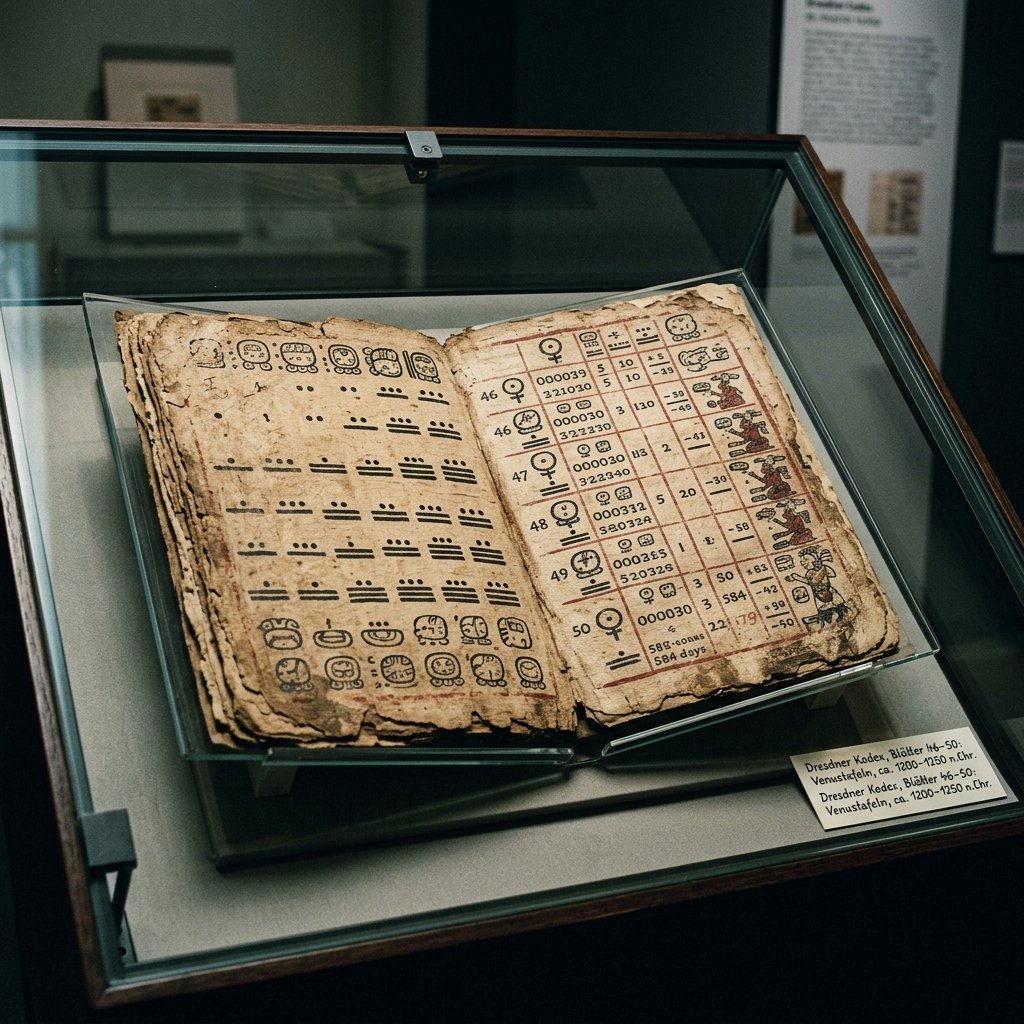
The Venus tables of the Dresden Codex. These columns of dot-and-bar numerals calculate the synodic period of Venus with such accuracy that the Maya predicted its cycle to within two hours over a span of 481 years.
The most spectacular surviving demonstration of Maya mathematical ability is the Dresden Codex, a Pre-Columbian book written on bark paper. Its Venus tables predict the planet's movements across 481 years (301 synodic cycles), arriving at an average synodic period of 583.92 days. The modern accepted value, measured with space-age precision, is 583.93 days (Aveni, A. F., Skywatchers of Ancient Mexico, University of Texas Press, 2001, pp. 184–192).
To achieve this, Maya astronomers performed naked-eye observations spanning generations and then executed arithmetic calculations involving five- and six-digit numbers — using no technology beyond pen, paper, and the vigesimal system. They corrected for accumulated drift by inserting periodic correction factors, a technique analogous to (but independent of) the methods later used by European astronomers adjusting the Julian calendar.
The Lunar Series, also found on Classic Period stelae, demonstrates similar precision. Maya mathematicians calculated the length of 405 lunations (complete moon cycles) as 11,960 days. The actual value is 11,959.888 days — an error of roughly two and a half hours over 33 years (Teeple, J. E., "Maya Astronomy," Contributions to American Archaeology, Vol. 1, No. 2, Carnegie Institution, 1930).
Comparison to Other Ancient Number Systems
To fully appreciate what the Maya accomplished, it helps to understand what other ancient civilizations were working with:
| Civilization | Base | Positional? | Had Zero? | Approx. Date | Notable Limitation |
|---|---|---|---|---|---|
| Maya | Base-20 | Yes | Yes (true numeral) | ~36 BC | Modified for calendrics (×18 at 3rd position) |
| Indian | Base-10 | Yes | Yes (true numeral) | ~3rd–5th c. AD | Later diffusion via Arab scholars to Europe |
| Babylonian | Base-60 | Yes | Partial (placeholder only) | ~3rd c. BC | Zero never used in terminal position |
| Chinese | Base-10 | Hybrid | Late adoption | ~1st c. AD | Rod numerals were positional; written forms not fully |
| Roman | Base-10 | No | No | ~7th c. BC | Cannot perform arithmetic; no place value |
| Egyptian | Base-10 | No | No | ~3000 BC | Additive system; large numbers require many symbols |
The critical distinction is between a placeholder zero (the Babylonian approach, where a gap-marker prevents positional confusion) and a true numeral zero (where zero is treated as a number in its own right, appearing in any position including the terminal one). Only the Maya and Indians achieved the latter. The Maya may have done so first, and they certainly did so without any external influence (Kaplan, 2000, pp. 46–48).
Why Base-20? The Embodied Origins of Maya Counting
The question "Why twenties?" has a disarmingly human answer. In dozens of Maya languages, the word for "twenty" is linguistically identical to, or derived from, the word for "person." In Yucatec, k'al means both "twenty" and carries the root meaning of "completed" or "whole." A person has twenty digits — ten fingers and ten toes — and a person is therefore a complete counting unit (Houston, 2014).
This is not unique to the Maya. The French word quatre-vingts (literally "four-twenties" = 80) and the Danish tres (short for "three-twenties" = 60) are echoes of ancient European vigesimal counting. But while Europe abandoned base-20 in favor of base-10 centuries ago, the Maya formalized it into a complete positional system — the only fully positional vigesimal system with a true zero in the ancient world (Ifrah, 2000, pp. 93–96).
Mathematical Applications Beyond Calendrics
While the calendar is the most visible application of Maya mathematics, the vigesimal system was woven into the fabric of daily Maya life:
- Commerce and Tribute: Cacao beans functioned as both currency and a commodity. Tribute records from Postclassic sites document payments of 8,000 cacao beans (one pik, the fourth vigesimal order). Tax assessment and trade accounting required fluency in vigesimal arithmetic.
- Architecture and Urban Planning: The precise astronomical alignments of structures at Chichén Itzá, Uxmal, and Palenque required geometric calculation. The Castillo pyramid has exactly 91 steps per side (364 total, plus the platform = 365), a design requiring precise mathematical planning.
- Agricultural Prediction: Planting schedules were timed to calendrical calculations that predicted the onset of seasonal rains. A miscalculation could mean the death of an entire community's food supply.
- Demographic and Administrative Records: Population tallies, labor conscription, and construction planning for monumental architecture all depended on sophisticated counting.
A Legacy That Endures
Today, over six million Maya people continue to speak Maya languages in which vigesimal counting structures persist. When a K'iche' speaker says juwinäq (one-twenty = 20) or oxk'al (three-twenty = 60), they are using a mathematical vocabulary that stretches back more than two thousand years. The base-20 system is not a museum artifact — it is a living linguistic reality.
The next time you type a zero on a keyboard, or see a "0" on a bank statement, or watch a countdown timer reach 00:00, consider this: the concept that makes all of that possible was independently conceived by farmers, astronomers, and priests in the rainforests of Guatemala and Mexico, likely while watching the stars from the tops of limestone pyramids. They did not have telescopes. They did not have metal tools. They did not have contact with any other mathematical tradition on Earth. And they got it right.
Frequently Asked Questions
Did the Maya invent zero before anyone else?
The Maya are among the earliest civilizations to use zero as a true numeral, with carved dates using zero appearing by approximately 36 BC. This is roughly contemporary with early Babylonian placeholder zeros, and centuries before the Indian formalization of zero as a standalone number. The key distinction is that the Maya invention was completely independent — they developed it without any contact whatsoever with Old World mathematical traditions.
Why did the Maya use base-20 instead of base-10?
The prevailing scholarly consensus is that the Maya counted on both fingers and toes, yielding twenty as the natural counting unit. In many Maya languages, the word for "twenty" is etymologically related to the word for "person" or "completion" — a human being literally equals one complete counting set. This is paralleled by historical base-20 counting in Celtic and Scandinavian languages.
Why does the third position count to 18 instead of 20?
In calendrical calculations, the Maya deliberately modified the third vigesimal position to count to 18 (instead of the expected 20), making that level equal to 360 days — a close approximation of the solar year. This adaptation reveals that Maya mathematics was not a purely abstract exercise but a practical system designed specifically to model astronomical time.
How accurate were Maya astronomical calculations?
Extraordinarily accurate. The Dresden Codex calculates the synodic period of Venus as 583.92 days; the modern space-age measurement is 583.93 days. Their lunar calculations are accurate to within roughly two and a half hours over 33 years. All of this was achieved with naked-eye observation and vigesimal arithmetic alone — no telescopes, no metallic instruments, no Old World mathematical knowledge.
Is the Maya base-20 system still used today?
Yes. Over six million Maya people speak languages that retain vigesimal counting structures. While modern Maya communities use the decimal system for most commercial purposes, the base-20 vocabulary and conceptual framework remain an active part of indigenous linguistic and cultural identity across Guatemala, Mexico, Belize, and Honduras.
Scholarly References
- Aveni, A. F. (2001). Skywatchers of Ancient Mexico. University of Texas Press.
- Coe, M. D. and Van Stone, M. (2005). Reading the Maya Glyphs. Thames & Hudson.
- Houston, S. (2014). The Life Within: Classic Maya and the Matter of Permanence. Yale University Press.
- Ifrah, G. (2000). The Universal History of Numbers: From Prehistory to the Invention of the Computer. Wiley.
- Kaplan, R. (2000). The Nothing That Is: A Natural History of Zero. Oxford University Press.
- Lounsbury, F. G. (1978). "Maya Numeration, Computation, and Calendrical Astronomy." Dictionary of Scientific Biography, Vol. 15, Supplement 1, pp. 759–818.
- Stuart, D. (2005). The Inscriptions from Temple XIX at Palenque. Pre-Columbian Art Research Institute.
- Teeple, J. E. (1930). "Maya Astronomy." Contributions to American Archaeology, Vol. 1, No. 2. Carnegie Institution.
- Thompson, J. E. S. (1960). Maya Hieroglyphic Writing: An Introduction. University of Oklahoma Press.