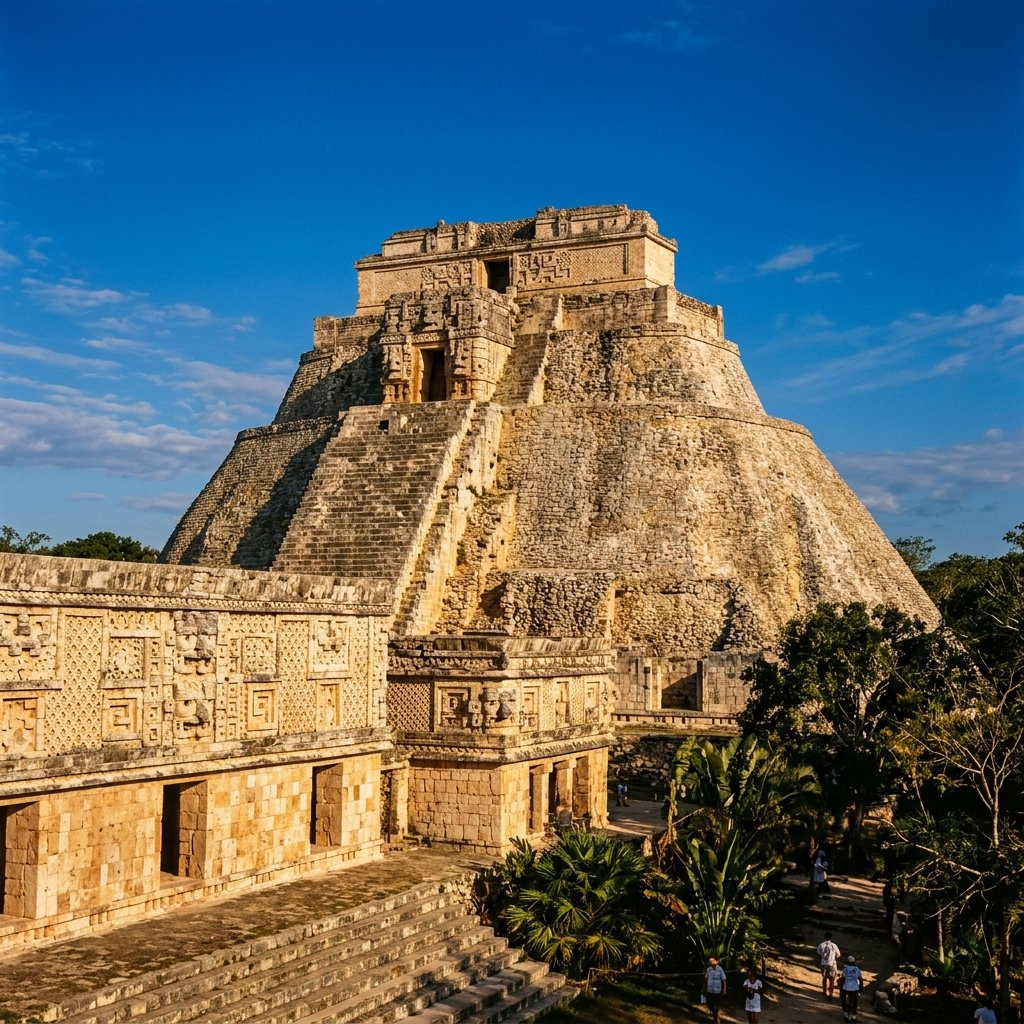
Uxmal at a Glance
Why Architects Consider Uxmal the Most Beautiful Maya City
Among scholars and architects, it is Uxmal — not Chichén Itzá, not Tikal — that is most often cited as the single most beautiful architectural achievement of the ancient Maya. The distinction is important: Tikal impresses through sheer vertical power, Chichén Itzá through mathematical precision, and Palenque through natural grace. But Uxmal achieves something unique: every surface is art.
The Puuc architectural style — named after the low Puuc Hills of the western Yucatán — represents the culmination of Maya building technique. Where other Maya cities decorated their buildings with modeled stucco (which eventually crumbles) or carved relief (limited by the hardness of limestone), Puuc architects invented a radically different approach: stone mosaic facades. Thousands of precisely cut, individually carved stone blocks were assembled like a three-dimensional jigsaw puzzle into elaborate decorative programs — geometric fretwork, stacked deity masks, feathered serpents, and lattice patterns of breathtaking complexity (Kowalski, The House of the Governor: A Maya Palace at Uxmal, Yucatan, Mexico, University of Oklahoma Press, 1987).
The result is architecture that looks woven rather than built — the stone facades resembling frozen textiles. This is not coincidence. Maya scholars believe the Puuc mosaic style deliberately referenced the geometric patterns of woven cotton textiles, the most prestigious trade goods in the Postclassic Maya economy. The buildings wear clothes of carved stone (Andrews, "Architecture of the Puuc Region and the Northern Plains" in The Handbook of Middle American Indians, 1965).
The Architecture: Five Masterworks
The Pyramid of the Magician
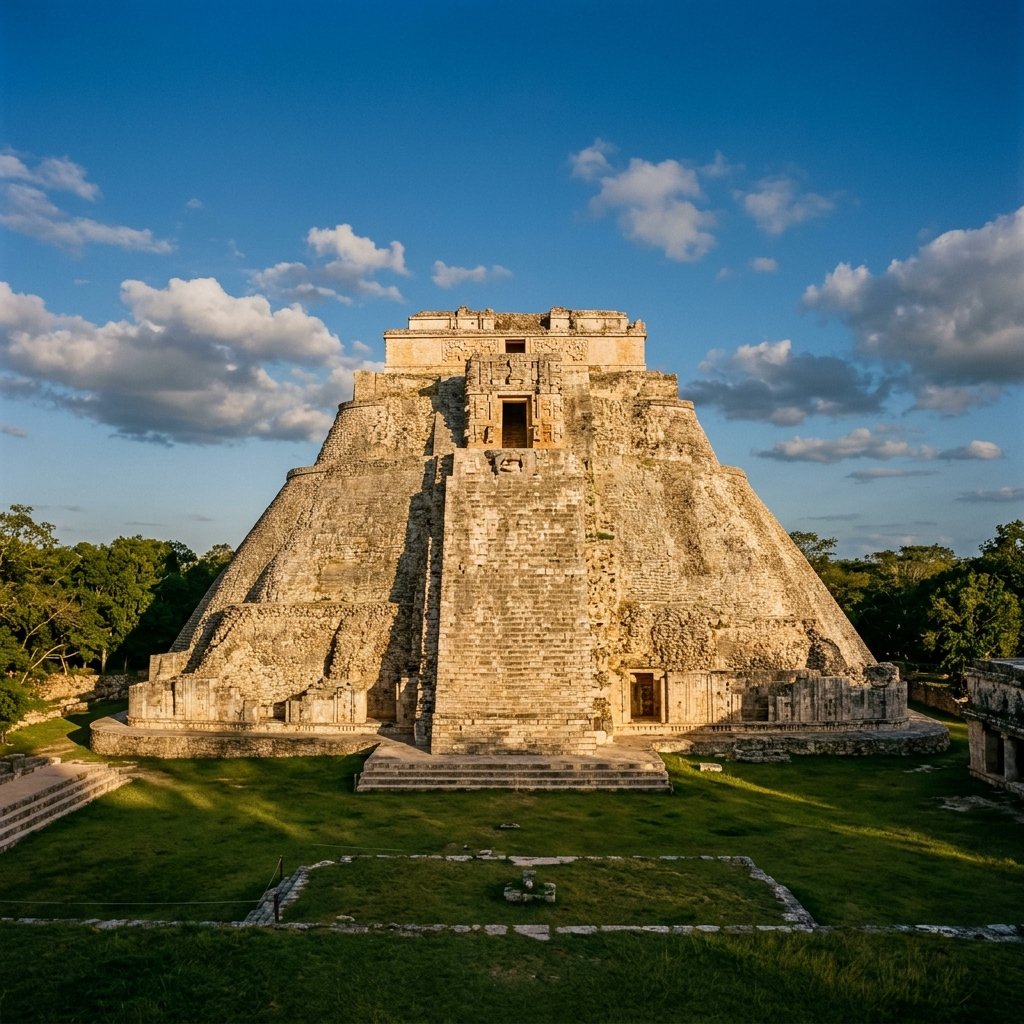
The Pyramid of the Magician — the only major oval-based pyramid in the Maya world. Five construction phases over approximately 300 years created its distinctive organic profile. The western face features a massive Chaac mask doorway where the rain god's open mouth serves as the temple entrance — visitors literally walk into the mouth of a deity.
The Pyramid of the Magician (Pirámide del Adivino) is Uxmal's most immediately striking structure and the only major oval-based pyramid in the Maya world. Where virtually every other Maya pyramid is built on a rectangular plan, this one rises on an elliptical footprint, giving it a distinctive organic, almost biological profile that seems to grow from the earth rather than sit upon it.
Maya legend says the pyramid was built in a single night by a dwarf magician hatched from an egg by a fortune-telling old woman. The archaeological reality is scarcely less remarkable: the pyramid was built in five overlapping construction phases spanning approximately 300 years (c. 600–900 AD), with each new temple built over — but not destroying — its predecessors. Tunnels dug into the structure have revealed the earlier phases nested inside like Russian dolls (Kowalski, 1987).
The western face features the structure's most dramatic element: a massive Chaac mask doorway at the fourth temple level. The rain god's enormous open mouth is the doorway — visitors walking through the entrance literally pass between the deity's jaws. This architectural device — where the building itself becomes the body of a god — is one of the most vivid expressions of Maya sacred architecture, transforming passage through a door into ritual transit between the human and divine worlds.
The Governor's Palace
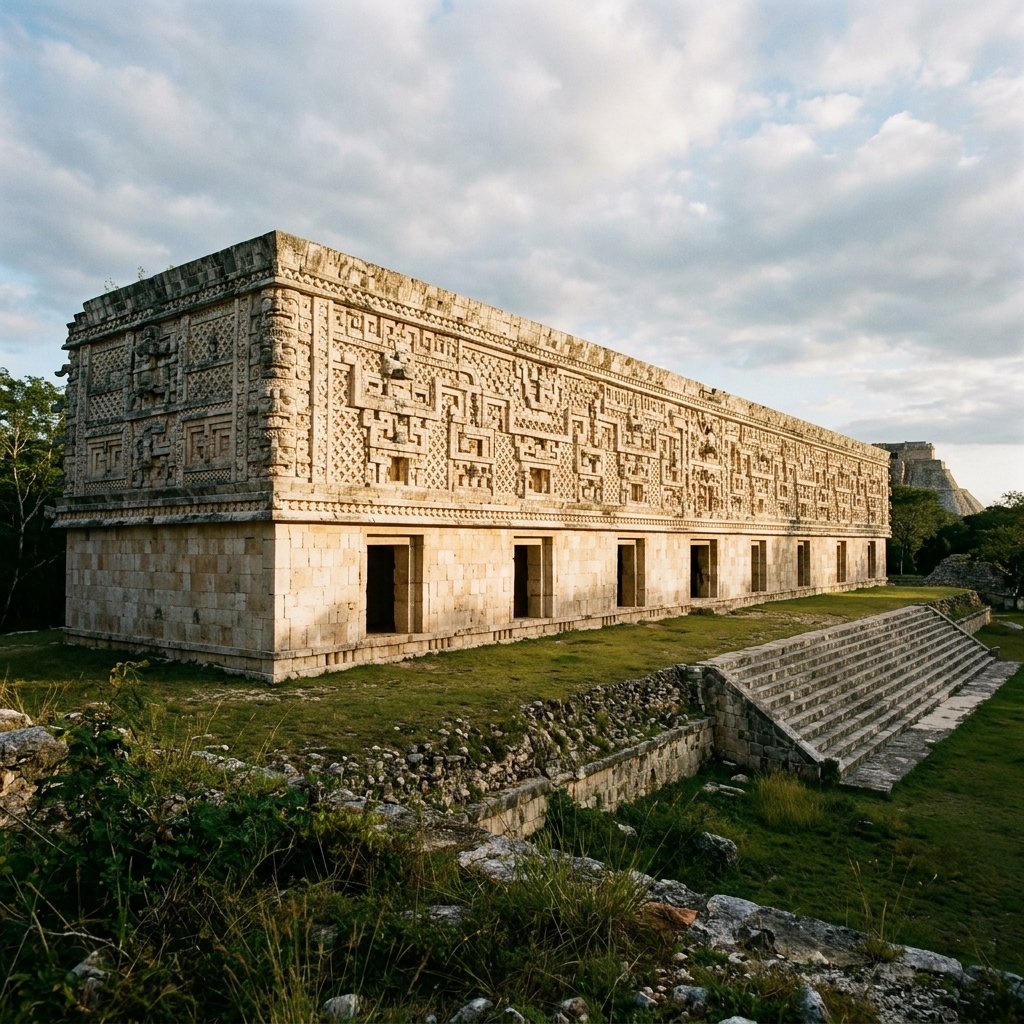
The Governor's Palace — widely considered the finest single building in pre-Columbian architecture. The 98-meter-long facade is composed of 20,000 individually carved stone pieces assembled into an intricate mosaic of geometric fretwork, Chaac masks, and interlocking patterns. The building is precisely aligned with the rise of Venus, connecting its ruler to the planet of war and royal authority.
The Governor's Palace is where Uxmal reaches its absolute summit — and, many scholars argue, where all of pre-Columbian architecture reaches its summit. Architect and historian Sylvanus Morley called it "the most magnificent, the most spectacular single building in all pre-Columbian America." The assessment has been echoed by virtually every scholar since (Morley, The Ancient Maya, Stanford University Press, 1946).
The building stretches 98 meters long atop a massive three-level platform. Its upper facade is composed of approximately 20,000 individually carved stone mosaic pieces — each cut to precise specifications and assembled into a continuous decorative program of stacked Chaac masks, interlocking geometric frets, feathered serpent bands, and lattice patterns of extraordinary complexity. The labor required to carve, transport, and assemble this number of precision-cut stone elements is staggering to contemplate.
The building is also a work of precision astronomy. Archaeoastronomer Anthony Aveni demonstrated that the Governor's Palace is aligned not with the cardinal directions but with the southernmost rising point of Venus — the planet the Maya associated with warfare, sacrifice, and royal legitimacy. A jaguar throne positioned before the building faces the precise point on the horizon where Venus rises at its maximum declination. The building's ruler could literally sit on the throne and watch the war star rise directly before him — a breathtaking fusion of architecture, astronomy, and political theology (Aveni, Skywatchers of Ancient Mexico, 2001).
The Nunnery Quadrangle
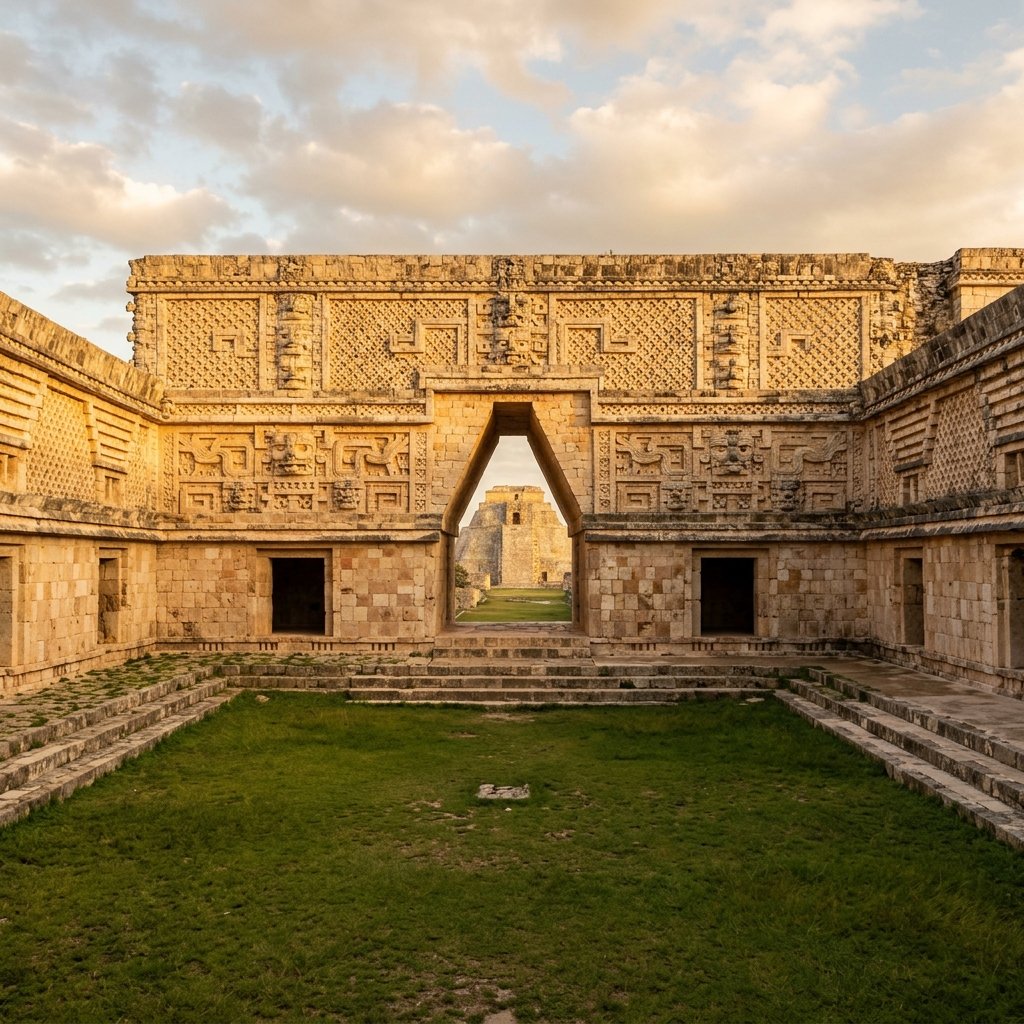
The Nunnery Quadrangle — four buildings of varying heights surrounding a ceremonial courtyard. Each facade is covered in different Puuc mosaic patterns: geometric lattice work, feathered serpents, thatched-hut motifs carved in stone, and stacked Chaac masks. The name was given by the Spanish, who misidentified it; it was likely a royal administrative and ceremonial complex.
The Nunnery Quadrangle (Cuadrángulo de las Monjas) consists of four rectangular buildings arranged around a sunken courtyard — a spatial arrangement that creates an atmosphere of intimate enclosure totally different from the open plazas at most Maya sites. The name is a Spanish misnomer; the complex almost certainly served as a royal administrative and ceremonial center, possibly housing delegations from allied cities for political assemblies or ritual events.
Each of the four buildings is decorated with a different mosaic program, creating a visual encyclopedia of Puuc decorative art. The North Building (the tallest and most elaborately decorated) features stacked Chaac masks, feathered serpents, and what appear to be representations of thatched-roof houses carved in stone — a remarkable detail that immortalizes the humble domestic architecture of ordinary Maya farmers on the facade of an elite palace. The East Building is decorated with trapezoidal geometric motifs; the West with interlocking fret patterns; the South (the simplest) serves as the entry platform through its monumental corbel-arch gateway.
Jeff Karl Kowalski's architectural analysis has shown that the four buildings' heights and decorative programs correspond to the four cardinal directions and their associated cosmic layers — the North Building being tallest because the Maya considered north the direction of the celestial zenith. The entire quadrangle is, in effect, a cosmogram built in stone — a three-dimensional map of the ordered universe (Kowalski, The House of the Governor, 1987).
The Obsession with Chaac: Water, Power, and Survival
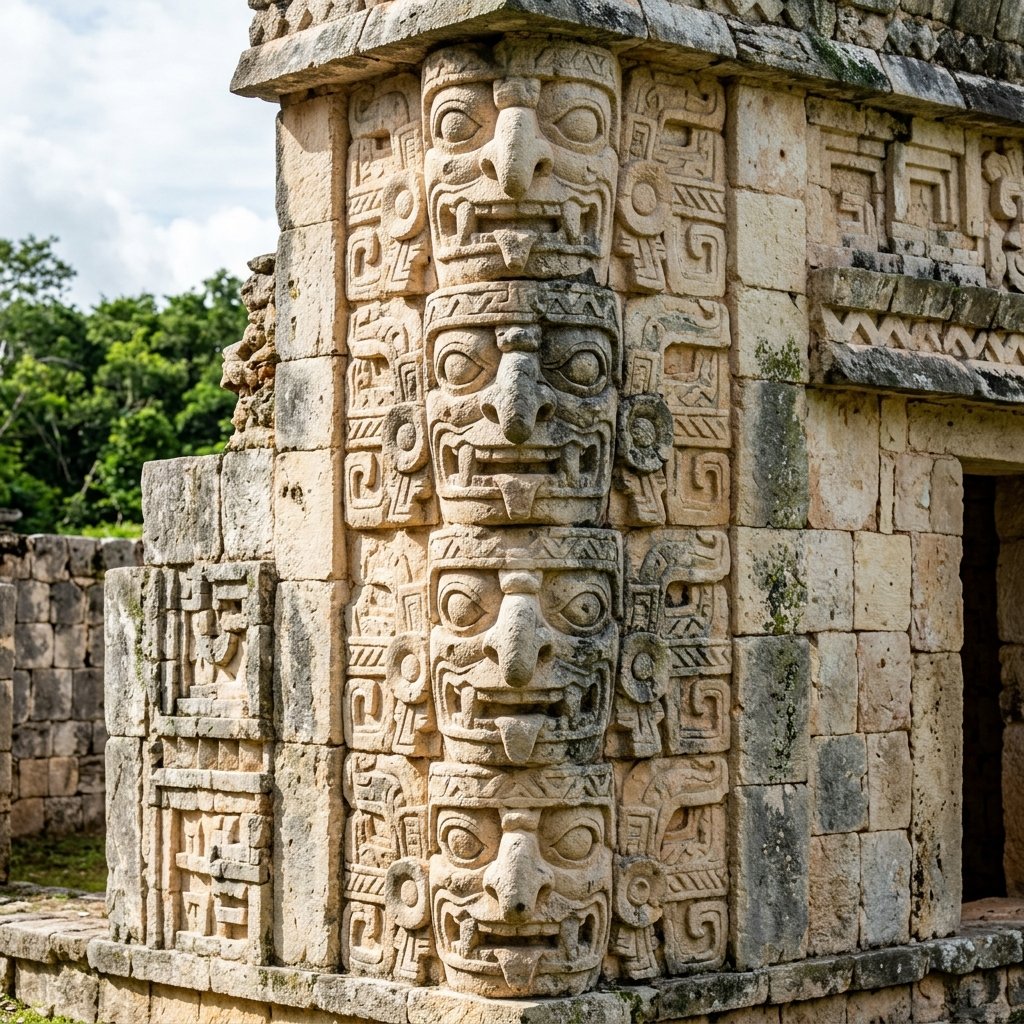
Stacked Chaac masks at a building corner — the defining decorative element of Puuc architecture. Each mask is assembled from dozens of individually carved stone blocks fitted together with extraordinary precision. The long, curving nose hook represents rain. In a city with no natural water source, the rain god was not merely worshipped — the city's survival literally depended on him.
No other Maya city is so dominated by a single deity as Uxmal is by Chaac, the rain god. His distinctive long-nosed mask appears hundreds of times across nearly every major facade — stacked vertically at building corners, embedded in mosaic frieze bands, framing doorways. The obsession is not mere decoration; it reflects a matter of existential survival.
Unlike virtually every other major Maya city, Uxmal has no cenotes, no rivers, and no permanent water source. The flat limestone shelf of the Puuc Hills contains no natural surface water of any kind. The city depended entirely on chultunes — underground cisterns carved into the bedrock to collect rainwater — and on the rain itself. A prolonged drought would have been catastrophic, and many scholars believe that drought did eventually contribute to Uxmal's abandonment around 1000–1100 AD (Dunning, "Environmental Variability and Land Use in the Puuc Region" in The Puuc: New Perspectives, 2009).
In this context, the hundreds of Chaac masks become something more than decoration — they are architectural prayer. Every building is a petition for rain. Every facade is a plea to the god upon whom the entire city's existence depended. The aesthetic beauty of the Puuc style is inseparable from the desperation that drove it.
The Puuc Route: A Network of Lost Cities
Uxmal was not an isolated masterpiece — it was the capital of a network of Puuc-style cities scattered across the low hills south of Mérida. The so-called "Puuc Route" connects several of these sites, and a visit to even one or two of them dramatically enriches the understanding of what Uxmal represented.
Kabah, 22 km southeast of Uxmal, features the Codz Poop ("Palace of the Masks") — a building whose entire facade is covered with hundreds of Chaac masks, so dense that the surface appears to be made entirely of rain god noses. It is connected to Uxmal by a sacbé (raised Maya road), suggesting a formal political relationship between the two cities.
Sayil preserves the Great Palace, a three-story building that is one of the largest residential structures in the Maya world. Labná features the most beautiful corbel arch in Maya architecture — a freestanding gateway decorated with thatched-hut motifs. The Loltún Caves, 30 km from Uxmal, contain Maya paintings and handprints dating back thousands of years, evidence that the Puuc region was inhabited long before the great cities arose (Andrews, 1965).
Practical Travel Guide
Getting There
80 km south of Mérida (1 hour drive). Easy day trip from Mérida. Rental car gives the most flexibility and allows you to combine Uxmal with the Puuc Route cities (Kabah, Sayil, Labná). Second-class buses run from Mérida's TAME terminal.
Best Strategy
Arrive at opening (8 AM) to beat the heat and tour buses. Allow 3–4 hours. The site is open and exposed with little shade — bring water, a hat, and sunscreen. Afternoon light is best for photographing the Governor's Palace facade. Check the light show schedule before planning your return drive.
Light & Sound Show
Uxmal offers an excellent nightly light-and-sound show projected onto the Pyramid of the Magician and Nunnery Quadrangle. Maya creation myths narrated while the buildings glow with colored light. It's a unique experience among Maya ruins — worth staying for if your schedule allows.
The Puuc Route
Combine Uxmal with Kabah (Codz Poop mask facade), Sayil (three-story palace), Labná (exquisite arch), and Loltún Caves. The full route takes a day by car. Each site adds dimension to the Puuc architectural tradition. Kabah alone is worth the 20-minute side trip.
Visitor Comparison
| Feature | Uxmal | Chichén Itzá | Palenque |
|---|---|---|---|
| Best Feature | Governor's Palace / Mosaic | El Castillo / Equinox | Pakal's Tomb / Stucco |
| Decorative Detail | Extraordinary | High | Very High |
| Crowd Level | Low–Moderate | Very High | Moderate |
| Light Show | ✅ Nightly | ✅ Nightly | ❌ No |
| Time Needed | 3–4 hours | 3–5 hours | 3–5 hours |
Key Academic References
- Andrews, George F. "Architecture of the Puuc Region and the Northern Plains." In The Handbook of Middle American Indians, vol. 2. University of Texas Press, 1965.
- Aveni, Anthony F. Skywatchers of Ancient Mexico. University of Texas Press, 2001.
- Dunning, Nicholas P. "Environmental Variability and Land Use in the Puuc Region." In The Puuc: New Perspectives. Archaeopress, 2009.
- Kowalski, Jeff Karl. The House of the Governor: A Maya Palace at Uxmal, Yucatan, Mexico. University of Oklahoma Press, 1987.
- Morley, Sylvanus G. The Ancient Maya. Stanford University Press, 1946.
- Schele, Linda & Freidel, David. A Forest of Kings: The Untold Story of the Ancient Maya. William Morrow, 1990.
Frequently Asked Questions
Is Uxmal better than Chichén Itzá?
For architecture lovers, many scholars say yes. Uxmal's Puuc-style mosaic stonework is more intricate and refined than anything at Chichén Itzá. It's also significantly less crowded. Chichén Itzá has greater historical fame and El Castillo's iconic recognition, but Uxmal offers a more intimate, architecturally rich experience. If you love decorative detail and craftsmanship, Uxmal is unmatched.
What is the Puuc architectural style?
Puuc is a distinctive Maya architectural tradition developed in the low hills of the western Yucatán. Its defining feature is stone mosaic facades — thousands of individually carved stone blocks assembled into intricate geometric patterns, Chaac masks, and lattice work. The technique produces surfaces that look woven rather than built. Uxmal is the supreme expression of the style, but Kabah, Sayil, and Labná are also outstanding examples.
Why are there so many Chaac masks at Uxmal?
Uxmal has no cenotes, rivers, or permanent water source — the city depended entirely on rainfall captured in underground cisterns. Chaac, the rain god, was not merely worshipped; the entire city's survival depended on him. The hundreds of Chaac masks covering virtually every facade are best understood as architectural prayer — a monumental, perpetual plea for the rain that kept the city alive.
What is the Puuc Route?
The Puuc Route connects several lesser-known but architecturally outstanding Maya cities south of Mérida: Kabah (with its extraordinary all-mask facade), Sayil (three-story palace), Labná (the most beautiful Maya arch), and the Loltún Caves. A rental car allows you to visit all of them in a single day combined with Uxmal. Kabah alone is worth the 20-minute side trip from Uxmal.
Is the light show at Uxmal worth seeing?
Yes — it's one of the unique experiences among Maya ruins. Colored light is projected onto the Pyramid of the Magician and Nunnery Quadrangle while Maya creation myths are narrated. The effect of seeing these ancient buildings illuminated against the night sky is genuinely magical. Check current schedules; shows typically begin after sunset and last about 45 minutes.