Key Takeaway
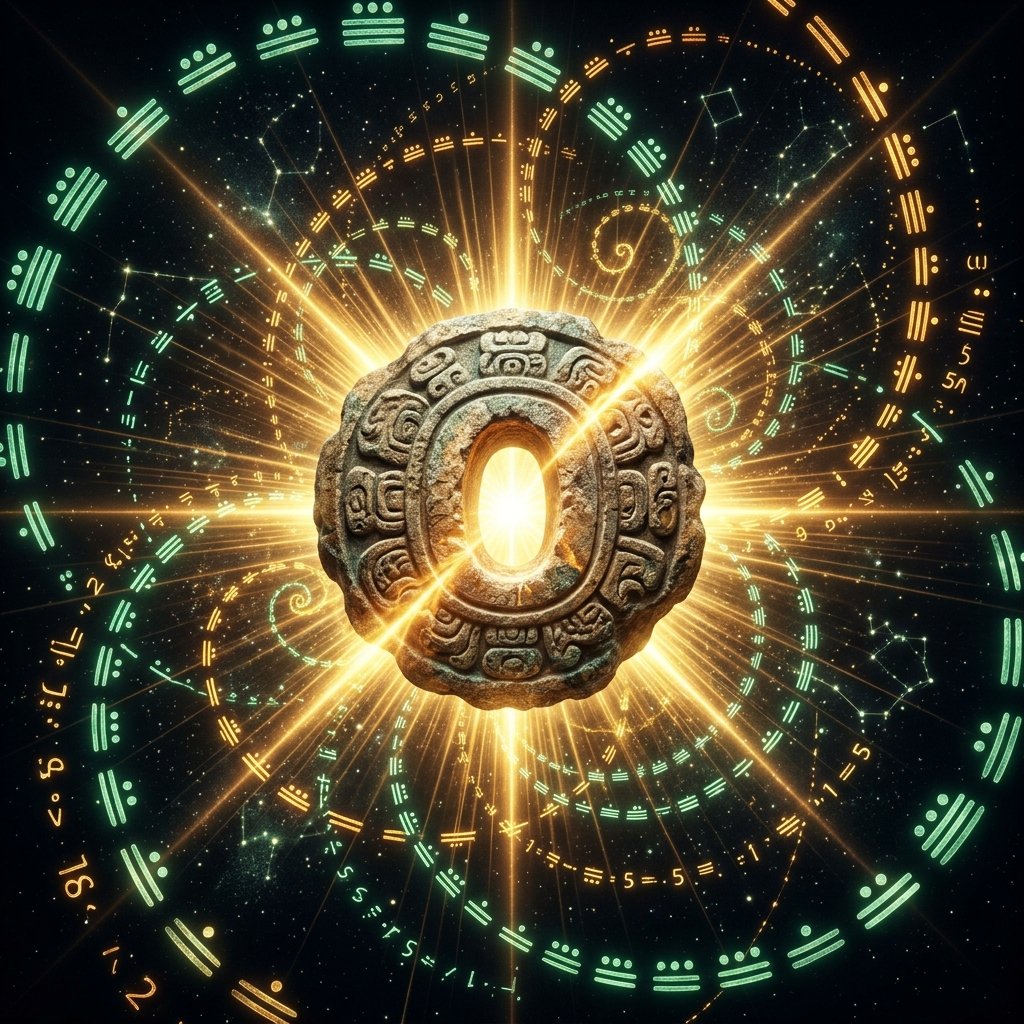
The concept of zero was independently invented only three times in human history: by the Babylonians (circa 300 BC, as a placeholder only), by the Indians (circa 5th–7th century AD, as a full number), and by the Maya (by at least 36 BC, as both placeholder and true numeral). The Maya invention is the earliest documented use of zero as a positional number in the Western Hemisphere — represented by a shell-shaped glyph and functioning exactly as zero operates in our modern decimal system.
Why Zero Matters
To a modern person, zero seems obvious — even trivial. It is anything but. For most of human history, no civilization had the concept of zero. The ancient Greeks — who invented formal geometry, proof-based mathematics, and much of the intellectual foundation of Western science — never developed zero. Neither did the Romans, whose numeral system (I, V, X, L, C, D, M) cannot represent the concept at all.
Zero enables two revolutionary mathematical capabilities:
- Positional notation — the ability to express any number using a fixed set of digits whose value depends on their position (e.g., in "305," the zero indicates no tens). Without zero, you cannot have a compact, scalable number system.
- The number itself — zero as a quantity, as something that can be calculated with. This is philosophically radical: it requires conceiving of "nothing" as "something."
The Three Independent Inventions
| Civilization | Earliest Evidence | Symbol | Type | Base |
|---|---|---|---|---|
| Babylonian | ~300 BC | Two slanted wedges | Placeholder only | Base-60 |
| Maya | 36 BC (Stela C, Tres Zapotes) | Shell glyph 𝍸 | Full positional numeral | Base-20 |
| Indian | ~5th–7th c. AD | Dot → circle (0) | Full number + arithmetic | Base-10 |
Sources: Ifrah, The Universal History of Numbers, 2000; Kaplan, The Nothing That Is, 1999
The Maya Number System
The Maya base-20 (vigesimal) number system used only three symbols:
Numbers were written vertically, with the lowest-order position at the bottom — exactly analogous to how we read multi-digit numbers from right to left. The positions represent powers of 20: the bottom row is 1s, the next is 20s, then 400s (20²), then 8,000s (20³), and so on. This system can express numbers of any size with just three symbols — an elegance that our 10-symbol decimal system cannot match.
The Earliest Known Zero
The earliest confirmed Long Count date containing a positional zero comes from Stela C at Tres Zapotes, Veracruz, Mexico, which records the date 7.16.6.16.18 — corresponding to September 3, 32 BC in the Gregorian calendar. While this monument is from the Epi-Olmec tradition rather than the Maya proper, it uses the same Long Count system that the Maya adopted and refined.
Within the Maya cultural sphere specifically, the earliest known use of the shell-zero appears on Stela 1 at Cobá and in the Dresden Codex's astronomical tables, where zero is essential for the positional notation that makes the Long Count calendar — and therefore all of Maya chronometry — functional.
Zero and the Calendar
Maya zero is not merely a mathematical abstraction — it is structurally necessary for their calendar system. The Long Count expresses dates as five-digit numbers (e.g., 9.15.0.0.0), where zeros indicate "completion" of a cycle. The date 13.0.0.0.0 — the completion of the 13th Baktun that caused the 2012 media frenzy — is fundamentally a number full of zeros, representing a grand cosmological reset.
As mathematician Robert Kaplan observed, the Maya concept of zero perfectly illustrates how "nothing" can be the most powerful number of all — it is the pivot around which their entire intellectual architecture rotates (Kaplan, The Nothing That Is: A Natural History of Zero, 1999).
Why Europe Was Late
Zero did not arrive in Europe until the 13th century AD, when Fibonacci introduced the Hindu-Arabic numeral system (including zero) via his Liber Abaci (1202). Even then, zero was met with suspicion and resistance — Florence banned Hindu-Arabic numerals from accounting records in 1299, fearing that the unfamiliar "0" could be easily forged into a "6" or "9."
By the time Europe adopted zero, the Maya had been using it for over 1,200 years.
Frequently Asked Questions
Did the Maya really invent zero before Europe?
Yes. The earliest evidence of Maya positional zero dates to at least the 1st century BC — over 1,300 years before zero reached Europe through the transmission of Indian mathematics via the Islamic world. The Maya invention was entirely independent of developments in India and Babylon.
Is the Maya zero the same as our zero?
Functionally, yes — it serves the same positional role in base-20 that our "0" serves in base-10. However, the Maya zero also carried philosophical and cosmological significance that our mathematical zero does not: it represented "completion" of a cycle rather than mere emptiness. In the calendar, zero meant "fullness," not "nothing."
References & Further Reading
- Kaplan, R. (1999). The Nothing That Is: A Natural History of Zero. Oxford University Press.
- Ifrah, G. (2000). The Universal History of Numbers: From Prehistory to the Invention of the Computer. Wiley.
- Seife, C. (2000). Zero: The Biography of a Dangerous Idea. Viking.
- Sharer, R. J. & Traxler, L. P. (2006). The Ancient Maya. 6th ed. Stanford UP. (Ch. 14: "Maya Intellectual Culture")
- Justeson, J. S. & Kaufman, T. (1993). "A Decipherment of Epi-Olmec Hieroglyphic Writing." Science, 259(5102), 1703–1711.