God L at a Glance
The Most Vivid Character in Maya Art
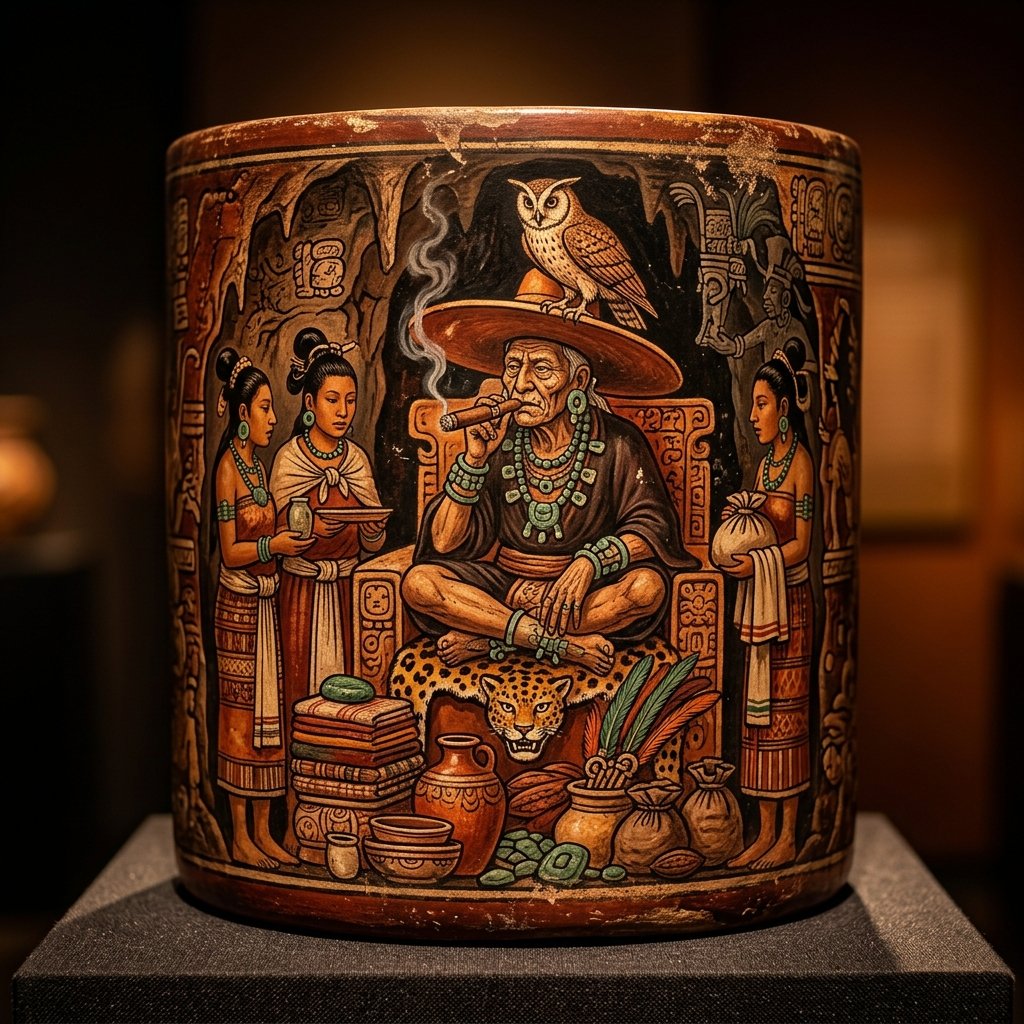
Some Maya deities are known primarily through inscriptions and scholarly reconstruction. God L is known through pictures — and what pictures they are. He is arguably the most visually distinctive and characterful deity in the entire Maya pantheon: an elderly, imperious underworld lord who sits on a jaguar-pelt throne, wears a magnificent broad-brimmed hat with a Muan owl perched on top, smokes a fat cigar, and is surrounded by tribute goods and beautiful female attendants.
He looks, frankly, like a mob boss — and that's not entirely wrong. God L is the lord of underworld wealth, the supernatural figure who controls the riches hidden beneath the earth: jade, obsidian, cacao, and minerals. He is the patron of merchants and long-distance traders, and his imagery emphasizes the connection between wealth, darkness, and power.
The Diagnostic Features
The Broad-Brimmed Hat
God L's most recognizable attribute is his enormous wide-brimmed hat — unique among Maya deities. The hat is often decorated with feathers, and atop it sits the Muan owl. The broad brim may represent the sky-band seen from below — from the underworld, the sky appears as a distant disc overhead — or it may simply be the marker of a wealthy merchant, as broad-brimmed hats appear in Maya art on merchant figures.
The Muan Owl
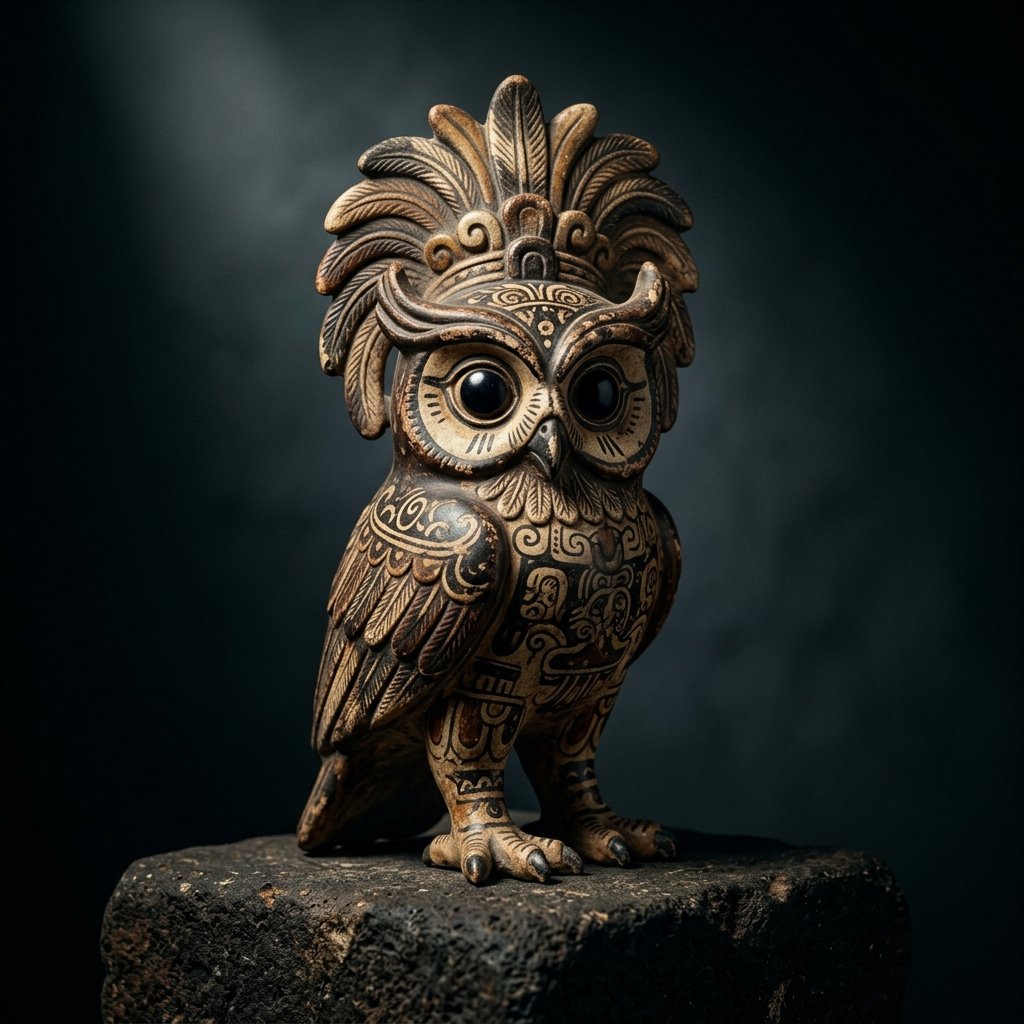
The Muan owl is God L's familiar spirit and messenger. In Maya cosmology, owls were birds of the underworld — their nocturnal habits, haunting calls, and association with dark places made them natural emissaries of the death realm. The Popol Vuh describes four owl messengers sent by the Lords of Xibalba to summon the Hero Twins' father to the underworld.
The Cigar
God L is almost always depicted smoking — holding a large, lit cigar that trails smoke. Tobacco (Nicotiana rustica and N. tabacum) was a sacred substance in Maya ritual, used for purification, communication with the supernatural world, and offerings. God L's cigar emphasizes his supernatural status and his connection to the smoke-filled darkness of the underworld.
The Vase of the Seven Gods
God L's most important appearance is on the famous "Vase of the Seven Gods" (Kerr number K2796) — a polychrome ceramic vessel that depicts a creation scene. In this image:
- God L sits enthroned in a darkened chamber — the interior of the underworld
- Before him stand six other deities, including identifiable gods from the Maya pantheon
- A Long Count date of 13.0.0.0.0 4 Ajaw 8 Kumk'u is painted on the vessel — the creation date of the current world age (August 13, 3114 BC)
- The scene appears to depict the moment of creation itself — with God L presiding over the assembly of gods who will bring the new world into being
This placement of God L at creation is remarkable. It suggests that the underworld lord was not merely a secondary figure but a primordial deity present at the foundation of the cosmos. Darkness existed before light; the underworld existed before the surface world; and God L ruled that original darkness (Miller, M. & Martin, S., Courtly Art of the Ancient Maya, 2004, pp. 58–63).
God L's Humiliation
Despite his power, God L does not escape unscathed in Maya myth. On several Classic-period ceramics, he is depicted being stripped of his clothing and possessions by the young Moon Goddess (Goddess I) — specifically, scenes show the Rabbit Scribe (a mythological trickster figure) stealing God L's clothes and hat while the Moon Goddess watches or participates.
This "stripping" narrative parallels the defeat of Vucub Caquix — both are powerful, arrogant figures who are brought low through trickery rather than force. The theological message: even the lord of the underworld is not immune to humiliation, and cosmic power must eventually be redistributed.
References
- Miller, M. & Martin, S. Courtly Art of the Ancient Maya. Fine Arts Museum of San Francisco / Thames & Hudson, 2004.
- Taube, K. The Major Gods of Ancient Yucatan. Dumbarton Oaks, 1992.
- Kerr, J. (ed.) The Maya Vase Book, Vols. 1–6. Kerr Associates, 1989–2000.
- Martin, S. "Cacao in Ancient Maya Religion: First Fruit from the Maize Tree and Other Tales from the Underworld." In McNeil, C. (ed.), Chocolate in Mesoamerica, University Press of Florida, 2006.
- Coe, M.D. The Maya. Thames & Hudson, 9th edition, 2015.
Frequently Asked Questions
Who is God L?
God L is one of the most distinctive deities in Maya art — an elderly underworld merchant lord who sits on a jaguar-pelt throne, wears a broad-brimmed hat with an owl on top, and smokes a fat cigar. He controls the wealth hidden beneath the earth (jade, obsidian, cacao) and is associated with long-distance trade, darkness, and the original creation of the world. His Maya name is still debated; "God L" is his Schellhas letter designation.
Why is God L shown smoking?
Tobacco was a sacred substance in Maya ritual — used for purification, supernatural communication, and offerings to the gods. God L's cigar is not recreational; it signals his supernatural status and his connection to the smoke-filled darkness of the underworld. Tobacco smoke was believed to carry messages between the human and divine worlds, and its association with God L reinforces his role as a mediator between the surface world and the realm below.
What is the Vase of the Seven Gods?
The "Vase of the Seven Gods" (K2796) is one of the most important ceramics in Maya art. It depicts God L enthroned in the underworld, presiding over an assembly of six other deities at the moment of the current creation (dated 13.0.0.0.0 — August 13, 3114 BC). The scene suggests that God L was present at the foundation of the cosmos, ruling the primordial darkness from which the created world emerged.