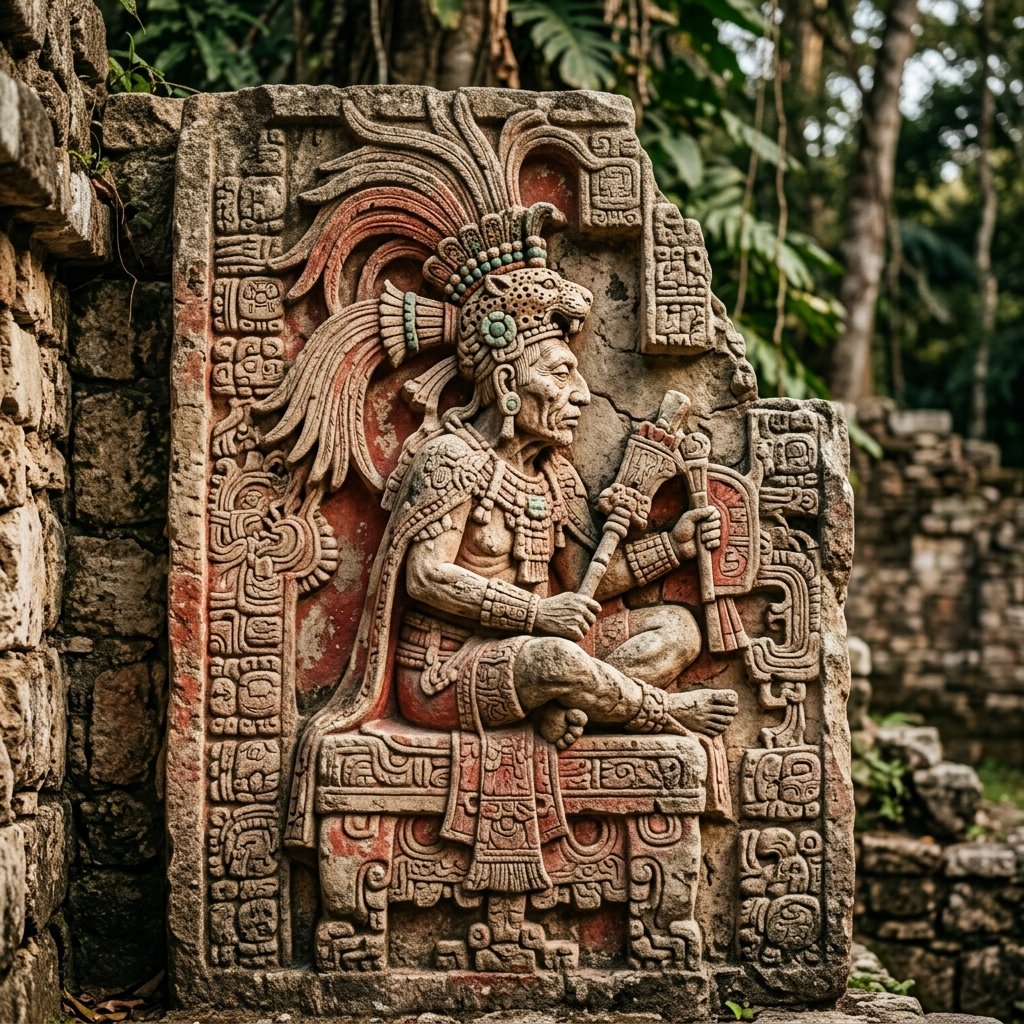
Itzamná at a Glance
"He was there before the world was made. He invented writing so the Maya could record their history, the calendar so they could measure time, medicine so they could heal, and agriculture so they could eat. And then, having given them everything they needed to build a civilization, he sat down on the throne of heaven and watched them do it."
The Invisible Supreme: Why You Haven't Heard of Itzamná
If you asked a casual reader to name a Maya god, they would almost certainly say Kukulkán — the Feathered Serpent, whose pyramid at Chichén Itzá draws millions of visitors annually. Or perhaps Chaac, whose long-nosed masks dominate the architecture of the Puuc region. Itzamná is rarely the first name mentioned — and this is paradoxical, because in the theological hierarchy of the Maya pantheon, Itzamná sits at the very top.
The reason for this obscurity is revealing. Itzamná was so supreme, so fundamental, so architecturally embedded in the structure of the cosmos itself, that he became almost invisible — like the sky. You don't worship the sky; you live under it. You don't pray to the foundation of your house; you stand on it. Itzamná was the cosmic given — the background condition that made everything else possible. As the Mayanist Karl Taube notes, "Itzamná is probably the most important Classic Maya deity, yet he remains one of the most poorly understood" (Taube, K., The Major Gods of Ancient Yucatan, Dumbarton Oaks, 1992, p. 31).
While Chaac was the "god of the common man" to whom farmers prayed daily, Itzamná was the god of priests, scribes, kings, and scholars — the learned elite who understood the deeper theological framework. He was the patron of the specialized knowledge class that made Maya civilization extraordinary: its astronomers, mathematicians, calendar keepers, physicians, and authors.
The Name: "Iguana House" and the Cosmic Reptile
The name Itzamná is generally interpreted as deriving from itzam (iguana, caiman, or large lizard) + na (house) — literally "Iguana House" or "Lizard House." This is not a quirky animal association but a profound cosmological statement. In Maya thought, the sky itself was the body of a colossal cosmic reptile — the Itzam Cab Ain — whose arched body formed the dome of the heavens, whose open jaws framed the eastern and western horizons, and along whose back the sun traveled each day.
Itzamná was the consciousness or spirit of this cosmic being. He didn't merely live in the sky; he was the sky — or more precisely, he was the divine intelligence that animated it. The archaeologist J. Eric S. Thompson was among the first to elaborate this interpretation, writing that "Itzamná was the sky in its totality — the great celestial dragon whose body arched across the four directions and whose substance was simultaneously heaven, earth, and water" (Thompson, J.E.S., Maya History and Religion, University of Oklahoma Press, 1970, pp. 209–233).
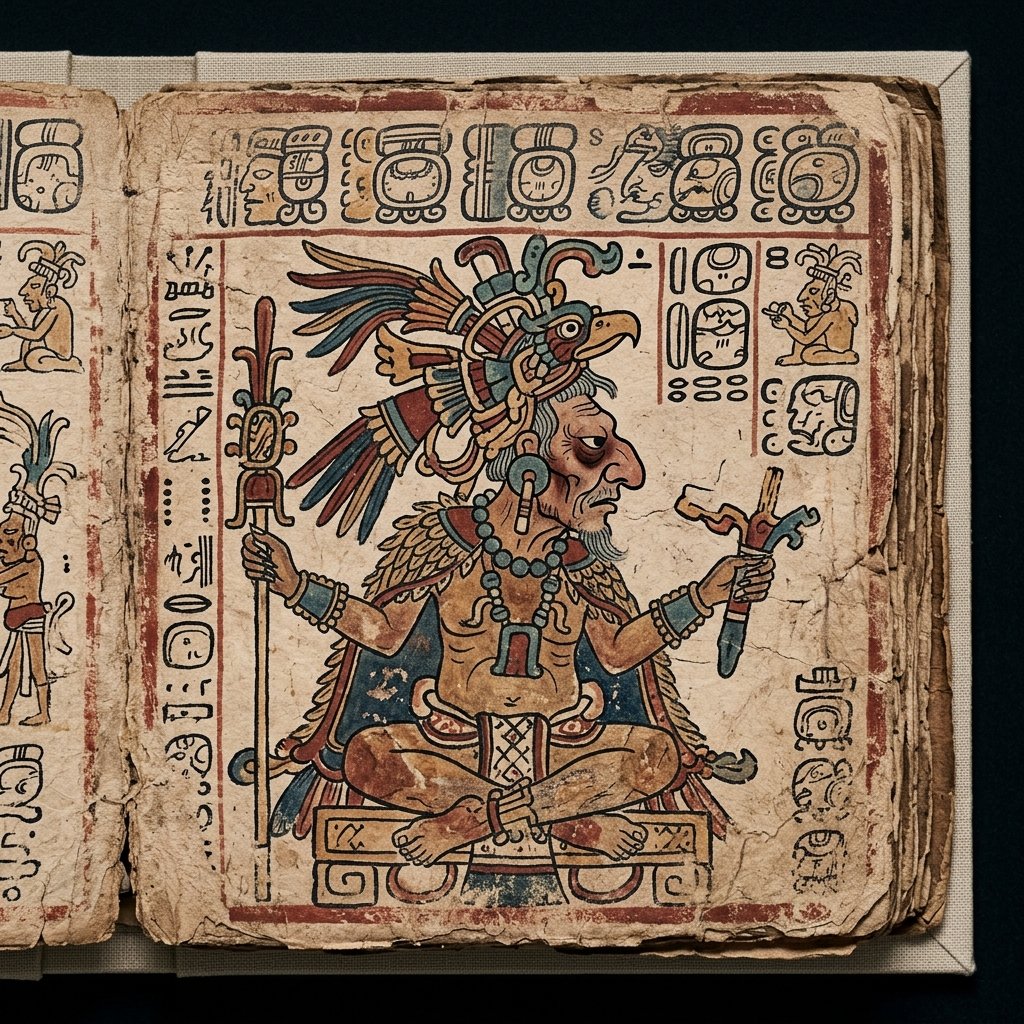
Itzamná (God D) as depicted in codex-style Maya painting. Note the diagnostic features: the aged, wrinkled face representing primordial wisdom, the prominent Roman nose, the single visible tooth (sometimes showing the "Ik" wind glyph), and the elaborate headdress signifying supreme divine authority. His old age is not a sign of weakness — it represents unimaginable antiquity. He was there at the beginning.
Iconography: How to Recognize Itzamná
In the Schellhas classification system, Itzamná is designated God D. His diagnostic features in the codices and on painted ceramics include:
Physical Traits
- Aged, wrinkled face — representing primordial wisdom and extreme antiquity
- Large, Roman-style nose — one of his most distinctive profile features
- Sunken cheeks and squinting eyes — the face of ancient knowledge
- Single prominent tooth — sometimes bearing the "Ik" (wind/breath) glyph
- Square, bearded chin — unusual in Maya art where beards are rare
Attributes & Symbols
- Codex or book — signifying his invention of writing and his role as lord of knowledge
- Celestial throne — often depicted seated in authority above the cosmos
- Flower or offering — sometimes depicted distributing gifts to humanity
- "Akbal" (night/darkness) motifs — on his body, indicating his dominion over the cosmic cycle
- Bird headdress — sometimes featuring the Principal Bird Deity (Itzam Ye)
Inventor of Civilization
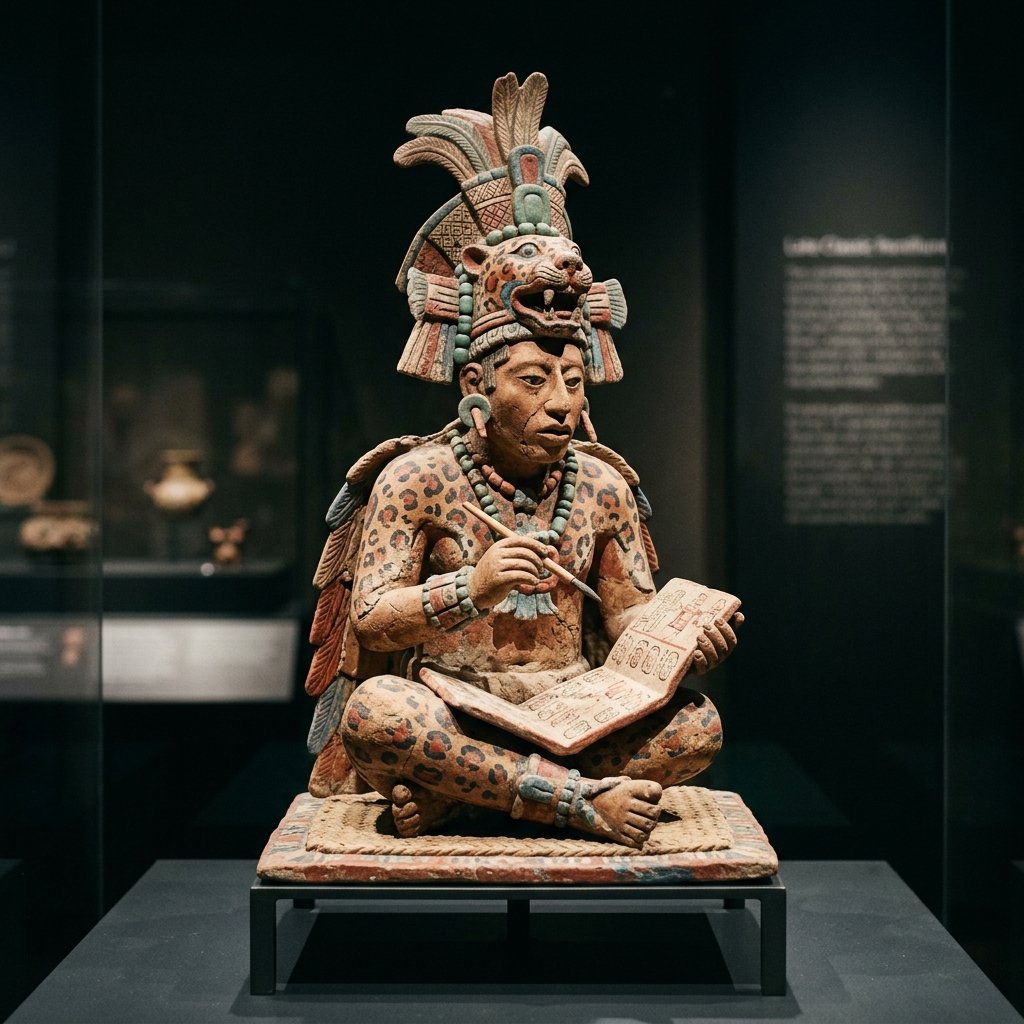
A Maya ceramic figurine depicting a scribe — one of the specialized elite practitioners patronized by Itzamná. Maya scribes (aj tz'ib, "he of the writing") were among the most prestigious members of Classic Maya society, and they attributed their art directly to Itzamná's patronage. Writing was understood not as a human invention but as a divine gift.
The Maya credited Itzamná with inventing the foundational technologies of their civilization. This was not merely mythological embellishment — it reflects a genuine theological conviction that human knowledge originates in the divine, and that the specialized skills of the literate elite were sacred gifts requiring proper ritual maintenance.
Hieroglyphic Writing
The Maya developed the only fully phonetic writing system in the pre-Columbian Americas — a script of approximately 800 glyphs capable of recording any word in their language. This achievement was attributed to Itzamná, making writing itself a sacred technology. The patron deity of scribes was a specific aspect of Itzamná known as God N or the Monkey Scribes (the Hero Twins' older brothers in the Popol Vuh, transformed into howler monkeys by divine decree).
The Calendar System
The Maya calendar — arguably the most sophisticated timekeeping system of the ancient world — was credited to Itzamná. This includes the 260-day Tzolk'in, the 365-day Haab', and the Long Count that tracked historical time across millennia. The calendar was not merely a practical tool but a cosmic map revealing the divine pattern underlying all of reality.
Medicine & Healing
Maya medical knowledge was remarkably sophisticated, including herbal pharmacology, bone setting, dental work, and surgical procedures. All of this was understood as flowing from Itzamná's divine gift. Bishop Diego de Landa recorded that during the month of Zip, Maya priests and healers gathered to honor Itzamná as the patron of medicine, consulting sacred books to determine treatments (de Landa, Relación, c. 1566).
Agriculture
The techniques of maize cultivation — the foundation of Maya survival — were divine gifts. While the Maize God embodied the corn itself and Chaac provided the rain, it was Itzamná who gave humanity the knowledge of how to clear, plant, tend, and harvest. Knowledge, not merely resources, was his domain.
Izamal: The Golden City
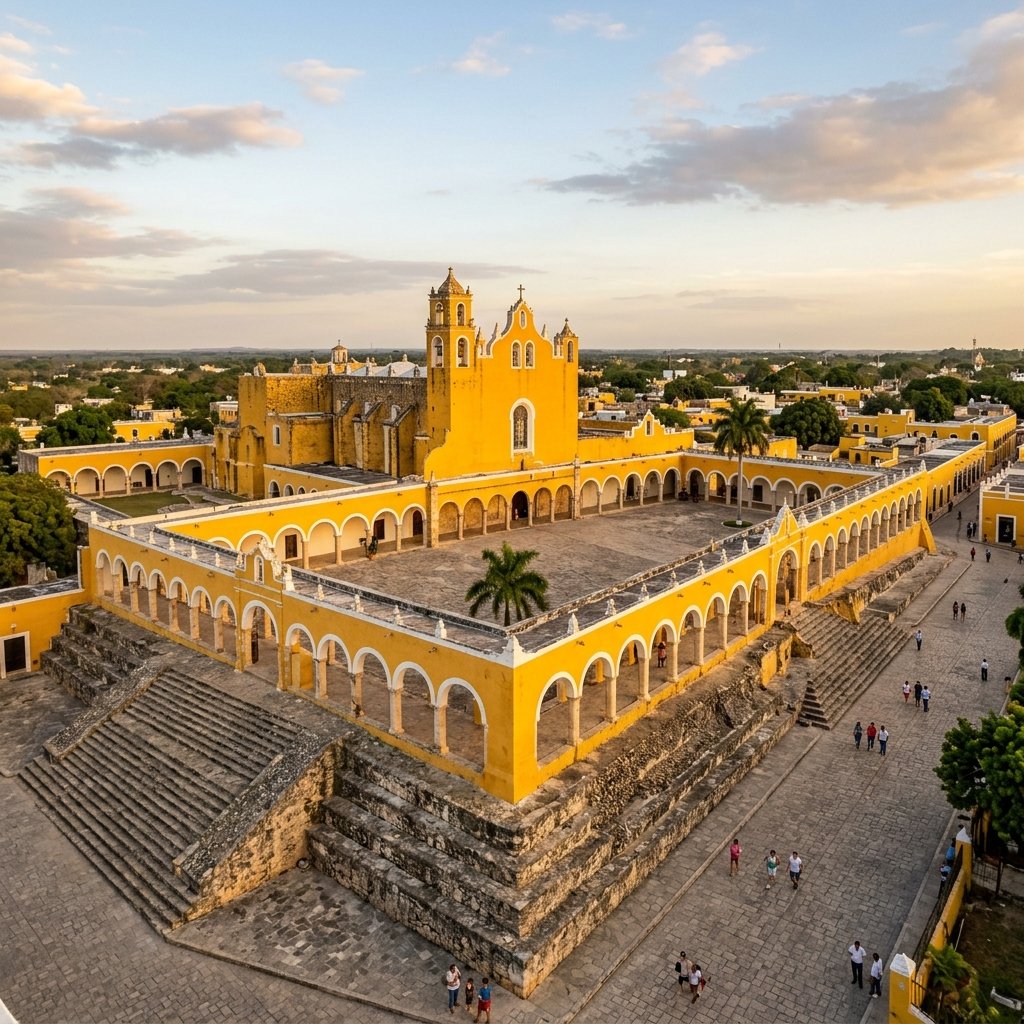
The Franciscan Convent of San Antonio de Padua in Izamal, Yucatan, built directly on top of the ancient Maya pyramid platform of Ppapp Hol Chac — one of the major temple pyramids dedicated to Itzamná. The golden-yellow color that now characterizes Izamal echoes the solar and celestial associations of the creator god whose presence still defines this city after more than a millennium.
Izamal, located in the interior of the Yucatan Peninsula, was Itzamná's primary cult center — one of the most important pilgrimage destinations in the Maya world. The city contained at least four enormous pyramid complexes, the largest of which — Kinich Kak Moo ("Fire Macaw with a Solar Face") — was one of the biggest structures on the Yucatan Peninsula, with a base footprint larger than that of El Castillo at Chichén Itzá.
According to Bishop Diego de Landa, who documented Maya religion in considerable detail before helping to destroy its textual record, the Maya believed that Itzamná had literally walked the earth at Izamal — that he had once manifested in human form there and founded the city as a center of healing and learning. "They say that the lords of Izamal were very just and that there came to them a great number of sick people from all parts, and that he cured them, laying his hands on them" (de Landa, D., Relación de las cosas de Yucatán, c. 1566; translated by A. Tozzer, Peabody Museum Papers, Vol. 18, 1941, p. 159).
After the Spanish conquest, the Franciscan friars recognized Izamal's sacred importance and deliberately built one of the largest monastery complexes in the Americas directly on top of the Ppapp Hol Chac pyramid platform — a colonial strategy of architectural domination that nonetheless preserved the site's significance as a pilgrimage destination. Today, Izamal remains a major Catholic pilgrimage city, its golden-yellow colonial architecture glowing above the ancient Maya foundation that has never ceased to attract the faithful.
Itzamná and Ix Chel: The Cosmic Couple
Itzamná's consort is Ix Chel, the moon goddess and lady of medicine, fertility, and weaving. Together they represent the cosmic masculine and feminine — sky and earth, sun and moon, knowledge and intuition, the visible and the hidden. Their union is not merely a domestic arrangement among gods; it is the generative principle of the cosmos itself.
Where Itzamná represents articulated knowledge — writing, calendar computation, formalized healing — Ix Chel represents embodied wisdom — fertility, biological cycles, textile creation, and the intuitive arts. Neither is complete without the other. The Maya understood the universe as requiring both the architectonic intelligence of the sky (Itzamná) and the fertile creative power of the earth and moon (Ix Chel) to function. This complementarity extended to their cult centers: Itzamná's was inland at Izamal; Ix Chel's was coastal at Cozumel — two sacred poles of a unified spiritual geography.
Itzamná in the Classic Period: The Hidden King of Kings
During the Classic period (250–900 AD), when Maya art and architecture reached their zenith, Itzamná was ubiquitous but often covert in the visual record. He appears less frequently as a standalone figure than Chaac or the Maize God — but his presence permeates the entire iconographic system.
Classic Maya kings frequently depicted themselves channeling Itzamná's power through bloodletting rituals and ceremonial performances. Royal titles in many cities incorporated the name or attributes of Itzamná, and the cosmic caiman — his zoomorphic form — appears on carved lintels, ceramic vessels, and monumental sculpture across the Maya lowlands. The paleographer David Stuart has demonstrated that Itzamná's name glyph appears embedded within royal name strings at sites including Palenque, Copán, and Tikal, suggesting that kings claimed a direct spiritual connection to the creator god as a basis for their political authority (Stuart, D., "The Fire Enters His House: Architecture and Ritual in Classic Maya Texts," in Function and Meaning in Classic Maya Architecture, Harvard University Press, 1998, pp. 373–425).
The Ritual Calendar: Honoring Itzamná
Several months of the Haab' solar calendar were specifically associated with Itzamná worship. Bishop de Landa provides the most detailed colonial accounts:
- Month of Uo (Wo): Priests performed ceremonies honoring Itzamná as the inventor of arts and sciences. Sacred books were consulted to determine omens for the coming year. Copal incense was burned and prayers offered to "Itzamná Kauil," Itzamná in his aspect as the giver of knowledge.
- Month of Zip (Sip): Itzamná was honored as the patron of medicine. Priests, herbalists, and healers gathered to invoke his blessing on their practices, opening their sacred medical texts and renewing their connection to divine healing knowledge.
- Month of Mac (Mak): A special ceremony was performed for Itzamná and the rain god Chaac together, emphasizing the connection between cosmic knowledge (Itzamná) and the practical delivery of rain (Chaac). Elderly men performed the rituals while young boys stood ready — a symbolic transfer of knowledge across generations.
Legacy: The Enduring Presence of the Creator
Itzamná's legacy extends far beyond his role in ancient Maya theology. He represents a civilization's deepest conviction that knowledge is sacred — that writing, mathematics, astronomy, medicine, and agriculture are not merely practical skills but divine gifts requiring ritual care and intellectual humility to maintain.
In contemporary Maya communities, Itzamná's specific name and cult have been largely absorbed into syncretic Catholic traditions — but his function persists. The Maya reverence for books, for calendar knowledge, for herbal medicine, and for the specialized wisdom of the h-men (ritual specialist) echoes the creator god's ancient patronage of human learning. Every time a K'iche' daykeeper consults the Tzolk'in calendar to determine a propitious date, or a Yucatec herbalist invokes traditional knowledge to prepare a remedy, they are performing an act whose theological foundation was laid by the god who sat at the top of the Maya cosmos and gave his children the tools to build a civilization.
References
- de Landa, D. Relación de las cosas de Yucatán. c. 1566. Translated by A. Tozzer. Peabody Museum Papers, Vol. 18. Harvard University, 1941.
- Stuart, D. "The Fire Enters His House: Architecture and Ritual in Classic Maya Texts." In Function and Meaning in Classic Maya Architecture. Harvard University Press, 1998.
- Stuart, D. "Hieroglyphs on Maya Vessels." The Maya Vase Book, Vol. 1. Kerr Associates, 1989.
- Taube, K. The Major Gods of Ancient Yucatan. Dumbarton Oaks, 1992.
- Thompson, J.E.S. Maya History and Religion. University of Oklahoma Press, 1970.
- Schellhas, P. Representation of Deities of the Maya Manuscripts. Harvard University, Peabody Museum Papers, Vol. 4, No. 1, 1904.
Frequently Asked Questions
Is Itzamná the most powerful Maya god?
In terms of cosmic authority, yes — Itzamná sits at the pinnacle of the Maya theological hierarchy as the supreme creator. He is the inventor of writing, the calendar, medicine, and agriculture — the founding technologies of civilization itself. However, in terms of popular worship and everyday importance among commoners, Chaac (rain) and Kukulkán (the Feathered Serpent) were more prominent in daily life. Itzamná was primarily the god of the literate, priestly, and royal elite — the patron of specialized knowledge rather than agricultural survival.
Why is Itzamná shown as old?
His aged appearance represents primordial wisdom, not decline. Itzamná was there at the creation of the world — he is the oldest of all beings, the first consciousness in the cosmos. In Maya culture, age equaled accumulated knowledge and authority. His wrinkled face, sunken cheeks, and single tooth are signs of a being so ancient that he predates everything else in existence. His decrepitude is a mark of supreme power, not weakness.
What is Itzam Cab Ain?
Itzam Cab Ain ("Iguana-Earth-Caiman") is the cosmic reptile whose body the Maya conceived as forming the structure of the sky. This enormous celestial crocodile or iguana arched across the heavens, its jaws forming the eastern and western horizons, its back serving as the pathway along which the sun traveled each day. Itzamná was the consciousness or spirit of this cosmic being — he didn't merely live in the sky; he was the sky in its totality.
Where was Itzamná worshipped?
Itzamná's primary cult center was Izamal, a major Maya pilgrimage city in the interior of the Yucatan Peninsula. The city contained at least four enormous pyramid complexes, the largest of which had a base footprint exceeding El Castillo at Chichén Itzá. After the Spanish conquest, the Franciscans built a massive convent directly on top of one of Itzamná's pyramid platforms — the golden-yellow Convent of San Antonio de Padua — which remains a major Catholic pilgrimage site today.