The Ballgame at a Glance
The Mythological Foundation
The Maya ballgame was not invented as entertainment. According to the Popol Vuh, it was established at the beginning of time when the Hero Twins — Hunahpu and Xbalanque — played against the Lords of Death in Xibalba, the underworld.
In the myth, the ballgame is the arena where the fate of the cosmos is decided. The Hero Twins' father, One Hunahpu, was summoned to Xibalba to play and was killed by the Lords of Death. His sons later descended to avenge him, ultimately defeating the death gods through cunning rather than athletic prowess — and then ascending to become the sun and moon.
Every ballgame played on a Maya court was understood as a ritual reenactment of this primordial contest. The court was not simply a playing field — it was the boundary between the world of the living and the world of the dead (Miller & Houston, "The Classic Maya Ballgame and Its Architectural Setting," RES, 1987).
The Court
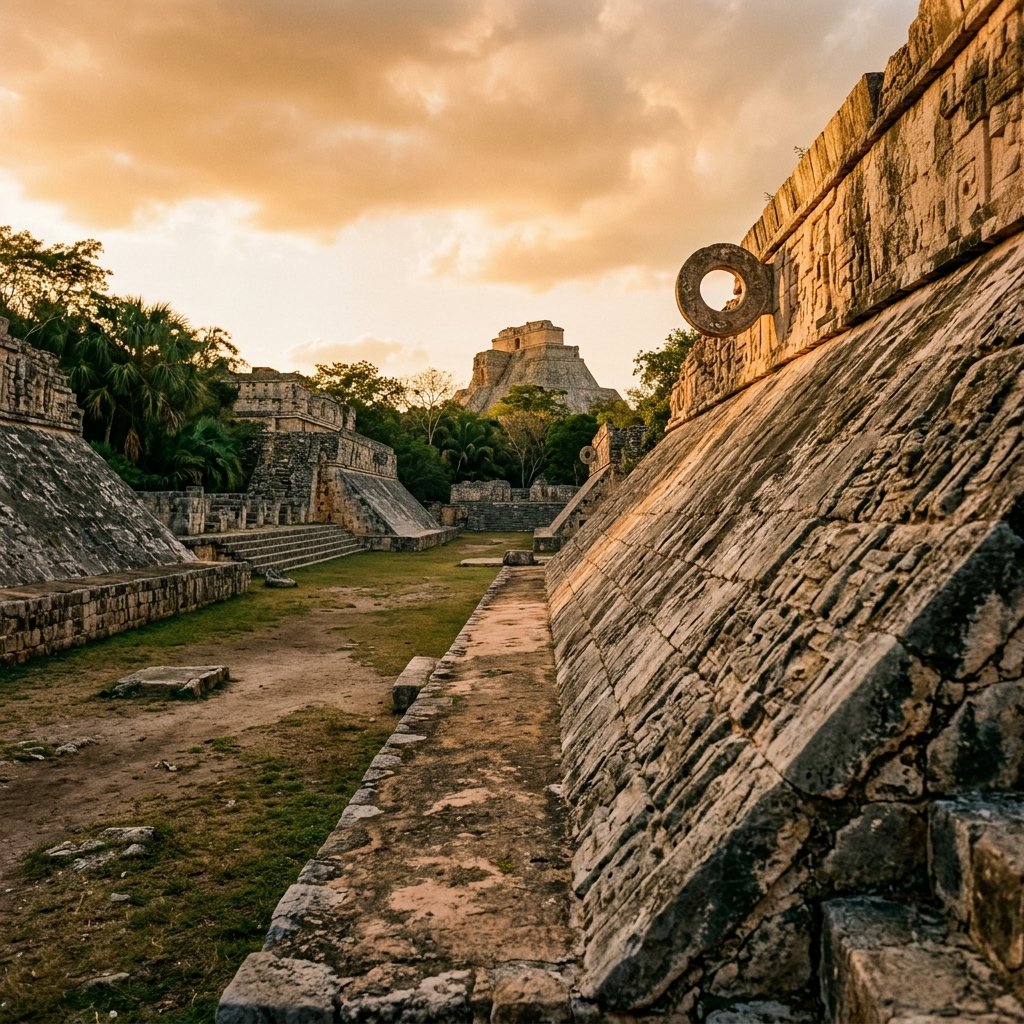
Maya ballcourts share a distinctive I-shaped plan: a long, narrow central alley flanked by two sloping or vertical walls, with open end-zones at each end. The architectural form is remarkably consistent across time and space — the same basic shape appears at sites from 1400 BC through the Spanish conquest.
- Playing surface: A flat, stone-paved alley typically 20–30 meters long and 6–8 meters wide.
- Side walls: Sloped or vertical stone walls, ranging from 2 to 8 meters high, from which the ball would ricochet.
- Stone rings: In some Postclassic courts (notably at Chichen Itza), a stone ring was mounted vertically high on each wall. Passing the ball through this ring likely resulted in an immediate victory — though this was extremely difficult.
- Markers: Three circular stone markers were typically embedded in the floor of the playing alley — one at center court and one at each end.
The Great Ballcourt at Chichen Itza
The largest known ballcourt in the ancient Americas is the Gran Juego de Pelota at Chichen Itza — measuring 168 meters (551 feet) long and 70 meters (230 feet) wide. Its walls stand 8 meters high, with stone rings mounted 7 meters above the playing surface. The acoustics are extraordinary: a whisper at one end can be heard clearly at the other — a distance of over 150 meters (Lubman, D., "An Archaeological Study of Chirped Echo from the Mayan Pyramid at Chichén Itzá," meeting of the Acoustical Society of America, 1998).
The Game
The exact rules of the Maya ballgame remain debated, as no complete rule set survives. What is known comes from colonial-era descriptions, archaeological evidence, and artistic depictions:
- The ball: Made of solid rubber (from the Castilla elastica tree), weighing approximately 3–4 kilograms (6.5–9 pounds). Rubber balls recovered from the mangrove swamp site of El Manatí, Veracruz, have been dated to approximately 1600 BC, making them the oldest rubber artifacts in the world (Ortiz & Rodríguez, 1999).
- Body contact: Players struck the ball primarily with their hips, forearms, and torsos — not with hands or feet (as depicted in hundreds of carved and painted scenes). Heavy stone yokes worn around the hips served as both protection and striking surfaces.
- Teams: Typically 2–4 players per side, based on artistic depictions.
- Scoring: Likely based on keeping the ball in play and directing it past the opposing team's end zone. In courts with stone rings, passing the ball through the ring was the supreme achievement.
The Question of Sacrifice
The most famous — and most debated — aspect of the ballgame is its association with human sacrifice. At the Great Ballcourt of Chichen Itza, carved relief panels along the walls depict a decapitation scene: one player kneels, headless, with blood spurting from his neck in the form of serpents and flowering vines. Another player holds the severed head.
The question is: who was sacrificed — the winner or the loser?
- The traditional view — followed by most early scholars — held that the loser was sacrificed. This mirrors the intuitive logic: defeat leads to death.
- The revisionist view — proposed by some scholars — suggests that the winner may have been sacrificed, as an honor. In Maya cosmology, sacrifice was not punishment but transformation — the ultimate offering to the gods. Being chosen for sacrifice was, in this view, a privilege (Gillespie, S.D., "Ballgames and Boundaries," in The Mesoamerican Ballgame, 1991).
- The nuanced view — most current scholars argue that sacrifice was not an automatic outcome of every game. Many games were likely played without sacrifice. When sacrifice did occur, it may have involved captive warriors who were forced to play a ritually predetermined game — making the "game" a formalized execution rather than a genuine athletic contest (Schele & Miller, The Blood of Kings, 1986, pp. 241–264).
The Cosmic Symbolism
The ballgame encoded multiple layers of cosmic meaning:
- The ball as the sun: The movement of the heavy rubber ball across the court represented the path of the sun across the sky — and its descent into the underworld at night.
- The court as the cosmos: The playing alley represented the Middle World; the walls represented the boundaries between life and death; the end-zones represented the eastern and western horizons.
- The game as agriculture: The ball's bouncing mirrored the cycle of planting and harvest — the maize kernel dropped into the earth (the underworld), germinating and rising again.
- The game as political theater: Many games were played to settle political disputes, affirm alliances, or celebrate military victories. The cosmic stakes of the mythological game lent spiritual authority to these political outcomes.
References
- Miller, M.E. & Houston, S. "The Classic Maya Ballgame and Its Architectural Setting." RES: Anthropology and Aesthetics, No. 14, 1987, pp. 46–65.
- Schele, L. & Miller, M.E. The Blood of Kings: Dynasty and Ritual in Maya Art. Kimbell Art Museum, 1986.
- Scarborough, V.L. & Wilcox, D.R. (eds.) The Mesoamerican Ballgame. University of Arizona Press, 1991.
- Whittington, E.M. (ed.) The Sport of Life and Death: The Mesoamerican Ballgame. Thames & Hudson, 2001.
- Tedlock, D. Popol Vuh: The Definitive Edition. Simon & Schuster, 1996.
Frequently Asked Questions
Was someone always sacrificed after a ballgame?
No. Most scholars now believe that sacrifice was not an automatic outcome of every game. Many games were played for political, social, or purely competitive purposes without any killing. When sacrifice did occur, it was likely in specific ritual contexts — and may have involved captive warriors forced to play a predetermined outcome rather than genuine athletic competition.
How heavy was the ball?
Approximately 3 to 4 kilograms (6.5 to 9 pounds) of solid rubber. The balls were made from the sap of the Castilla elastica tree, processed into solid rubber through a technique the Maya developed independently. Being struck by a ball this heavy at high speed could cause serious injury, which is why players wore heavy protective equipment including stone yokes and padded arm guards.
Can you see a ballcourt today?
Yes — ballcourts are among the best-preserved structures at Maya archaeological sites. The most impressive is the Great Ballcourt at Chichen Itza (the largest in the Americas), but excellent examples also exist at Copán, Palenque, Uxmal, Toniná, and dozens of other sites. Over 1,300 ballcourts have been identified across Mesoamerica.