A Note on Sensitivity
This article discusses ancient Maya religious beliefs about death, including suicide. These are historical and anthropological observations — not endorsements. The Maya concept of "noble death" existed within a specific cultural and cosmological framework that is fundamentally different from modern contexts. If you or someone you know is struggling, please contact the 988 Suicide & Crisis Lifeline (call or text 988 in the US) or your local crisis service.
Who Is Ix Tab?
Ix Tab (sometimes written Ixtab) is a figure from Maya religion identified primarily through colonial-era sources. She is described as a goddess who escorted the souls of those who died by hanging — specifically by their own hand — directly to paradise, bypassing Xibalba (the underworld of the dead).
The primary source for Ix Tab is Bishop Diego de Landa's Relación de las Cosas de Yucatán (c. 1566), where he mentions a deity associated with those who died by hanging, though he does not use the name "Ix Tab" directly. The name and its association with the hanging goddess were later systematized by the Mayanist J. Eric S. Thompson in his influential work on Maya religion (Thompson, J.E.S., Maya History and Religion, University of Oklahoma Press, 1970, pp. 300–303).
The Depiction
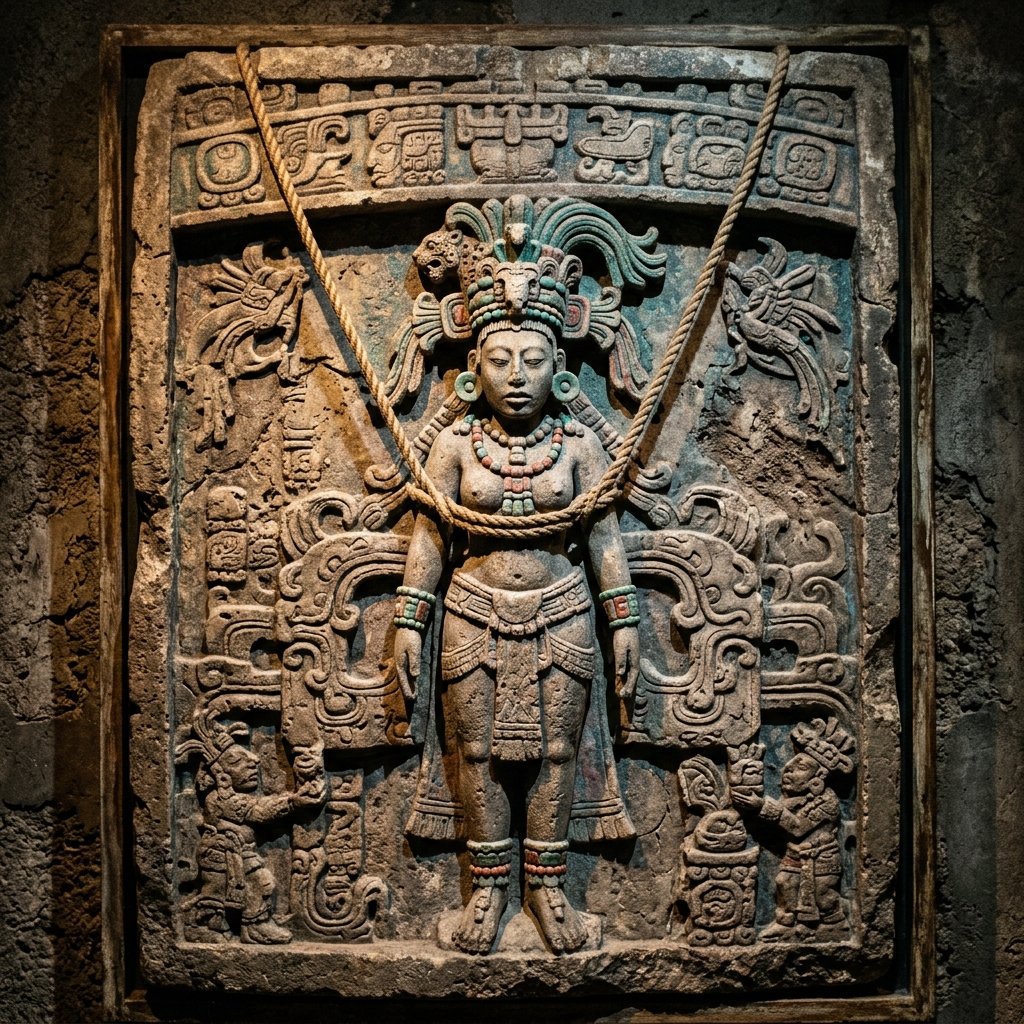
The image most commonly associated with Ix Tab appears in the Dresden Codex, one of only four surviving pre-Columbian Maya books. On page 53 of the codex, a female figure is shown hanging from a celestial band by a rope around her neck. Her eyes are closed (or depicted with the "death eye" — a closed or half-closed eye associated with deceased beings in Maya iconography), and she wears a black circle on her cheek — a symbol associated with decomposition in Maya art.
The identification of this figure specifically as "Ix Tab" is Thompson's interpretation and has been accepted by many but not all scholars. Some researchers have suggested the figure may represent a more general death goddess rather than a specific patron of suicide (Taube, K., The Major Gods of Ancient Yucatan, 1992, pp. 27–28).
The Maya Concept of Noble Death
To understand Ix Tab, one must understand the Maya view of death — which was radically different from the Christian framework that Bishop Landa brought to Yucatán.
In Maya cosmology, the manner of death — not moral conduct during life — determined the destination of the soul. Most souls went to Xibalba, the underworld. But certain categories of death were considered noble or privileged, granting the soul direct passage to a celestial paradise:
- Death in battle — warriors killed in combat.
- Death in childbirth — women who died giving birth were considered equivalent to warriors and received the same celestial destination.
- Death by sacrifice — those chosen as offerings to the gods.
- Death by hanging — guided by Ix Tab to paradise.
This framework meant that certain forms of death were not feared but welcomed as a form of transcendence. The concept has parallels in other Mesoamerican traditions — the Aztec Tlalocan (paradise for those who died by water or lightning) operates on a similar principle of death-manner determining afterlife destination.
Colonial Context and Interpretation
It is important to approach this topic with scholarly caution. Our knowledge of Ix Tab comes primarily through colonial-era Spanish sources — written by Catholic friars who had strong theological reasons to emphasize aspects of Maya religion they found horrifying or heretical.
Several important caveats apply:
- Landa's bias: Diego de Landa was the same bishop who ordered the destruction of thousands of Maya codices and religious objects in the auto-da-fé at Maní in 1562. His descriptions of Maya religion, while invaluable as primary sources, are filtered through Christian condemnation.
- Thompson's systematization: J. Eric S. Thompson, writing in the mid-20th century, organized and named many Maya deities based on limited colonial sources and codex imagery. Some of his identifications have been revised or challenged by later scholarship.
- Pre-Columbian silence: No known Classic-period Maya inscription mentions Ix Tab by name. The concept may be Postclassic (post-900 AD) or may have been reshaped by colonial-era recording practices.
Death in Maya Art
While "Ix Tab" as a named deity is debated, the Maya relationship with death is abundantly documented in the archaeological record:
- Death gods in ceramic art: Classic-period painted pottery frequently depicts skeletal death gods — often shown dancing, smoking cigars, or participating in court scenes. Death was personified but not demonized (Coe, M.D., "Death and the Ancient Maya," in Death and the Afterlife in Pre-Columbian America, 1975).
- Royal funerary practice: The elaborate tombs of Maya kings — such as Pakal's tomb at Palenque — demonstrate that death was understood as transformation, not annihilation. The king was expected to be reborn as the Maize God.
- Ancestor veneration: The dead were not gone — they were present, consulted, and fed through regular ritual offerings. Maya households often buried their dead beneath the floors of their homes, maintaining a literal closeness to deceased family members.
References
- Thompson, J.E.S. Maya History and Religion. University of Oklahoma Press, 1970.
- Tozzer, A.M. Landa's Relación de las Cosas de Yucatán: A Translation. Papers of the Peabody Museum, Vol. 18, 1941.
- Taube, K. The Major Gods of Ancient Yucatan. Dumbarton Oaks, 1992.
- Coe, M.D. "Death and the Ancient Maya." In Benson, E.P. (ed.), Death and the Afterlife in Pre-Columbian America. Dumbarton Oaks, 1975, pp. 87–104.
- Houston, S. & Stuart, D. "The Way Glyph: Evidence for 'Co-essences' among the Classic Maya." Research Reports on Ancient Maya Writing, No. 30, 1989.
Frequently Asked Questions
Is Ix Tab a real Maya deity?
Ix Tab is documented through colonial-era Spanish sources and the Dresden Codex, but her exact nature and name are debated. The image in the Dresden Codex (page 53) showing a hanging female figure is genuine pre-Columbian Maya art. The name "Ix Tab" and the specific identification as a "goddess of suicide" were systematized by the 20th-century Mayanist J. Eric S. Thompson, and some scholars have questioned whether this represents the full original Maya understanding of the figure.
Did the Maya consider suicide acceptable?
Within specific ritual and cosmological contexts, certain forms of death — including death by hanging — were understood as granting privileged afterlife destinations. This does not mean that all forms of self-inflicted death were considered positive, or that the practice was common or casual. The concept existed within a complex religious framework that cannot be directly compared to modern attitudes. Colonial-era accounts are our primary source, and they are filtered through significant cultural and religious bias.
Where can I see the image of Ix Tab?
The image most commonly identified as Ix Tab appears on page 53 of the Dresden Codex, one of four surviving pre-Columbian Maya books. The original codex is held at the Saxon State and University Library in Dresden, Germany. High-resolution digital reproductions are available through various academic databases and museum websites.