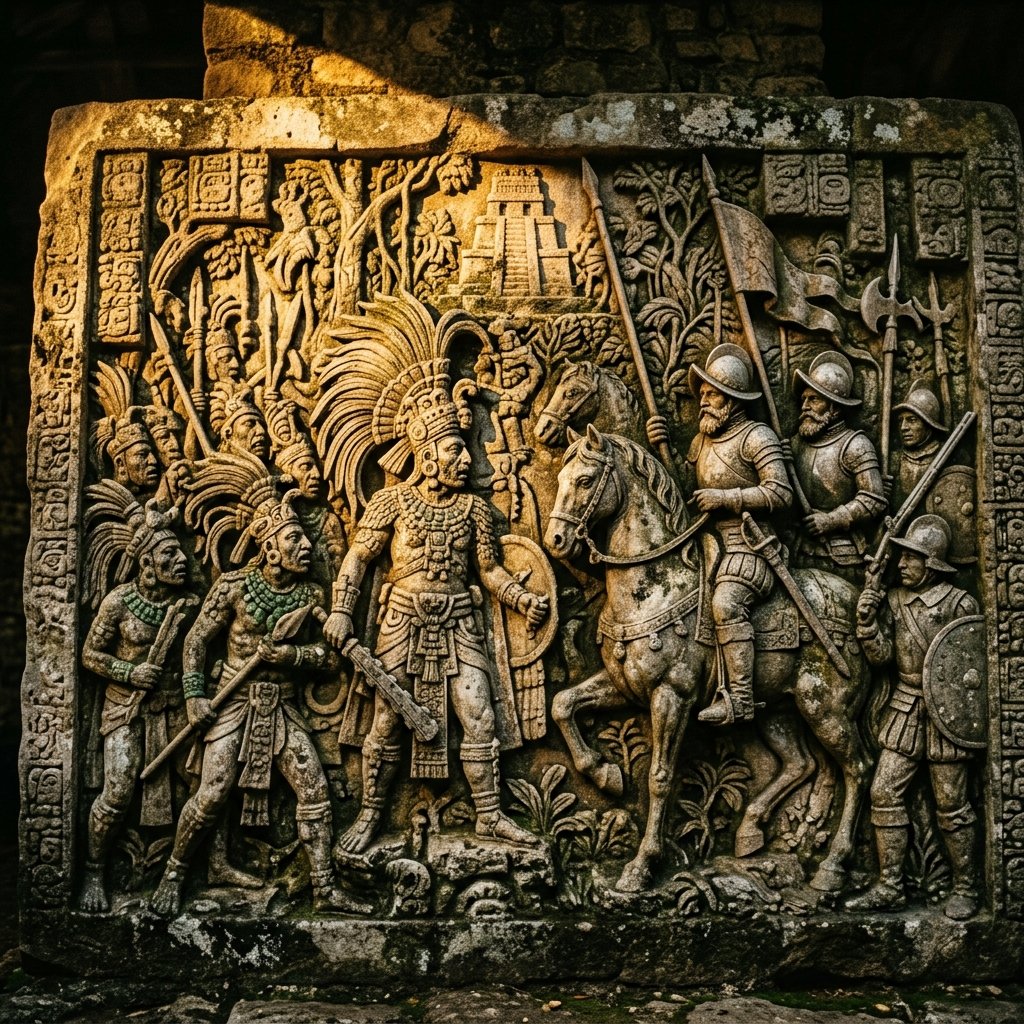
The Historical Record
What the primary sources say: Multiple independent accounts — Spanish, indigenous, and mestizo — consistently describe the Aztecs and other Mesoamerican peoples treating the arriving Spaniards with extraordinary awe, reverence, and offerings appropriate for divine or semi-divine beings. The Nahuatl word teteo ("gods" or "divine ones") was applied to the newcomers.
The human pattern: Attributing divine status to powerful strangers is not unique to Mesoamerica — it appears in Egypt, Rome, Japan, China, Polynesia, and elsewhere. That the Mesoamerican peoples may have responded to the unprecedented with the cultural frameworks they possessed is neither naive nor shameful — it is profoundly human.
The tragedy: Whether understood as literal deity-worship or cultural awe at the extraordinary, the Spanish exploited this reverence with calculated cruelty — and that is the real moral weight of this story.
What the Primary Sources Tell Us
The historical evidence that indigenous Mesoamerican peoples received the arriving Spaniards with extraordinary reverence is substantial, consistent, and drawn from multiple independent sources — both Spanish and indigenous. For centuries, this was the accepted understanding of the encounter, and the primary sources remain compelling:
Bernal Díaz del Castillo — The Eyewitness
Bernal Díaz del Castillo, a soldier who served under Cortés and wrote The True History of the Conquest of New Spain (c. 1568), provides the most detailed eyewitness account. He describes Moctezuma's emissaries arriving at the Spanish camp bearing gifts of extraordinary richness — gold, featherwork, jade, and elaborate costumes — and performing rituals of obeisance that, to the Spaniards, appeared unmistakably devotional. Díaz describes the Aztec ambassadors dressing Cortés in the costume of Quetzalcoatl, fitting him with the turquoise serpent mask, the quetzal feather mantle, and the wind god's jewelry (Díaz del Castillo, B., The True History of the Conquest of New Spain, c. 1568, Chapters 38–39).
When the Spaniards finally entered Tenochtitlan, Díaz describes crowds of people lining the causeways, staring in wonder — behavior he interpreted not as mere curiosity but as profound awe at beings they considered otherworldly.
Bernardino de Sahagún — The Nahua Voice
Friar Bernardino de Sahagún's monumental Florentine Codex (c. 1545–1590), compiled with the help of educated Nahua scholars, preserves indigenous accounts of the encounter. Book 12 records speeches attributed to Moctezuma that address Cortés as a returning lord, including the famous passage: "You have come to sit on your throne, on your seat, which I have been keeping for you..." The Nahua narrators describe the emperor's court as gripped by fear and wonder, the people applying the word teteo to the newcomers (Sahagún, B. de, Florentine Codex, Book 12).
While some modern scholars question how much post-conquest editorial framing shaped these accounts, the fact remains that Sahagún's Nahua collaborators — men who had access to living memory of the conquest — chose to describe the encounter in these terms. Their account cannot simply be dismissed as fabrication.
Cortés's Own Letters
In his Cartas de Relación (1520–1526), Hernán Cortés describes Moctezuma delivering a speech of welcome that acknowledges the Spaniards as long-anticipated returning lords. Cortés clearly understood and exploited this perception — he reports that Moctezuma voluntarily offered tribute, housing, and gold, and treated the Spaniards as honored guests of the highest rank. While Cortés had political motivations for his account, the core description of Aztec reverence is corroborated by other sources.
Diego Durán and Indigenous Histories
Dominican friar Diego Durán (The History of the Indies of New Spain, 1581), drawing on indigenous oral histories and now-lost painted manuscripts, provides detailed accounts of Moctezuma consulting his priests and advisors about the meaning of the strangers' arrival, of signs and omens that preceded the coming of the Spaniards, and of the emperor's growing conviction that a prophesied return was unfolding.
A Universal Human Response
The idea that one culture might regard powerful strangers as divine is not unique to Mesoamerica — it is one of the most well-documented patterns in world history. Cultures across the globe have attributed divine or semi-divine status to their rulers, to extraordinary strangers, and to the powerful:
- Egypt: The Pharaoh was not merely a king — he was a living god, the incarnation of Horus and the son of Ra. For over 3,000 years, the most sophisticated civilization of the ancient world worshipped its rulers as literally divine.
- Rome: After Julius Caesar's assassination, the Senate formally declared him Divus Iulius — a god. Augustus, Claudius, Vespasian, and many subsequent emperors were deified after death, and some (Caligula, Domitian, Commodus) demanded worship during their lifetimes.
- Japan: The Emperor was considered a direct descendant of the sun goddess Amaterasu, maintaining divine status until Emperor Hirohito formally renounced his divinity in 1946 — within living memory.
- China: The Emperor held the Mandate of Heaven (Tiānmìng), ruling as the Son of Heaven with divine sanction. To rebel against the emperor was to rebel against cosmic order itself.
- Polynesia: When Captain James Cook arrived in Hawaii in 1779, he was received with elaborate rituals that scholars believe reflected his identification with the god Lono. The Hawaiians' initial reverence, followed by their disillusionment when Cook proved mortal, directly parallels the Mesoamerican experience.
That the Mesoamerican peoples — whose own rulers were semi-divine figures who performed bloodletting rituals to communicate with gods, who understood kingship as a sacred institution, and who structured their entire civilization around the relationship between humans and the divine — might have responded to the unprecedented arrival of bearded, pale-skinned strangers in metal armor riding unknown animals with the cultural frameworks they already possessed is neither naive nor implausible. It is entirely consistent with how human beings across cultures have responded to the extraordinary.
The Word Teteo and the Question of Meaning
A key point of scholarly discussion involves the Nahuatl word teteo (plural of teotl), which indigenous sources use to describe the Spaniards. Linguist James Lockhart demonstrated that teotl had a broader semantic range than the English word "god" — encompassing meanings like "sacred," "powerful," "wondrous," and "extraordinary" (The Nahuas After the Conquest, 1992).
This linguistic nuance is valuable, but it does not diminish the significance of the encounter. Whether the Aztecs regarded the Spaniards as literal returning deities or as extraordinary, sacred, and wondrous beings of immense power, the practical effect was the same: they received them with reverence, gifts, and hospitality that the Spanish then exploited mercilessly. The distinction between "they thought they were gods" and "they treated them as awe-inspiring sacred beings" is academically important but does not change the moral reality of what followed.
The Tragedy: How Reverence Was Exploited
This is the part of the story that truly matters — not whether the indigenous peoples' awe was "literal" deity-worship or a broader expression of cultural reverence, but what the Spanish did with it.
Cortés and his men recognized the advantage that indigenous reverence gave them and deliberately cultivated it:
- They staged theatrical demonstrations of cannon fire and cavalry charges to maintain the aura of supernatural power.
- They accepted lavish gifts, tribute, and hospitality as their due — never correcting the misperception that they were more than men.
- They used the period of reverent reception to gather intelligence, forge alliances with discontented tributary states, and position themselves inside the heart of the Aztec Empire.
- When the moment came, they seized Moctezuma as a hostage, looted his treasury, massacred the Aztec nobility during the Festival of Toxcatl, and ultimately besieged and destroyed Tenochtitlan — one of the largest and most beautiful cities in the world.
The people who had opened their doors in wonder were repaid with enslavement, epidemic disease, cultural destruction, and death. Whether the indigenous reverence was rooted in prophecy, religious cosmology, or simple human awe at the unprecedented, the Spaniards' calculated exploitation of that openness remains one of the great moral crimes of history.
What About the Maya?
The "returning god" narrative is primarily associated with the Aztec (Nahua) context. The Maya encounter with the Spanish followed a notably different trajectory:
- The Yucatec Maya first encountered Spanish expeditions in 1517 (Francisco Hernández de Córdoba) and 1518 (Juan de Grijalva).
- The Maya fought fiercely from the beginning. The Battle of Champotón (1517) was a Maya military victory that killed or wounded over half the Spanish force.
- However, the Books of Chilam Balam do contain prophecies about the arrival of powerful foreigners, and some Maya communities' responses included both resistance and accommodation — suggesting that the Maya reaction, like the Aztec one, was complex and varied across regions and political factions.
- The Spanish conquest of the Maya world took over 170 years (1527–1697), with the last independent Maya kingdom — the Itza at Nojpetén/Tayasal — falling only in 1697.
Modern Scholarly Debate
Beginning in the late 20th century, some scholars have questioned the literal accuracy of the "returning god" narrative. Historians like Camilla Townsend ("Burying the White Gods," 2003) and Matthew Restall (Seven Myths of the Spanish Conquest, 2003) have argued that the narrative was amplified or constructed after the conquest for political purposes. Their work raises valid questions about how post-conquest editorial framing may have shaped the sources.
However, it is important to note that revisionist scholarship has its own limitations:
- The primary sources — Díaz del Castillo's eyewitness account, Sahagún's Nahua collaborators, Cortés's letters, Durán's indigenous oral histories — are multiple, independent, and mutually corroborating. Dismissing all of them as politically motivated fabrication requires explaining why sources with very different agendas all describe the same phenomenon.
- The cross-cultural parallels (Egypt, Rome, Japan, Hawaii) demonstrate that divine attribution to powerful rulers and extraordinary strangers is a well-documented human behavior — making the Mesoamerican accounts more plausible, not less.
- The revisionist position can itself reflect modern ideological concerns — a desire to portray indigenous peoples as rational and unsuperstitious — that may inadvertently impose contemporary Western secular assumptions on deeply religious societies for whom the divine and the political were inseparable.
The most honest reading of the evidence suggests a middle ground: the indigenous response to the Spanish was complex, varied across regions and individuals, and combined genuine awe at the unprecedented with pragmatic political calculation. The primary sources are not perfect, but they are not fabrications either — they preserve a real and deeply human reaction to one of history's most dramatic encounters.
Frequently Asked Questions
Did indigenous peoples believe the Spanish were gods?
Multiple primary sources — Díaz del Castillo's eyewitness account, Sahagún's Nahua collaborators, Cortés's letters, and Durán's indigenous oral histories — consistently describe the Aztecs treating the Spaniards with extraordinary reverence, offering them gifts fit for deities, and using the Nahuatl word teteo (divine beings) to describe them. Whether this was literal deity-worship or a broader expression of cultural awe is debated, but the historical record of reverence is substantial and corroborated across multiple sources.
Is this kind of reaction unique to Mesoamerica?
No. Attributing divine status to rulers and extraordinary strangers is documented across world history — Egyptian pharaohs were living gods, Roman emperors were deified, Japanese emperors descended from Amaterasu, and Captain Cook was received as the god Lono in Hawaii. The Mesoamerican response fits a well-documented cross-cultural pattern.
What is the real tragedy of this story?
Regardless of whether the indigenous response was literal deity-worship or cultural awe, the Spaniards recognized and deliberately exploited the reverence they received. They staged theatrical displays of power, accepted lavish tribute without correcting the misperception, used the period of hospitality to infiltrate the empire, then seized Moctezuma, massacred the nobility, and destroyed Tenochtitlan. The exploitation of genuine cultural openness is the real moral crime.
References
- Díaz del Castillo, B. The True History of the Conquest of New Spain. c. 1568. (Maudslay translation, 1908.)
- Sahagún, B. de. Florentine Codex: General History of the Things of New Spain. Book 12. c. 1545–1590. (Anderson & Dibble translation, 1975.)
- Cortés, H. Cartas de Relación (Letters from Mexico). 1520–1526. (Pagden translation, Yale University Press, 1986.)
- Durán, D. The History of the Indies of New Spain. 1581. (Heyden translation, University of Oklahoma Press, 1994.)
- Lockhart, J. The Nahuas After the Conquest: A Social and Cultural History. Stanford University Press, 1992.
- Townsend, C. "Burying the White Gods: New Perspectives on the Conquest of Mexico." American Historical Review, Vol. 108, No. 3, 2003, pp. 659–687.
- Restall, M. Seven Myths of the Spanish Conquest. Oxford University Press, 2003.
- Sahlins, M. "The Apotheosis of Captain Cook." In Islands of History. University of Chicago Press, 1985.