The Legend at a Glance
The Two Women
The legend begins not with the Xtabay herself, but with two women who lived in the same village:
Xkeban — "The Sinful One"
Xkeban (sometimes Xtabay or Xkeban-Ha) was a beautiful woman who was scorned by the village because she had many lovers. She was considered impure, disreputable, and shameful. But despite her reputation, Xkeban was secretly kind. She cared for the sick, fed the poor, took in stray animals, and showed compassion to everyone — regardless of their status. She loved with her whole heart, without selfishness.
Utz-Colel — "The Virtuous One"
Utz-Colel was the other woman — publicly admired for her rigid respectability, her piety, and her "purity." She never had lovers. She attended every ceremony. The village considered her the model of virtue. But underneath, Utz-Colel was cold, proud, and cruel. She showed no compassion for the suffering. She looked down on everyone. Her "virtue" was performative — it served only her own reputation.
Their Deaths
Xkeban died first. She died alone, as the outcast she was. But when the villagers approached her body (reluctantly, expecting the stench of a sinner), they found it surrounded by the most beautiful fragrance — a sweet, intoxicating perfume that filled the air. Flowers bloomed spontaneously around her body. This fragrance was the scent of the Xtabentún flower (Turbina corymbosa) — a small, delicate white flower that grows wild across Yucatán.
When Utz-Colel died some time later, the villagers expected her body to produce an even more magnificent fragrance. Instead, her corpse emitted a terrible stench — the smell of rot and decay, reflecting the corruption that had always been hidden beneath her respectable exterior. From where she was buried grew the Tzacam cactus — a spiny, thorny plant with an unpleasant odor.
The Transformation
After death, Xkeban's spirit was at peace. Her genuine compassion had earned her rest. She became the Xtabentún flower — fragrant, beautiful, and harmless.
But Utz-Colel, consumed by jealousy even in death, could not understand why the "sinful" woman received beauty and fragrance while she received thorns and stench. She believed that Xkeban's beauty must have come from her physical love — so Utz-Colel made a pact with dark spirits to return from the dead as a seductress, using physical beauty as a weapon.
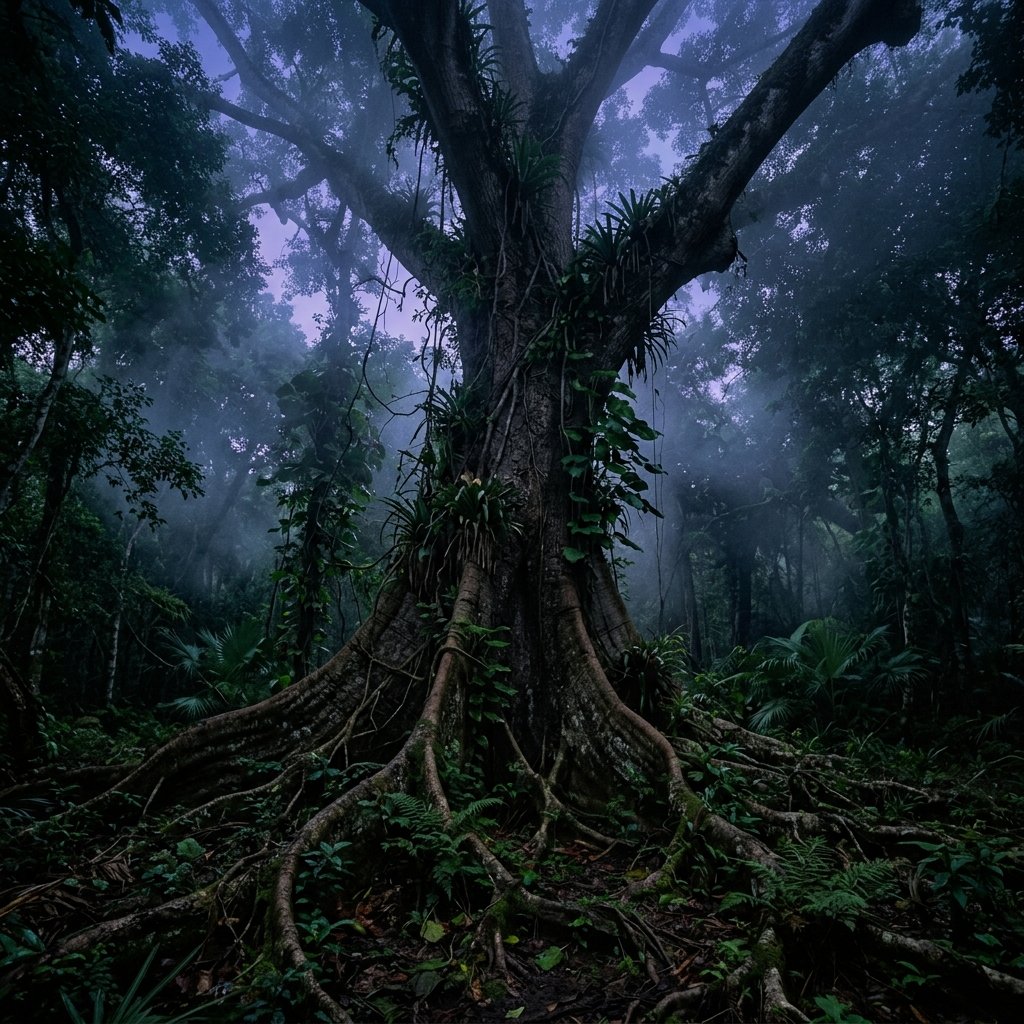
She became the Xtabay — a phantom who appears as a breathtakingly beautiful woman beneath the sacred ceiba tree. She combs her long black hair with a spine from the Tzacam cactus, singing softly to lure passing men. Those who follow her into the forest are found dead the next morning at the base of the ceiba tree — their bodies covered in cactus thorns, their faces frozen in expressions of terror.
The Ceiba Tree
The Xtabay's association with the ceiba (ya'axche' in Yucatec Maya) is deeply significant. The ceiba was the most sacred tree in Maya cosmology — it was the Wakah-Chan, the World Tree whose roots reached into Xibalba (the underworld), whose trunk stood in the Middle World, and whose branches extended into the thirteen heavens.
The ceiba is a physically extraordinary tree: it can grow to heights of 70 meters (230 feet), with massive buttress roots that spread 6–10 meters from the trunk. Its trunk is often covered in large thorns. Its canopy can span 50 meters. In Maya communities, ceiba trees were traditionally planted in the center of villages and were never cut down — they were treated as living sacred monuments.
By placing the Xtabay beneath the ceiba, the legend situates her at the cosmic axis — the boundary between the living and the dead, the human and the supernatural. She is a liminal being, inhabiting the threshold (Freidel, D. et al., Maya Cosmos, 1993, pp. 53–54).
The Moral Structure
The Xtabay legend is one of the most morally sophisticated stories in Maya folklore. Its message is not — as a surface reading might suggest — "beautiful women are dangerous." Instead, it makes a far more nuanced argument:
- True virtue is in actions, not appearances. Xkeban, the "sinner," showed genuine compassion. Utz-Colel, the "saint," was cruel beneath her propriety.
- Social reputation is unreliable. The village judged by external behavior and was wrong about both women.
- Jealousy corrupts even in death. Utz-Colel's inability to accept the reality of her own character — even after death — is what transforms her into a monster.
- Love freely given is sacred; love weaponized is destructive. Xkeban loved openly and became a flower. Utz-Colel mimicked love as a tool and became a killer.
References
- Burns, A.F. An Epoch of Miracles: Oral Literature of the Yucatec Maya. University of Texas Press, 1983.
- Freidel, D., Schele, L. & Parker, J. Maya Cosmos: Three Thousand Years on the Shaman's Path. William Morrow, 1993.
- Montejo, V. Popol Vuh: A Sacred Book of the Maya. Groundwood Books, 1999.
- Roys, R.L. The Ethno-Botany of the Maya. Tulane University, Middle American Research Series, Publication 2, 1931.
Frequently Asked Questions
Is the Xtabay a real Maya legend?
Yes — it is one of the most widely known and actively told legends in the Yucatán Peninsula. It is taught in schools, referenced in popular culture, and told by locals and tour guides throughout the region. The Xtabentún flower (and the liqueur made from it) takes its name from the legend. While it is primarily a folk legend rather than a pre-Columbian religious text, it incorporates deeply Maya elements — particularly the sacred ceiba tree and the cosmological associations with the underworld.
What is the Xtabentún flower?
The Xtabentún (Turbina corymbosa) is a small white morning glory flower native to the Yucatán. In the legend, it grows from Xkeban's grave, representing her genuine beauty. The flower has mild psychoactive properties and was used in certain Maya rituals. Today, "Xtabentún" is also the name of a popular Yucatecan anise liqueur made with honey and the flower's extract.
Why is the ceiba tree sacred?
The ceiba was the Maya World Tree (Wakah-Chan) — the axis of the cosmos. Its roots reached into the underworld (Xibalba), its trunk stood in the Middle World, and its branches extended into the thirteen heavens. Ceiba trees were planted at the center of Maya communities and were never cut down. Even today, ceiba trees are treated with respect across the Maya world, and many modern Maya communities still plant them in town centers.