Bonampak at a Glance
"In a single stroke, the vivid, chaotic, and terrifyingly graphic paintings of Bonampak wiped away decades of academic consensus. The Maya were not peaceful stargazers isolated from human violence. They were sophisticated, brutal, and entirely human."
The Myth of the Peaceful Maya
For the first half of the 20th century, the dominant theory pushed by towering archaeologists like J. Eric S. Thompson was that the Classic Maya were an exceptional anomaly in world history — a society ruled by peaceful astronomer-priests whose lives were dedicated purely to mathematics, ecology, and the observation of time. Thompson's influential model held sway for decades, shaping both public imagination and academic research (Miller & Brittenham, The Spectacle of the Late Maya Court, University of Texas Press, 2013).
That all changed in the spring of 1946.
Guided by the local Lacandon Maya, who had guarded the secret of the ruins for generations, American photographer Giles Healey entered a small, seemingly unremarkable building in the Chiapas jungle. When Healey shined his flashlight into the dark, vaulted chambers, he was stunned. The walls and ceilings were comprehensively covered in the most vivid, detailed, and graphically violent frescoes ever found in the Americas. The Lacandon, who still performed rituals at the site, had kept the murals a closely held secret from outsiders for centuries.
Structure 1: The Temple of the Murals
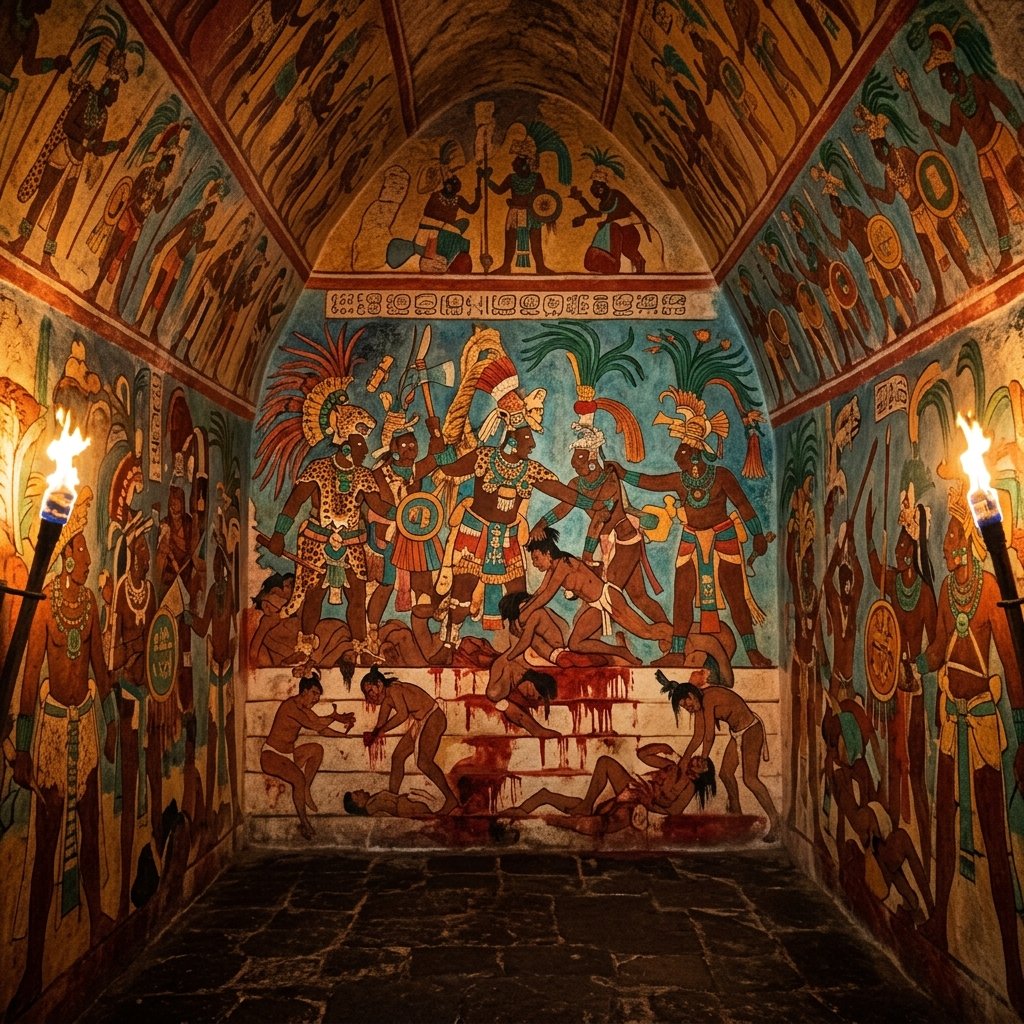
The murals of Bonampak's Structure 1 — the most complete surviving Maya painting cycle. Three rooms contain over 100 square meters of continuous fresco depicting courtly life, warfare, and ritual sacrifice with an immediacy and dynamism unmatched anywhere else in Mesoamerica.
Structure 1 is a relatively modest building facing the Great Plaza, containing three narrow rooms. The murals covering its interior date precisely to 790 AD, during the reign of Bonampak's ruler Chan Muwan II. They represent a continuous narrative reading from Room 1 to Room 3, covering a total surface area of approximately 112 square meters — the most complete surviving painted program from the ancient Maya world (Miller & Brittenham, 2013).
The murals were painted using a modified fresco technique: pigments were applied to wet lime plaster, then finished with details applied a secco (on dry plaster). The vibrant blues were created using the famous Maya Blue pigment — an extraordinarily durable synthetic color made by heating indigo dye with palygorskite clay, a technology unique to Mesoamerica.
Room 1: The Presentation
The story begins with pomp and circumstance. The murals in Room 1 depict a grand royal ceremony: the presentation of Chan Muwan II's young heir to the nobles of the court. The paintings offer an incredible glimpse into Maya aristocratic life. Musicians are shown playing turtle shells struck with deer antlers, wooden drums (tunkul), rattles, and large trumpets. Nobles are draped in heavy white cotton mantles, dripping with jade, and adorned with elaborate headdresses made of brilliant quetzal feathers.
The lower register of Room 1 features a rare depiction of commoner life — masked dancers and costumed performers entertaining the assembled court, a scene that provides invaluable evidence about Maya theatrical arts and public spectacle (Martin & Grube, Chronicle of the Maya Kings and Queens, Thames & Hudson, 2008).
Room 2: The Chaos of Battle
Room 2 is the most famous — and the most shocking. It captures the chaotic climax of a jungle battle. Warriors are shown thrusting spears, brandishing flint-bladed clubs, and grappling in hand-to-hand combat. What is extraordinary is the lack of rigid formalism; bodies are twisted, overlapping, and intensely dynamic. Art historian Mary Ellen Miller described the battle scene as "the single most important ancient American painting" (Miller, The Art of Mesoamerica, Thames & Hudson, 2019).
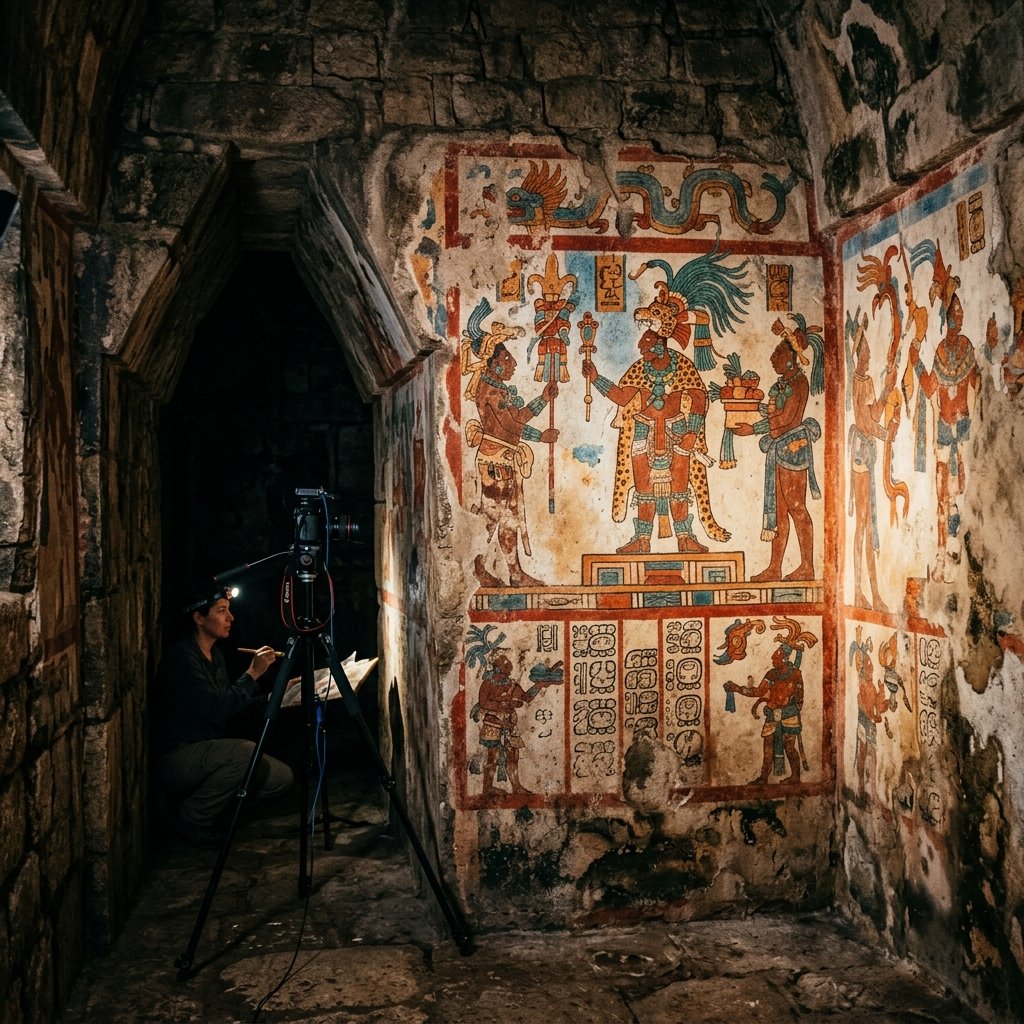
While these are the stucco reliefs of Ek' Balam, they hint at the extraordinary level of detail and color that characterized Late Classic Maya visual arts — a tradition that reached its absolute pinnacle in the painted chambers of Bonampak.
The north wall of Room 2 depicts the battle's aftermath on the terraced steps of a pyramid. King Chan Muwan stands victorious in a jaguar-pelt tunic, gripping a captive by the hair. At his feet, defeated enemies are stripped almost naked. One captive pleads for mercy with outstretched hands; another has already been executed, his severed head placed on a bed of leaves; others sit horrified as their fingernails are ripped out to disable them before the final sacrifice. Blood drips visibly from their tortured fingers.
The meticulous rendering of individual faces — each captive displaying a unique expression of terror, resignation, or agony — suggests the artists may have painted from life, documenting actual prisoners held at the site (Miller & Brittenham, 2013).
Room 3: The Bloody Celebration
The final room details the ritual culmination of the victory. The king and his family are shown engaging in personal bloodletting — piercing their tongues and genitals with stingray spines to offer blood to the gods in thanks for the victory. A woman of the royal household, likely Chan Muwan's wife (a princess from Yaxchilán), is depicted pulling a thorn-studded cord through her tongue.
Above the bloodletting scene, elaborately costumed dancers perform on a stepped platform, their bodies adorned with massive feathered backracks and jade ornaments so heavy they required attendants to help support them. The level of sartorial detail — every bead, every feather, every textile pattern — is staggering, providing textile historians with an irreplaceable primary source for Late Classic Maya costume.
The Geopolitics of Bonampak
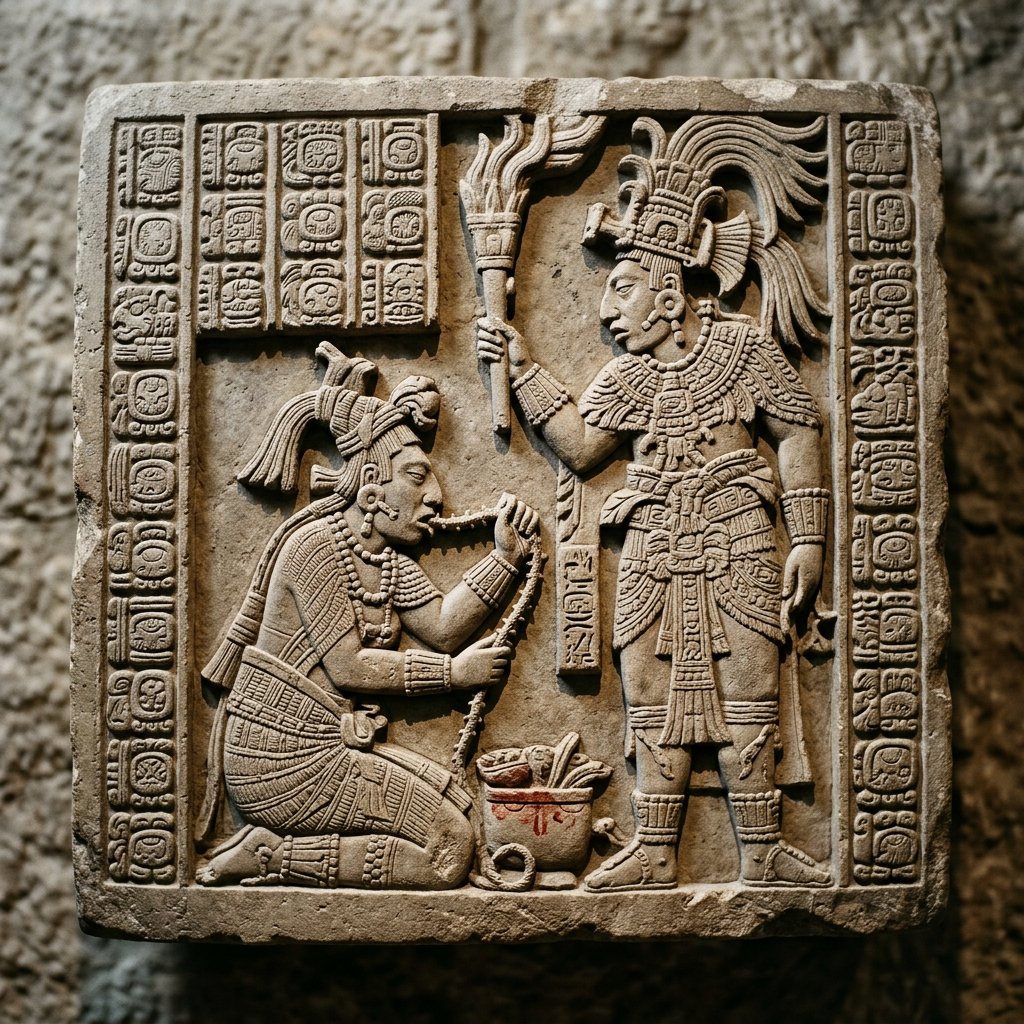
Lintel 24 from Yaxchilán — the dominant overlord city of Bonampak. The carving depicts Lady K'abal Xook performing a bloodletting ritual, pulling a thorn-studded cord through her tongue. Bonampak's murals show the same ritual in vivid color.
While the murals are magnificent, Bonampak itself was a relatively minor, secondary city. It sat firmly in the shadow of its vastly more powerful neighbor to the north: Yaxchilán. The relationship was explicitly one of political subordination — Bonampak's kings derived their legitimacy from the Yaxchilán dynasty (Martin & Grube, 2008).
The murals themselves confirm this vassal status. Prominently featured in the frescoes helping Chan Muwan II is Shield Jaguar IV, the mighty king of Yaxchilán. Most scholars believe the war depicted in Room 2 was orchestrated by Yaxchilán, with Bonampak acting as a crucial military proxy operating along the contested frontier of the Usumacinta drainage. Chan Muwan II derived much of his legitimacy from his marriage to a Yaxchilán princess — a classic Maya strategy of political binding through intermarriage.
The Mysterious Abandonment
Mysteriously, shortly after the magnificent murals were completed in 790 AD, the site was rapidly abandoned. The murals were never completely finished — in several areas, preliminary sketch lines are visible where the final paint was never applied. Texts detailing the future of the young heir end abruptly mid-narrative, as if the scribes were interrupted and never returned.
The site was swallowed by the jungle as the broader Classic Maya collapse consumed the Usumacinta region during the 9th century. The collapse of Yaxchilán — Bonampak's protector and overlord — likely removed the political and military support structure that had sustained the smaller city. Without its patron, Bonampak had no independent means of survival (Sharer & Traxler, The Ancient Maya, Stanford University Press, 2006).
Visitor Comparison
| Feature | Bonampak | Yaxchilán | Palenque |
|---|---|---|---|
| Star Attraction | Painted murals | Carved lintels | Pakal's tomb |
| Accessibility | Moderate (jungle van) | Challenging (river boat) | Easy (paved road) |
| Crowd Level | Very low | Very low | Moderate |
| Time Needed | 2–3 hours | 4–5 hours | 4–6 hours |
| Can combine? | ✅ With Yaxchilán | ✅ With Bonampak | Standalone |
Practical Travel Guide: Visiting Bonampak
Getting There
Bonampak is located deep in the Lacandon Jungle of Chiapas. The most common launching point is Palenque (about 3 hours by road). You cannot drive directly to the site in a rental car; you must drive to the Lacandon community of Lacanjá Chansayab. From there, you are required to hire local Lacandon Maya transport (vans) to traverse the final 8 kilometers through the protected Montes Azules Biosphere Reserve.
The Viewing Experience
To protect the incredibly fragile pigments from humidity and human breath, visitors are not allowed to fully enter the rooms of Structure 1. You must view them standing at the doorway thresholds. Despite this, the color and detail are breathtaking. No flash photography is permitted under any circumstances. Bring a good zoom lens.
The Bonampak–Yaxchilán Combination
Most tour operators offer a combined day trip from Palenque: Bonampak in the morning, followed by a boat ride down the Usumacinta River to Yaxchilán in the afternoon. This pairing — seeing Bonampak's painted murals and Yaxchilán's carved stone lintels back to back — provides the single most cohesive narrative experience available in Usumacinta Maya archaeology.
Best Season
Visit during the dry season (November–April). During the rainy season, the unpaved roads to Lacanjá Chansayab can become extremely difficult or impassable, and the jungle humidity makes viewing the murals through the doorways significantly more challenging.
Frequently Asked Questions
Where is Bonampak located?
Bonampak is located in the Lacandon Jungle of Chiapas, Mexico, near the border with Guatemala. It is situated in the Usumacinta River valley, about 30 kilometers south of the larger and dominant ancient city of Yaxchilán.
Who discovered the Bonampak murals?
The ruins were known to the local Lacandon Maya for centuries. They led American photographer Giles Healey to the site in 1946, making him the first non-Maya to see the spectacular frescoes inside the Temple of the Murals. Mayanist Sylvanus Morley subsequently gave the site its modern name — "Bonampak," meaning "Painted Wall."
Why are the Bonampak murals so important?
Before 1946, archaeologists believed the Classic Maya were peaceful astronomers and priests. The Bonampak murals realistically depict bloody battles, the torture of captives, and elaborate, violent court rituals, fundamentally changing our understanding of Maya society. Art historian Mary Ellen Miller called the battle scene "the single most important ancient American painting."
Can you visit the original Bonampak murals?
Yes, tourists can visit the original Temple of the Murals (Structure 1) at the archaeological site in Chiapas. However, access is strictly controlled to preserve the delicate paint — visitors are only allowed to look from the doorway thresholds. No flash photography is allowed. Full-scale reproductions are displayed at the Museo Nacional de Antropología in Mexico City.
How long should I allow for a visit?
The archaeological site itself requires 2–3 hours. However, because of the remote location and mandatory local transport from Lacanjá Chansayab, you should plan for a full day from Palenque. Most visitors combine Bonampak with a visit to Yaxchilán via boat on the Usumacinta River.
References
- Miller, M. E., & Brittenham, C. The Spectacle of the Late Maya Court: Reflections on the Murals of Bonampak. University of Texas Press, 2013.
- Miller, M. E. The Art of Mesoamerica: From Olmec to Aztec. Thames & Hudson, 6th ed., 2019.
- Martin, S., & Grube, N. Chronicle of the Maya Kings and Queens. Thames & Hudson, 2nd ed., 2008.
- Sharer, R. J., & Traxler, L. P. The Ancient Maya. Stanford University Press, 6th ed., 2006.
- de la Fuente, B. "The Murals of Bonampak." Maya: Divine Kings of the Rain Forest. Könemann, 2001.