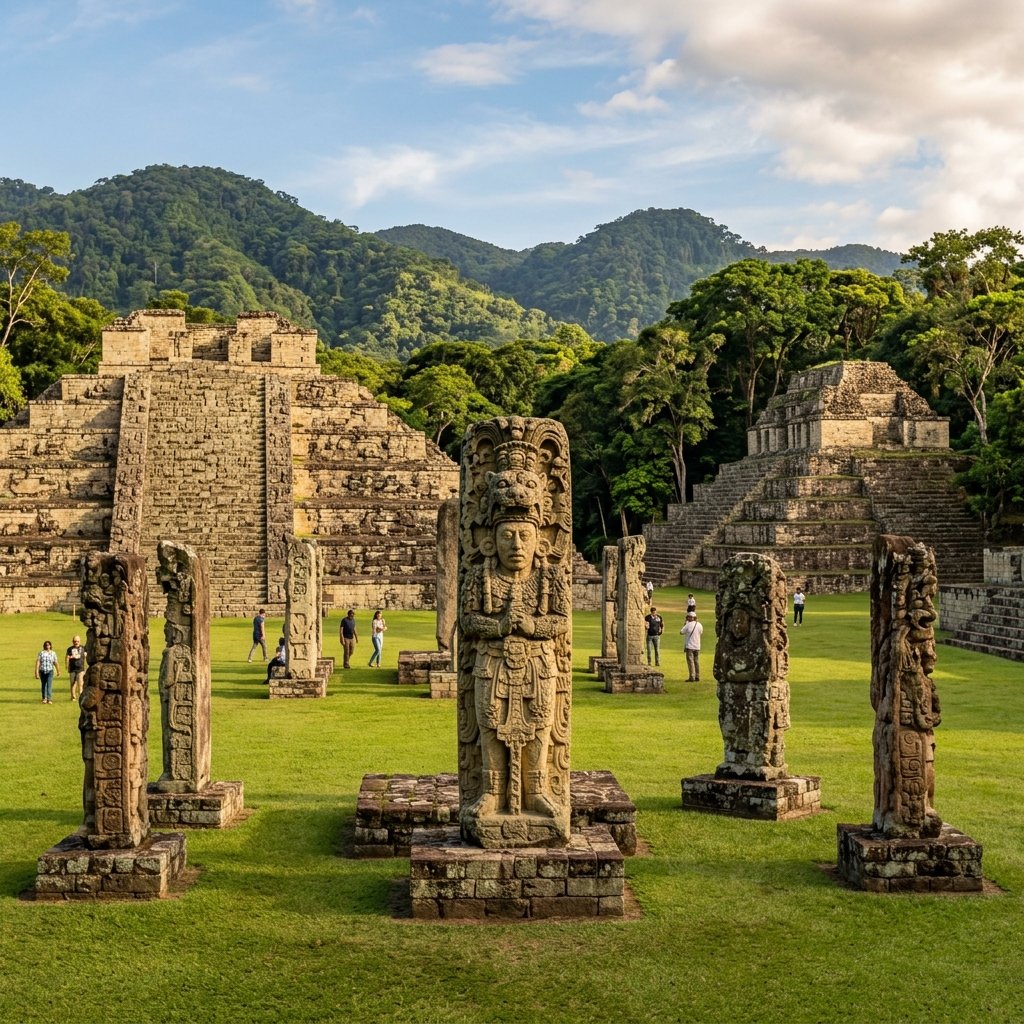
Copán at a Glance
Why Copán Is the "Athens of the Maya World"
The nickname is not casual flattery — it is a statement of fact. Where Tikal excelled at military power and Chichén Itzá at architectural scale, Copán invested its resources in artistic and intellectual achievement at a level no other Maya city matched. The stelae at Copán are the finest sculptural works in the ancient Americas. The Hieroglyphic Stairway is the longest pre-Columbian text ever carved. The astronomical observations recorded here rank among the most precise in the ancient world.
Copán occupied a unique position in the Maya world — geographically isolated at the extreme southeastern edge of the Maya cultural zone, in a fertile mountain valley in what is now western Honduras. This frontier location may have paradoxically fueled its artistic ambition: Copán's rulers seem to have invested heavily in artistic display precisely because they lacked the military might of cities deeper in the heartland. What they couldn't command through armies, they asserted through beauty (Fash, Scribes, Warriors, and Kings: The City of Copán and the Ancient Maya, Thames & Hudson, 2001).
The Copán Valley also offered something most Maya lowland cities lacked: volcanic tuff — a relatively soft stone that could be carved with extraordinary precision and detail, then hardened upon exposure to air. This geological gift partly explains why Copán's sculptors achieved a depth of three-dimensional modeling that was physically impossible at limestone-based sites elsewhere in the Maya world (Fash & Fash, Journal of World Prehistory, 2000).
The Art: Sculpture Without Equal
The Royal Stelae of the Great Plaza
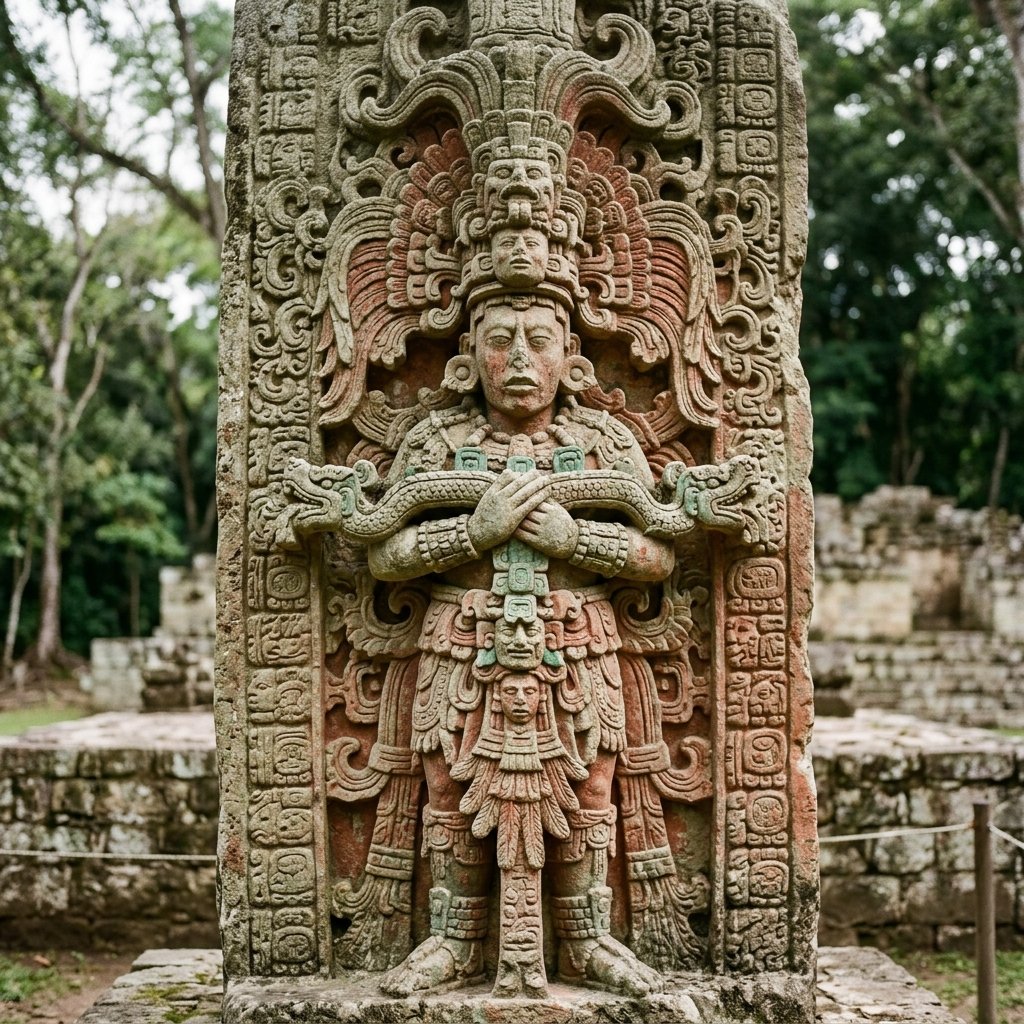
A royal stela at Copán — among the finest sculptural achievements in the pre-Columbian Americas. Unlike the flatter relief carvings at other Maya sites, Copán's sculptors carved nearly in-the-round, producing three-dimensional portraits of kings that seem ready to step forward from the stone. The volcanic tuff allowed extraordinary depth and detail impossible in limestone.
The stelae (carved stone monuments) at Copán represent the absolute pinnacle of Maya sculptural art. While other sites carved their royal portraits in relatively flat relief, Copán's artists achieved something approaching full sculpture in the round — kings modeled so deeply that you can walk around them and see the figures from multiple angles. The headdresses, costumes, and ceremonial objects are carved with a density of detail that is staggering to contemplate: every feather individually rendered, every jade bead distinct, every hieroglyphic element precisely formed.
The seven stelae erected by 18 Rabbit (Waxaklajuun Ub'aah K'awiil, ruled 695–738 AD) in the Great Plaza are the masterworks. Each depicts the king in a different cosmic guise — as the Maize God, as a patron deity, as a warrior, as the embodiment of Venus — transforming the Great Plaza into an open-air gallery of divine impersonation. The intent was theological: each stela represented the king at a specific moment in a specific ritual, performing the cosmic acts that sustained the world (Schele & Miller, The Blood of Kings, Kimbell Art Museum, 1986).
Epigraphist David Stuart has noted that Copán's stelae are unique in the Maya world for their emphasis on the individual ruler's body as a canvas for cosmological display. The king doesn't merely stand beside symbols of power — he becomes them. His body merges with deity imagery until the boundary between human and divine dissolves entirely (Stuart, "Copán Notes", Copán Mosaics Project, 1992).
The Hieroglyphic Stairway
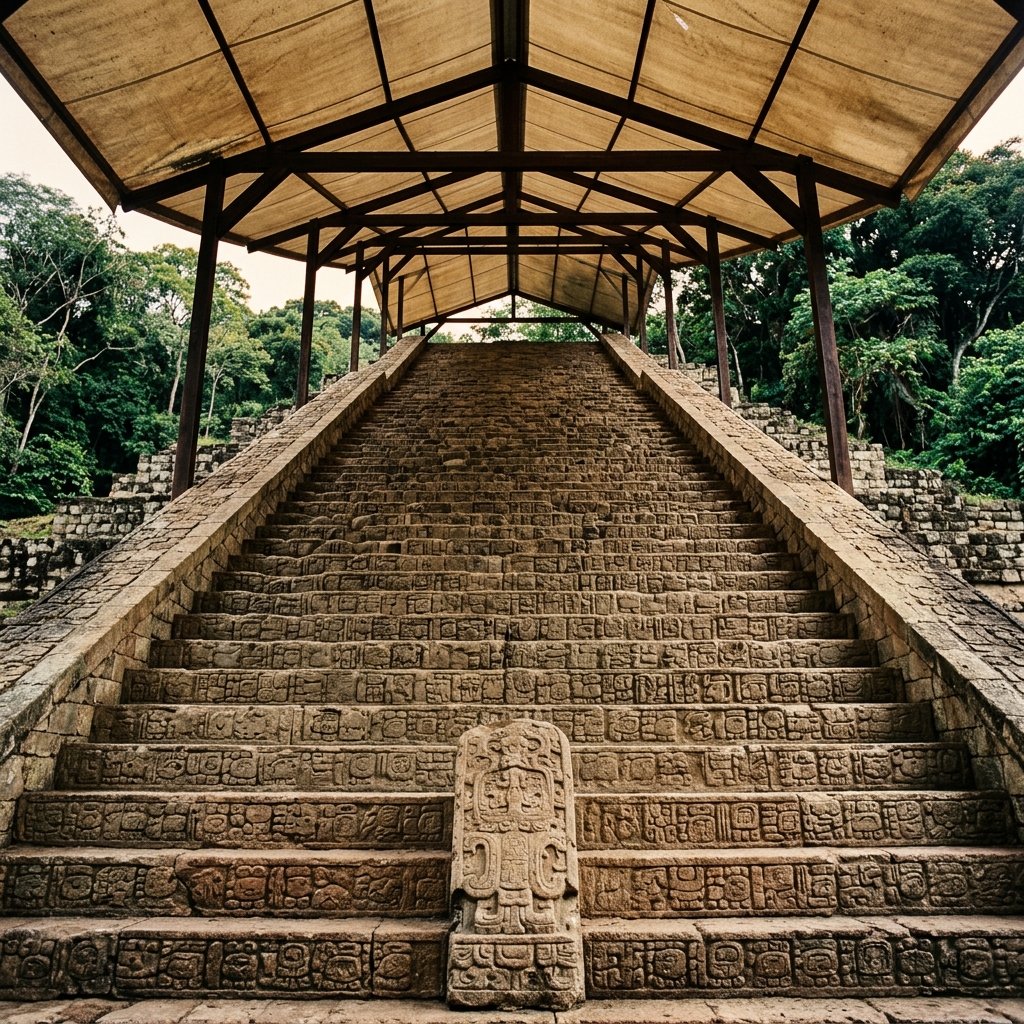
The Hieroglyphic Stairway — the longest pre-Columbian text in the Americas. Sixty-two stone steps are covered in 2,200 individual glyph blocks recording the complete dynastic history of Copán's 16 rulers. Now protected under a canvas shelter, the stairway took decades of dedicated epigraphic scholarship to decipher.
The Hieroglyphic Stairway is one of the most remarkable monuments in the ancient world. Sixty-two stone steps are carved with 2,200 individual glyph blocks — the longest continuous Maya text ever discovered, and the longest pre-Columbian inscription in the Americas. The text records the full dynastic history of Copán's ruling lineage across approximately four centuries and sixteen kings.
The stairway was commissioned by K'ak' Joplaj Chan K'awiil (Smoke Shell), the fifteenth ruler (749–763 AD), as a deliberate act of dynastic rehabilitation. His predecessor 18 Rabbit had been captured and executed by the vassal city of Quiriguá in 738 AD — a devastating humiliation. The Hieroglyphic Stairway was the response: a monumental assertion of Copán's unbroken royal lineage, emphasizing continuity and divine right despite the catastrophe. It is, in essence, a 2,200-glyph argument that Copán's dynasty remained legitimate (Fash, Stuart & Williamson, Copán Note 117, Copán Acropolis Archaeological Project, 1992).
Deciphering the stairway was one of the great challenges of Maya epigraphy. Many blocks had fallen from their original positions and were reassembled incorrectly by early excavators. It took decades of painstaking work by epigraphers including David Stuart, Nikolai Grube, and Linda Schele to reconstruct the text's proper reading order — a process that transformed our understanding of Maya political history.
The Ball Court
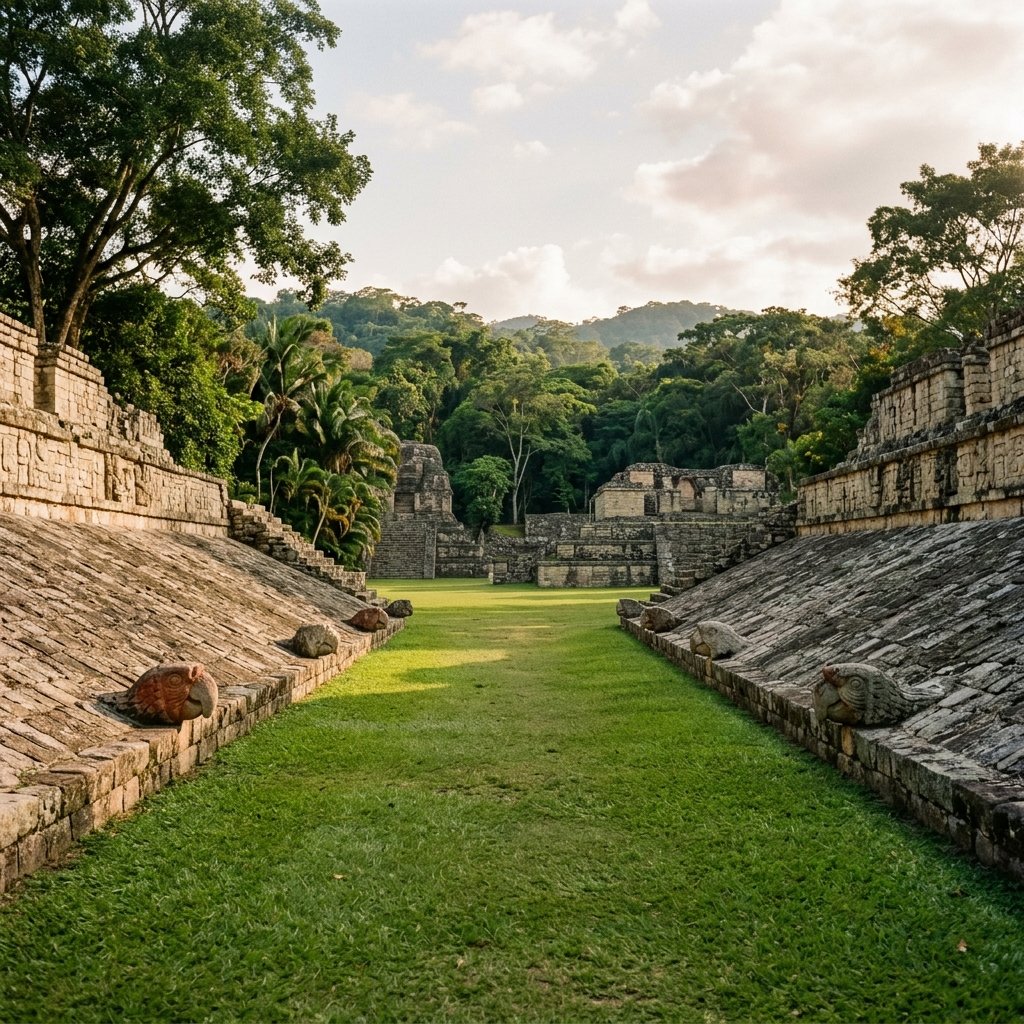
The ball court at Copán — smaller than the great court at Chichén Itzá but far more artistically refined. The sculpted macaw-head markers set into the playing surface reflect Copán's sacred animal and connect the ritual game to the Maya creation myth described in the Popol Vuh.
Copán's ball court is small by the standards of Chichén Itzá, but it is arguably the most artistically elegant in the Maya world. The court features three sculpted guacamaya (scarlet macaw) heads set as markers into the playing surface — the macaw being Copán's sacred emblem and arguably the city's patron bird.
The ball game at Copán was deeply connected to the Hero Twins myth preserved in the Popol Vuh. In the Maya creation story, the Hero Twins Hunahpu and Xbalanque defeated the Lords of Death in the ballgame of the underworld, making the game a cosmic act of regeneration — the triumph of life over death, the victory that allowed the current world to be created. Copán's sculptors embedded this mythology into the court's decorative program with characteristic elegance (Schele & Miller, The Blood of Kings, 1986).
The Tragedy of 18 Rabbit
On April 29, 738 AD, Copán's greatest king — Waxaklajuun Ub'aah K'awiil, known as "18 Rabbit" — was captured by K'ak' Tiliw Chan Yopaat, the ruler of Quiriguá, a much smaller city that had long been Copán's vassal state. Eighteen days later, on May 17, 18 Rabbit was ritually decapitated at Quiriguá. The event is recorded in triumphant detail on Quiriguá's own stelae.
The shock was immense. This was not a battle between equals — Quiriguá had been a subject city paying tribute to Copán. The capture and execution of a reigning Maya king by his own vassal was without precedent. Scholars now believe that Calakmul, Tikal's great northern rival, may have secretly backed Quiriguá's rebellion as part of its ongoing proxy war against Tikal's alliance network, which included Copán (Martin & Grube, Chronicle of the Maya Kings and Queens, 2000).
The aftermath at Copán was devastating. No new monuments were erected for seventeen years — a silence that echoes the "Tikal Hiatus" following Tikal's defeat by Calakmul in 562 AD. When construction finally resumed under Smoke Shell, the Hieroglyphic Stairway was commissioned — a desperate attempt to reassert dynastic legitimacy. But the damage was done. Copán's last ruler, Yax Pasaj Chan Yopaat (the sixteenth king, 763–~822 AD), oversaw a city in visible decline — his final monument, Altar Q, records all 16 rulers in a row, but the quality of the carving is noticeably inferior to the masterworks of 18 Rabbit's era. The dynasty ended with him.
What Lies Beneath: The Tunnels
One of Copán's great archaeological treasures is largely invisible from the surface. The Copán Tunnels — over 4 km of excavated passages beneath the Acropolis — reveal earlier construction phases buried beneath the visible buildings. The Maya routinely built new structures over old ones, and the tunnels allow you to walk through centuries of architectural history like geological strata.
The most spectacular discovery within the tunnels is the Rosalila Temple — an entire 6th-century temple found virtually intact inside a later pyramid, its original brightly painted red, green, and cream stucco facade completely preserved. Rosalila was so sacred that when the Maya decided to build over it, they carefully preserved it rather than destroying it as was customary. A life-size replica is displayed in the Copán Sculpture Museum, and it is stunning — a glimpse of what Maya temples actually looked like when they were alive with color, not the bare stone we see today (Agurcia Fasquelle, "Rosalila, Temple of the Sun-King" in Understanding Early Classic Copan, University of Pennsylvania Museum, 2004).
The Scarlet Macaw: Copán's Living Emblem
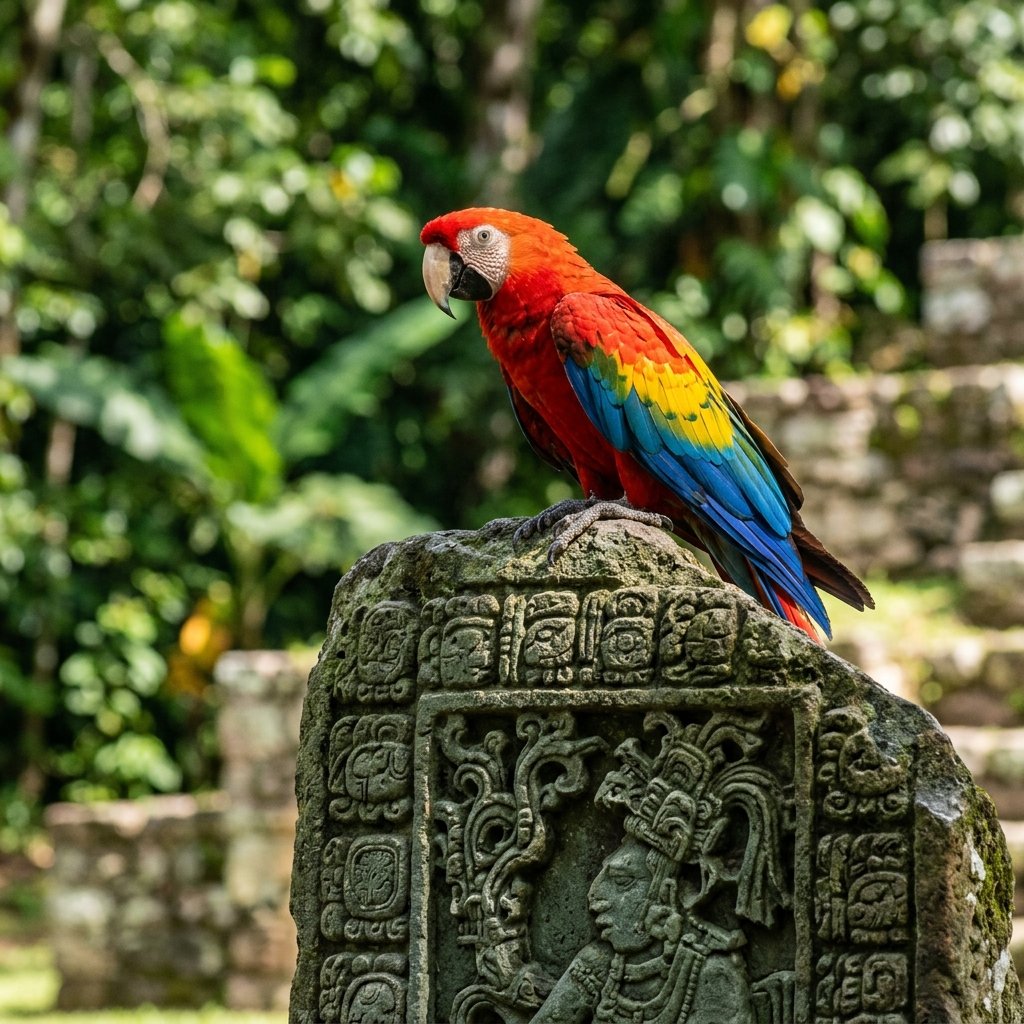
A scarlet macaw at Copán — the city's sacred animal and living emblem. The brilliantly colored bird appears throughout Copán's art: as ball court markers, temple decorations, and royal costume elements. Today, a conservation program has reintroduced macaws to the valley, and they can be seen flying between the ruins and the nearby Macaw Mountain reserve.
The scarlet macaw (Ara macao) was central to Copán's identity. The bird appears everywhere in the city's art — on the ball court markers, in temple reliefs, as costume elements on royal portraits, and in the city's dynastic mythology. The name "Copán" itself may derive from copantl, a Nahuatl word meaning "place of the macaws."
The founder of Copán's dynasty, K'inich Yax K'uk' Mo' ("Great Sun First Quetzal Macaw"), arrived in 426 AD and established the ruling lineage that would endure for sixteen generations. His very name combines the macaw with the quetzal — the two most sacred birds in Mesoamerica. Isotopic analysis of his skeletal remains has determined that he was not originally from the Copán Valley — he likely came from the Petén region of Guatemala, possibly from Tikal or a Tikal-allied city, and may have been installed by Teotihuacan-connected political networks (Price et al., Journal of Anthropological Archaeology, 2010).
Today a conservation program has reintroduced scarlet macaws to the Copán Valley, and the birds can be seen flying between the ruins and the nearby Macaw Mountain Bird Park — one of the rare places where you can see the living creature alongside the ancient art it inspired.
Practical Travel Guide
Getting There
The charming town of Copán Ruinas is near the Honduras-Guatemala border. From San Pedro Sula: 3 hours by bus. From Antigua Guatemala: ~5 hours via the Chiquimula border crossing. The town itself has excellent budget-to-midrange accommodation and some of the best restaurants in western Honduras.
Time Needed
Allow a full day: 3–4 hours for the main ruins, plus the Sculpture Museum (essential — houses the full-scale Rosalila replica and original carved monuments) and the Tunnels (extra ticket, absolutely worth it). Don't rush this site; the details reward slow looking.
Don't Miss
The Copán Sculpture Museum — one of the finest archaeological museums in the Americas. The full-scale replica of the Rosalila Temple in its original colors is genuinely breathtaking, and the original carved monuments are displayed at eye level for close study.
Macaw Mountain
The Macaw Mountain Bird Park (15 min walk from town) houses scarlet macaws, toucans, and parrots in a lush forest setting. Seeing the living birds after studying their images in the ruins creates a powerful connection between ancient and modern Copán.
Visitor Comparison
| Feature | Copán | Palenque | Chichén Itzá |
|---|---|---|---|
| Best Feature | Sculpture / Stairway | Pakal's Tomb / Stucco | El Castillo / Equinox |
| Artistic Quality | Unmatched (sculpture) | Unmatched (stucco) | Very High |
| Crowd Level | Low | Moderate | Very High |
| Country | Honduras | Mexico | Mexico |
| Time Needed | Full day | 3–5 hours | 3–5 hours |
Key Academic References
- Agurcia Fasquelle, Ricardo. "Rosalila, Temple of the Sun-King." In Understanding Early Classic Copan. University of Pennsylvania Museum, 2004.
- Fash, William L. Scribes, Warriors, and Kings: The City of Copán and the Ancient Maya. Thames & Hudson, 2001.
- Fash, William L. & Fash, Barbara W. "Teotihuacan and the Maya: A Classic Heritage." In Mesoamerica's Classic Heritage. University Press of Colorado, 2000.
- Fash, William L., Stuart, David & Williamson, Richard. "Copán Note 117." Copán Acropolis Archaeological Project, 1992.
- Martin, Simon & Grube, Nikolai. Chronicle of the Maya Kings and Queens. Thames & Hudson, 2000.
- Price, T. Douglas et al. "Kings and commoners at Copán: Isotopic evidence for origins and movement in the Classic Maya polity." Journal of Anthropological Archaeology, 29(1), 2010.
- Schele, Linda & Miller, Mary Ellen. The Blood of Kings: Dynasty and Ritual in Maya Art. Kimbell Art Museum, 1986.
- Stuart, David. "Copán Notes." Copán Mosaics Project and IHAH, 1992.
Frequently Asked Questions
Is Copán in Mexico?
No — Copán is in western Honduras, very close to the Guatemala border. It's the only major Maya site in Honduras and one of the most important archaeological sites in all of Central America. The town of Copán Ruinas is easily accessible from both Honduras and Guatemala.
What happened to 18 Rabbit?
In 738 AD, Copán's greatest king — 18 Rabbit (Waxaklajuun Ub'aah K'awiil) — was captured by the ruler of Quiriguá, a city that had been Copán's own vassal. He was publicly decapitated on May 17, 738 AD. It remains one of the most shocking events in Maya history. Scholars believe Calakmul may have secretly backed the rebellion as part of its geopolitical rivalry with Tikal's alliance network.
What is the Rosalila Temple?
Rosalila is a complete 6th-century temple found perfectly preserved inside a later pyramid at Copán. Its original red, green, and cream painted stucco facade survived intact because the Maya ritually preserved it rather than destroying it when they built over it. A life-size replica in the Sculpture Museum shows what Maya temples actually looked like in their prime — not bare stone, but blazing with color.
Is the Sculpture Museum worth visiting?
Absolutely essential. The Copán Sculpture Museum is one of the finest archaeological museums in the Americas. It houses the full-scale Rosalila replica, original carved monuments displayed at eye level, and the original macaw-head ball court markers. You'll understand the art far more deeply than if you only see the weathered originals outdoors. Allow at least an hour.
Can you see live macaws at Copán?
Yes! A conservation program has reintroduced scarlet macaws to the Copán Valley. The Macaw Mountain Bird Park, a 15-minute walk from town, houses macaws, toucans, and parrots in a lush forest setting. They can sometimes be seen flying freely over the ruins — a living connection to the ancient city's sacred emblem.