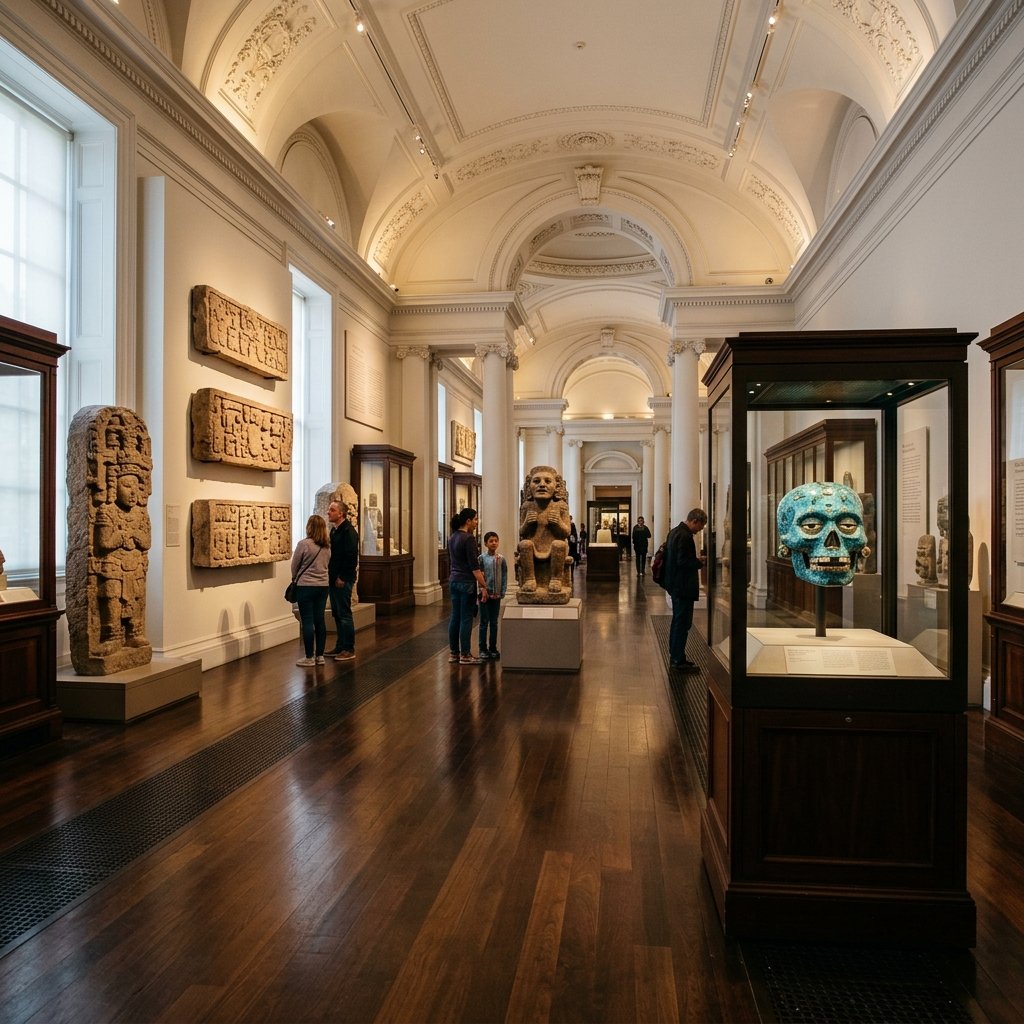
Why This Museum Matters
The British Museum holds one of the most significant Maya collections outside the Americas — a treasure trove built largely through the work of one extraordinary Victorian explorer: Alfred Percival Maudslay. Between 1881 and 1894, Maudslay made seven expeditions to Central America, producing meticulous plaster casts, glass plate photographs, and detailed drawings of Maya monuments at a time when the jungle was actively consuming them. His work — much of it housed here — preserved inscriptions that have since eroded beyond recognition at the original sites. The museum's Maya holdings also include the famous Yaxchilán lintels and the exquisite Copán Maize God bust, both acquired during the same era of exploration.
Signature Artifacts
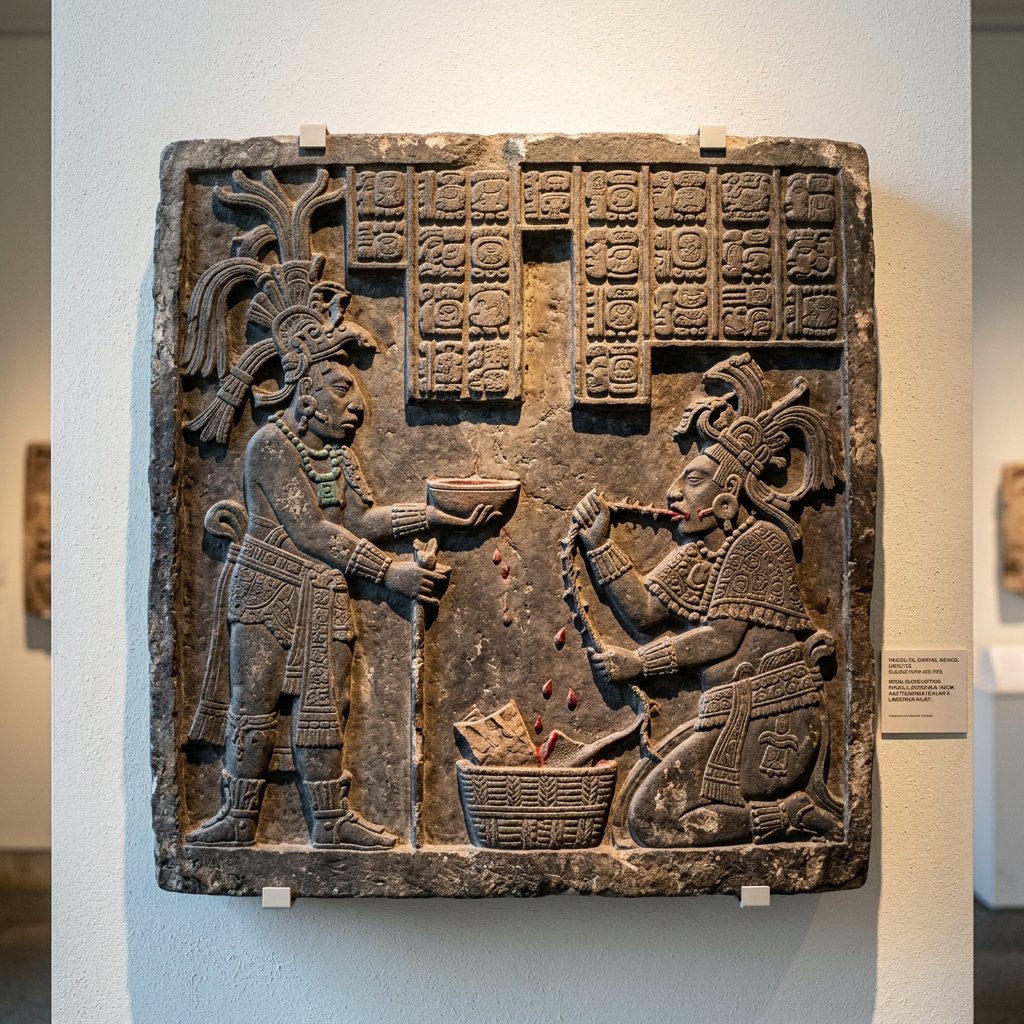
Yaxchilán Lintel 24
The most famous single carving in Maya art. This limestone lintel — originally set above a doorway in Structure 23 at Yaxchilán — depicts Lady K'abal Xook, royal wife of King Shield Jaguar III, performing a blood sacrifice on October 28, AD 709. She kneels before the king, pulling a rope studded with obsidian blades through her tongue. Blood drips onto bark paper in a basket below. The hieroglyphic text records the date and names of the participants.
Acquired: Removed from Yaxchilán by Alfred Maudslay in 1882; gifted to the British Museum in 1886. The lintel's removal is now considered ethically problematic, though it arguably preserved the object from jungle deterioration.
Gallery: Mexico Gallery, Room 27
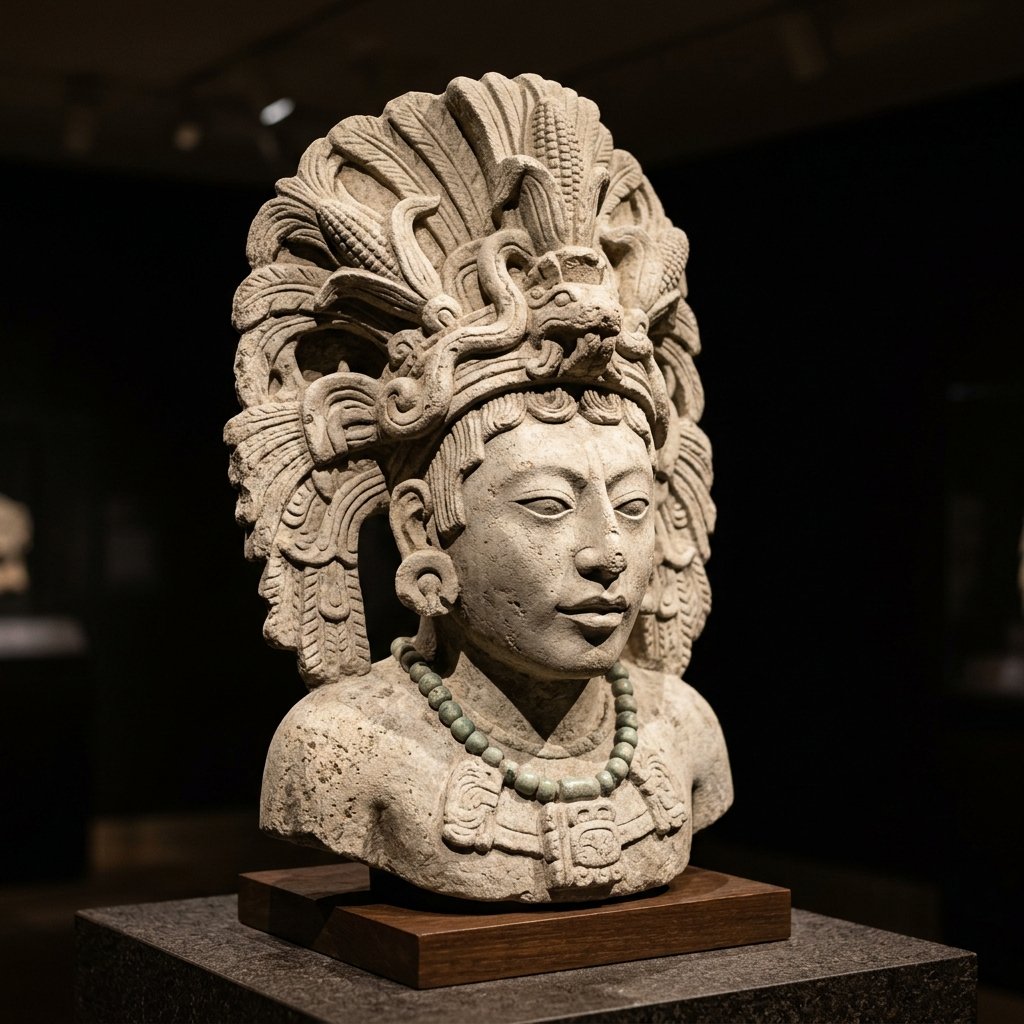
The Copán Maize God Bust
One of the most beautiful sculptures in all of Maya art. This limestone bust of the Young Maize God (Juun Ixiim) was carved at Copán, Honduras, during the Late Classic Period (~AD 700–800). The idealized face — smooth skin, almond-shaped eyes, slightly parted lips — represents the Maya aesthetic ideal. The corn-leaf headdress identifies him as the deity whose death and resurrection mirrored the annual agricultural cycle.
Acquired: Collected by Alfred Maudslay at Copán in the 1880s. Displayed in the Enlightenment Gallery (Room 1) and the Mexico Gallery (Room 27).
Yaxchilán Lintels 25 & 26
The museum also holds Lintel 25 — showing Lady K'abal Xook experiencing a bloodletting vision of a warrior emerging from the jaws of a serpent — and Lintel 26, depicting Shield Jaguar III being dressed for battle by his wife. Together, the three lintels from Structure 23 form a complete narrative cycle: sacrifice → vision → war. They are among the most studied objects in Maya art history and were instrumental in Tatiana Proskouriakoff's 1960 breakthrough proving that Maya inscriptions record historical events.
Significance: These lintels helped transform our understanding of the Maya from "peaceful stargazers" to a civilization of warring dynastic kingdoms — one of the most important paradigm shifts in 20th-century archaeology.
The Maudslay Archive
Beyond the physical artifacts, the British Museum holds what may be its most scientifically valuable Maya asset: the Alfred Maudslay Archive. This includes:
- Plaster casts: Over 400 detailed plaster molds of Maya monuments, stelae, and architectural details — many from monuments that have since deteriorated beyond recognition
- Glass plate photographs: Hundreds of large-format photographs documenting Maya sites in the 1880s–1890s, providing an irreplaceable visual record
- Drawings and field notes: Maudslay's meticulous hand-drawn copies of hieroglyphic inscriptions, with annotations
- Published volumes: Biologia Centrali-Americana: Archaeology (1889–1902), a landmark publication that brought Maya art to European scholarly attention
Maudslay's casts have proven invaluable for modern epigraphers. When weathering has erased details from the original monuments, the plaster casts — made when the carvings were in better condition — often preserve readings that would otherwise be lost forever.
Additional Maya Highlights
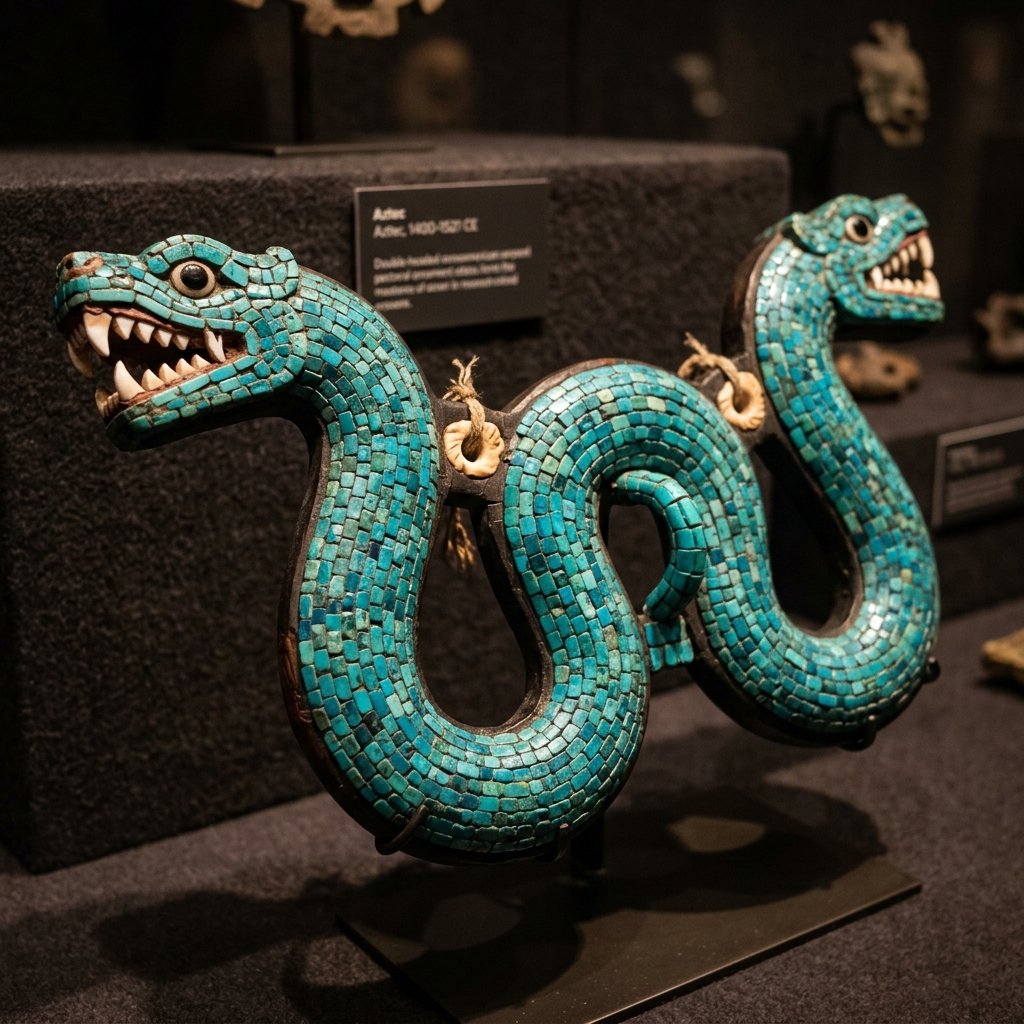
- Turquoise mosaic serpent (Mixtec-Aztec): While not Maya, this spectacular double-headed serpent mosaic is one of the museum's most photographed objects and demonstrates the broader Mesoamerican artistic traditions that the Maya shared.
- Maya ceramic vessels: A collection of Classic Period polychrome vessels with mythological scenes and the Primary Standard Sequence rim text.
- Jade and greenstone objects: Ear spools, pectorals, and figurines from various Maya sites.
- Stucco heads: Portrait heads from Palenque, showing the extraordinary naturalism of Maya portraiture.
Scholarly References
- Maudslay, A. P. (1889–1902). Biologia Centrali-Americana: Archaeology. London: R. H. Porter and Dulau & Co.
- Proskouriakoff, T. (1960). "Historical Implications of a Pattern of Dates at Piedras Negras, Guatemala." American Antiquity, 25(4), 454–475.
- Martin, S. & Grube, N. (2000). Chronicle of the Maya Kings and Queens. Thames & Hudson. pp. 124–131 (Yaxchilán).
- Miller, M. E. (1999). Maya Art and Architecture. Thames & Hudson. pp. 72–78 (Lintel 24 analysis).
- Tate, C. E. (1992). Yaxchilan: The Design of a Maya Ceremonial City. University of Texas Press.
- Graham, I. (1977). Corpus of Maya Hieroglyphic Inscriptions, Vol. 3, Part 1: Yaxchilán. Peabody Museum, Harvard.
Practical Information
Contact & Location
- 📍 Great Russell Street, London, WC1B 3DG, United Kingdom
- 📞 +44 (0)20 7323 8181 (Box Office, Mon–Fri 10:00–16:50)
- ✉️ info@britishmuseum.org
- 🌐 britishmuseum.org
- 🎨 Mexico Gallery (Room 27) page
Visitor Information
- 🕐 Daily: 10:00 AM – 5:00 PM (last entry 4:45 PM)
- 🌙 Fridays: Open late until 8:30 PM
- 🚫 Closed: December 24, 25, 26
- 🆓 Admission is FREE (permanent collection)
- 🎟️ Timed entry recommended — book online
- 🚇 Nearest Tube: Tottenham Court Road, Holborn, Russell Square
Tips for Your Visit
- Head straight to Room 27. The Mexico Gallery is on the ground floor. Turn right from the Great Court and follow signs for the Americas galleries. The Maya lintels are mounted on the wall above eye level — look up.
- Don't miss Room 1. The Enlightenment Gallery contains additional Maya pieces, including the Copán Maize God bust, in a broader context of 18th-century scholarly collections.
- Book Friday evenings. The museum is open late until 8:30 PM on Fridays; the galleries are significantly less crowded after 5 PM.
- Use the online collection database. The British Museum's online search tool lets you browse all Maya holdings — including pieces not currently on display — before your visit.
- Photography is permitted (no flash) throughout the permanent galleries.
Frequently Asked Questions
Should the Yaxchilán lintels be returned to Mexico?
This is an active and legitimate debate. Mexico has periodically requested the return of the lintels. The British Museum's position has historically been that the objects are part of a "universal collection" accessible to all. Critics argue this position is a remnant of colonial-era attitudes. In practice, the lintels' removal by Maudslay in the 1880s likely did preserve them from jungle deterioration, but the ethical landscape of collecting has changed dramatically since then. This conversation continues to evolve.
How large is the British Museum's Maya collection?
The museum holds several hundred Maya objects in total, though only a fraction are on display at any given time. The collection's strength lies not in quantity but in the exceptional quality and historical importance of key pieces — particularly the Yaxchilán lintels, the Maudslay archive, and the Copán sculptures.