Why This Museum Matters
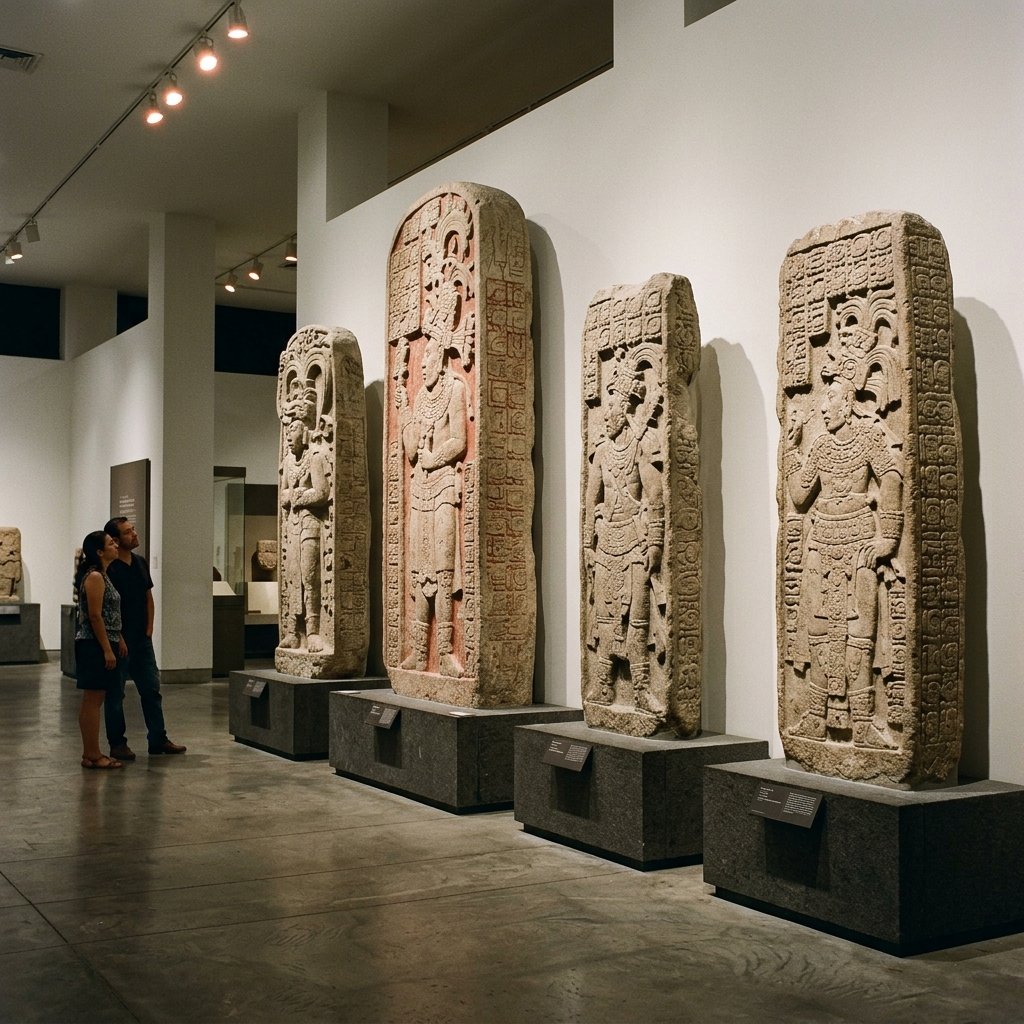
The Museo Nacional de Arqueología y Etnología (MUNAE) is, in the estimation of many Maya scholars, the single most important Maya museum in the world. Located in Guatemala City's La Aurora cultural district, MUNAE houses the Guatemalan national collection — the mother lode of Maya art. Its holdings include monumental stelae from Tikal, Piedras Negras, Machaquilá, and Uaxactún; extraordinarily rare carved wooden lintels from Tikal (some of the only surviving Maya woodwork); one of the world's finest collections of carved jade; and thousands of ceramic vessels spanning the entire Maya chronological sequence. If you visit one Maya museum in your lifetime, many archaeologists will tell you it should be this one.
Signature Artifacts
Tikal Stelae & Wooden Lintels
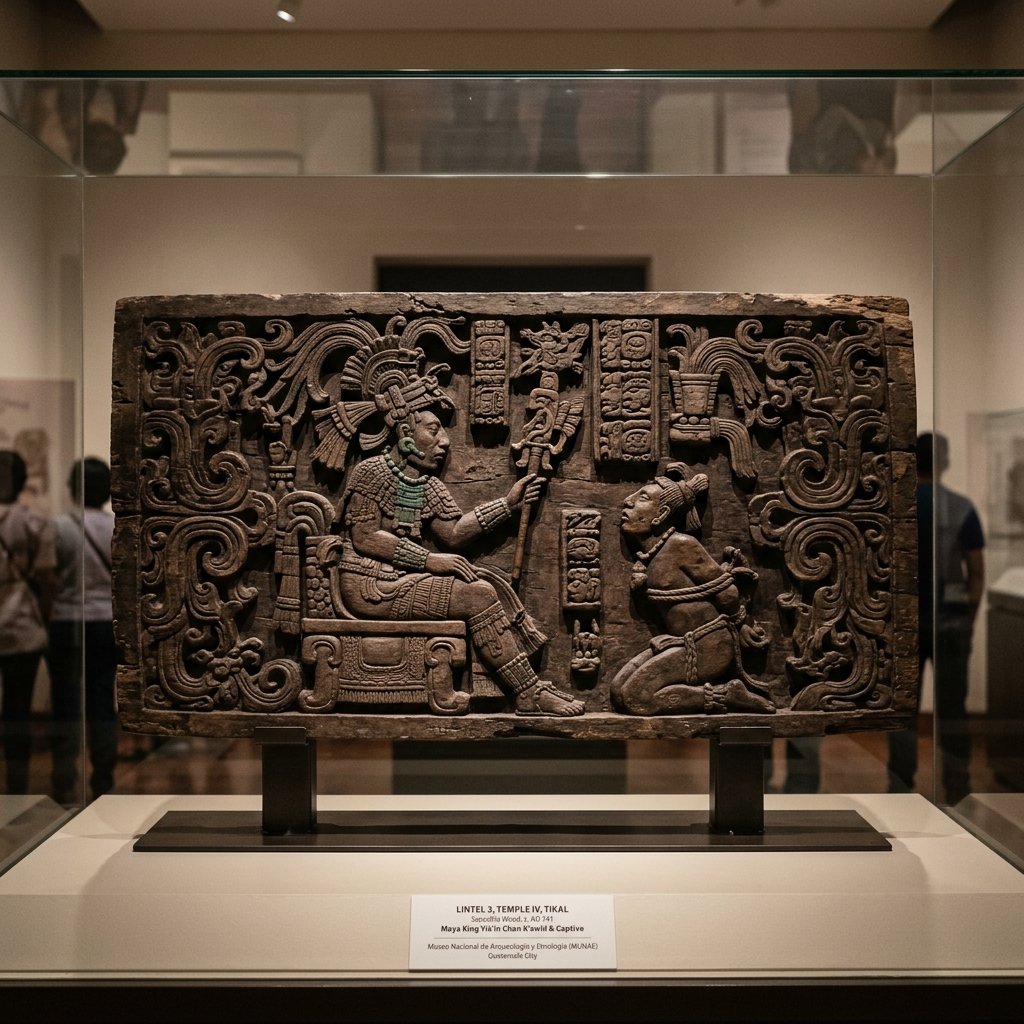
MUNAE holds the Guatemalan share of the Tikal monuments — massive carved stone stelae depicting the great kings of the dynasty. Even more precious are the carved wooden lintels from Temples I and IV — sapodilla-wood beams carved with detailed scenes of Jasaw Chan K'awiil I seated on a palanquin throne above a bound captive. These are among the only surviving examples of Maya woodcarving — the vast majority having rotted in the tropical climate. Their preservation is nothing short of miraculous.
Note: One of the Temple IV lintels is at the Museum der Kulturen in Basel, Switzerland — removed by Gustav Bernoulli in 1877.
Piedras Negras Throne 1
One of the masterpieces of Maya art. This enormous carved stone throne — weighing several tons — depicts a royal accession scene: the new ruler seated on a raised platform with attendant figures below and hieroglyphic text recording the date. Piedras Negras is the site where Tatiana Proskouriakoff made her 1960 breakthrough proving that Maya inscriptions record historical events — and this throne is one of the key monuments she studied.
Significance: The Piedras Negras monuments at MUNAE are directly responsible for one of the most important intellectual breakthroughs in 20th-century archaeology.
Additional Highlights
- Jade collection: Hundreds of jade objects — masks, pectorals, ear spools, beads, figurines — representing the pinnacle of Maya lapidary art. Jade was more precious than gold to the ancient Maya.
- El Naranjo and Machaquilá stelae: Carved stone monuments from these Petén sites, many with well-preserved hieroglyphic texts recording political alliances and warfare.
- Ethnological galleries: The museum's second floor houses an extensive ethnological collection documenting Guatemala's 22 living Maya linguistic communities — textiles, ritual objects, and musical instruments.
- Uaxactún ceramics: Beautifully painted vessels from one of the earliest Maya cities, demonstrating the origins of the polychrome tradition.
- Architectural models: Scale reconstructions of major buildings from Tikal, Uaxactún, and other Petén sites.
Scholarly References
- Proskouriakoff, T. (1960). "Historical Implications of a Pattern of Dates at Piedras Negras." American Antiquity, 25(4), 454–475.
- Martin, S. & Grube, N. (2000). Chronicle of the Maya Kings and Queens. Thames & Hudson. pp. 24–53 (Tikal), 74–81 (Piedras Negras).
- Jones, C. & Satterthwaite, L. (1982). The Monuments and Inscriptions of Tikal: The Carved Monuments. University of Pennsylvania Museum.
- Sharer, R. J. & Traxler, L. P. (2006). The Ancient Maya. 6th ed. Stanford University Press. Ch. 5 (Guatemala).
- Morley, S. G. (1946). The Ancient Maya. Stanford University Press.
Practical Information
Contact & Location
- 📍 6a Calle y 7a Avenida, Salón No. 5, Finca La Aurora, Zona 13, Guatemala City
- ✉️ mramirez@munae.gob.gt
- 🌐 munae.gob.gt
Visitor Information
- 🕐 Tue–Fri: 9:00 AM – 4:00 PM
- 🕐 Sat–Sun: 9:00 AM – 12:00 PM, 1:30 – 4:00 PM
- 🚫 Closed Mondays
- 💰 Nationals: Q5 (~$0.65 USD) | Tourists: Q60 (~$7.75 USD)
- 🏛️ Located in the Finca La Aurora cultural district (near the zoo and other museums)
Frequently Asked Questions
Is MUNAE better than the MNA in Mexico City for Maya art?
For specifically Maya material, many scholars would say yes. The MNA covers all of Mesoamerica and has a superb Maya hall, but MUNAE holds the national collection of Guatemala — the heartland of Classic Maya civilization. The carved wooden lintels and the Piedras Negras throne alone are unparalleled anywhere. MUNAE is also far less crowded and much more affordable.
Is the area around MUNAE safe?
MUNAE is in the Zona 13 cultural district (Finca La Aurora), which is one of the safest parts of Guatemala City. The area includes the zoo, the modern art museum, and a crafts market. Take standard urban precautions and use taxis or rideshare rather than walking long distances in the broader city.