The World Tree at a Glance
The Pillar that Holds the Sky
At the absolute center of the ancient Maya universe stood the World Tree. In the Classic period (c. 250–900 AD), it was known as the Wakah-Chan (the "Raised Up Sky"); in the Yucatan, it was often called the Ya'axche'.
This wasn't merely a mythological concept; it was a structural necessity. The Maya conceived of the cosmos in three vertical layers: the starry heavens above, the earthly plane in the middle, and the watery underworld (Xibalba) below. The World Tree was the axis mundi—the central cosmic pillar that pierced all three levels. Its roots plunged deep into the underworld, its trunk formed the earthly world, and its massive branches supported the thirteen levels of heaven.
Because it touched all three realms, the World Tree was the ultimate conduit. It was the pathway by which the souls of the dead descended into the underworld, and the pathway by which the gods, visions, and ancestors were drawn up to the surface during royal bloodletting rituals.
The Ceiba: The Tree of Life in the Jungle
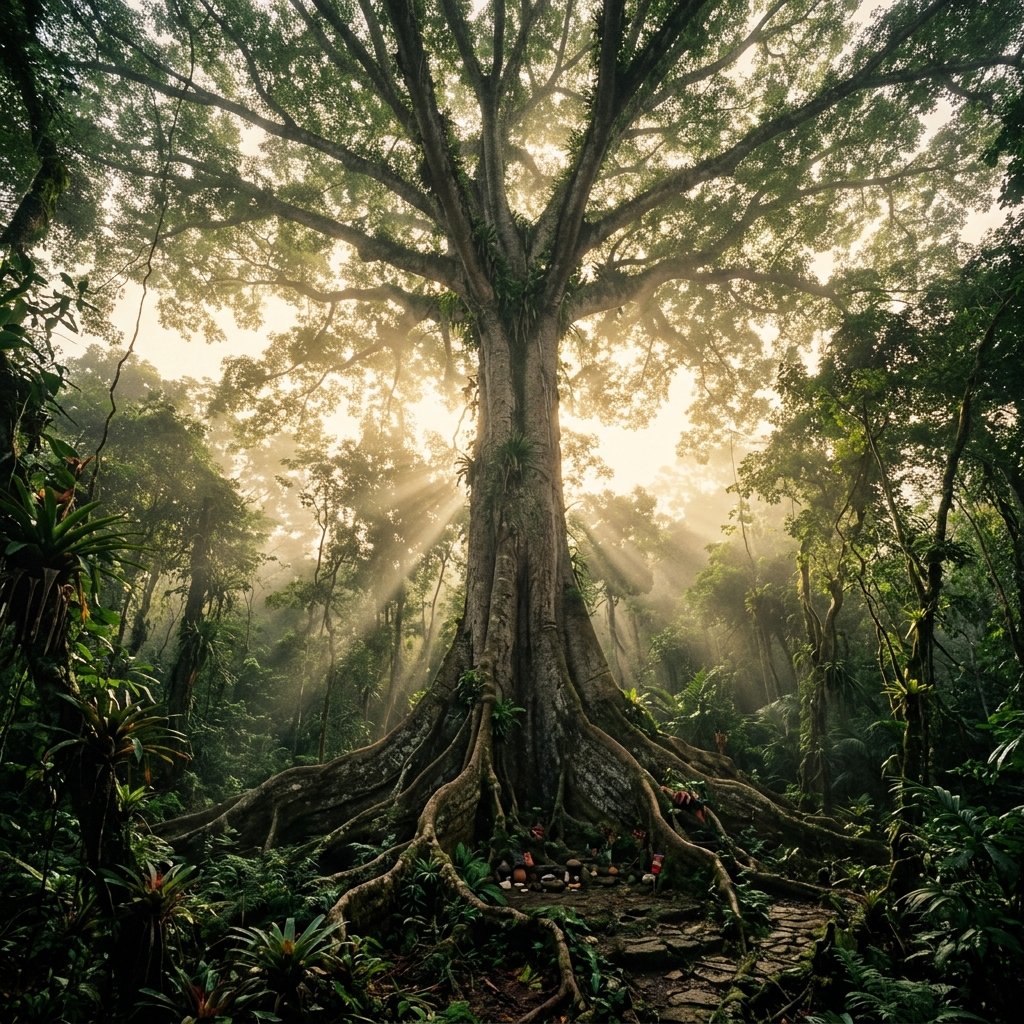
The physical manifestation of this cosmic concept is the Ceiba tree (Ceiba pentandra). If you stand before a mature Ceiba in the Mesoamerican jungle, the theological connection is immediately obvious.
The Ceiba is a giant. Its trunk is thick, perfectly straight, and covered in conical thorns. At its base, enormous fluted buttress roots grip the earth like dragon claws. It grows taller than the surrounding jungle canopy—often reaching up to 200 feet (60 meters)—before bursting into a massive, umbrella-like crown of branches. Even today, many traditional Maya communities refuse to fell a Ceiba tree, viewing it as a sacred entity.
The Iconography of the Wakah-Chan
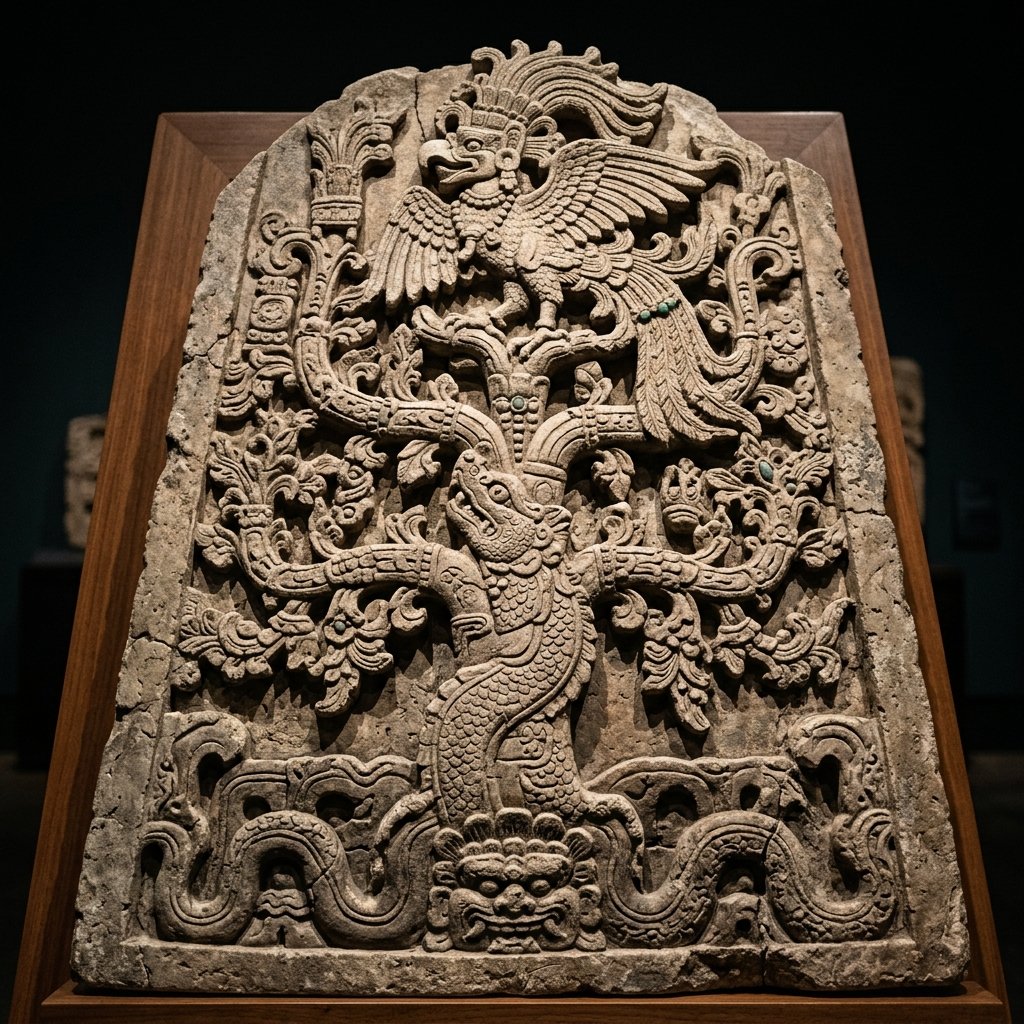
In Maya art, the World Tree is frequently depicted with specific iconographic elements:
- The Crocodilian Base: The tree often emerges from a stylized split in the earth, frequently depicted as the open, bony jaws of a crocodilian monster or a skeletal deity head. This represents the entrance to Xibalba.
- The Dragon-Like Trunk: The trunk is rarely depicted as plain wood. It is often scaled or marked with symbols for wood, jade, and water, reflecting its status as a living, pulsating conduit of divine energy.
- The Principal Bird Deity (Itzam-Ye): A massive, fearsome supernatural bird is almost always perched at the very top branches of the tree, representing the celestial realm and acting as the avian counterpart to the supreme creator god Itzamná.
The Milky Way Connection
Recent archaeoastronomical research has revealed that the Maya did not just see the World Tree in the jungle; they saw it in the night sky.
During certain times of the year at the latitude of the Maya lowlands, the Milky Way arcs overhead, stretching from the northern horizon to the southern horizon. When the Milky Way is in its upright, north-south orientation, the Maya identified the glowing band of stars as the "Raised Up Sky"—the celestial manifestation of the World Tree. The dark rift in the Milky Way (the path of cosmic dust obscuring the stars) was viewed as the crevice or portal leading down into the underworld (Freidel, D., Schele, L., & Parker, J., Maya Cosmos, 1993).
Kings as the World Tree
Classic Maya kings often appropriated the imagery of the World Tree to justify their rule. When a king stood in the center of the main plaza to perform a ritual, wearing heavy jade ornaments and a massive feathered headdress, he was visually transforming himself into the axis mundi.
The king became the World Tree. Through his royal blood, he connected the gods in heaven with the ancestors in the underworld, ensuring that the cosmos continued to function. When the great King Pakal of Palenque died, his famous sarcophagus lid depicted him slipping down the trunk of the World Tree into the underworld, confident that he, like the sun and the maize, would travel the axis and rise again.
References
- Freidel, D., Schele, L., & Parker, J. Maya Cosmos: Three Thousand Years on the Shaman's Path. William Morrow, 1993.
- Miller, M. & Taube, K. The Gods and Symbols of Ancient Mexico and the Maya. Thames & Hudson, 1993.
- Schele, L. & Mathews, P. The Code of Kings: The Language of Seven Sacred Maya Temples and Tombs. Scribner, 1998.
Frequently Asked Questions
What was the Maya World Tree?
The World Tree (Wakah-Chan) was the central pillar of the Maya universe. It functioned as an axis that connected the three layers of the cosmos: its roots reached down into the underworld, its trunk formed the earthly plane, and its branches supported the heavens.
What real tree represents the World Tree?
The Ceiba tree (Ceiba pentandra) is the biological model for the World Tree. With its massive buttress roots, straight thorny trunk, and enormous umbrella-like canopy that towers over the jungle, it perfectly embodies the physical structure of the cosmic pillar.
What bird sits on top of the World Tree?
In Maya art, the Principal Bird Deity (often identified as Itzam-Ye, the avian aspect of the supreme creator god Itzamná) perches at the very top of the World Tree. It represents the highest celestial realm, contrasting with the underworld jaws typically depicted at the tree's base.