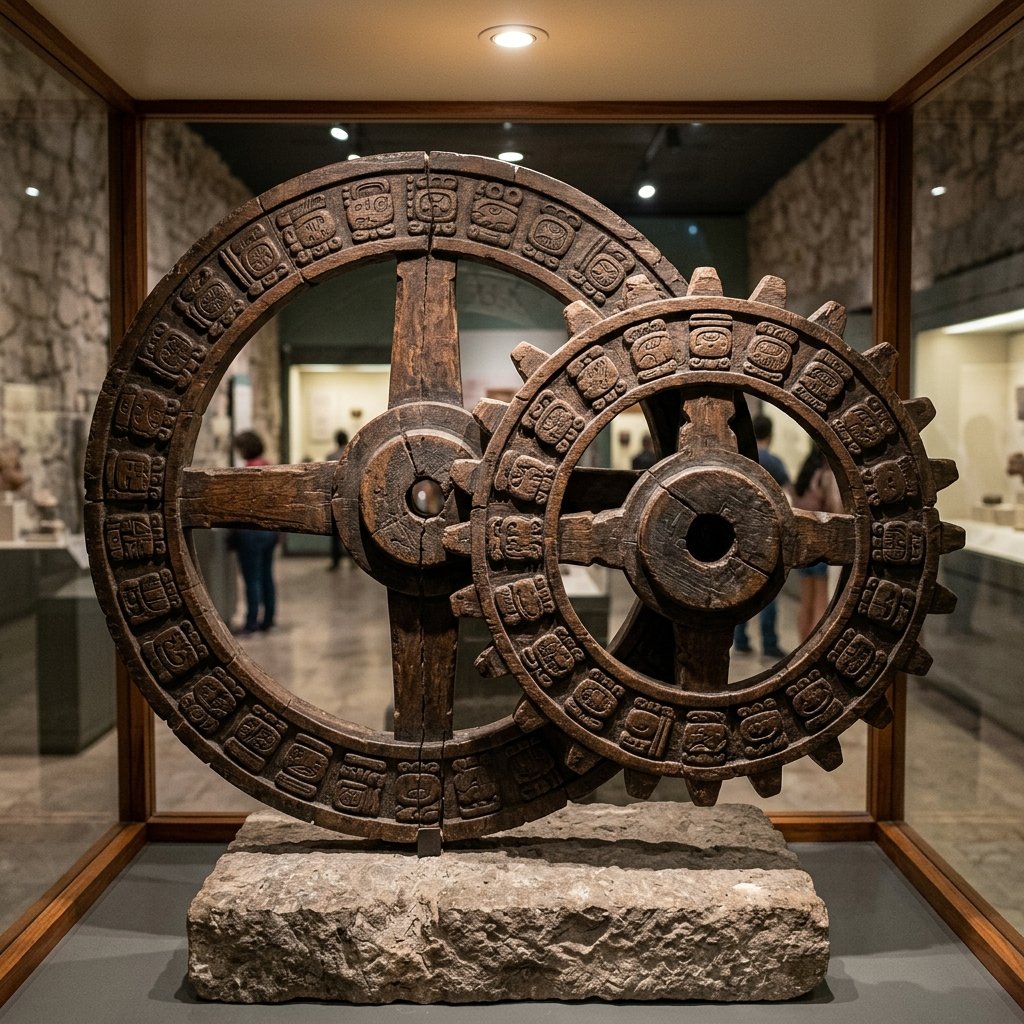
The Calendar Round at a Glance
"Two wheels turn at different speeds. Once every 52 years, they click back into the exact same groove."
The Interlock Explained Simply
If you understand how the Maya calendar works day-to-day, you inevitably encounter a mathematical problem: how do you uniquely identify a day? The Tzolk'in repeats every 260 days. The Haab repeats every 365 days. Used alone, neither is very helpful for pinpointing a specific event in a person's life.
The Maya solution was elegant: they ran both calendars simultaneously. A full Maya date did not consist of just a Tzolk'in sign or just a Haab date; it was a combination of both. The Smithsonian National Museum of the American Indian refers to this synthesized system as the Calendar Round (NMAI, "Living Maya Time," 2024).
Imagine two interlocking gears. Gear A is the 260-day Tzolk'in. Gear B is the 365-day Haab. Every day, both gears click forward one notch. Because the gears are different sizes, it takes a long time for the system to return to the exact same combination of teeth.
Why 260 and 365 Yield 18,980
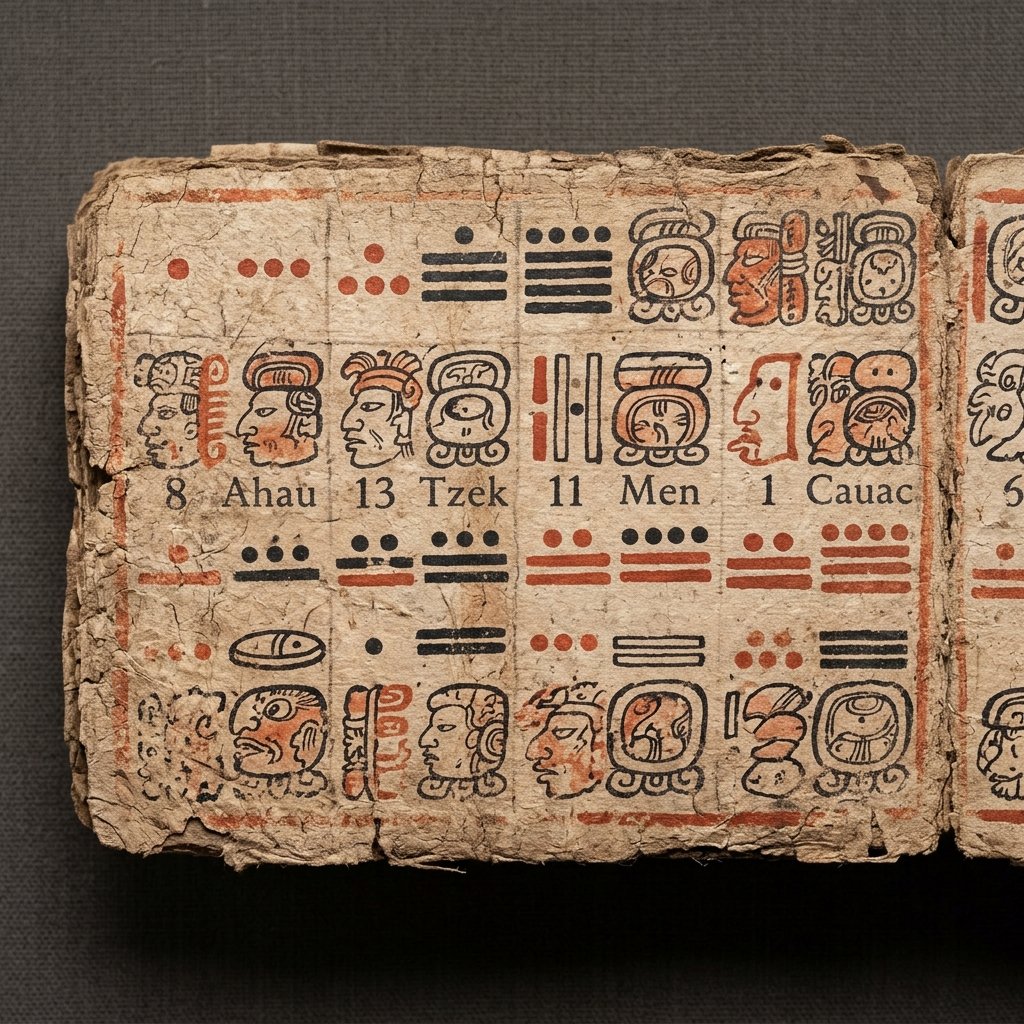
Rows of chronological permutations painted on a bark-paper codex. The Maya did not guess when dates would repeat; they calculated the lowest common multiple with absolute precision.
Mathematically, the Calendar Round is the least common multiple of 260 and 365.
- 260 factors into 5 × 52
- 365 factors into 5 × 73
Since they share the common factor of 5, we multiply 52 × 73 × 5 to find their least common multiple, which is 18,980 days.
If you divide 18,980 days by the 365-day Haab year, you get exactly 52 years. If you divide 18,980 days by the 260-day Tzolk'in cycle, you get exactly 73 cycles.
This means that any specific combination — for example, 4 Ahau 8 Kumk'u — will happen today, and it will not happen again for another 18,980 days (52 years). It is a completely unique date identification within that half-century window (Thompson, J. E. S., Maya Hieroglyphic Writing: An Introduction, 1960, pp. 123).
A Step-by-Step Example
Let's look at how the Calendar Round advances day by day. Remember that a Calendar Round date has four parts: Tzolk'in Number, Tzolk'in Sign, Haab Day, Haab Month.
Why 52 Years Mattered Culturally
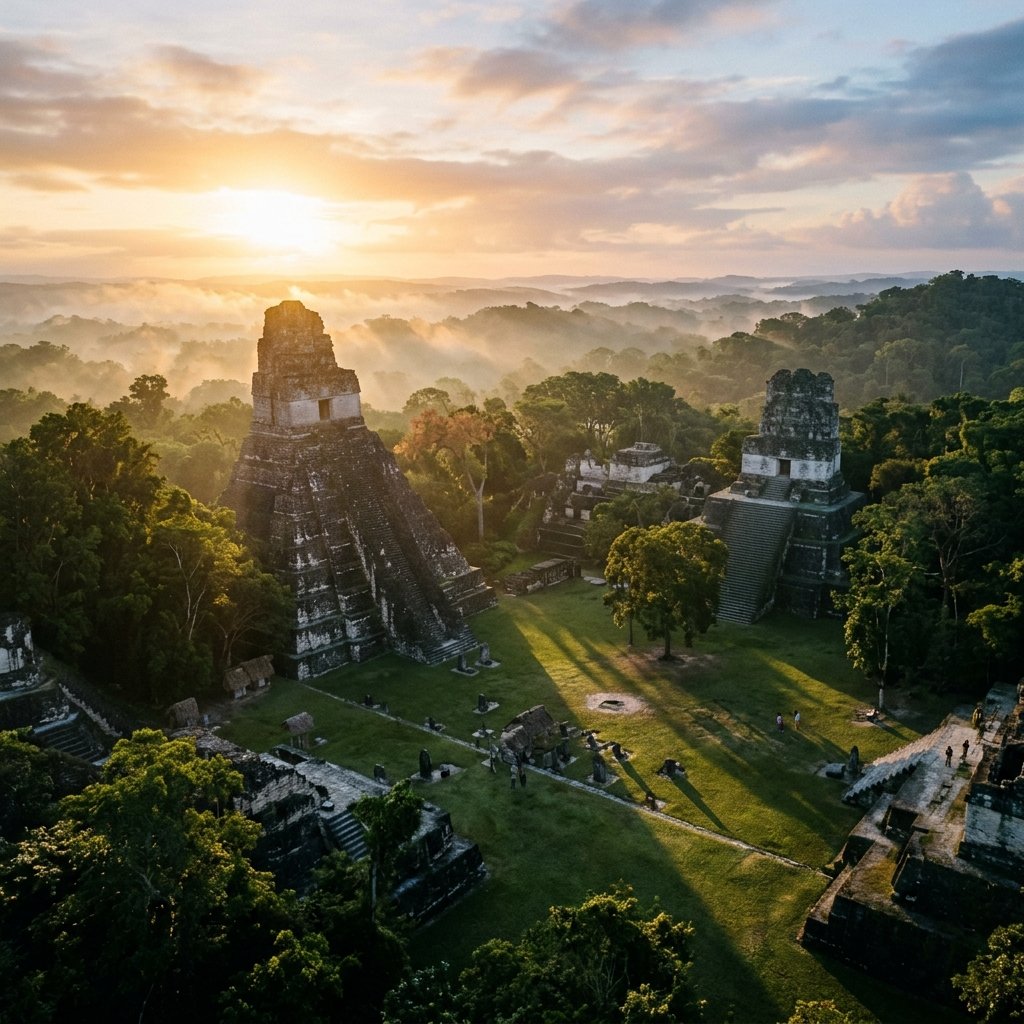
Dawn breaking over ancient temple unins. The 52-year Calendar Round roughly mapped onto the ancient Maya life expectancy. Seeing a "New Fire" — the start of a new 52-year cycle — was a profound generational milestone.
A cycle of 52 years meant something profound in ancient Mesoamerica. It roughly mapped onto human life expectancy. To put it practically: a person born on 1 Imix 4 Pop would turn 52 years old the next time 1 Imix 4 Pop rolled around. Reaching the completion of your personal Calendar Round was a milestone of elderhood and survival (Sharer, R. J. and Traxler, L. P., The Ancient Maya, 2006).
The completion of the 52-year cycle was a time of immense anxiety and massive celebration. Particularly in Central Mexico among the Aztec (who shared this same calendar mathematics), it was believed that the sun might not rise on the the day the cycle reset. When the stars aligned and the world continued, the priests would drill a New Fire on the chest of a sacrificial victim, and that flame would be carried to rekindle the hearths of every home in the empire (Smith, M. E., The Aztecs, 2011).
While the Classic Maya did not perform the exact Aztec New Fire ceremony, they extensively recorded the completion of half-cycles (K'atuns) and full cycles with monument dedications, massive public feasts, and the extinguishing and relighting of temple fires.
Why the Long Count Was Still Needed
The Calendar Round is brilliant for human-scale time. But what if you are a king trying to record your lineage stretching back 600 years?
If a stela simply records that a battle happened on 4 Ahau 8 Kumk'u, an archaeologist cannot tell which 52-year cycle that refers to. Did it happen in 500 AD? 552 AD? 604 AD? This historical ambiguity is exactly why the Maya invented the Long Count — an absolute chronological system that pegs a Calendar Round date to a specific point in a 5,125-year epoch.
The Long Count provided the absolute "Year," while the Calendar Round provided the localized "Month and Day" identity. Together, they formed the most sophisticated dating system in the ancient world.
Frequently Asked Questions
How do you calculate 18,980 days?
The number 18,980 is the least common multiple of 260 (the Tzolk'in days) and 365 (the Haab days). Because 260 and 365 share the common factor of 5, the calculation is (260 × 365) / 5 = 18,980.
Could two people share the same Calendar Round birthday?
Yes, but only if they were born exactly 52 years apart (or multiples of 52 years). Within a single 52-year generation, every day has a unique Calendar Round date. If a grandfather and grandson shared exactly the same birthday, it was considered a deeply auspicious sign of lineage rebirth.
Why isn't one calendar enough?
The Tzolk'in was needed for spiritual and divinatory purposes. The Haab was needed for agricultural and seasonal management. Neither could be discarded without collapsing the culture, so the Maya mathematically interlocked them to track both civic and sacred time simultaneously.
Scholarly References
- NMAI / Smithsonian. (2024). "Living Maya Time: The Calendar Round."
- Sharer, R. J. and Traxler, L. P. (2006). The Ancient Maya. 6th ed. Stanford University Press.
- Smith, M. E. (2011). The Aztecs. 3rd ed. Wiley-Blackwell.
- Thompson, J. E. S. (1960). Maya Hieroglyphic Writing: An Introduction. University of Oklahoma Press.