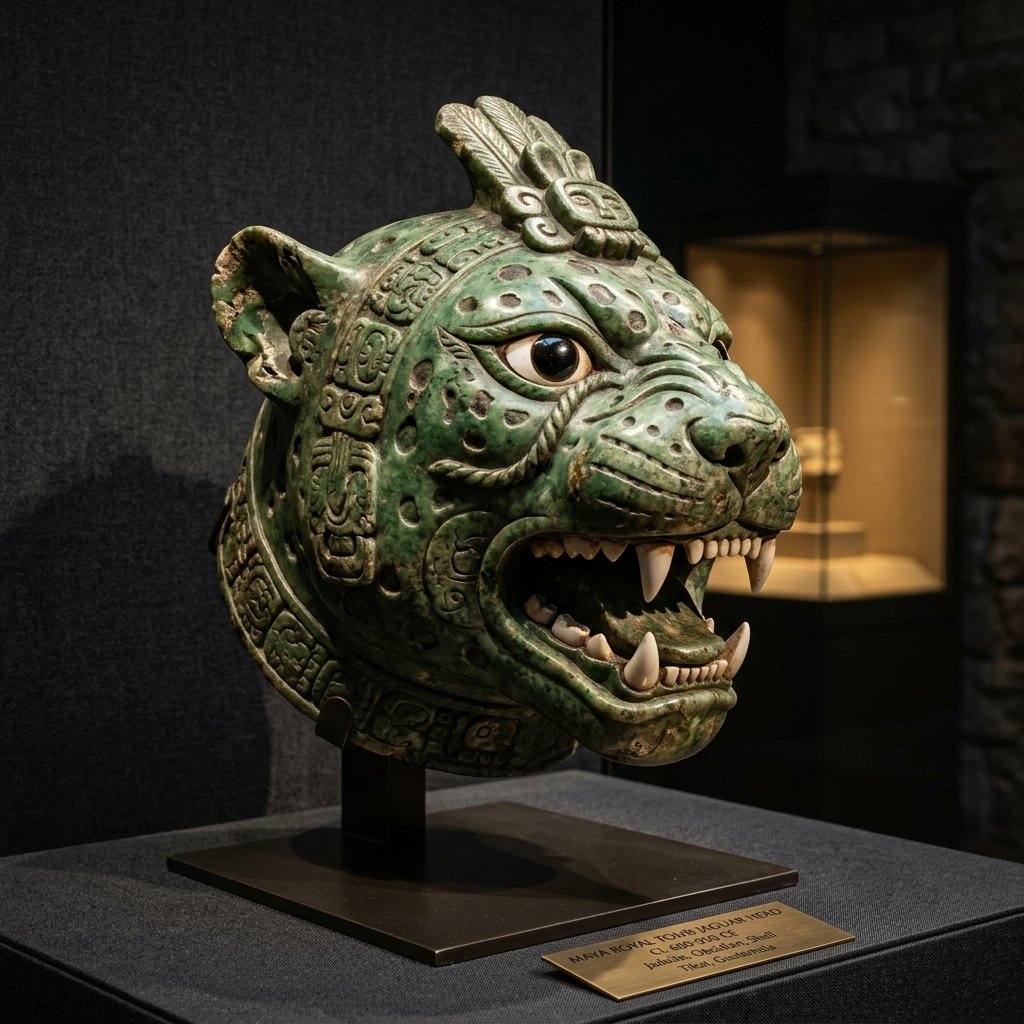
The Jaguar God at a Glance
The Most Powerful Animal in the Maya World
The jaguar (Panthera onca) was the undisputed apex predator of the Mesoamerican jungle — and the most powerful symbol in Maya civilization. Weighing up to 350 pounds with the strongest bite force of any big cat, the jaguar hunted at night, swam through rivers, and moved through the forest with silent, lethal efficiency. To the Maya, it was the living embodiment of supernatural power, royal authority, and the darkness that conceals.
The jaguar's theological importance stemmed from a simple but profound observation: the sun goes somewhere at night. When the sun sets, it descends into the underworld — and what moves through darkness? The jaguar. The Maya concluded that the sun transforms into a jaguar during its nighttime passage through Xibalba, emerging at dawn to become the sun again. The Jaguar God of the Underworld is the Night Sun (Miller, M.E. & Martin, S., Courtly Art of the Ancient Maya, 2004, pp. 55–63).
Multiple Jaguar Deities
The Maya had not one but several jaguar gods, reflecting the animal's multifaceted symbolism:
- The Jaguar God of the Underworld (GIII): One of the Palenque Triad deities. Associated with the sun's nighttime journey, fire, and war. Depicted with a distinctive fire element on his forehead, jaguar ears, and a skeletal jaw.
- God L: The wealthy old lord of Xibalba who sits on a jaguar throne, smokes a cigar, wears a broad-brimmed hat with an owl on top, and is attended by young women who serve him cacao. God L was the merchant-lord of the underworld — powerful, rich, and dangerous.
- Jaguar Paddler: One of the two Paddler Gods who escort the Maize God on his canoe journey through the underworld. The Jaguar Paddler has jaguar features and represents nighttime.
- The Baby Jaguar (Unen Balam): A small jaguar deity associated with war captives and sacrifice, sometimes shown held in the arms of captive-taking kings.
Jaguar Kings
Maya rulers aggressively identified with jaguar power. The title "Balam" (Jaguar) appears in the names of some of the most powerful kings in Maya history:
- Itzamnaaj Balam II (Shield Jaguar the Great) — ruler of Yaxchilán, who reigned for 60 years and commissioned some of the finest carved lintels in Maya art.
- Yaxun Balam IV (Bird Jaguar IV) — his son and successor, another prolific builder and monument-raiser.
- Chak Tok Ich'aak I (Great Jaguar Paw) — early ruler of Tikal who was killed in the famous "Entrada" of Siyaj K'ahk' in 378 AD.
- The four original men of the Popol Vuh — Balam Quitze, Balam Acab, Mahucutah, and Iqui Balam — three of the four carry the title Balam.
Kings sat on jaguar thrones — literal stone seats carved in the shape of jaguars or covered with jaguar pelts. At Chichén Itzá, a red-painted stone jaguar with jade spots was found inside El Castillo, serving as a throne in the inner temple. At Palenque, the Temple of the Sun is dedicated to the Jaguar God of the Underworld — the war aspect of the Palenque Triad — and its interior panels depict a jaguar war shield (Schele, L. & Miller, M.E., The Blood of Kings, 1986, pp. 188–195).
God L and the Underworld Court
One of the most vivid depictions of the Jaguar God appears in the Late Classic painted ceramics showing God L's throne room in Xibalba. In these scenes, God L presides over a dark palace, seated on a jaguar-skin cushion, smoking a cigar, wearing a Muan bird (great horned owl) on his broad-brimmed hat. Young women attend him, pouring chocolate.
But the Hero Twins ultimately humiliate God L. In the Vase of the Seven Gods (K2796), the Twins strip him of his finery, rob him of his throne, and expose his pretensions. This humiliation of the underworld's richest lord is part of the Twins' cosmic mission to break the power of death — even the wealthiest overlord of Xibalba is no match for solar trickery.
The Jaguar in Maya Art
Jaguar imagery saturates Maya material culture:
- Royal thrones: Jaguar-shaped or jaguar-skin-covered seats in palace and temple interiors.
- War costume: Jaguar-skin capes, helmets, and shields worn by warriors and kings in battle.
- Jade masks: Jade jaguar heads placed in royal burials as supernatural protection.
- Ceramic painting: Narrative scenes of jaguars in the underworld, jaguar gods on thrones, and jaguar transformation rituals.
- Architecture: Jaguar facades at Uxmal and Kabah; jaguar friezes on temple platforms.
Frequently Asked Questions
Who is the Jaguar God of the Underworld?
A major Maya deity associated with darkness, war, and the sun's nighttime passage through Xibalba. He appears in several forms: as GIII of the Palenque Triad (with fire on his forehead), and as God L (the wealthy cigar-smoking lord of the underworld). The jaguar's ability to hunt at night made it the natural symbol for the Night Sun.
Why were jaguars sacred to the Maya?
The jaguar was the apex predator of the Maya world and symbolized royal power, military strength, and nocturnal hunting. Its ability to move through darkness linked it to the underworld and the sun's nighttime journey. Kings took jaguar titles, wore jaguar pelts, sat on jaguar thrones, and were buried with jade jaguar masks.
What is the connection between jaguars and Maya kings?
Maya kings identified with jaguar power. The name "Balam" (jaguar) appears in names of the most powerful rulers: Shield Jaguar at Yaxchilán, Great Jaguar Paw at Tikal, and three of the four original men in the Popol Vuh. Kings sat on jaguar thrones and wore jaguar war costumes.
Scholarly References
- Miller, M.E. & Martin, S. Courtly Art of the Ancient Maya. Thames & Hudson, 2004.
- Schele, L. & Miller, M.E. The Blood of Kings: Dynasty and Ritual in Maya Art. Kimbell Art Museum, 1986.
- Taube, K.A. The Major Gods of Ancient Yucatan. Dumbarton Oaks, 1992.
- Saunders, N.J. People of the Jaguar. Souvenir Press, 1989.