Quiriguá at a Glance
"In the humid floodplain of the Motagua River, a relatively small Maya city managed to accomplish two things that shook the ancient world: they brutally executed the divine king of a ruling superpower, and they carved stone monuments so massive they rival the obelisks of ancient Egypt."
The Monoliths of the Motagua
Quiriguá is an anomaly in the Maya world. Architecturally, it is small; its pyramids and palaces are modest when compared to the towering structures of Tikal or the sprawling complexes of Chichén Itzá. But what Quiriguá lacked in architecture, it compensated for with statuary of incomprehensible scale.
The city's location along the lower Motagua River placed it near a seam of hard, uniform red sandstone — a geological advantage that proved decisive. This material was ideal for carving: dense enough to hold fine detail, yet soft enough to work without metal tools. Freed from the limitations of brittle limestone (the standard Maya building material), the sculptors of Quiriguá achieved a three-dimensional depth and scale unparalleled anywhere in Mesoamerica (Looper, Lightning Warrior: Maya Art and Kingship at Quirigua and Copan, University of Texas Press, 2003).
Stela E: The Giant
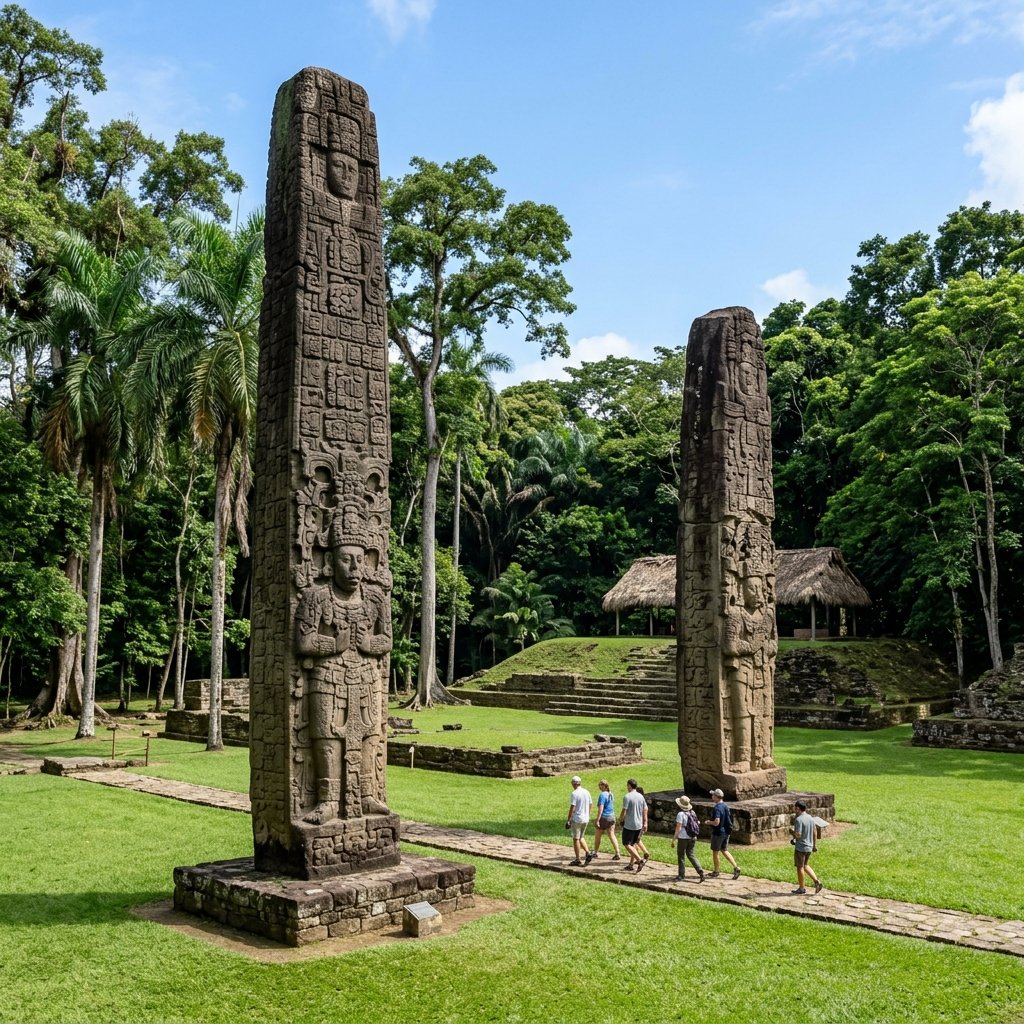
Stela E at Quiriguá — the tallest free-standing stone monument ever erected in the prehistoric Americas. Carved from a single shaft of red sandstone, it stands 35 feet (10.6 meters) above ground with another 10 feet buried as a foundation. The front depicts King K'ak' Tiliw Chan Yopaat holding the instruments of divine rulership.
Erected in 771 AD, Stela E is the undisputed champion of ancient American monoliths. Carved from a single shaft of stone, it stands 35 feet (10.6 meters) tall above the plaza floor, with an additional 10 feet buried underground acting as a stabilizing foundation. The entire monument weighs approximately 65 tons — roughly the weight of ten African elephants.
Transporting the sheer physical mass of the stone from the quarries several miles away — without the aid of draft animals, pulleys, wheels, or metal tools — remains a testament to the staggering civil engineering capabilities of Quiriguá's labor force. The front face depicts King K'ak' Tiliw Chan Yopaat in full royal regalia, holding the double-headed ceremonial bar symbolizing divine rulership. The sides and back are covered in dense, deeply carved hieroglyphic texts recording the king's astronomical knowledge and political achievements (Martin & Grube, Chronicle of the Maya Kings and Queens, Thames & Hudson, 2008).
The Zoomorphs: Visual Puzzles in Stone
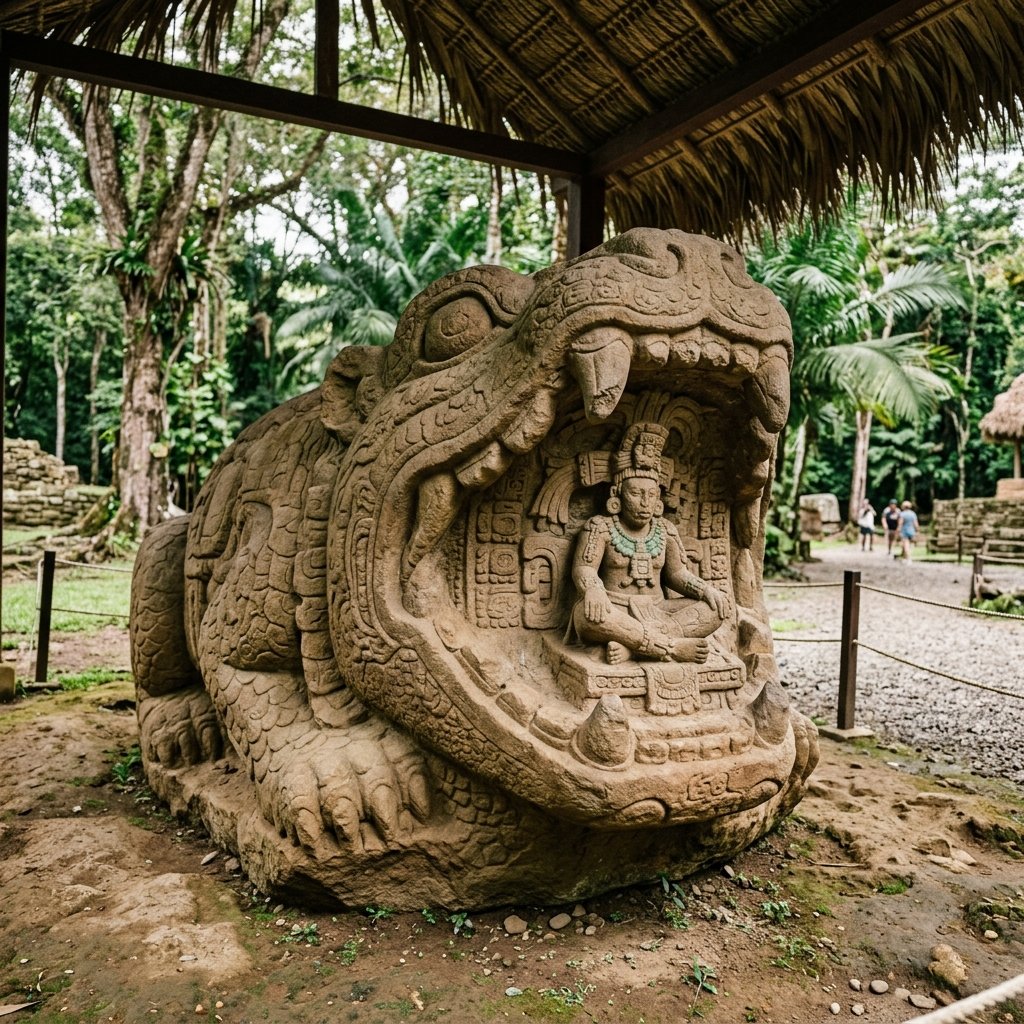
One of Quiriguá's extraordinary zoomorphs — massive boulders carved into three-dimensional mythological beasts. These later monuments replaced the tall vertical stelae and represent the most complex sculptural achievements in the entire Maya world. The king's face often emerges from the maw of a cosmic monster.
Later in the city's history, the sculptors abandoned tall vertical shafts in favor of natural sandstone boulders, transforming them into stunningly complex, three-dimensional mythological beasts known as Zoomorphs. These extraordinary monuments are unique to Quiriguá and have no parallel anywhere in Mesoamerica.
The zoomorphs function like visual puzzles. They frequently depict cosmic monsters — toads, crocodilians, or two-headed serpents — with the face of the king emerging from the beast's gaping maw, symbolizing royal passage between the human and supernatural worlds. Every visible surface is covered in intricate scrollwork, hieroglyphs, and supernatural imagery. Standing before them, the viewer must physically circle the monument to decode the narrative — an intentionally immersive, ritualistic viewing experience (Looper, 2003).
The Great Rebellion of 738 AD
The story of why Quiriguá began erecting these massive monuments is one of the most famous diplomatic crises in all of Maya history.
For much of its early history, Quiriguá was a vassal state, strictly controlled by the much larger, dominant city of Copán to the south. Quiriguá's strategic value was immense: it controlled the Motagua River, the primary trade route for importing extremely valuable jade from the Guatemalan highlands to the Petén lowlands. Control of the jade trade meant control of the most precious commodity in the Maya world — jade was valued more highly than gold.
In 724 AD, the great king of Copán, Uaxaclajuun Ub'aah K'awiil (commonly known by his nickname "18 Rabbit"), installed a local lord named K'ak' Tiliw Chan Yopaat to rule over Quiriguá as his loyal subordinate. This turned out to be a fatal mistake.
Quietly, K'ak' Tiliw sought an alliance with the distant superpower of Calakmul — Copán's geopolitical rival. Emboldened by this backing, K'ak' Tiliw rebelled against the Copán empire. In May of 738 AD, the small army of Quiriguá achieved the seemingly impossible: they captured the divine king 18 Rabbit alive on the battlefield (Martin & Grube, 2008).
Six days later, in a stunning public display of independence, the vassal lord K'ak' Tiliw decapitated the mighty ruler of Copán in the main plaza of Quiriguá. The hieroglyphic text recording this event uses the phrase "the flint was brought down" — the standard Maya euphemism for ritual execution by axe or blade.
This single act transferred immense wealth and total control of the jade trade to Quiriguá, funding the 60-year explosion of monumental art that produced the legendary stelae and zoomorphs. K'ak' Tiliw Chan Yopaat ruled for an extraordinary 61 years — the longest documented reign of any Maya king — and used Copán's wealth to commission nearly every monument visible at the site today.
Visitor Comparison
| Feature | Quiriguá | Copán |
|---|---|---|
| Star Attraction | Giant stelae & zoomorphs | Hieroglyphic Stairway |
| UNESCO Status | ✅ Since 1981 | ✅ Since 1980 |
| Walking Difficulty | Easy (flat terrain) | Moderate (hilly) |
| Time Needed | 2–3 hours | 4–5 hours |
| Historical Link | Intimately connected — visit both for the full story | |
Practical Travel Guide: Visiting Quiriguá
Getting There
Quiriguá is easily accessible from the CA-9 highway connecting Guatemala City to the Caribbean port of Puerto Barrios. It sits amid sprawling modern banana plantations (originally owned by the United Fruit Company, whose workers first brought the ruins to international attention in the late 19th century).
What to Expect
The site is very flat, shaded by massive ceiba trees, and requires minimal climbing compared to other ruins. The main attraction is the Great Plaza, where the giant stelae are currently housed under thatched roofs to protect the intricate sandstone carvings from acid rain and erosion. The atmosphere is serene, scholarly, and deeply peaceful — a dramatic contrast to the violent history recorded on the stones.
The Copán Pairing
Because Quiriguá's history is so intimately tied to Copán (which is less than two hours away across the Honduran border), visiting both sites on consecutive days offers one of the most cohesive and satisfying historical narratives available in Maya tourism. You see the victim's city first, then the usurper's victory monuments.
Best Time
Early morning or late afternoon light is ideal for photography of the stelae. The site is small enough to explore in 2–3 hours. The Izabal region is hot and humid year-round; bring water and sun protection.
The Fall of the Stone Giants
Quiriguá successfully maintained its independence and prosperity for several generations following the capture of 18 Rabbit. K'ak' Tiliw Chan Yopaat ruled for 61 years, dominating the region and overseeing the dedication of nearly all the massive monuments visible today. His successors continued the tradition, producing the remarkable zoomorphs during the final decades of the site's active life.
However, like its neighbors, Quiriguá could not survive the Terminal Classic collapse. The collapse here seems to have been directly associated with the cessation of the jade trade along the Motagua River — the same resource that had funded the city's golden age now dried up as highland trade networks disintegrated. The last known hieroglyphic date at Quiriguá was carved in 810 AD. Shortly afterward, the stonemasons laid down their tools, and the jungle reclaimed the giant monoliths for over a millennium (Sharer & Traxler, 2006).
Frequently Asked Questions
What is Quiriguá famous for?
Quiriguá is universally renowned for its enormous sandstone monuments. Stela E is the tallest stone monument ever erected in the prehistoric Americas, standing 35 feet (10.6 meters) tall and weighing over 65 tons. The site is also famous for its unique zoomorphs — massive boulders carved into three-dimensional mythological beasts.
Who was K'ak' Tiliw Chan Yopaat?
K'ak' Tiliw Chan Yopaat (sometimes called "Cauac Sky") was Quiriguá's greatest ruler. Originally installed as a vassal by Copán, he rebelled in 738 AD, captured and executed Copán's king "18 Rabbit," seized control of the lucrative Motagua jade trade, and used the wealth to commission the massive stelae that made Quiriguá famous. He reigned for 61 years — the longest documented reign of any Maya king.
Is Quiriguá a UNESCO World Heritage Site?
Yes. Quiriguá was designated a UNESCO World Heritage Site in 1981, recognized for both its archaeological importance and the unmatched artistic quality of its stone monuments.
How does Quiriguá compare to Copán?
They are complementary rather than competitive. Copán is larger, more architecturally complex, and famous for its Hieroglyphic Stairway and elaborate sculptural tradition. Quiriguá is smaller but possesses the tallest and most massive stelae in the Americas. Because their histories are so intimately linked by the 738 AD rebellion, visiting both sites together provides one of the most rewarding narrative experiences in Maya archaeology.
References
- Looper, M. G. Lightning Warrior: Maya Art and Kingship at Quirigua and Copan. University of Texas Press, 2003.
- Martin, S., & Grube, N. Chronicle of the Maya Kings and Queens. Thames & Hudson, 2nd ed., 2008.
- Sharer, R. J., & Traxler, L. P. The Ancient Maya. Stanford University Press, 6th ed., 2006.
- Sharer, R. J. Quirigua: A Classic Maya Center and Its Sculptures. Carolina Academic Press, 1990.