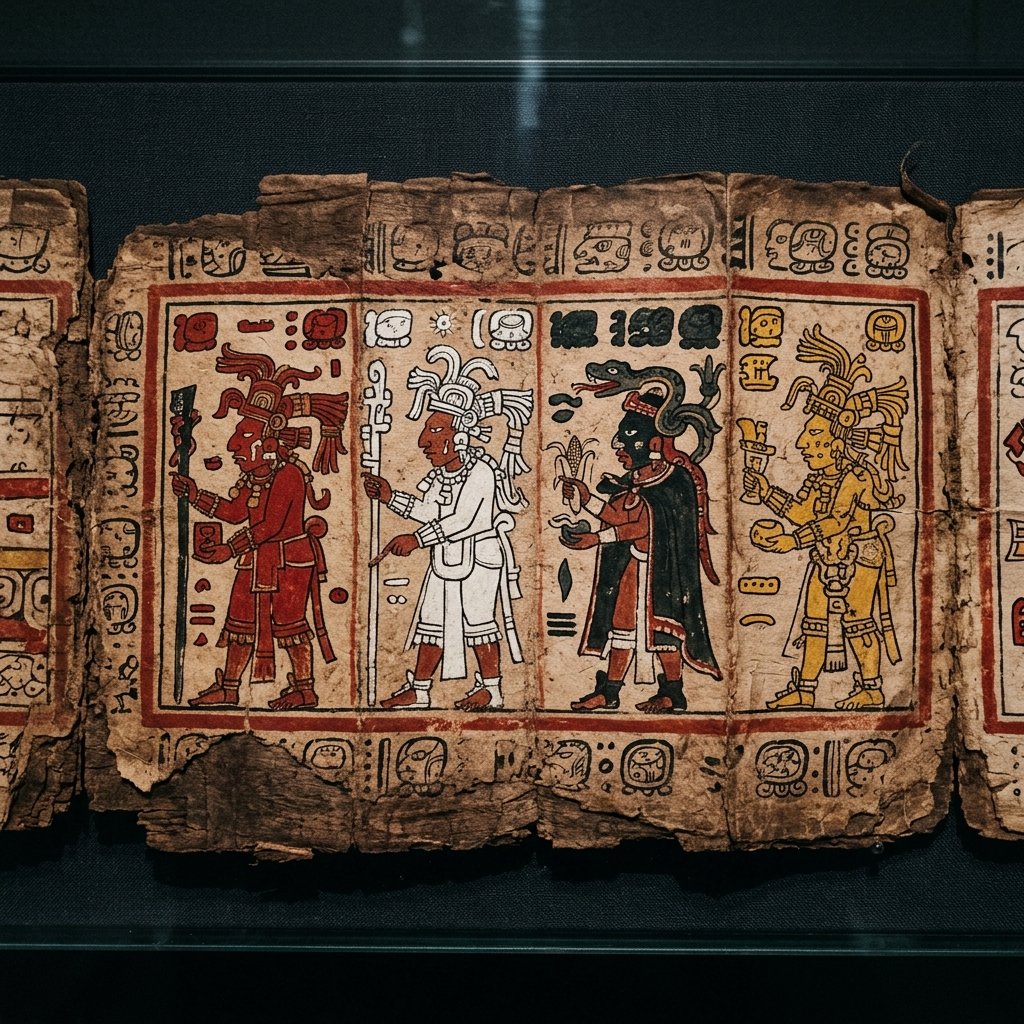
Directional Colors at a Glance
Space is Not Empty
To modern people, the cardinal directions (North, South, East, West) are merely navigational tools. They are arbitrary points on a compass, completely devoid of inherent emotional or spiritual meaning.
To the ancient Maya, space was not empty or neutral. It was intensely sacred, deeply structured, and color-coded. The Maya did not just possess a map of the world; they possessed a sacred geography in which every direction possessed its own color, its own specific tree, its own bird, and its own presiding aspect of the gods (particularly the Bacab sky-bearers and the rain god Chaac).
The Four Colors of the Cosmos
The Maya oriented their world not to the North (as modern compasses do), but to the East, where the sun rose. The four directions and their associated colors were:
- East — Red (Chak): The primary direction, associated with the dawn, the rising sun (Kinich Ahau), birth, and the color of blood and life force.
- North — White (Sak): Standing facing East, North is to the left. It was associated with the ancestors, the cooling winds, and the white band of the Milky Way across the night sky.
- West — Black (Ek): The direction of the setting sun, sunset, darkness, death, and the entrance into the watery underworld of Xibalba.
- South — Yellow (K'an): Standing facing East, South is to the right. Associated with the heat of the midday sun and the color of ripe maize.
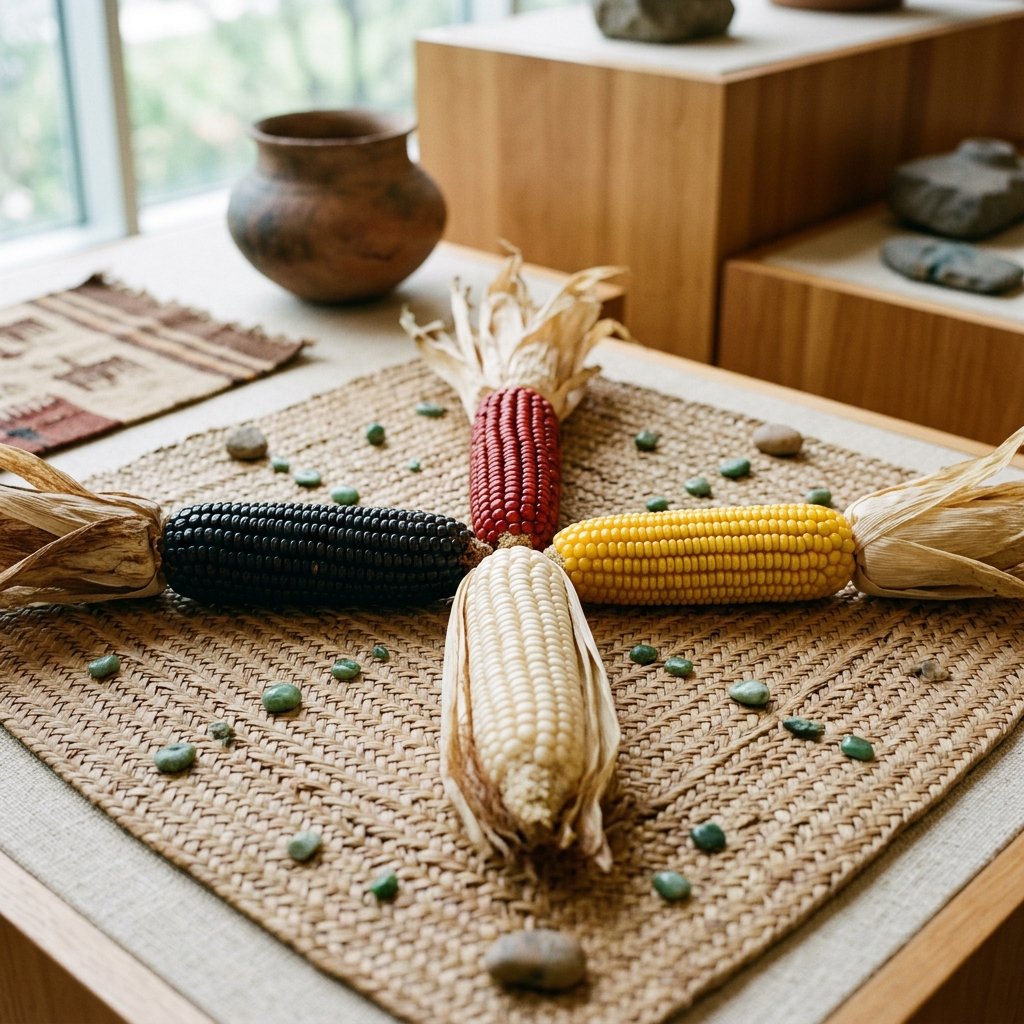
The Center: The Fifth Direction
Unlike the four-point Western compass, the Maya conceptual model required a fifth point: The Center.
The center point where the four directions met was the axis mundi, the pivot of the universe where the World Tree (Wakah-Chan) grew. This central point was associated with the color Yax, an untranslatable Maya color-concept that encompasses both blue and green—the color of jade, water, the sky, and fresh vegetation. The center represented life, fertility, and the connection between the underworld, the earth, and the heavens.
Ritual Organization
The four directional colors were not just abstract concepts; they dictated how the Maya organized their lives and their rituals.
When a Maya priest or daykeeper performed a ceremony, they would construct a ritual altar aligned to the four directions, making specific offerings of colored maize, colored beans, or colored stones to each corner to ensure the cosmic balance was maintained.
This color-coding extended to the calendar itself. The 20 day signs of the Tzolk'in calendar were divided into four groups of five, with each group assigned to one of the four directions and its corresponding color. Time itself was believed to cycle through the four corners of the universe (Stuart, D., The Order of Days, 2011).
References
- Coe, M.D. The Maya. Thames & Hudson, 9th edition, 2015.
- Freidel, D., Schele, L., & Parker, J. Maya Cosmos: Three Thousand Years on the Shaman's Path. William Morrow, 1993.
- Stuart, D. The Order of Days: Unlocking the Secrets of the Ancient Maya. Harmony Books, 2011.
- Taube, K. The Major Gods of Ancient Yucatan. Dumbarton Oaks, 1992.
Frequently Asked Questions
What were the four Maya directions and colors?
East was Red (associated with sunrise and blood); North was White (associated with ancestors); West was Black (associated with sunset and the underworld); and South was Yellow (associated with the sun's path and ripe maize). A fifth direction, the Center, was Blue-Green (Yax).
Did the Maya orient their maps to the North?
No. Unlike modern Western maps which place North at the top, the ancient Maya oriented their world to the East, the direction of the rising sun. In their cosmology, East was the primary and most important direction.
How are the colors related to corn?
The four directional colors exactly match the four primary colors of indigenous Mesoamerican maize: red, white, black/blue, and yellow. Because the Maya believed humans were crafted from maize dough, the cosmological colors of the universe were intimately tied to their fundamental food source.