The Serpent Bar at a Glance
The Scepter of Power
When a European monarch wishes to project their authority, they hold a golden orb and a jeweled scepter. When a Classic Maya king wished to project his divine authority, he held the Double-Headed Serpent Bar.
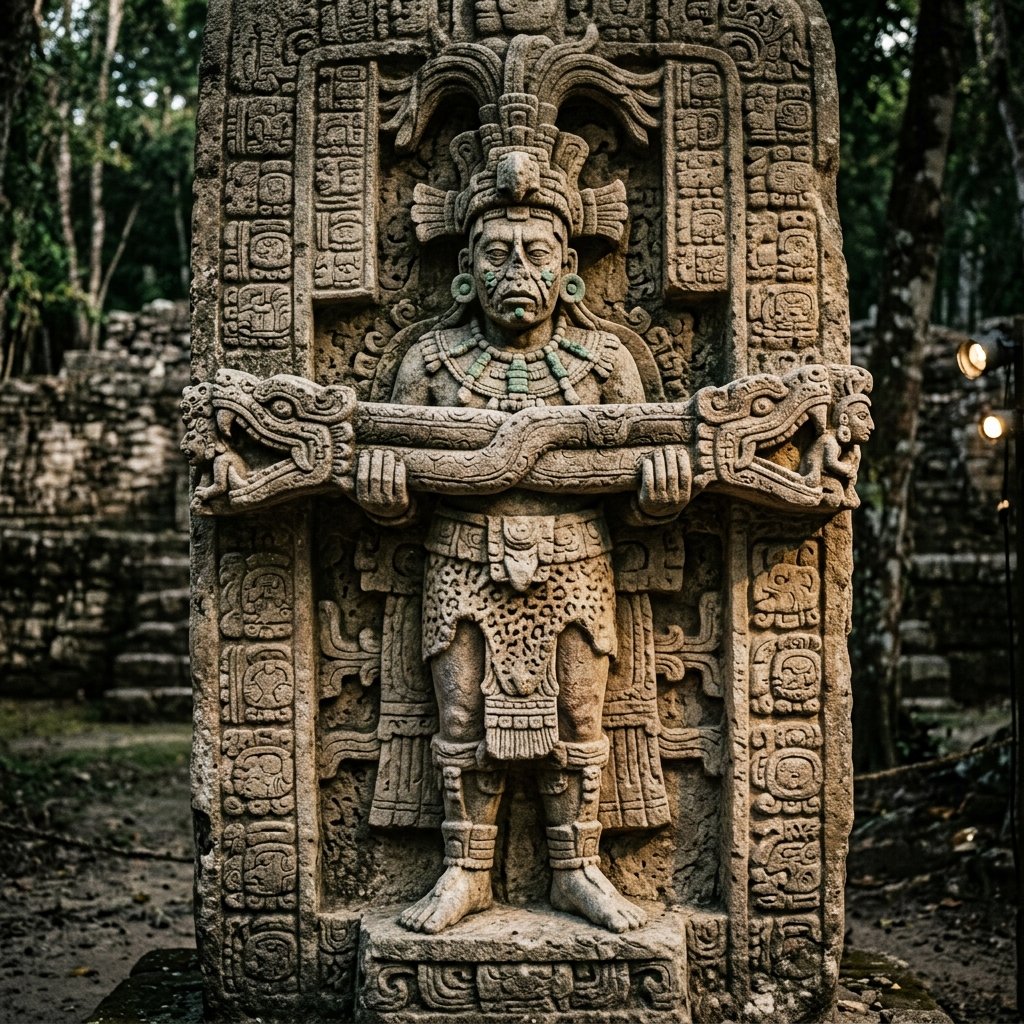
Across the vast lowlands of the Maya world, from Tikal to Copán, thousands of stone monuments depict rulers in exactly the same pose: standing rigidly, facing forward, holding a large, rigid, double-ended serpent horizontally across their chest.
This object was not a mere decoration. It was the physical manifestation of the king's most important job: serving as the bridge between humanity and the gods (Schele, L. & Miller, M.E., The Blood of Kings, 1986).
Anatomy of the Serpent Bar
The ceremonial bar is a complex theological object. While no intact wooden or textile serpent bars have survived the damp jungle environment, the immense detail in stone carvings allows archaeologists to understand exactly how they were constructed.
The central body of the bar is usually depicted as the flaccid, scaled body of a snake, or sometimes as a rigid tube inscribed with celestial symbols (like the crossed-bands motif representing the sky). The most important features are at the ends: two massive, terrifying, open serpent jaws.
The Serpent Bar is related conceptually to the Vision Serpent. By holding the bar, the king is demonstrating his control over the supernatural portals of the universe. From the open jaws of the scepter, miniature gods emerge into the earthly realm. The most commonly depicted deity emerging from the snake's mouth is K'awiil, the god of lightning, royal lineage, and conjuring.

The Sky Band and the Milky Way
Beyond simply representing a portal, the Serpent Bar was deeply connected to Maya astronomy.
The body of the serpent is frequently marked with "Sky Band" glyphs—symbols representing the sun, the moon, Venus, and darkness. In this context, the double-headed serpent represents the overarching sky itself, or specifically, the ecliptic (the path that the sun, moon, and planets seem to travel across the sky).
Some archaeoastronomers suggest that the two heads of the serpent represent the eastern and western horizons, where the celestial bodies enter and exit the underworld. When the king held the Serpent Bar, he was symbolically holding the entire cosmos in his hands, maintaining the balance of the heavens (Freidel, D., Schele, L., & Parker, J., Maya Cosmos, 1993).
The Decline of the Symbol
The Double-Headed Serpent Bar was the defining symbol of the "Divine Lord" (k'uhul ajaw) institution of the Classic period (c. 250–900 AD).
However, as the Classic Maya political system collapsed in the 9th and 10th centuries, the Serpent Bar slowly faded from the iconographic record. In the Postclassic period (c. 900–1500 AD), political power shifted away from absolute, divine kings toward more collaborative council governments (like the multepal system at Chichén Itzá). Because the Serpent Bar was so intimately tied to the concept of one supreme, divine ruler, it disappeared when that style of rulership collapsed.
References
- Freidel, D., Schele, L., & Parker, J. Maya Cosmos: Three Thousand Years on the Shaman's Path. William Morrow, 1993.
- Martin, S. & Grube, N. Chronicle of the Maya Kings and Queens. Thames & Hudson, 2008.
- Schele, L. & Miller, M.E. The Blood of Kings: Dynasty and Ritual in Maya Art. Kimbell Art Museum, 1986.
Frequently Asked Questions
What was the Double-Headed Serpent Bar?
It was the supreme symbol of Maya kingship during the Classic period. Kings are frequently carved on stone monuments holding this horizontal, double-headed snake across their chest to demonstrate their religious and political authority.
What do the snake heads represent?
The open jaws of the serpent act as portals between the human world and the supernatural realm. Miniature gods—most frequently K'awiil, the god of lightning and royalty—are often shown emerging from the mouths, proving that the king has the power to conjure the divine.
Are there any surviving Serpent Bars today?
No physical examples have survived. Given the intensely humid jungle environment of the Maya lowlands, objects made of wood, cloth, feather, or papier-mâché decomposed centuries ago. We know of them entirely through their incredibly detailed depictions in stone and ceramic art.