The Wayeb at a Glance
"What happens when a perfect calendar runs out of perfect numbers?"
Where Wayeb Sits in the Haab
The ancient Maya preferred absolute mathematical symmetry. Their primary unit of civic time, the Haab, was built of 18 beautiful, uniform "months" of exactly 20 days each. 18 multiplied by 20 equals 360 days. But the solar year cares nothing for mathematical elegance — it insists on 365 (and a quarter) days.
To keep their calendar tethered to the seasons, the Maya had to append five extra days to the end of the cycle. This 5-day terminal period was called the Wayeb (or Uayeb). The Smithsonian National Museum of the American Indian refers to it as "five days of transition" that fell outside the normal orderly bounds of time (NMAI, "Living Maya Time," 2024).
Superstition, Danger, and Liminality

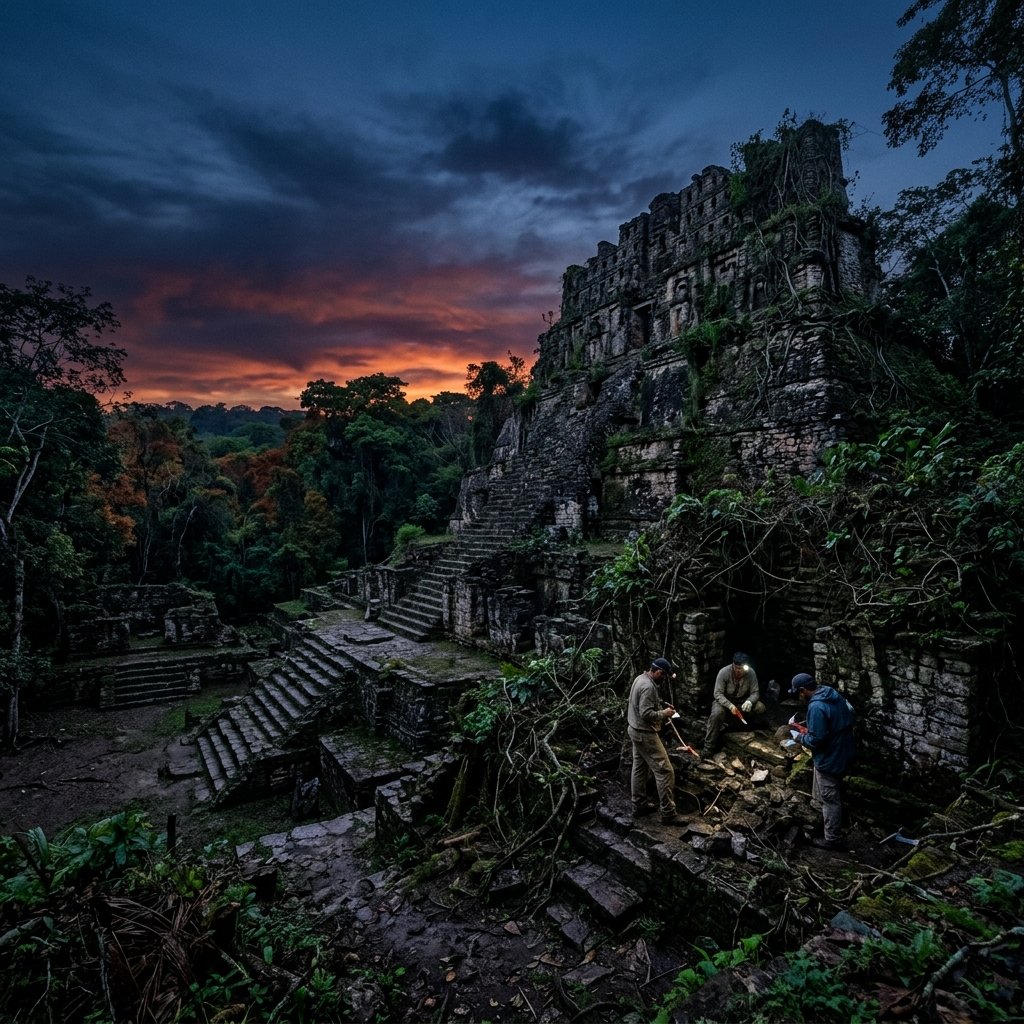
Rain-darkened limestone showing calendar inscriptions. The Wayeb was seen as a time when boundaries dissolved. It was a perilous transition from one solar year to the next.
Because the Wayeb fell outside the neatly ordered 18 months, the ancient Maya viewed it as inherently disordered, chaotic, and perilous. It was a liminal (threshold) time. The barriers between the mortal world and the underworld (Xibalba) thinned.
During these five days, the presiding deities or "patrons" of the year were shifting power. The previous Year Bearer was laying down the burden of time, and the next Year Bearer was picking it up. In this moment of cosmic hand-off, the world was vulnerable.
To mitigate disaster, the Maya observed strict taboos. Sixteenth-century Spanish chronicler Diego de Landa recorded that during the Wayeb:
- People avoided washing or bathing.
- Heavy labor was suspended.
- No major journeys were undertaken.
- Arguments were strictly avoided to prevent lifelong bad luck.
- Hearth fires were sometimes extinguished.
Rituals of Closure and Transition
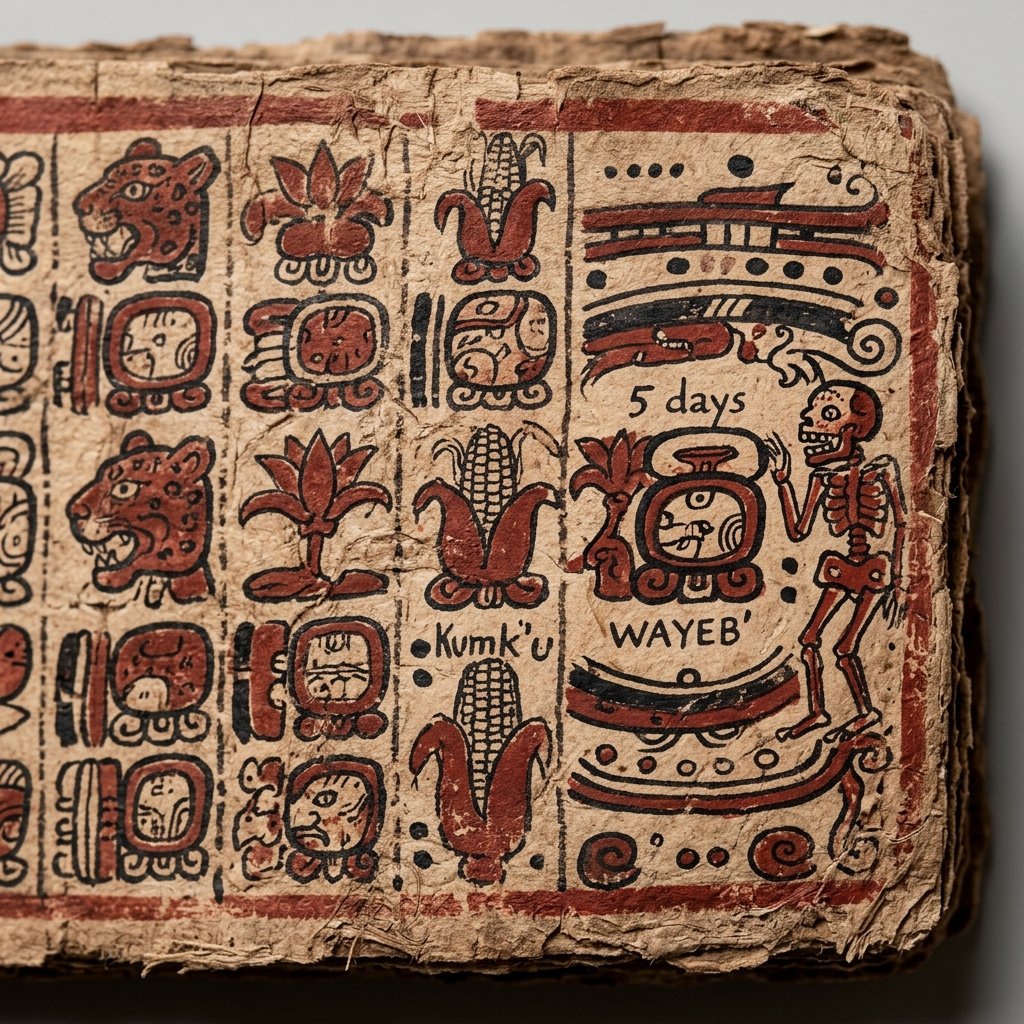
Codex page detailing year-end ceremonies. To survive the Wayeb, the Maya engaged in intensive purification and renewal rituals to ensure the sun would successfully begin an orderly new year.
Despite the danger, the Wayeb was not simply about hiding in fear. It was an intensely active ritual period focused on ending and beginning.
The most crucial ceremonies involved the installation of the new Year Bearer (the Tzolk'in day sign that would fall on the first day of the new Haab year). Wooden idols representing the outgoing patron deity were respectfully discarded or burned. Statues of the new patron deity were elevated and placed in temples or domestic shrines. Bloodletting ceremonies, fasting, and the burning of massive amounts of copal incense were used to feed and strengthen the incoming gods (Sharer, R. J. and Traxler, L. P., The Ancient Maya, 6th ed., Stanford University Press, 2006).
In this sense, the Wayeb functioned culturally much like modern New Year's Eve, but stretched over five tense, solemn days of reflection, purification, and careful stepping.
What Modern Retellings Exaggerate
A common modern narrative describes the Wayeb as "the five nameless days." This is a romanticized exaggeration. The days were not nameless; they belonged to the "month" of Wayeb. Like all days in the Haab, they were numbered. They were counted as 0 Wayeb, 1 Wayeb, 2 Wayeb, 3 Wayeb, and 4 Wayeb. They also simultaneously held a Tzolk'in name and number, just like any other day in the Calendar Round. They were not "missing" from the calendar, they were simply structurally anomalous.
How Wayeb Links Back to the Calendar Round
The existence of the Wayeb is entirely responsible for the specific mechanics of the Calendar Round. If the Maya had simply used a 360-day calendar (18 months of 20 days), the math would have been clean, but seasons would have drifted drastically. Because they forced the Haab to 365 by appending the Wayeb, the 365-day solar count and the 260-day sacred count meshed perfectly to create the 52-year Cycle.
The Wayeb was the mathematical glue that anchored human ritual to the reality of the turning earth.
Frequently Asked Questions
Was Wayeb truly "unlucky"?
It is more accurate to call it "dangerous" or "unprotected." The Maya believed that the deities who normally enforced cosmic order were transitioning power during this time. Because the usual boundaries were down, humans had to be excruciatingly careful to avoid inviting chaos or disease.
What rituals were associated with it?
The most important rituals were the Year Bearer ceremonies — transitioning power from the old patron god to the new one. At a household level, rituals were mostly about avoidance: not bathing, not arguing, and staying indoors to avoid negative spiritual forces. Fires were put out and a new fire was kindled to mark the proper new year.
How should modern readers interpret the symbolism?
The Wayeb represents universal human anxiety regarding thresholds. It is the architectural equivalent of a "liminal space" — a hallway between two locked doors. Cultures worldwide observe liminal holidays (like Halloween/Samhain) where the veil is thin. The Wayeb was the Maya structural version of this psychological reality.
Scholarly References
- Britannica. (2024). "Maya calendar." Encyclopædia Britannica.
- De Landa, D. (1566/1941). Relación de las cosas de Yucatán (Tozzer, A. M., Trans.). Peabody Museum.
- NMAI / Smithsonian. (2024). "Living Maya Time: The Haab."
- Sharer, R. J. and Traxler, L. P. (2006). The Ancient Maya. 6th ed. Stanford University Press.