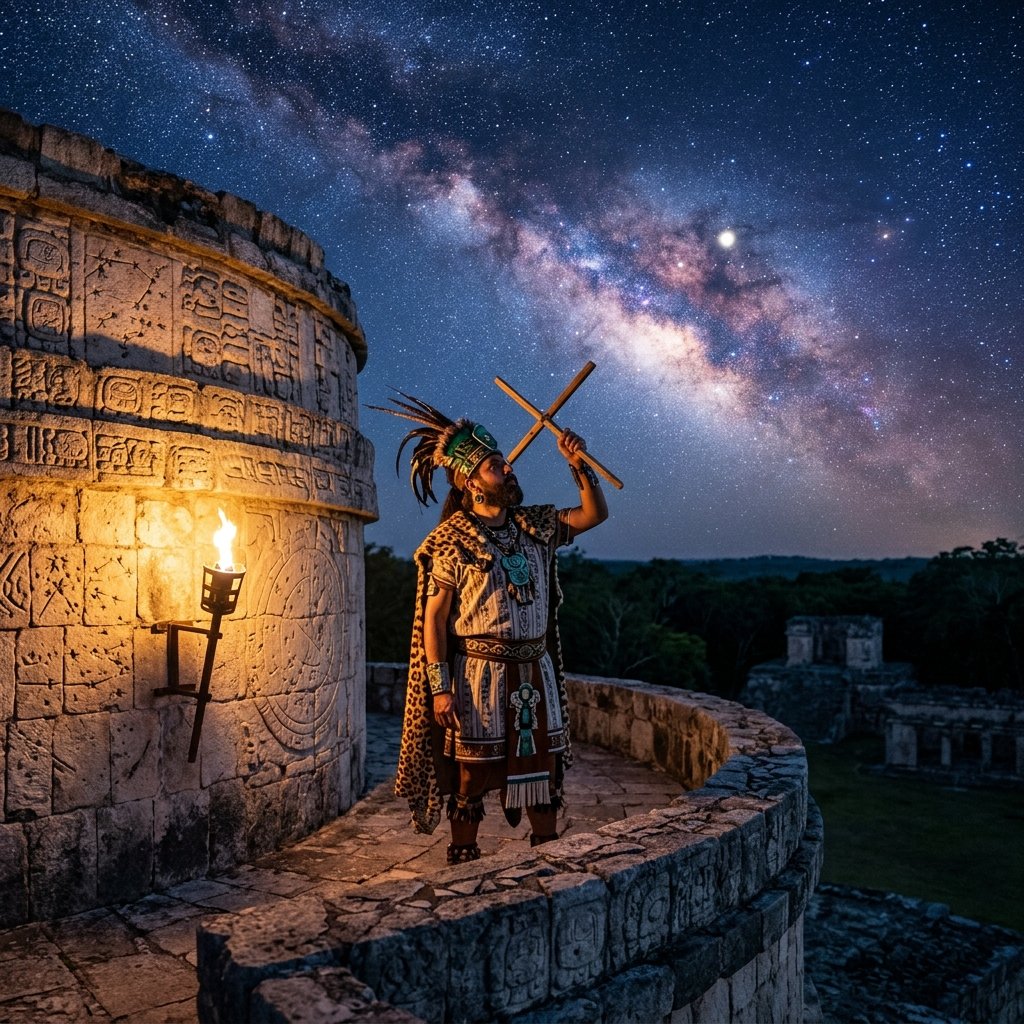
Maya Astronomy at a Glance
"They had no telescopes, no lenses, no clocks, no metal tools. They had patience — centuries of it — and mathematics precise enough to track a planet to within fourteen minutes of accuracy over half a millennium."
The Scale of the Achievement
To appreciate what the Maya accomplished, you must first understand what they lacked. They had no glass, which means no lenses, no telescopes, no magnifying instruments of any kind. They had no metal, which means no precision-machined sighting tubes or calibrated astrolabes. They had no mechanical clocks, which means all timing was done by counting days and observing horizon events. And they had no contact with the astronomical traditions of Babylon, Greece, China, India, or the Islamic world.
Despite all of this, by the Classic Period (250–900 AD), Maya astronomers had produced calculations that would not be surpassed in Europe until the Copernican revolution more than five hundred years later. The astronomer Anthony Aveni, who has spent decades studying Mesoamerican skywatching, writes that the Maya Venus tables "represent one of the most extraordinary achievements in the history of science" (Aveni, A. F., Skywatchers of Ancient Mexico, University of Texas Press, 2001, p. 184).
Venus: The Great Star
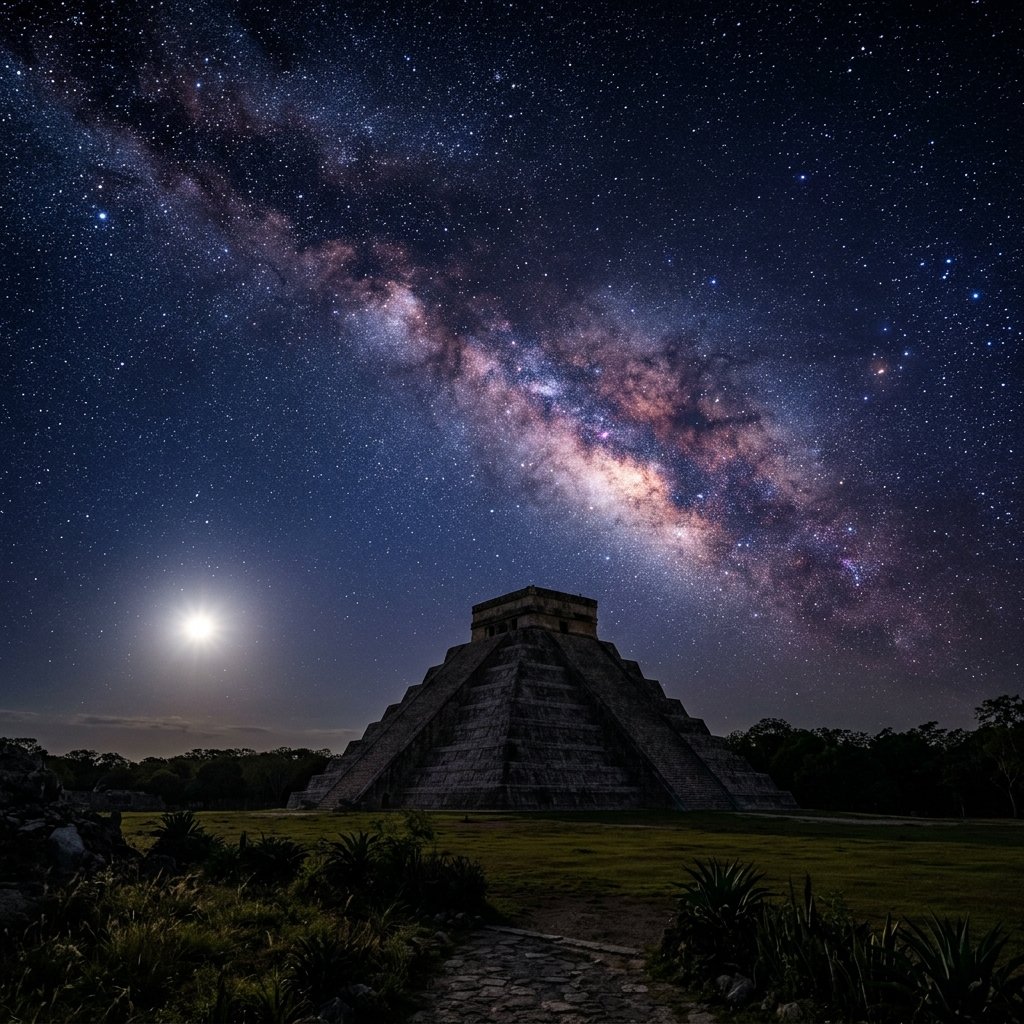
Venus blazing near the horizon above a Maya temple. The Maya called Venus Noh Ek — the "Great Star" — and they tracked its movements with an obsession unmatched by any other ancient culture. Its appearances governed war, sacrifice, and royal accession.
No celestial body consumed more Maya intellectual energy than Venus. The Maya called it Noh Ek ("Great Star") or Chak Ek' ("Red Star"), and they associated it with the feathered serpent deity Kukulkán (known as Quetzalcoatl among the Aztec). Venus was not merely observed — it was feared.
The synodic period of Venus — the time it takes for the planet to return to the same apparent position relative to the Sun — is 583.93 days by modern measurement. The Maya, using generations of naked-eye observation, calculated it as 583.92 days. Over a span of 481 years (301 complete synodic cycles), this produces a cumulative error of roughly two hours (Aveni, 2001, p. 192).
Venus cycles through five distinct phases visible from Earth, and the Maya tracked all of them:
The first heliacal rising of Venus as Morning Star — the moment it reappeared on the eastern horizon after its eight-day inferior conjunction — was considered an event of immense supernatural danger. The Dresden Codex explicitly associates these dates with military raids, royal sacrifices, and divine wrath. Kings timed their conquests to coincide with the rising of the Morning Star, using Venus as a celestial war-trumpet (Schele, L. and Freidel, D., A Forest of Kings, William Morrow, 1990, pp. 130–135).
The Dresden Codex: The Greatest Surviving Astronomical Text
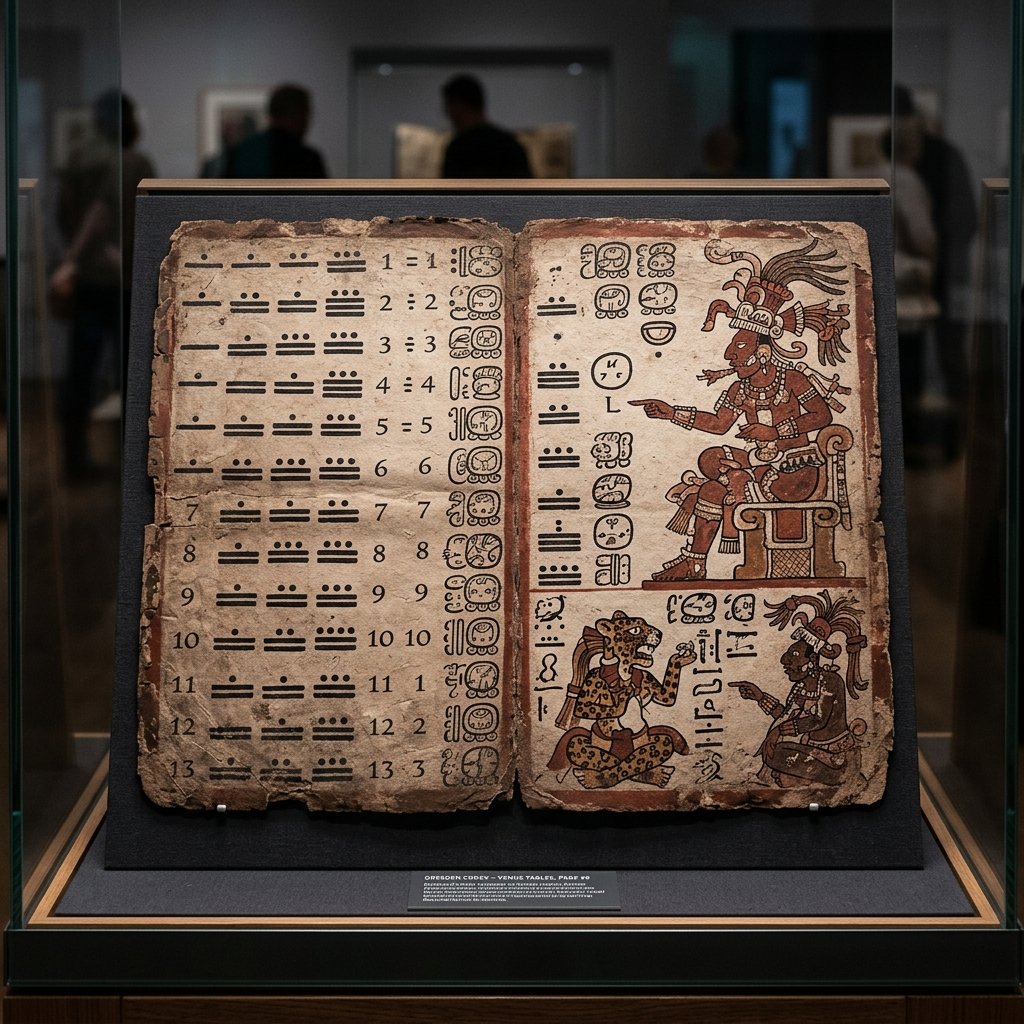
The Venus tables of the Dresden Codex — perhaps the most extraordinary astronomical document in the pre-Columbian Americas. These bark-paper pages calculate Venus's synodic period with an error of just 14 minutes over 481 years.
The Dresden Codex is the single most important surviving Maya scientific document. Housed at the Saxon State and University Library in Dresden, Germany, this 78-page folding-screen book — made from bark paper coated with a thin layer of lime plaster and painted in red, black, and blue — contains four major astronomical sections:
The Venus Tables (pp. 46–50)
Five pages tracking Venus through 65 synodic cycles (104 Haab years = 2 Calendar Rounds = 37,960 days). Each page predicts Morning Star and Evening Star appearances with correction mechanisms to accumulate errors and then reset them — a technique functionally identical to leap-year corrections (Thompson, J. E. S., A Commentary on the Dresden Codex, American Philosophical Society, 1972).
The Eclipse Tables (pp. 51–58)
Eight pages predicting 69 possible solar and lunar eclipse dates over a span of approximately 33 years. The Maya recognized that eclipses cluster in groups separated by intervals of 177 or 148 days — what modern astronomers call the eclipse semester. They could not predict where an eclipse would be visible, but they could predict when one might occur anywhere on Earth.
The Mars Tables (pp. 43–45)
Three pages tracking the 780-day synodic period of Mars. The Mars almanacs use multiples of 780 to forecast Mars's position across decades. Mars's association with warfare complemented Venus's, giving Maya priests a dual celestial arsenal for divining military outcomes.
The Lunar Series
Inscribed on stelae rather than in codices, the Lunar Series records the moon's age (days since the last new moon) at the time of a monument's dedication. Over 405 lunations, the Maya calculated the cumulative period as 11,960 days. The modern value is 11,959.888 — an error of approximately 2.7 hours over 33 years (Teeple, J. E., "Maya Astronomy," Contributions to American Archaeology, Vol. 1, No. 2, Carnegie Institution, 1930).
Architecture as Observatory
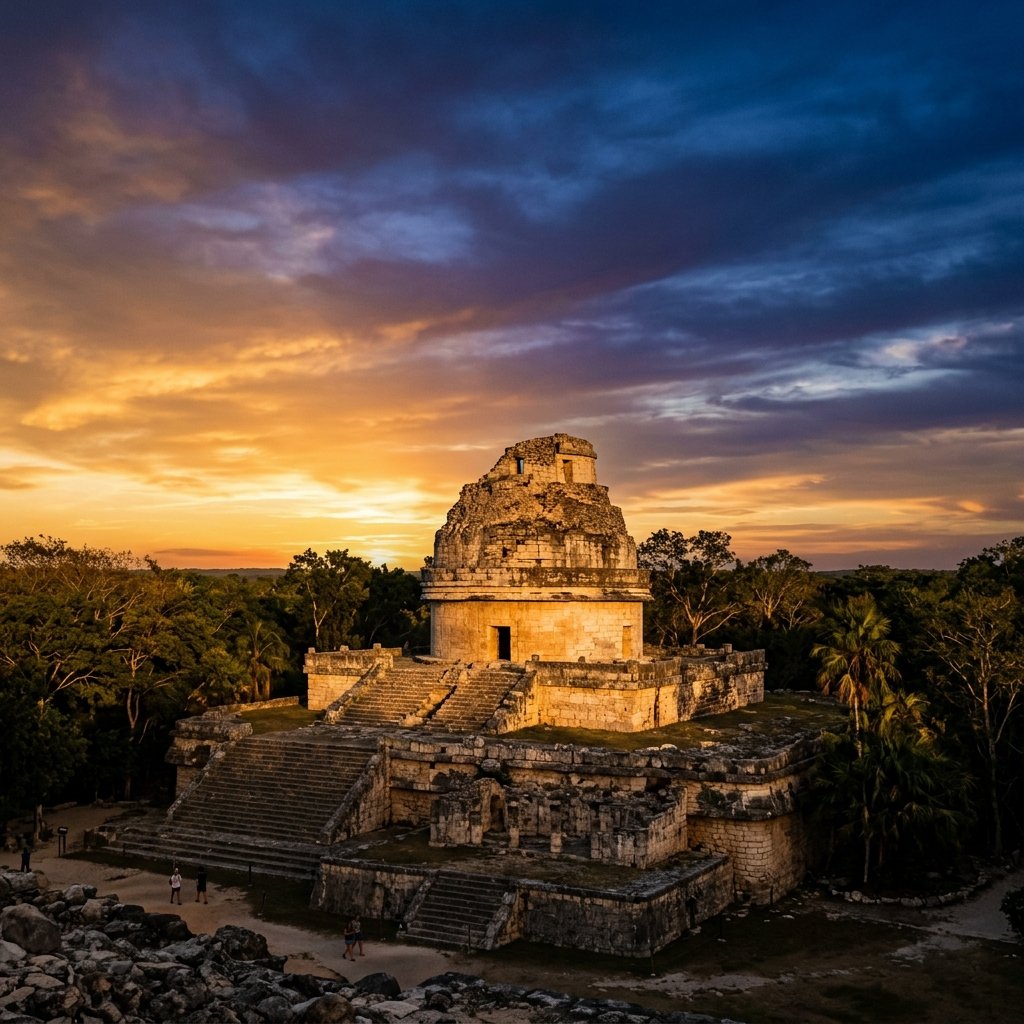
El Caracol at Chichén Itzá — often called "The Observatory." Its circular tower, unusual in Maya architecture, contains window openings precisely aligned with the extreme positions of Venus on the horizon.
The Maya did not build domed observatories with rotating telescopes. They did something arguably more ingenious: they turned entire buildings into fixed astronomical instruments. By aligning doorways, windows, roof combs, and corridors with specific horizon points where the Sun, Venus, or other bodies rose or set at key moments, they created architectural sighting systems of remarkable precision.
El Caracol, Chichén Itzá
The circular tower — unique in Maya architecture — contains three surviving window openings. Window 1 aligns with Venus's maximum northerly setting point. Window 2 aligns with Venus's maximum southerly setting point. Window 3 aligns with due south. These alignments allowed priests to track Venus's 8-year cycle of horizon positions (Aveni, A. F., Gibbs, S. L., and Hartung, H., "The Caracol Tower at Chichén Itzá: An Ancient Astronomical Observatory?" Science, Vol. 188, 1975, pp. 977–985).
Governor's Palace, Uxmal
The central doorway of this magnificent building aligns exactly with the point on the horizon where Venus reaches its maximum southerly declination — an event that occurs only once every 8 years. A distant mound on the horizon marks the precise line of sight, creating a Venus observation corridor spanning several kilometers (Aveni, 2001, pp. 270–275).
El Castillo, Chichén Itzá
On the spring and autumn equinoxes, the afternoon sun creates a pattern of triangular shadows on the north stairway that resembles a serpent descending the pyramid — the famous "light serpent" of Kukulkán. Whether intentional or not, the effect demonstrates the builders' precise awareness of solar geometry.
Group E Complexes
Found across the Maya lowlands, these standardized "E-Group" plaza arrangements consist of a western pyramid and an eastern observation platform. From the western pyramid, the observer watches the Sun rise over specific points on the eastern structure, marking equinoxes and solstices. Over 60 E-Groups have been identified — a Pan-Maya observatory template (Chase, A. F. and Chase, D. Z., "Ancient Maya Causeways and Site Organization at Caracol, Belize," Ancient Mesoamerica, Vol. 12, 2001).
Eclipse Prediction: Reading the Dragon's Mouth
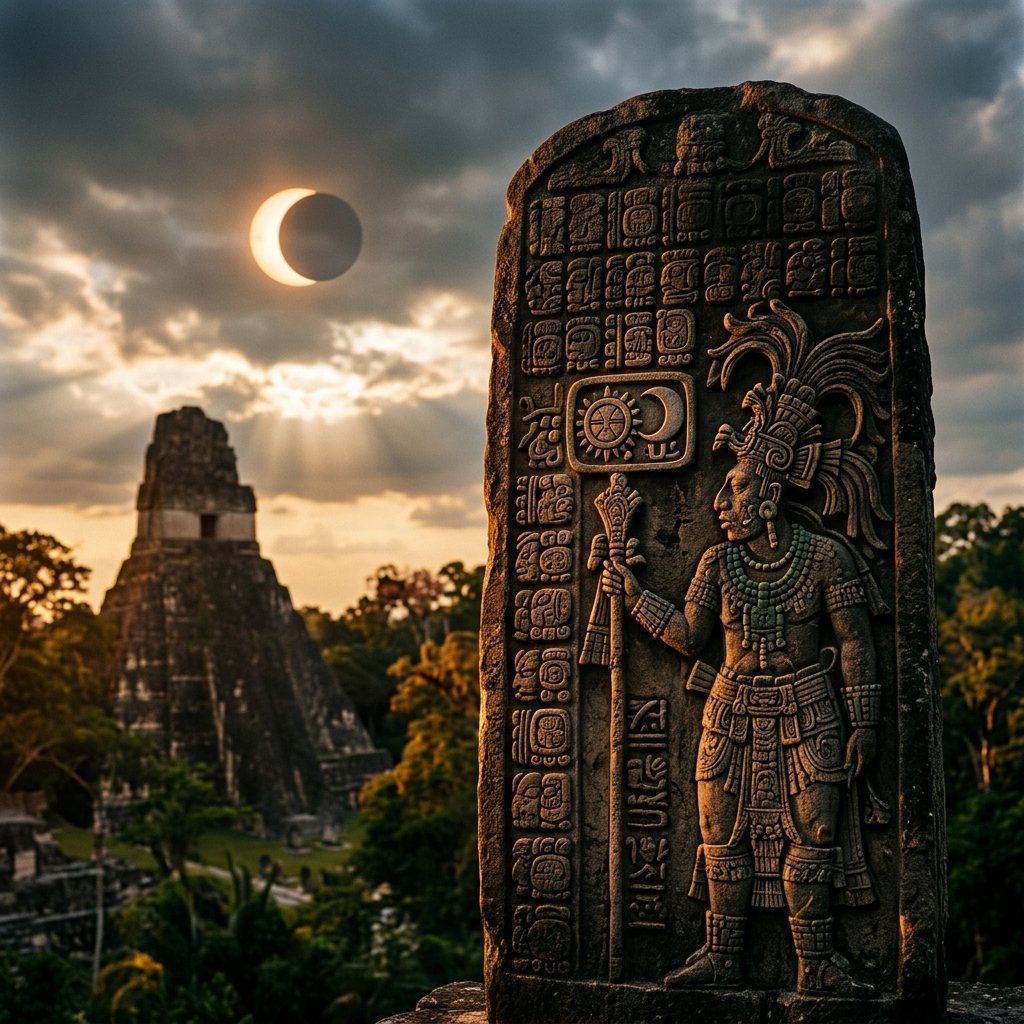
Eclipses terrified the Maya — they described them as the Sun or Moon being "eaten" or "bitten." But terror did not prevent them from predicting eclipses with remarkable mathematical precision using the Dresden Codex tables.
The Maya described eclipses as the Sun or Moon being "eaten" — swallowed by a celestial monster. The Yucatec word for eclipse, chi'ibal k'in (literally "the biting of the Sun"), reflects this cosmological understanding. Eclipses were not merely observed; they were predicted, feared, and ritually managed.
The eclipse tables of the Dresden Codex (pages 51–58) demonstrate that the Maya recognized a critical pattern: solar eclipses tend to occur in groups separated by intervals of either 177 days (six lunar months) or 148 days (five lunar months). Modern astronomers call these the eclipse semester — the period during which the Sun is close enough to a lunar node to make an eclipse possible. The Maya had empirically discovered this pattern through centuries of observation, without any knowledge of orbital mechanics.
To be clear about a common overstatement: the Maya could not predict exactly where an eclipse would be visible. Their tables identify danger windows — dates on which an eclipse was possible somewhere on Earth. But the fact that they achieved even this level of prediction, using only a base-20 number system and a dot-and-bar notation scheme, is nothing short of extraordinary (Bricker, H. M. and Bricker, V. R., Astronomy in the Maya Codices, American Philosophical Society, 2011, pp. 234–280).
How They Did It: The Method Behind the Precision
How did a culture without optical technology achieve precision rivaling that of 16th-century Europe? The answer lies in four interlocking advantages:
- Multi-generational data accumulation. Maya astronomical knowledge was not the achievement of any single genius. It was the product of centuries of continuous observation, each generation of astronomers refining the numbers their predecessors had recorded. Over hundreds of years, random measurement errors cancel out, and what remains is extraordinary signal clarity.
- Architectural sighting instruments. By building permanently fixed sighting lines into their architecture, the Maya eliminated the imprecision of handheld instruments. A window sightline in stone does not wobble, does not need recalibration, and endures for centuries.
- Mathematical sophistication. The Maya base-20 number system with true zero allowed them to perform calculations that would be nearly impossible using Roman numerals or Egyptian hieratic notation. Positional notation is not just convenient — it is the computational engine that makes astronomical prediction tractable.
- Calendrical integration. The three interlocking calendars (Tzolk'in, Haab, Long Count) provided a framework for correlating different astronomical cycles. The 260-day Tzolk'in synchronized with Venus's 584-day synodic period every 2,920 days (5 × 584 = 8 × 365 = 2,920). This interlocking was not accidental — it was the mathematical backbone of Maya cosmology (Malmström, V. H., Cycles of the Sun, Mysteries of the Moon, University of Texas Press, 1997).
Precision Comparison: Maya vs. the World
| Measurement | Maya Value | Modern Value | Error | Context |
|---|---|---|---|---|
| Solar Year | 365.2420 days | 365.2422 days | ~17 seconds/year | More accurate than the Gregorian calendar (365.2425) |
| Venus Synodic Period | 583.92 days | 583.93 days | ~14 min/cycle | Tracked over 481 years in the Dresden Codex |
| Lunar Month | 29.53020 days | 29.53059 days | ~34 seconds/month | Calculated from 405 lunations = 11,960 days |
| Mars Synodic Period | 780 days | 779.94 days | ~0.06 days/cycle | Tracked using 780-day almanacs in the Dresden Codex |
| Eclipse Semester | 177 days / 148 days | 173.31 days (avg) | Pattern-based | Identified the 177/148-day eclipse grouping empirically |
The Cosmic Stakes: Why Astronomy Was Not Optional
It is tempting to view Maya astronomy as a curiosity — as something "primitive" people did for spiritual reasons, unconnected to "real" science. This fundamentally misunderstands the Maya world.
For the ancient Maya, astronomical accuracy was a matter of political survival. A king who correctly predicted a Venus event demonstrated divine authority. A king who got it wrong demonstrated weakness. The astronomical tables were instruments of statecraft. Royal astronomers who could predict celestial phenomena proved that they — and, by extension, their king — were in communion with the cosmic order. When the prediction came true, the king's legitimacy was confirmed. Astronomical precision was, in a very real sense, a political weapon (Martin, S. and Grube, N., Chronicle of the Maya Kings and Queens, Thames & Hudson, 2008).
The Maya did not separate science from religion, politics from cosmology, or mathematics from myth. Astronomy was all of these simultaneously. And they pursued it with a rigor, patience, and mathematical sophistication that demands our genuine intellectual respect.
Frequently Asked Questions
How could the Maya be so accurate without telescopes?
Time and mathematics. The Maya advantage was centuries of continuous, meticulous naked-eye observation recorded using a base-20 positional number system with true zero. By averaging measurements over hundreds of years, random errors cancel out, leaving extraordinary signal clarity. Patience and mathematical rigor substituted entirely for optical technology.
Did the Maya have observatories?
Yes, though not in the modern sense. El Caracol at Chichén Itzá is a circular tower with window openings precisely aligned to Venus's extreme horizon positions. The Governor's Palace at Uxmal is aligned with Venus's maximum southerly declination. And "E-Group" plaza complexes — found at over 60 Maya sites — served as standardized solar observation platforms for marking equinoxes and solstices.
Why was Venus so important to the Maya?
Venus was associated with the feathered serpent deity Kukulkán and was considered an agent of cosmic warfare. Its first heliacal rising as Morning Star — the moment it reappeared on the eastern horizon after its inferior conjunction — was thought to unleash dangerous supernatural forces. Maya kings deliberately timed military campaigns to coincide with these events, using Venus as a celestial war-trumpet.
Could the Maya actually predict eclipses?
They could predict when an eclipse was possible, but not where it would be visible. The Dresden Codex eclipse tables identify 69 potential eclipse dates over 33 years by exploiting the 177-day and 148-day eclipse semester pattern. This is a remarkable empirical achievement, even though it does not constitute the kind of precise geographic prediction that modern orbital mechanics allows.
Was Maya astronomy really more accurate than European astronomy?
In specific measurements, yes. The Maya solar year calculation (365.2420 days) was closer to the true value than the Gregorian reform of 1582 (365.2425 days). Their Venus synodic calculation was within 14 minutes of the modern space-age value. However, it's important to compare fairly: the Maya were measuring different things for different reasons, and they did not develop a heliocentric model or a theory of gravity. Their precision was empirical and computational, not theoretical.
Scholarly References
- Aveni, A. F. (2001). Skywatchers of Ancient Mexico. University of Texas Press.
- Aveni, A. F., Gibbs, S. L., and Hartung, H. (1975). "The Caracol Tower at Chichén Itzá: An Ancient Astronomical Observatory?" Science, Vol. 188, pp. 977–985.
- Bricker, H. M. and Bricker, V. R. (2011). Astronomy in the Maya Codices. American Philosophical Society.
- Chase, A. F. and Chase, D. Z. (2001). "Ancient Maya Causeways and Site Organization at Caracol, Belize." Ancient Mesoamerica, Vol. 12.
- Malmström, V. H. (1997). Cycles of the Sun, Mysteries of the Moon. University of Texas Press.
- Martin, S. and Grube, N. (2008). Chronicle of the Maya Kings and Queens. Thames & Hudson.
- Schele, L. and Freidel, D. (1990). A Forest of Kings: The Untold Story of the Ancient Maya. William Morrow.
- Teeple, J. E. (1930). "Maya Astronomy." Contributions to American Archaeology, Vol. 1, No. 2. Carnegie Institution.
- Thompson, J. E. S. (1972). A Commentary on the Dresden Codex: A Maya Hieroglyphic Book. American Philosophical Society.