The Two Questions
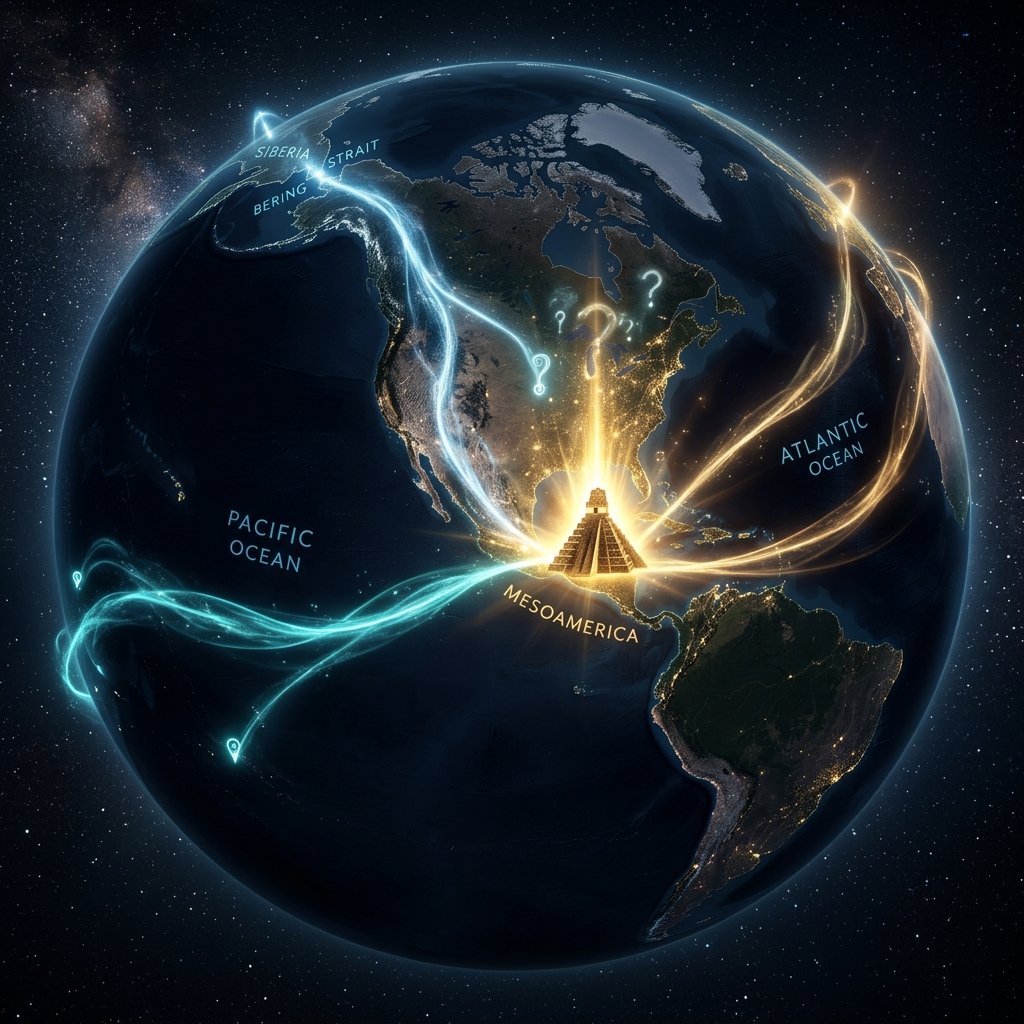
There are really two questions hiding inside "Where did the Maya come from?" The first — biological origins — is largely settled: East Asian/Siberian ancestry via Beringia. The second — cultural origins — is far more interesting and far less settled. Where did their intellectual traditions, their mathematical system, their cosmology, and their urbanism originate? The answer to this second question is where all the mystery lives.
The Biological Answer
Modern genetics has established that the ancestors of the Maya — like all indigenous American populations — derive primarily from populations that crossed from northeast Asia to the Americas via Beringia during the Late Pleistocene, approximately 15,000–20,000 years ago. Ancient DNA from early Mesoamerican remains confirms this basic framework (Posth et al., Cell, 2018).
But the biological answer leaves puzzles:
- Haplogroup X2: Found in both Native American and Near Eastern populations but absent in Siberian populations — suggesting a possible alternative migration route (Reidla et al., AJHG, 2003)
- Hoyo Negro skeleton: "Naia," a 13,000-year-old teenager found in a Yucatán cenote, has cranial features unlike modern Native Americans but DNA confirming shared ancestry (Chatters et al., Science, 2014)
- Multiple waves: Growing evidence supports at least 2–3 distinct migration waves, not a single crossing (Reich et al., Nature, 2012)
The Cultural Answer: Three Theories
1. Independent Invention (Mainstream)
Maya civilization developed locally from Archaic and Early Preclassic roots, with innovation driven by maize agriculture, water management, competitive feasting, and social stratification. The Olmec provided early inspiration. No outside input required. This is the consensus position and it is well-supported — but it struggles to explain the speed and simultaneity of Preclassic innovations.
2. Diffusion / Contact
Some cultural elements were introduced through pre-Columbian transoceanic contact. Sweet potato DNA links Polynesia and South America (Roullier et al., PNAS, 2013). Cotton genetics suggest Old World admixture. The Book of Mormon and the Popol Vuh both describe ancestral arrivals from across the sea. This was mainstream anthropology in the early 20th century before swinging to strict independent-invention orthodoxy.
3. Lost Precursor
Göbekli Tepe proved that monumental construction predates agriculture by millennia. Aguada Fénix proved that it could happen without hereditary hierarchies. If complex societies existed earlier and in more places than we currently document, some of the Maya's "sudden" innovations may have deeper roots in traditions we haven't yet found — or that were destroyed by the Younger Dryas catastrophe or post-glacial sea-level rise.
What the Maya Said About Themselves
Perhaps the most interesting perspective is the Maya's own. The Popol Vuh states that the K'iche' ancestors came from "Tulan Zuyva" — a place of origin "in the East, across the sea" where they received their gods, their knowledge, and their fire. The text describes a difficult ocean crossing: "They crossed the sea, the waters having parted."
Most scholars interpret this mythologically. But it's worth noting that other Maya origin traditions — from the Yucatec, Tzotzil, and Tzutujil — contain similar themes of ancestral migration from a distant land. Whether these encode genuine historical memory or universal migration mythology is precisely the question that keeps this debate alive.
Frequently Asked Questions
Were the Maya Native Americans?
Yes. The Maya are indigenous American people whose biological ancestry traces primarily to Siberian/East Asian populations. Approximately 6 million Maya people live today in Guatemala, Mexico, Belize, and Honduras. Modern Maya communities actively maintain cultural traditions including the Tzolk'in calendar, traditional weaving, and ceremonial practices that connect directly to their ancient heritage.
References & Further Reading
- Posth, C., et al. (2018). "Reconstructing the Deep Population History of Central and South America." Cell, 175(5), 1185–1197.
- Chatters, J. C., et al. (2014). "Late Pleistocene Human Skeleton and mtDNA." Science, 344(6185), 750–754.
- Reich, D., et al. (2012). "Reconstructing Native American population history." Nature, 488, 370–374.
- Christenson, A. J. (2007). Popol Vuh: The Sacred Book of the Maya. U of Oklahoma Press.