The 10 Greatest Maya Sites at a Glance
The Maya built hundreds of cities across modern-day Mexico, Guatemala, Belize, Honduras, and El Salvador. These ten represent the finest — chosen for their historical significance, architectural grandeur, artistic achievement, and visitor experience. From UNESCO World Heritage Sites to remote jungle expeditions, this guide covers the full spectrum of Maya exploration.
Chichén Itzá
The most iconic Maya site in the world. El Castillo's equinox serpent-shadow phenomenon — where a diamond-pattern of light descends the north staircase at sunset — draws tens of thousands of visitors twice yearly. The Great Ballcourt is the largest in Mesoamerica, and the acoustics allow a whisper at one end to be heard 150 meters away.
El Castillo (Temple of Kukulkán), The Great Ballcourt, Sacred Cenote, El Caracol observatory
Visit at opening (8 AM) to beat tour bus crowds. The equinox events (March 20 and September 22) are spectacular but extremely crowded.
Tikal
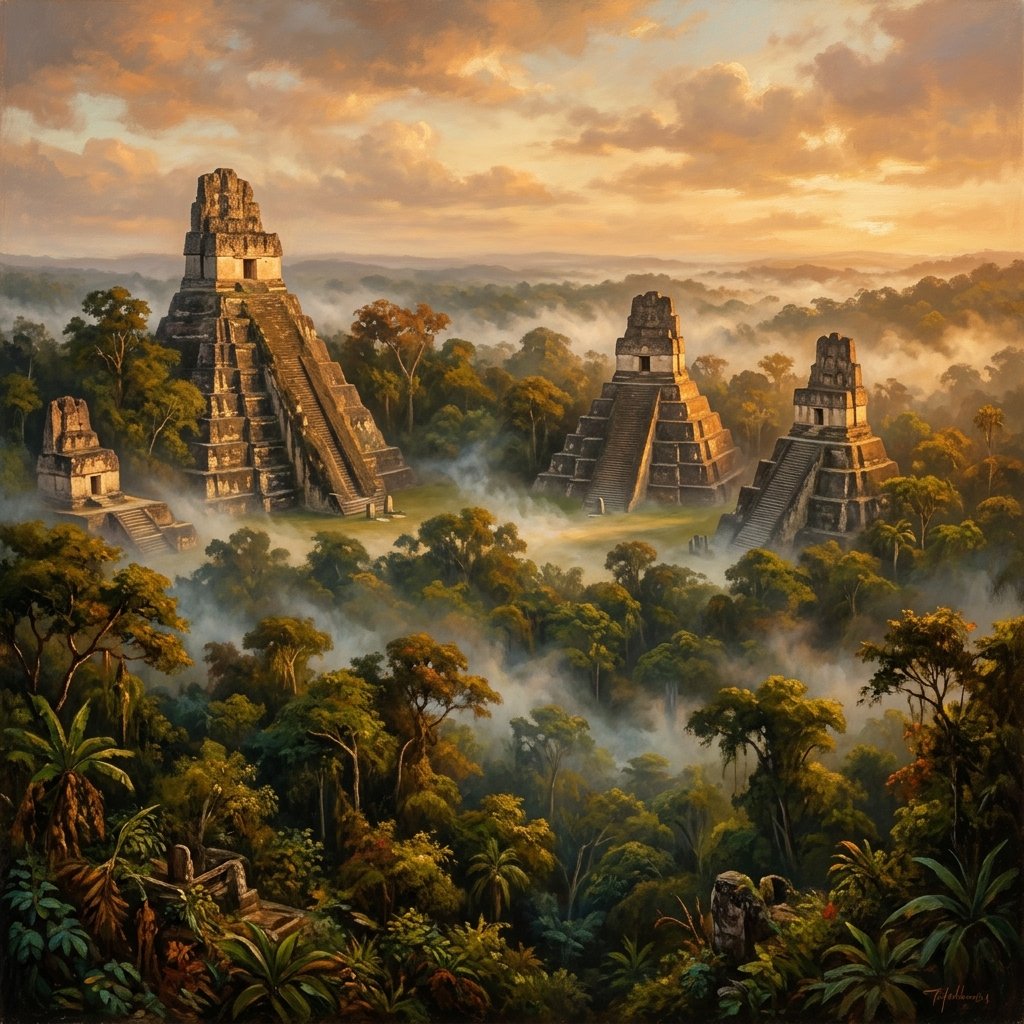
Rising above the jungle canopy, Tikal's temples are the defining image of Classic Maya civilization. Temple IV — at 65 meters — offers a panoramic view across an unbroken sea of rainforest, with the limestone peaks of Temples I, II, and III emerging from the green. The sounds of howler monkeys and toucans complete the experience.
Temple I (Temple of the Great Jaguar), Temple IV, The Great Plaza, Twin Pyramid complexes
Book a sunrise tour to watch dawn break from Temple IV — it's the most magical experience at any Maya site.
Palenque
Palenque combines architectural elegance, lush jungle setting, and one of the greatest archaeological discoveries of the 20th century — the intact tomb of K'inich Janaab Pakal beneath the Temple of the Inscriptions. The stucco artwork and carved panels here represent the pinnacle of Maya artistic achievement.
Temple of the Inscriptions (Pakal's Tomb), The Palace, Temple of the Cross Group, Queen's Aqueduct
The site museum houses the original jade funerary mask replica and carved panels. Allow at least half a day.
Copán
Copán is the intellectual and artistic capital of the Maya world. The Hieroglyphic Stairway — with 2,200 individual glyphs — is the longest known Maya text. The portrait stelae in the Great Plaza are three-dimensional masterpieces unlike anything else in Maya art. The on-site Sculpture Museum is world-class.
The Hieroglyphic Stairway, The Great Plaza stelae, Rosalila Temple (replica), Sculpture Museum
Hire a guide who can read the hieroglyphs — the inscriptions here tell a complete dynastic history spanning 16 kings.
Uxmal
Uxmal represents the aesthetic zenith of Maya architecture. The Governor's Palace — with its 320-foot mosaic facade containing over 20,000 individually carved stones — was called by Sylvanus Morley "the most magnificent single building in all of pre-Columbian America." The entire site gleams with Puuc-style precision.
Pyramid of the Magician, The Nunnery Quadrangle, Governor's Palace, House of Turtles
The evening light-and-sound show is excellent and uncrowded compared to Chichén Itzá.
Calakmul
Calakmul was the "Snake Kingdom" — Tikal's great rival and the most powerful city in the Classic Maya world for over a century. It lies deep inside the Calakmul Biosphere Reserve, surrounded by pristine jungle. Climbing Structure II puts you above the canopy with nothing but forest to the horizon. You may see jaguars, spider monkeys, and ocellated turkeys.
Structure II (the Great Pyramid), Structure I, jade funerary masks, jungle wildlife
The 60 km dirt road from the highway takes 1.5 hours. Bring insect repellent and water. Few visitors come here — you may have the site nearly to yourself.
Tulum
Tulum is the only major Maya city built on a Caribbean cliff edge. While architecturally modest compared to Tikal or Palenque, the dramatic setting — grey limestone temples silhouetted against turquoise water — makes it one of the most photographed ruins in the Americas. It was still occupied when the Spanish arrived.
El Castillo, Temple of the Frescoes, clifftop views of the Caribbean, Temple of the Wind
Arrive at 8 AM opening to beat the Cancún tour buses. Bring a swimsuit — the beach below the cliffs is stunning.
Yaxchilán
Accessible only by boat along the Usumacinta River, Yaxchilán is one of the most atmospheric Maya sites. Its carved lintels — depicting bloodletting rituals, Vision Serpents, and battle scenes — are considered the finest relief sculpture in all of Maya art. Many originals are in the British Museum and Mexico's National Museum of Anthropology.
Carved lintels (the finest in Maya art), Building 33, the Great Acropolis, river approach by boat
The boat ride from Frontera Corozal takes 45 minutes. Howler monkeys inhabit the ruins and their roars echo through the forest.
Caracol
Caracol defeated Tikal in a devastating Star War in 562 AD, making it one of the most powerful cities in the Maya world. The site is enormous — covering 88 square miles with an estimated population of 150,000+. Caana remains the tallest man-made structure in Belize. The remote jungle setting and lack of crowds create an explorer's atmosphere.
Caana ("Sky Palace" — tallest structure in Belize at 43m), ball courts, astronomical observatory, reservoir system
The road from San Ignacio takes 2–3 hours on rough dirt. A 4WD is essential. Bring lunch and water — there are no services.
El Mirador
El Mirador was the first Maya "superpower" — a vast Preclassic city with pyramids rivaling those of Egypt in volume. The La Danta complex (72m tall, 2.8 million cubic meters) is among the largest structures ever built in the ancient Americas. The site is accessible only by a guided 5-day trek through the jungle or by helicopter — preserving it as one of the last true archaeological frontiers.
La Danta pyramid (one of the largest structures in the ancient Americas), El Tigre pyramid, Preclassic stucco friezes
This is an expedition, not a day trip. Book through a licensed tour operator in Flores. The 5-day trek (2 days in, 1 day at the site, 2 days out) is physically demanding but life-changing.
Planning Your Maya Journey
Whether you're a first-time visitor or a seasoned Maya traveler, here are general principles for planning:
- Mexico's Yucatán offers the most accessible sites — Chichén Itzá, Uxmal, and Tulum can all be visited from Mérida or Cancún.
- Guatemala's Petén is the heartland of Classic Maya civilization — Tikal is the essential site, and the adventurous can trek to El Mirador.
- Honduras and Belize offer Copán (unmatched sculpture) and Caracol (unmatched remoteness) respectively.
- Chiapas, Mexico — Palenque and Yaxchilán are best combined in a single journey along the Usumacinta frontier.
- Always hire a local guide. A knowledgeable guide transforms piles of stone into a living civilization.
Frequently Asked Questions
What are the best Maya ruins to visit?
The top Maya ruins are Chichén Itzá (iconic architecture), Tikal (jungle grandeur), Palenque (artistic elegance), Copán (sculptural masterpieces), Uxmal (Puuc perfection), Calakmul (remote power), Tulum (Caribbean setting), Yaxchilán (unmatched carvings), Caracol (Belize's giant), and El Mirador (the ultimate expedition).
Which Maya ruins are easiest to visit?
Chichén Itzá, Tulum, and Uxmal in Mexico's Yucatán Peninsula are the most accessible, with paved roads and modern facilities. Copán in Honduras is also very visitor-friendly. For a moderate challenge, Tikal in Guatemala is well-organized with hotels near the site. El Mirador requires a multi-day jungle trek or helicopter — it's for the truly committed.
Can you still climb Maya pyramids?
It depends on the site. Chichén Itzá's El Castillo has been closed to climbing since 2006. However, you can still climb pyramids at Cobá (Nohoch Mul), Calakmul (Structure II), and many structures at Tikal. Policies change frequently — always check before visiting.
Scholarly References
- Coe, M.D. The Maya. Thames & Hudson, 8th ed., 2011.
- Martin, S. & Grube, N. Chronicle of the Maya Kings and Queens. Thames & Hudson, 2nd ed., 2008.
- Sharer, R. & Traxler, L. The Ancient Maya. Stanford University Press, 6th ed., 2006.
- Kelly, J. An Archaeological Guide to Northern Central America. University of Oklahoma Press, 1996.