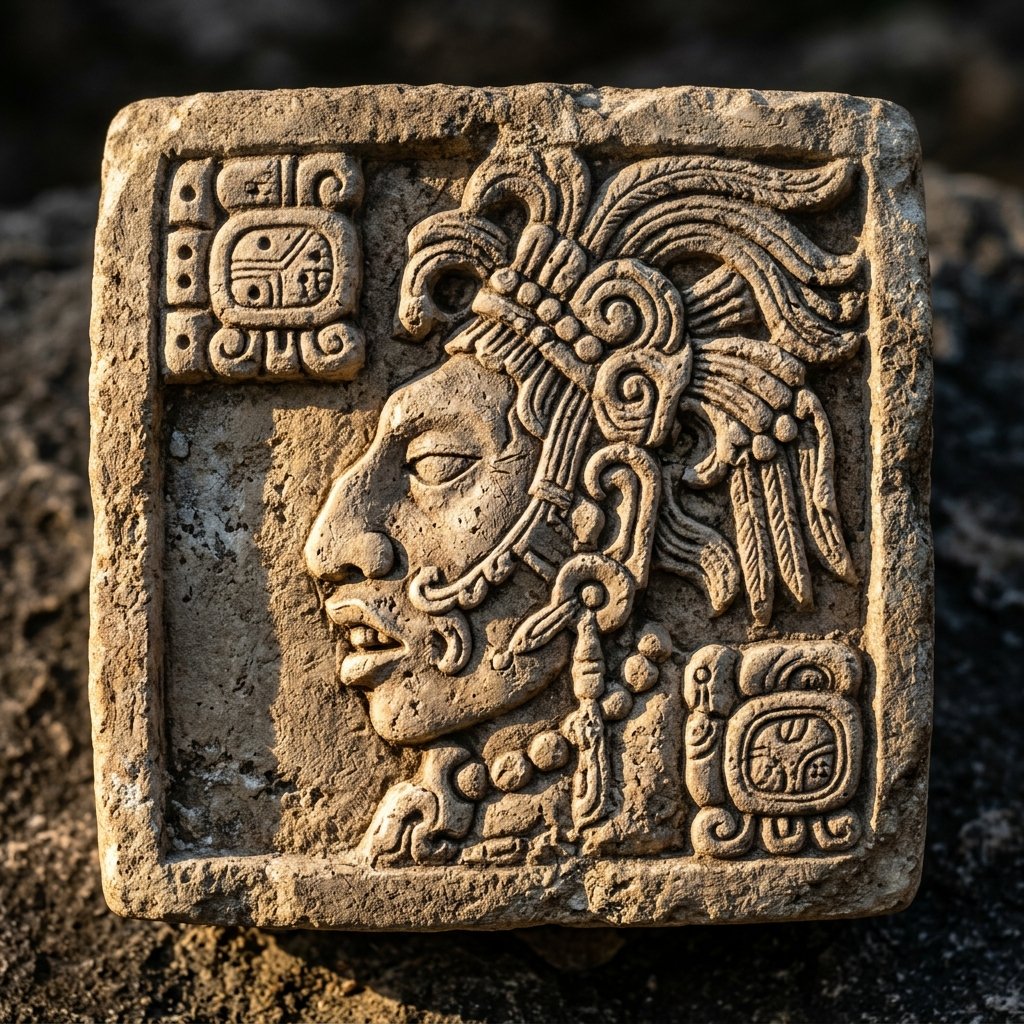
Why This Matters
The Maya script is the only fully developed writing system ever created in the pre-Columbian Americas. It can express any word in any Mayan language — names, dates, verbs, poetry, history, and prophecy. When scholars finally cracked the code in the late 20th century, an entire civilization began speaking again after four centuries of silence.
"For 400 years, these inscriptions were regarded as beautiful but meaningless — ornamental patterns carved by an ancient people whose thoughts were forever lost. Then, in a single generation, linguists proved that every one of those 'decorations' was a word. The Maya had been speaking to us for thirteen centuries. We simply hadn't learned to listen."
How Maya Writing Works
Maya writing is logo-syllabic — it uses two kinds of signs simultaneously, giving scribes extraordinary flexibility in how they record language:
Logograms
One sign = one whole word. The jaguar head means b'alam (jaguar). The sun sign means k'in (day/sun/time). These are word-pictures that compress meaning into a single image — comparable to Chinese characters or Egyptian hieroglyphs.
Syllabograms
One sign = one syllable (consonant + vowel). These spell out words phonetically: ba-la-ma = b'alam. This flexibility means any word can be written — including names, places, and abstract concepts that have no logogram. This is what makes Maya writing a complete system.
The genius of the system lies in its redundancy: the same word can often be written purely logographically, purely syllabically, or in a hybrid combining both methods. A scribe might write the word b'alam (jaguar) as a single jaguar-head logogram, or as the three syllable signs ba-la-ma, or as the jaguar-head logogram with a -ma syllable sign appended as a phonetic complement to confirm the reading. This flexibility was not a defect but a deliberate feature — it allowed scribes to demonstrate virtuosity, create visual puns, and compose inscriptions that were simultaneously readable text and visual art.
The Anatomy of a Glyph Block
Maya inscriptions are organized into glyph blocks — roughly square cells arranged in paired columns, read from left to right and top to bottom. Each block is a self-contained unit containing:
- Main sign: The central element carrying the primary semantic content — typically the largest sign in the block
- Prefixes: Signs attached to the left or top of the main sign, modifying its meaning (grammatical markers, semantic qualifiers)
- Suffixes: Signs attached to the right or bottom — often phonetic complements confirming the reading of the main sign
- Infixes: Signs embedded within the main sign — the most complex arrangement, used by master scribes
Essential Glyphs Every Reader Should Know
| Glyph Name | Maya Word | Meaning | Where You'll See It |
|---|---|---|---|
| Ahau/Ajaw | ajaw | Lord, ruler, king | Royal titles, calendar day-sign, emblem glyphs |
| K'uhul | k'uhul | Divine, holy, sacred | Emblem glyph prefix — "Divine Lord of [City]" |
| Emblem Glyph | varies | City-state identifier | All royal monuments — Tikal, Copán, Palenque |
| K'in (Sun) | k'in | Day, sun, time | Calendar texts, royal names (K'inich Ahau) |
| Star-War | chak ch'ahb' | Venus-timed military attack | War monuments, hieroglyphic stairways |
| Capture | ch'ahk / chuk | To capture (an enemy ruler) | Bonampak murals, stela inscriptions |
| Accession | chumlaj | He/she sat (became king/queen) | Enthronement monuments across the Maya world |
| Zero (Shell) | mih | Zero / completion | Mathematical texts, Long Count dates |
The Hieroglyphic Stairway: The Longest Maya Inscription

The Hieroglyphic Stairway at Copán, Honduras — the longest known Maya inscription in existence. Containing over 2,200 individual glyph blocks carved into 63 steps, this stairway records the dynastic history of the Copán kingdom from its founding by K'inich Yax K'uk' Mo' in AD 426 through the reign of its 15th ruler, who commissioned the monument. It is a political history written in stone — a testament to both the Maya's literary ambition and their understanding of history as a legitimizing force.
The Hieroglyphic Stairway at Copán is the single most impressive demonstration of Maya writing as a medium for recording history. Commissioned by the 15th ruler of Copán, K'ahk' Yipyaj Chan K'awiil ("Smoke Shell"), around AD 755, the stairway narrates the entire history of the Copán dynasty over more than three centuries. Each step contains a row of carved glyph blocks that, read in sequence from bottom to top, tell the story of a kingdom: its founding, its wars, its ceremonies, its relationships with neighboring polities, and the deeds of individual rulers named by name and dated to the day.
Painted vs. Carved: Two Traditions of Maya Writing

A Maya painted inscription — demonstrating the second major tradition of Maya writing alongside stone carving. While carved monuments survive in greater numbers (stone is durable), the Maya also produced vast quantities of painted texts on ceramics, codices (bark-paper books), and interior surfaces of buildings. Painted texts often reveal a more fluid, calligraphic quality that carved inscriptions cannot easily replicate — reminding us that Maya scribes were trained as both carvers and painters.
Maya writing existed in two parallel traditions:
- Carved inscriptions: Stone monuments (stelae, lintels, stairways, altars) — the most durable medium and thus the most surviving. Carved texts tend toward formal, monumental compositions.
- Painted inscriptions: Codices (bark-paper books), ceramic vessels, wall murals, and interior building surfaces — a more fluid, calligraphic tradition that reveals the hand of individual scribes. The painted tradition was almost certainly the more common one during the Classic period, but painted surfaces are far more vulnerable to tropical weathering than carved stone.
The Maya scribe — aj tz'ib' ("he of the writing") — was typically a member of the royal court, often of noble or even royal blood. David Stuart has noted that the role of scribe was "among the most prestigious professions in Maya society" — and that some scribes signed their work, identifying themselves by name on the vessels and monuments they created (Stuart, D., The Order of Days, Harmony Books, 2011, p. 89). The scribe was not merely a technician but an artist, historian, and intellectual — the keeper of knowledge in a civilization that understood writing as a form of power.
What the Glyphs Actually Say
Now that we can read approximately 80% of known Maya glyphs, what do the inscriptions tell us? The answer has transformed our understanding of the Maya from a "mysterious" civilization into a fully historically documented civilization — one of the most thoroughly recorded in the ancient world:
- Dynastic History: Detailed records of births, wars, marriages, accessions, and deaths of named rulers — with exact dates in the Long Count calendar, accurate to the day
- Astronomy: Eclipse prediction tables, Venus cycle observations, lunar series calculations, and the synchronization of celestial and ritual events
- Mythology: Creation narratives, deity names, and ritual calendars connecting earthly events to cosmic patterns — confirming the antiquity of stories like the Popol Vuh
- Diplomacy: Records of alliances, tributary relationships, royal marriages between distant polities, and visits of foreign dignitaries
- Warfare: Accounts of "star wars" (Venus-timed attacks), the capture and sacrifice of enemy rulers, the sacking of cities, and the deliberate defacement of rival kings' monuments
- Ritual: Bloodletting ceremonies, period-ending celebrations, temple dedications, and the activation of sacred objects
References
- Coe, M.D. Breaking the Maya Code. Thames & Hudson, 2012 (3rd edition).
- Coe, M.D. & Van Stone, M. Reading the Maya Glyphs. Thames & Hudson, 2005.
- Montgomery, J. How to Read Maya Hieroglyphs. Hippocrene Books, 2002.
- Stone, A. & Zender, M. Reading Maya Art: A Hieroglyphic Guide to Ancient Maya Painting and Sculpture. Thames & Hudson, 2011.
- Stuart, D. The Order of Days: Unlocking the Secrets of the Ancient Maya. Harmony Books, 2011.
Frequently Asked Questions
Can I learn to read Maya glyphs?
Yes — and you can start right now. The basics — number signs (dots and bars), the 20 day signs, and common logograms like ajaw (lord) and k'in (sun/day) — can be learned in weeks. Excellent introductory resources include Reading Maya Art by Stone & Zender (2011), How to Read Maya Hieroglyphs by John Montgomery (2002), and free online materials from UT Austin's Mesoamerica Center. The experience of reading even a simple Maya date for the first time — and knowing what it says — is genuinely thrilling.
What percentage of Maya glyphs can we read?
Approximately 80% of known Maya glyphs have been deciphered — a remarkable achievement given that the writing system was considered "unreadable" as recently as the 1950s. The remaining 20% consists mainly of rare signs, damaged inscriptions, or signs whose phonetic values are still debated. New decipherments continue to be proposed and tested, and the field remains one of the most active areas of Maya scholarship.
What is a "star war" glyph?
The "star war" glyph depicts a star (Venus) raining down from the sky — a sign that the Maya used to record military attacks timed to the appearances of the planet Venus. Maya warfare was not random but astronomically planned: armies launched major attacks when Venus appeared as the Morning Star, a celestial event that the Maya associated with divine sanction for warfare. The decipherment of star-war glyphs revealed that Maya politics was far more violent and strategically complex than previously understood.