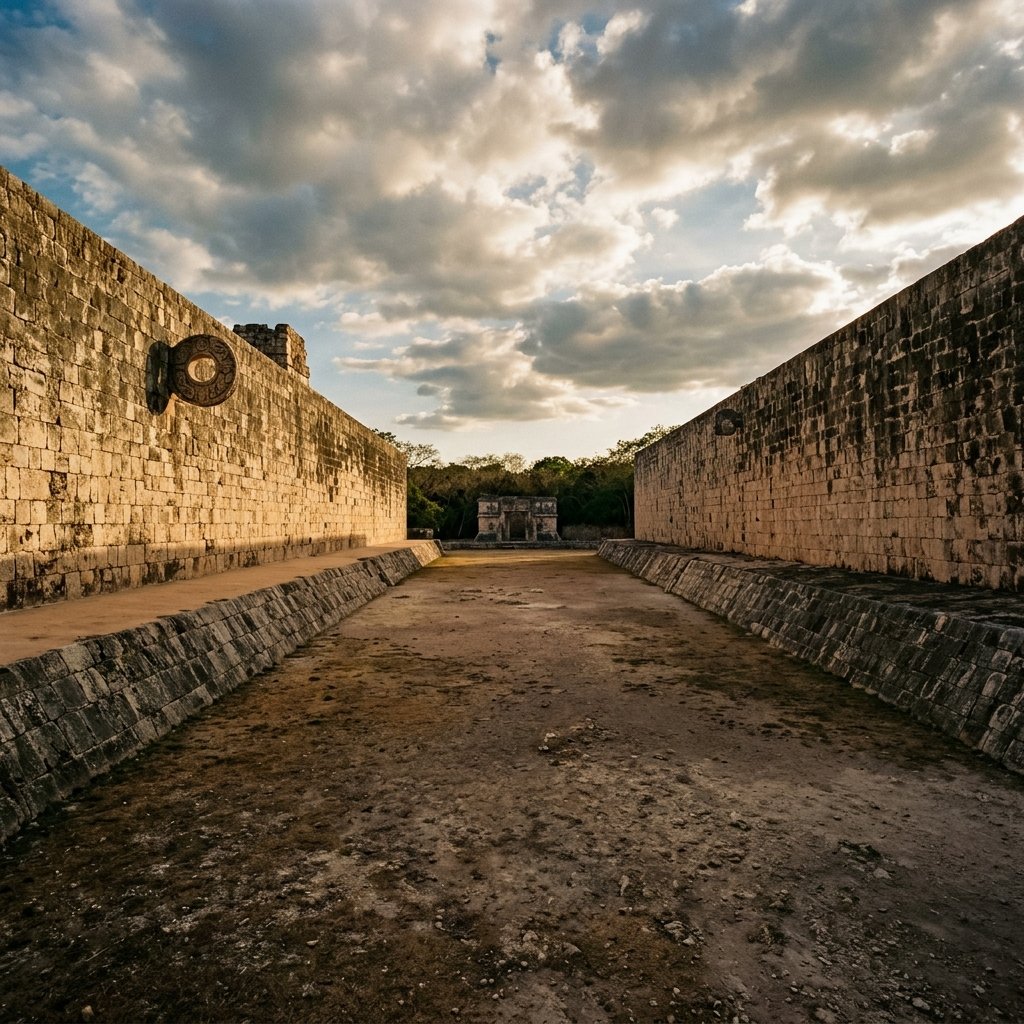
The Maya Ball Game at a Glance
"This was not sport as we understand it. The Maya ball game was ritual theater — a sacred performance in which the cosmic struggle between life and death was replayed on a stone stage. The ball was the sun. The court was the passage between worlds. And the players were stand-ins for the Hero Twins, reenacting the primal contest that created the sun and moon."
How the Game Was Played
The exact rules of the Maya ball game varied across time and region — the game was played for over 3,000 years across dozens of cultures from Honduras to Arizona — but the core mechanics were remarkably consistent:
- Court Shape: An elongated, I-shaped alley between two sloping or vertical stone walls, typically 20–40 meters long for standard courts. The Great Ball Court at Chichén Itzá is exceptional at 168 meters — the largest in the Americas.
- Ball: Solid rubber produced from latex of the Castilla elastica tree, weighing up to 4 kg. The sheer weight of the ball — combined with its velocity — made the game physically brutal.
- Body Parts: Players struck the ball primarily with their hips, using stone or leather yokes worn around the waist. Forearms and upper bodies were also used. Hands and feet were forbidden.
- Scoring (Classic period): Points were scored when the opposing team failed to return the ball, or when the ball crossed boundary lines or struck specific target markers (including macaw-head markers at Copán).
- Stone Rings (Postclassic): In later periods, stone rings were mounted high on the court walls. Passing the ball through the ring was an instant win — but the rings were so small (barely larger than the ball) and mounted so high that this was extraordinarily rare.
The Stone Yoke: Equipment of the Sacred Athlete
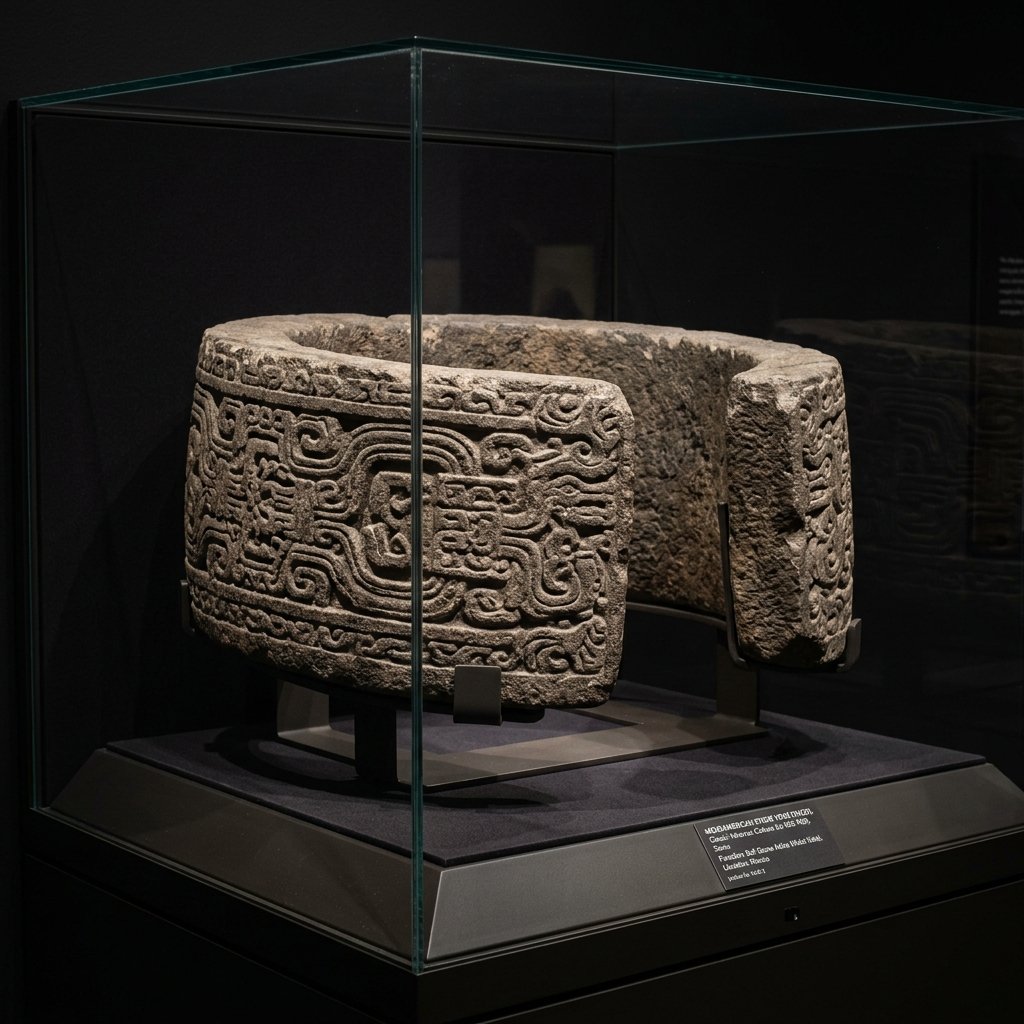
A stone yoke (yugo) — the most distinctive artifact of the Mesoamerican ball game. These U-shaped carved stones, weighing 20–30 kg, were worn around the waist and used to strike the heavy rubber ball. Some scholars believe that the heavier stone yokes were ceremonial versions of lighter, functional yokes made from wood or leather that were actually worn during play. Whether functional or ritual, they testify to the extraordinary physical demands of the game.
Players wore specialized protective equipment: thick leather padding on the hips, knees, and forearms; stone or leather yokes (yugos) around the waist for striking the ball; and in some regions, elaborate headdresses and ornamental elements that transformed athletes into ritual performers. The physical toll was severe — Spanish colonial observers recorded players dying from internal injuries caused by the heavy rubber ball striking unprotected areas of the body.
The Cosmic Meaning
The ball game was not entertainment — it was ritual theater. The court itself represented the liminal passage between the world of the living and Xibalba (the underworld). The rubber ball represented the sun, and its movement across the court symbolized the sun's daily journey through the sky and underworld. The sloping walls of the court replicated the horizon — the boundary between the visible sky and the invisible realm below.
Every ball game reenacted the most sacred Maya story: the Hero Twins' cosmic contest with the lords of death in Xibalba. When the twins defeated the death lords through intelligence and voluntary self-sacrifice, they achieved the resurrection of their father (the Maize God) and ascended to become the Sun and Moon. Every ball game on earth replayed this cosmic victory — maintaining the cosmic order through sacred performance (Miller, M.E. & Houston, S., "The Classic Maya Ballgame and Its Architectural Setting," RES: Anthropology and Aesthetics, 14, 1987, pp. 46–65).
The Stone Ring: The Goal
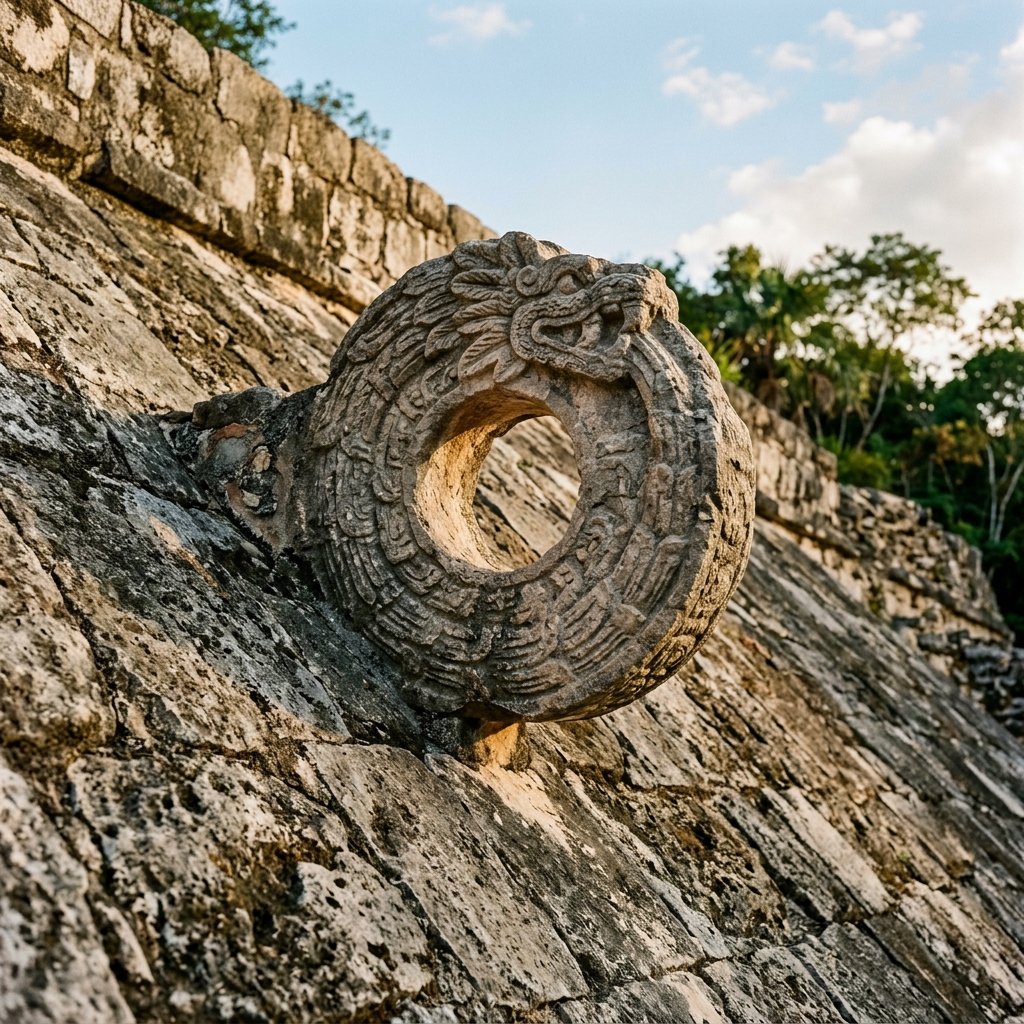
A stone ball game ring — the goal through which players attempted to pass the heavy rubber ball. Mounted high on the court walls and barely larger than the ball itself, scoring a ring-shot was so rare that it was considered an instant win. The carved serpent decorating the ring connects the scoring act to the Feathered Serpent (Kukulkán) and to the cosmic vision that the game was designed to reenact. These rings appear primarily in Postclassic courts (after ~900 AD).
Ritual Sacrifice and the Ball Game
The connection between the ball game and human sacrifice is attested in both art and epigraphy. Carved relief panels on the walls of the Great Ball Court at Chichén Itzá — the most detailed depictions of ball game ritual in the Maya world — show a kneeling player being decapitated. From his severed neck, serpents and vegetation emerge — a visual statement that sacrificial death produces life, exactly as it does in the Hero Twins story.
Whether it was the winners or losers who were sacrificed remains one of the most debated questions in Maya studies. Some scholars argue that being sacrificed was an honor — the winning captain offering his life as the supreme gift to the gods, paralleling the Hero Twins' voluntary self-sacrifice. Others interpret the evidence as showing the losers' fate. Linda Schele and Mary Ellen Miller argue that "the ambiguity may be intentional — the point of the game's ritual power was precisely that it blurred the boundary between victory and sacrifice, between life and death" (Schele, L. & Miller, M.E., The Blood of Kings, Kimbell Art Museum, 1986, p. 246).
Famous Ball Courts
Chichén Itzá
The largest ball court in Mesoamerica — 168m long with walls 8m high. Its acoustics are extraordinary: a whisper at one end carries clearly to the other, 150m away. The carved relief panels show the most detailed depictions of ball game sacrifice in the Maya world.
Copán
An artistically refined court with sculpted macaw-head ball markers that served as scoring targets. The court connects ball game ritual to Copán's extraordinary sculptural tradition — the finest in the Maya world.
Rubber Technology: A Maya Invention
The Maya were the first people in history to develop rubber technology. They extracted latex from rubber trees (Castilla elastica), mixed it with juice from morning glory vines (Ipomoea alba) to vulcanize it, and produced solid rubber balls — 3,000 years before Charles Goodyear "invented" vulcanization in 1839. This remains one of the most underappreciated technological achievements of the ancient world. The MIT archaeologist Dorothy Hosler confirmed through laboratory analysis that Maya rubber processing techniques produced material with properties comparable to modern vulcanized rubber (Hosler, D., Burkett, S.L., & Tarkanian, M.J., "Prehistoric Polymers: Rubber Processing in Ancient Mesoamerica," Science, 284(5422), 1999, pp. 1988–1991).
References
- Hosler, D., Burkett, S.L., & Tarkanian, M.J. "Prehistoric Polymers: Rubber Processing in Ancient Mesoamerica." Science, 284(5422), 1999, pp. 1988–1991.
- Miller, M.E. & Houston, S. "The Classic Maya Ballgame and Its Architectural Setting." RES: Anthropology and Aesthetics, 14, 1987, pp. 46–65.
- Schele, L. & Miller, M.E. The Blood of Kings: Dynasty and Ritual in Maya Art. Kimbell Art Museum, 1986.
- Whittington, E.M. (ed.). The Sport of Life and Death: The Mesoamerican Ballgame. Thames & Hudson, 2001.
Frequently Asked Questions
Was the Maya ball game like modern soccer?
Only superficially — two teams, a ball, a court. But the differences are profound: players used their hips (not feet), the solid rubber ball weighed up to 4 kg (modern soccer balls weigh 0.4 kg), the stakes were cosmic (not recreational), and games could end in ritual sacrifice. In terms of cultural function, the Maya ball game is more accurately compared to Roman gladiatorial combat or Greek Olympic events (which also had deep religious dimensions) than to modern team sports.
Is the ball game still played today?
Yes — a surviving variant called ulama is still played in parts of Sinaloa, western Mexico, making it the direct descendant of the oldest continuously played sport in the Americas. Modern revival efforts have also brought versions of the game back in Guatemala, Belize, and other parts of Mexico, though naturally without the sacrificial elements. The game's 3,000-year continuity makes it one of the most enduring athletic traditions in human history.
Where can I see a ball court?
Ball courts exist at virtually every major Maya archaeological site. The most impressive is the Great Ball Court at Chichén Itzá — the largest in Mesoamerica, with elaborately carved relief panels. Copán has an artistically refined court with macaw-head markers. Tikal, Palenque, Uxmal, and Cobá all have well-preserved courts open to visitors.