More Than Meets the Eye
The Maya hieroglyphic script is the most complex writing system ever developed in the pre-Columbian Americas — approximately 800 distinct signs operating simultaneously as phonetic syllables, word-pictures, and symbolic icons. But beyond their linguistic function, Maya symbols embed mathematical ratios, calendrical references, cosmological maps, and political codes that encode entire worldviews into single carved stones.
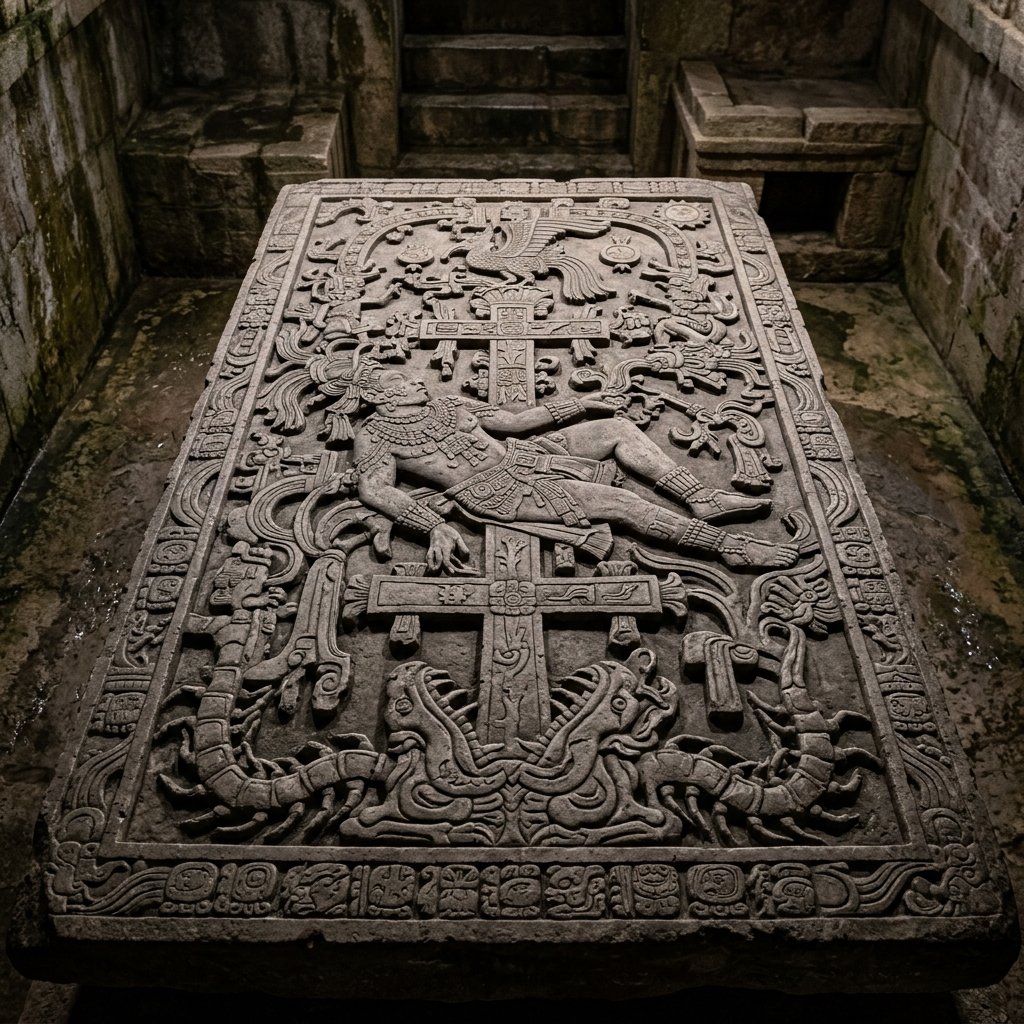
"Pakal's sarcophagus lid is not one image — it is at least four images superimposed on the same stone. It is a portrait. It is a map of the underworld. It is an astronomical chart. And it is a theological argument about the nature of death and rebirth. The Maya did not create art that did one thing at a time. They created art that did everything at once."
Level 1: What You Read — The Linguistic Surface
At the surface level, Maya glyphs function as writing — a fully developed logo-syllabic script that can record any spoken word in any Mayan language. The script was deciphered progressively from the 1950s through the 1990s — a breakthrough led by Yuri Knorosov, who demonstrated that each glyph block combines a main sign with attached affixes to spell words syllabically. Today, approximately 80% of known Maya texts can be read — revealing detailed accounts of royal history, astronomical observations, ritual events, and mythological narratives (Coe, M.D., Breaking the Maya Code, Thames & Hudson, 2012).
Level 2: What You See — The Iconographic Layer
Every Maya glyph is also a picture. The glyph for "jaguar" (b'alam) looks like a jaguar. The glyph for "lord" (ajaw) depicts a face with royal attributes — large eyes, a prominent nose, and an elaborate headdress. This iconographic layer means that even an illiterate ancient Maya viewer could grasp the subject of a carved panel — understanding that it depicted kings, gods, or celestial events — without reading the specific words. The visual and the verbal reinforce each other, creating a system that communicates on multiple channels simultaneously.
Level 3: What's Hidden — Embedded Encoding Systems
Here is where Maya art becomes truly extraordinary. Scholars have identified encoding systems within Maya artwork that go far beyond simple communication — systems that embed entire cosmological frameworks into individual compositions:
Numerical Embedding
Art historian Andrea Stone has demonstrated that Maya textile patterns and carved decorative borders often encode numerical sequences — the number of elements in a repeating pattern corresponds to calendrically significant numbers (13, 20, 52, 260). These aren't random decorative choices — they're mathematical statements woven into visual design. A border with 13 repeating units invokes the 13 tones of the Tzolk'in; a pattern with 20 elements invokes the 20 day signs. Decoration is theology (Stone, A. & Zender, M., Reading Maya Art, Thames & Hudson, 2011, pp. 34–47).
Cosmological Maps (Cosmograms)
Maya carved panels frequently function as cosmograms — visual maps of the cosmos compressed into a single composition. The most famous example is Pakal's sarcophagus lid at Palenque: it is simultaneously a portrait of the dead king, a depiction of his descent into the underworld, a map of the nine-layered Xibalba, an astronomical chart showing planetary positions at the moment of Pakal's death, AND a theological argument about royal resurrection. Every element serves multiple symbolic functions at the same time (Schele, L. & Miller, M.E., The Blood of Kings, Kimbell Art Museum, 1986, pp. 282–290).
Political Coding
Maya inscriptions contain emblem glyphs — symbols identifying specific city-states and royal lineages. These function as political codes: a reader trained in the system could immediately identify which kingdom commissioned a monument, which dynasties were allied, and which rivals were being subtly denigrated. Some stelae contain deliberate historical revisionism — rewriting events to favor the commissioning king, erasing the names of defeated predecessors, or appropriating the accomplishments of rivals (Martin, S. & Grube, N., Chronicle of the Maya Kings and Queens, Thames & Hudson, 2000, pp. 14–25).
The World Tree: A Symbol Operating on Every Level
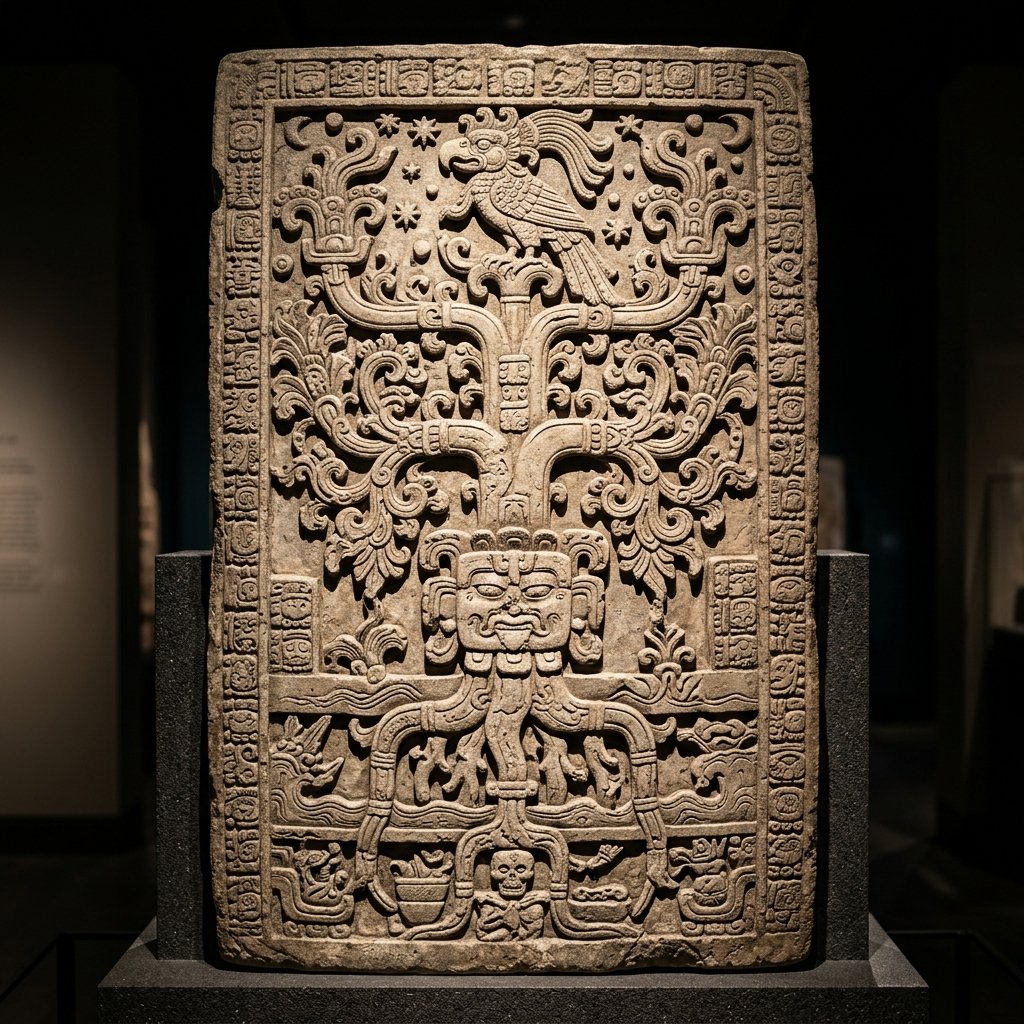
The Maya World Tree (Wakah Kan) — one of the most multilayered symbols in Maya art. It represents simultaneously: the ceiba tree (the tallest tree in the Maya forest), the Milky Way galaxy (oriented vertically across the night sky), the axis connecting the three cosmic levels (heaven, earth, underworld), the path of the dead king's soul ascending to the sky, and the raised cross-form that the Maya associated with cosmic order. No single "translation" captures its meaning — it is a symbol designed to mean many things at once.
The World Tree (Wakah Kan, "Raised-Up Sky") is the perfect example of multilayered Maya symbolism. On Pakal's sarcophagus lid, the World Tree appears growing from the dead king's body — and it operates on at least five simultaneous levels:
- Botanical: It is a ceiba tree (Ceiba pentandra) — the tallest tree in the Maya Lowland forest, with a distinctive umbrella-shaped canopy and buttress roots
- Astronomical: It represents the Milky Way galaxy when oriented vertically across the night sky — the "road" of the heavens
- Cosmological: It is the axis mundi — the central pillar connecting the 13 layers of heaven, the earth plane, and the 9 layers of Xibalba
- Eschatological: It is the path along which the dead king's soul ascends from the underworld to the celestial realm — the channel of resurrection
- Political: By placing the World Tree growing from his own body, Pakal asserts that he is the cosmic axis — that the kingdom's connection to the divine order passes through the king's physical person
This kind of polysemic density — the ability of a single image to carry five or more simultaneous meanings — is not merely a decorative quirk. It reflects a fundamental Maya intellectual principle: the most powerful symbols are those that connect the most levels of reality. A sign that means only one thing is a label. A sign that means five things at once is a key to the cosmos.
The Question of Deeper Codes
Some researchers — particularly those working at the intersection of comparative epigraphy and religious scholarship — have proposed that Maya symbols may contain additional layers of meaning connected to broader archaic traditions:
- The persistence of the Tree of Life motif across Maya art — appearing in forms strikingly similar to Near Eastern and Biblical symbolism
- Directional color symbolism (red = east, white = north, black = west, yellow = south) that parallels systems found in Native American, Chinese, and Tibetan traditions
- The shell glyph for zero — which represents both "nothing" and "completion," a philosophical duality that mirrors the Indian śūnyatā (emptiness as fullness)
- The Vision Serpent — a portal between worlds that emerges from ritual bloodletting, paralleling shamanic "world cord" concepts across Siberian, Central Asian, and Amazonian traditions
Whether these parallels reflect universal patterns in human symbol-making, ancient cultural contact, or coincidence remains an open and intellectually rewarding question — one that sits at the boundary between comparative religion, cognitive science, and archaeology.
References
- Coe, M.D. Breaking the Maya Code. Thames & Hudson, 2012 (3rd edition).
- Martin, S. & Grube, N. Chronicle of the Maya Kings and Queens. Thames & Hudson, 2000.
- Schele, L. & Miller, M.E. The Blood of Kings: Dynasty and Ritual in Maya Art. Kimbell Art Museum, 1986.
- Stone, A. & Zender, M. Reading Maya Art: A Hieroglyphic Guide to Ancient Maya Painting and Sculpture. Thames & Hudson, 2011.
Frequently Asked Questions
Can we read all Maya symbols today?
Approximately 80% of known Maya texts can be translated — a remarkable achievement given that the writing system was considered "undecipherable" as recently as the 1950s. The remaining 20% includes rare signs, damaged inscriptions, and logographic values that haven't been definitively confirmed. New readings are published regularly, and the field continues to advance through the collaborative work of epigraphers, linguists, and art historians worldwide.
Is Pakal's sarcophagus lid really a spaceship?
No. The popular "ancient astronaut" interpretation — proposed by Erich von Däniken in 1968 — misidentifies every element of the composition. What von Däniken interpreted as "rocket exhaust" is the jaws of the Earth Monster (the underworld portal). The "control panel" is the World Tree. The "oxygen mask" is a jade bead placed in the mouth of the dead. The "spaceship" is the cosmic frame of the Maya universe. Every element on the lid has been definitively identified using standard Maya iconographic analysis and matches dozens of other Maya compositions perfectly. The lid is a cosmogram — a map of the king's journey through death to rebirth — and it is far more intellectually impressive than a picture of a spaceship.